|
(11) | EP 0 776 966 B1 |

| (12) | EUROPEAN PATENT SPECIFICATION |
|
|
| (54) |
Liquid bleaching compositions packaged in spray-type dispenser and a process for pretreating fabrics therewith Flüssige Bleichmittelzusammensetzungen, verpackt in einem Sprühspender, und ein Verfahren zur Vorbehandlung von Geweben damit Compositions de blanchiment liquides, emballées dans un atomiseur, et procédé pour la prétraitement des tissus avec celles-ci |
|
|
||||||||||||||||||||||||||||
|
|||||||||||||||||||||||||||||
| Note: Within nine months from the publication of the mention of the grant of the European patent, any person may give notice to the European Patent Office of opposition to the European patent granted. Notice of opposition shall be filed in a written reasoned statement. It shall not be deemed to have been filed until the opposition fee has been paid. (Art. 99(1) European Patent Convention). |
Technical Field
[0001] The present invention relates to the bleaching of fabrics with a peroxygen bleach-containing pretreater composition packaged in a spray-type dispenser.
Background
[0002] Treatments of fabrics before they are washed, often referred to as fabric pretreatments are well known in the art. Indeed, it is known to use peroxygen bleach-containing compositions in laundry pretreatment applications to boost the removal of bleachable stains/soils which are otherwise particularly difficult to remove. Such liquid peroxygen-bleach compositions are directly applied by pouring onto the soiled/stained fabrics, followed optionally by gentle rubbing to aid the penetration of the detergent into the fabrics.
[0003] However, there are some limitations to the convenience of peroxygen bleach. In particular, we have observed that peroxygen bleach-containing compositions may damage fabrics resulting in tensile strength loss and/or color damage when used in pretreatment application, i.e. when applied directly (neat) onto the fabrics, and left to act onto said fabrics for prolonged periods of time before washing said fabrics.
[0004] It is thus an object of the present invention to provide improved fabric safety and/or color safety to fabrics when pretreating said fabrics with peroxygen bleach-containing compositions.
[0005] We have now found that this object is efficiently met by formulating a liquid composition comprising a peroxygen bleach and a surfactant, and by applying said composition to the fabrics to be pretreated by spraying it via a spray-type dispenser. Indeed, it has now been found that by spraying a liquid composition comprising a peroxygen bleach and a surfactant, onto the soiled/stained fabrics, before said fabrics are washed, it is possible to reduce the loss of tensile strength in said fabrics and/or to reduce the color damage of said fabrics, as compared to applying the same liquid composition in a form other than spraying it onto the soiled/stained fabrics, for example by simply pouring said composition onto said fabrics, and as compared to spraying the same liquid composition but without any surfactant. Preferred compositions to be used according to the present invention further comprise a bleach activator. Accordingly the present invention encompasses liquid compositions comprising peroxygen-bleach, a surfactant and a bleach activator, said compositions being packaged in a spray-type dispenser.
[0006] An advantage of the present invention is that a liquid peroxygen bleach-containing pretreater composition is easily applied to the soiled/stained fabrics while using a minimum amount of said composition, as compared to applying said liquid pretreater composition by directly pouring it onto the soiled fabrics, instead of spraying it according to the present invention. Indeed, the risk of spillage as well as the tendency of said liquid pretreater composition to be messy when applied onto soiled fabrics is reduced when said application is made by using a spray-type dispenser.
[0007] Another advantage of the present invention is that excellent laundry performance is provided on a broad range of stains and soils including bleachable stains such as wine, tea, coffee, grass, enzymatic stains such as blood, greasy stains such as spaghetti sauce, mud/clay-containing soils and the like.
[0008] A further advantage of liquid compositions comprising a peroxygen bleach, a surfactant and a bleach activator and packaged in a spray-type dispenser according to the present invention, is that excellent performance is also provided when used in other applications, apart from laundry pretreater application, such as in other laundry applications, as a laundry detergent or laundry additive, or carpet cleaning applications.
[0009] Yet another advantage is that liquid compositions packaged in a spray-type dispenser according to the present invention and comprising a peroxygen bleach, a surfactant and a bleach activator, especially those being formulated as a microemulsion, exhibit excellent chemical stability. Also said compositions allow to incorporate significant amounts of anionic surfactants, if it is desirable to have some of them to perform better on whiteness and stain removal, in particular on particulate and enzymatic stains, particularly clay and blood.
[0010] EP-A-209 228 discloses household fabric bleaching compositions which may be used as "pre-spotters". Said compositions comprise bleach like hydrogen peroxide, nonionic surfactants, amino polyphosphonate chelants and radical scavengers. No spray application is disclosed.
[0011] WO 95/16023 discloses the use of two separate liquid compositions, the first of which contains an acid or neutral composition which comprises a peroxide and the second of which contains an alkaline composition, said first and second compositions being stored separately and sprayed from a single unit to a common point/surface to be cleaned. Surfactants may be present in said first or second liquid composition. No bleach activator is disclosed. No laundry pretreatment is disclosed.
[0012] GB 2 194 547 discloses laundry pre-spotting compositions comprising mixtures of surfactants and benzyl alcohol, said compositions are in the form of microemulsions and are suitable for the treatment of heavily soiled areas of fabrics. Bleaches are mentioned as optional ingredients, for example hydrogen peroxide may be present in amounts of 0% to 3% by weight of the total composition. No bleach activator is mentioned. No spray application is mentioned.
[0013] US 4 648 987 discloses thickened laundry pre-wash compositions for remaining in localised engagement on selected fabric spots. Said pre-wash composition comprises water, surfactants, cosurfactants, hydrotropes and thickeners like xanthum gum. The thickened pre-wash compositions may be suitable for use with different dispensers such as those including pump or trigger sprayer elements. However, no bleaches are disclosed, let alone hydrogen peroxide.
[0014] EP-A-629 693 discloses a process of bleaching fabrics which comprises the steps of applying on at least a portion of said fabrics an effective amount of a liquid or pasty composition comprising acetyl triethyl citrate, then immersing said fabrics in an aqueous wash liquor and an effective amount of hydrogen peroxide is provided either in said liquid composition or in said wash liquor. No spray application is disclosed.
[0015] Co-pending European Patent Application EP-A-0752469 (relevant for novelty only, pursuant to Art. 54 (3) and (4) EPC) discloses microemulsions of a hydrophobic liquid bleach activator in a matrix comprising water, hydrogen peroxide or a water soluble source thereof, and a hydrophilic surfactant system comprising an anionic and a nonionic surfactant Laundry pretreatment is disclosed, however no spray application is disclosed.
[0016] J 2099662 discloses a volatile bleaching composition composed of aqueous hydrogen peroxide solution containing 10% to 90% by weight of methanol and/or ethanol. Another volatile bleaching composition disclosed therein contains hydrogen peroxide and 1% to 10% by weight of ethylene glycol ether and/or 0.1% to 1% by weight of silicone oil (dimethyl polysilane). An industrial process for bleaching textile products by spraying them with one of the above volatile bleaching compositions containing up to 10% of hydrogen peroxide, without subsequent rinsing is also claimed. J0299662 does not disclose that by spraying a liquid peroxygen bleach/surfactant-containing composition onto fabrics to pretreat said fabrics, the loss of tensile strength and/or color damage in said fabrics are reduced.
Summary of the invention
[0017] The present invention encompasses a process for cleaning fabrics with a liquid composition comprising a peroxygen bleach and a surfactant, said process comprising the steps of dispensing said composition from a spray-type dispenser onto at least a portion of said fabrics, allowing said composition to remain in contact with said fabrics and then washing said fabrics.
[0018] The present invention also encompasses the use of a liquid composition packaged in a spray-type dispenser, said composition comprising a peroxygen bleach and a surfactant, for pretreating a soiled fabric before said fabric is washed, for reducing the loss of tensile strength in said fabric as well as the use of said liquid composition packaged in a spray-type dispenser, for pretreating a soiled colored fabric before said colored fabric is washed, for reducing the color damage in said fabric.
[0019] The present invention further encompasses a liquid composition packaged in a spray-type dispenser for pretreating fabrics, said composition comprising a peroxygen bleach, a surfactant and a bleach activator. In the preferred compositions of the present invention wherein said bleach activator is a hydrophobic liquid bleach activator said compositions of the present invention are formulated as a microemulsion of said hydrophobic liquid bleach activator in a matrix comprising water, said peroxygen bleach, and a hydrophilic surfactant system comprising an anionic and a nonionic surfactant.
Detailed description of the invention
[0020] In its broadest embodiment, the present invention encompasses a process of cleaning fabrics with a liquid composition comprising a peroxygen bleach and a surfactant, said process comprising the steps of spraying said composition onto at least a portion of said fabrics, allowing said composition to remain in contact with said fabrics and then washing said fabrics. Preferably, said composition (in neat form) is left to act onto said portion of fabrics for a period of time before the fabrics are washed in said laundry operation. Preferably, said period of time is in between 1 minute to 24 hours, more preferably 1 minute to 1 hour, most preferably 1 minute to 30 minutes. Optionally, when the fabric is soiled with encrusted stains/soils which otherwise would be relatively difficult to remove, said pretreatment process according to the present invention may further involve rubbing and/or brushing, for example, by means of a sponge or a brush or simply by rubbing two pieces of fabric against each other.
[0021] By "washing" it is to be understood herein to simply rinse the fabrics with water, or the fabrics may be washed with conventional compositions comprising at least one surface active agent, this by means of a washing machine or simply by hand.
[0022] In a process of pretreating soiled fabrics by using a spray type dispenser, the sprayed compositions should preferably not be left to dry onto the fabrics. Indeed, it has been found that water evaporation contributes to increase the concentration of free radicals onto the surface of the fabrics and, consequently, the rate of chain reaction. It is also speculated that an auto-oxidation reaction occurs upon evaporation of water when the sprayed compositions are left to dry onto the fabrics. Said reaction of auto-oxidation generates peroxy-radicals which may contribute to the degradation of cellulose. Thus, not leaving the sprayed compositions, as described herein, to dry onto the fabric, in a process of pretreating soiled fabrics via a spray-type dispenser, contributes to the benefits according the present invention, i.e. to reduce the tensile strength loss and/or the color damage of fabrics when pretreating fabrics with liquid peroxygen bleach-containing compositions.
[0023] Actually, the present invention is based on the finding that the color damage of some kinds of dyes present on colored fabrics, i.e. the color change and/or decoloration, is reduced when a liquid composition comprising a peroxygen bleach and a surfactant is sprayed onto soiled colored fabrics to be pretreated, as compared to the color damage observed when pretreating soiled colored fabrics by directly applying thereto the same liquid composition but without a spray-type dispenser for example by simply pouring it thereto and as compared to spraying the same composition but without any surfactant. In other words, spraying a liquid composition comprising a peroxygen bleach and a surfactant onto soiled colored fabrics allows to prevent/reduce the decomposition (oxidation) of dyes generally present on the surface of colored fabrics (e.g. bleach sensitive dyes and/or metallized dyes including copper-formazan dyes and/or metal-azo dyes).
[0024] The color damage of a fabric may be evaluated by measuring the color deviation (DE) for example by employing the color damage method, as can be seen in the examples hereinafter. This method consists in measuring the color deviation (DE) with 'The Hunterlab tristimulus MINISCAN". By "color deviation" it is to be understood the difference when comparing the color of a fabric taken as a reference, e.g., a fabric which has not been pretreated, and the color of the same fabric after having been pretreated according to the present invention. A color deviation on bleach sensitive dye of zero means that no color damage is observed.
[0025] Thus in one aspect, the present invention encompasses the use of a liquid composition packaged in a spray-type dispenser, said composition comprising a peroxygen bleach and a surfactant, for pretreating a soiled colored fabric before said colored fabric is washed, for reducing the color damage of said colored fabric.
[0026] By "to pretreat a soiled fabric" it is to be understood that the liquid composition is applied in its neat form onto the soiled fabric and left to act onto said fabric before said fabric is washed. According to the present invention the liquid composition is sprayed in its neat form onto the soiled fabric and left to act onto said fabric before said fabric is washed.
[0027] The present invention is also based on the finding that, fabric damage resulting in tensile strength loss is reduced, when a liquid composition comprising a peroxygen bleach and a surfactant is sprayed onto the soiled fabrics to be pretreated, as compared to pretreating soiled fabrics by directly applying thereto the same liquid composition but without a spray-type dispenser, for example by simply pouring it thereto and as compared to spraying the same composition but without any surfactant.
[0028] Thus in another aspect, the present invention further encompasses the use of a liquid composition packaged in a spray-type dispenser, said composition comprising a peroxygen bleach and a surfactant, for pretreating a soiled fabric before said fabric is washed, for reducing the loss of tensile strength in said fabric.
[0029] The tensile strength loss of a fabric may be measured by employing the Tensile Strength method. This method consists in measuring the tensile strength of a given fabric by stretching said fabric until it breaks. The force, expressed in Kg, necessary to break the fabric is the "Ultimate Tensile Stress" and may be measured with "The Stress-Strain INSTRON Machine". By "tensile strength loss" it is to be understood the difference when comparing the tensile strength of a fabric taken as a reference, e.g., a fabric which has not been pretreated, and the tensile strength of the same fabric after having been pretreated according to the present invention. A tensile strength loss of zero means that no fabric damage is observed.
[0030] Also fabric tensile strength loss reduction and/or color damage reduction are obtained when spraying liquid peroxygen bleach-containing compositions according to the present invention onto soiled fabrics to be pretreated, without compromising on the bleaching performance nor on the stain removal performance.
[0031] Compositions suitable to be used according to the present invention are liquid aqueous compositions packaged in spray-type dispenser and comprising a peroxygen bleach and a surfactant.
[0032] Thus, they comprise as an essential ingredient a peroxygen bleach or a mixture thereof. Preferred peroxygen bleach for use herein are hydrogen peroxide or water-soluble sources thereof or mixtures thereof. As used herein a hydrogen peroxide source refers to any compound which produces hydrogen peroxide when said compound is in contact with water. Apart from hydrogen peroxide, suitable water-soluble sources thereof include perborate, percarbonate, perbenzoic and alkylperbenzoic acids, persilicate and persulfate salts and the like. Most convenient for use herein is hydrogen peroxide. The compositions of the present invention should comprise from 0.5% to 20% by weight of the total composition, preferably from 2% to 15%, most preferably from 3% to 10% of hydrogen peroxide or a water-soluble source thereof or mixture thereof.
[0033] The compositions according to the present invention comprise as an essential ingredient a surfactant. The presence of said surfactants in the liquid peroxygen-bleach containing compositions of the present invention contributes to the benefits obtained according to the present invention, i.e. reduced loss of tensile strengh and/or reduced color damage in the pretreated fabrics. The presence of said surfactants in the liquid peroxygen-bleach containing compositions of the present invention further allows to provide good cleaning performance on different types of stains including bleachable stains like tea, grass, enzymatic stains like blood, greasy stains like barbecue sauce, spaghetti sauce, bacon grease and the like, when pretreating fabrics according to the present invention. All types of surfactants may be used in the present invention including nonionic, anionic, cationic, amphoteric or zwitterionic surfactants. It is also possible to use mixtures of such surfactants without departing from the spirit of the present invention.
[0034] Suitable nonionic surfactants to be used herein are alkoxylated fatty alcohol nonionic surfactants which can be readily made by condensation processes which are well known in the art. Indeed, a great variety of such alkoxylated fatty alcohols are commercially available which have very different HLB values. The HLB values of such alkoxylated nonionic surfactants depend essentially on the chain length of the fatty alcohol, the nature of the alkoxylation and the degree of alkoxylation. Hydrophilic nonionic surfactants tend to have a high degree of alkoxylation and a short chain fatty alcohol, while hydrophobic surfactants tend to have a low degree of alkoxylation and a long chain fatty alcohol. Surfactants catalogues are available which list a number of surfactants including nonionics, together with their respective HLB values.
[0035] Accordingly, preferred alkoxylated alcohols for use herein are nonionic surfactants according to the formula RO(E)e(P)pH where R is a hydrocarbon chain of from 2 to 24 carbon atoms, E is ethylene oxide and P is propylene oxide, and e and p which represent the average degree of, respectively ethoxylation and propoxylation, are of from 0 to 24. The hydrophobic moiety of the nonionic compound can be a primary or secondary, straight or branched alcohol having from 8 to 24 carbon atoms. Preferred nonionic surfactants for use in the compositions according to the invention are the condensation products of ethylene oxide with alcohols having a straight alkyl chain, having from 6 to 22 carbon atoms, wherein the degree of ethoxylation is from 1 to 15, preferably from 5 to 12. Such suitable nonionic surfactants are commercially available from Shell, for instance, under the trade name Dobanol ® or from Shell under the trade name Lutensol ®. These nonionics are preferred because they have been found to allow the formulation of a stable product without requiring the addition of stabilisers or hydrotopes. When using other nonionics, it may be necessary to add hydrotopes such as cumene sulphonate or solvents such as butyldiglycolether.
[0036] Suitable anionic surfactants herein include water soluble salts or acids of the formula ROSO3M wherein R preferably is a C10-C24 hydrocarbyl, preferably an alkyl or hydroxyalkyl having a C10-C20 alkyl component, more preferably a C12-C18 alkyl or hydroxyalkyl, and M is H or a cation, e.g., an alkali metal cation (e.g., sodium, potassium, lithium), or ammonium or substituted ammonium (e.g., methyl-, dimethyl-, and trimethyl ammonium cations and quaternary ammonium cations, such as tetramethyl-ammonium and dimethyl piperdinium cations and quaternary ammonium cations derived from alkylamines such as ethylamine, diethylamine, triethylamine, and mixtures thereof, and the like). Typically, alkyl chains of C12-16 are preferred for lower wash temperatures (e.g., below about 50°C) and C16-18 alkyl chains are preferred for higher wash temperatures (e.g., above about 50°C).
[0037] Other suitable anionic surfactants for use herein are water soluble salts or acids of the formula RO(A)mSO3M wherein R is an unsubstituted C10-C24 alkyl or hydroxyalkyl group having a C10-C24 alkyl component, preferably a C12-C20 alkyl or hydroxyalkyl, more preferably C12-C18 alkyl or hydroxyalkyl, A is an ethoxy or propoxy unit, m is greater than zero, typically between about 0.5 and about 6, more preferably between about 0.5 and about 3, and M is H or a cation which can be, for example, a metal cation (e.g., sodium, potassium, lithium, calcium, magnesium, etc.), ammonium or substituted-ammonium cation. Alkyl ethoxylated sulfates as well as alkyl propoxylated sulfates are contemplated herein. Specific examples of substituted ammonium cations include methyl-, dimethyl-, trimethyl-ammonium and quaternary ammonium cations, such as tetramethyl-ammonium, dimethyl piperdinium and cations derived from alkanolamines such as ethylamine, diethylamine, triethylamine mixtures thereof, and the like. Exemplary surfactants are C12-C18 alky polyethoxylate (1.0) sulfate, C12-C18E(1.0)M), C12-C18 alkyl polyethoxylate (2.25) sulfate, C12-C18E(2.25)M), C12-C18 alkyl polyethoxylate (3.0) sulfate C12-C18E(3.0), and C12-C18 alkyl polyethoxylate (4.0) sulfate C12-C18E(4.0)M), wherein M is conveniently selected from sodium and potassium.
[0038] Other anionic surfactants useful for detersive purposes can also be used herein. These can include salts (including, for example, sodium, potassium, ammonium, and substituted ammonium salts such as mono-, di- and triethanolamine salts) of soap, C9-C20 linear alkylbenzenesulfonates, C8-C22 primary or secondary alkanesulfonates, C8-C24 olefinsulfonates, sulfonated polycarboxylic acids prepared by sulfonation of the pyrolyzed product of alkaline earth metal citrates, e.g., as described in British patent specification No. 1,082,179, C8-C24 alkylpolyglycolethersulfates (containing up to 10 moles of ethylene oxide); alkyl ester sulfonates such as C14-16 methyl ester sulfonates; acyl glycerol sulfonates, fatty oleyl glycerol sulfates, alkyl phenol ethylene oxide ether sulfates, paraffin sulfonates, alkyl phosphates, isethionates such as the acyl isethionates, N-acyl taurates, alkyl succinamates and sulfosuccinates, monoesters of sulfosuccinate (especially saturated and unsaturated C12-C18 monoesters) diesters of sulfosuccinate (especially saturated and unsaturated C6-C14 diesters), acyl sarcosinates, sulfates of alkylpolysaccharides such as the sulfates of alkylpolyglucoside (the nonionic nonsulfated compounds being described below), branched primary alkyl sulfates, alkyl polyethoxy carboxylates such as those of the formula RO(CH2CH2O)kCH2COO-M+ wherein R is a C8-C22 alkyl, k is an integer from 0 to 10, and M is a soluble salt-forming cation. Resin acids and hydrogenated resin acids are also suitable, such as rosin, hydrogenated rosin, and resin acids and hydrogenated resin acids present in or derived from tall oil. Further examples are given in "Surface Active Agents and Detergents" (Vol. I and II by Schwartz, Perry and Berch). A variety of such surfactants are also generally disclosed in U.S. Patent 3,929,678, issued December 30, 1975 to Laughlin, et al. at Column 23, line 58 through Column 29, line 23
[0039] Preferred anionic surfactants for use in the compositions herein are the alkyl benzene sulfonates, alkyl sulfates, alkyl alkoxylated sulfates, and mixtures thereof. Anionic surfactants provide improved cleaning performance. In the preferred compositions herein those being in the form of microemulsions and comprising both hydrophobic nonionic surfactants and anionic surfactants, said anionic surfactants which are hydrophilic compounds act together with said hydrophobic surfactants such as to counterbalance the negative effect of hydrophobic surfactants. Said anionic surfactants act as wetting agent, i.e. in a laundry application they wet the stains on the fabrics, especially on hydrophilic fabrics, and help hydrogen peroxide to perform its bleaching action thereby contributing to improved laundry performance on bleachable stains.
[0040] Suitable cationic surfactants to be used herein include derivatives of quaternary ammonium, phosphonium, imidazolium and sulfonium compounds. Preferred cationic surfactants for use herein are according to the formula R1R2R3R4N+ X-, wherein X is a counteranion, R1 is a C8-C20 hydrocarbon chain and R2, R3 and R4 are independently selected from H or C1-C4 hydrocarbon chains. In a preferred embodiment of the present invention, R1 is a C12-C18 hydrocarbon chain, most preferably C14, C16 or C18, and R2, R3 and R4 are all three methyl, and X is halogen, preferably bromide or chloride, most preferably bromide. Examples of cationic surfactants are stearyl trimethyl ammonium bromide (STAB), cetyl trimethyl ammonium bromide (CTAB) and myristyl trimethyl ammonium bromide (MTAB).
[0041] Suitable zwitterionic surfactants contain both cationic and anionic hydrophilic groups on the same molecule at a relatively wide range of pH's. The typical cationic group is a quaternary ammonium group, although other positively charged groups like phosphonium, imidazolium and sulfonium groups can be used. The typical anionic hydrophilic groups are carboxylates and sulfonates, although other groups like sulfates, phosphonates, and the like can be used. A generic formula for some preferred zwitterionic surfactants is
R1-N+(R2)(R3)R4X-
wherein R1 is a hydrophobic group; R2 and R3 are each C1-C4 alkyl, hydroxy alkyl or other substituted alkyl group which can also be joined to form ring structures with the N; R4 is a moiety joining the cationic nitrogen atom to the hydrophilic group and is typically an alkylene, hydroxy alkylene, or polyalkoxy group containing from 1 to 4 carbon atoms; and X is the hydrophilic group which is preferably a carboxylate or sulfonate group. Preferred hydrophobic groups R1 are alkyl groups containing from 8 to 22, preferably less than 18, more preferably less than 16 carbon atoms. The hydrophobic group can contain unsaturation and/or substituents and/or linking groups such as aryl groups, amido groups, ester groups and the like. In general, the simple alkyl groups are preferred for cost and stability reasons.
[0042] Other specific zwitterionic surfactants have the generic formulas:
R1-C(O)-N(R2)-(C(R3)2)n-N(R2)2(+)-(C(R3)2)n-SO3(-)
or
R1-C(O)-N(R2)-(C(R3)2)n-N(R2)2(+)-(C(R3)2)n-COO(-)
wherein each R1 is a hydrocarbon, e.g. an alkyl group containing from 8 up to 20, preferably up to 18, more preferably up to 16 carbon atoms, each R2 is either a hydrogen (when attached to the amido nitrogen), short chain alkyl or substituted alkyl containing from one to 4 carbon atoms, preferably groups selected from the group consisting of methyl, ethyl, propyl, hydroxy substituted ethyl or propyl and mixtures thereof, preferably methyl, each R3 is selected from the group consisting of hydrogen and hydroxy groups and each n is a number from 1 to 4, preferably from 2 to 3, more preferably 3, with no more than one hydroxy group in any (C(R3)2) moiety. The R1 groups can be branched and/or unsaturated. The R2 groups can also be connected to form ring structures. A surfactant of this type is a C10-C14 fatty acylamidopropylene(hydroxypropylene)sulfobetaine that is available from the Sheer Company under the trade name "Varian CAS sulfobetaine"®.
[0043] Suitable amphoteric surfactants are surfactants which are similar to the zwitterionic surfactants but without the quaternary group. However, they contain an amine group that is protonated at the low pH of the composition to form a cationic group and they may also possess an anionic group at these pHs.
[0044] Other suitable amphoteric surfactants include amine oxides having the following formula R1R2R3NO wherein each of R1, R2 and R3 is independently a substituted or unsubstituted, linear or branched alkyl groups of from 1 to 30 carbon atoms, preferably of from 6 to 30 carbon atoms, more preferably of from 10 to 20 carbon atoms and most preferably of from 12 to 18 carbon atoms. It has been observed that in pretreatment of fabrics according to the present invention, the presence of said amine oxide further improves the cleaning performance on particulate and/or greasy stains. Suitable amine oxides for use herein are preferably compatible with peroxygen bleaches.
[0045] Preferably the compositions according to the present invention comprise up to 40% by weight of the total composition of a surfactant or mixtures thereof, more preferably from 0.05% to 30%, more preferably from 1% to 20% and most preferably from 2% to 15%.
[0046] The composition according to the present invention as an optional but highly preferred ingredient further comprises a bleach activator. By bleach activator, it is meant herein a compound which reacts with hydrogen peroxide to form a peracid. The peracid thus formed constitutes the activated bleach. For the purpose of the present invention, it is preferred that the bleach activator be hydrophobic in order to ensure that it is partitioned from the hydrophilic bleach, thus avoiding premature reaction between both compounds. Accordingly, by hydrophobic bleach activator, it is meant herein an activator which is not substantially and stably miscible with water. Typically, such hydrophobic bleach activators have an HLB of below 11. Such suitable liquid hydrophobic bleach activators typically belong to the class of esters, amides, imides, or anhydrides. Examples of suitable compounds of this type are disclosed in British Patent GB 1 586 769 and GB 2 143 231 and a method for their formation into a prilled form is described in European Published Patent Application EP-A-62 523. Suitable examples of such compounds to be used herein are tetracetyl ethylene diamine (TAED), sodium 3,5,5 trimethyl hexanoyloxybenzene sulphonate, diperoxy dodecanoic acid as described for instance in US 4 818 425 and nonylamide of peroxyadipic acid as described for instance in US 4 259 201 and n-nonanoyloxybenzenesulphonate (NOBS). Also suitable are N-acyl caprolactam selected from the group consisting of substituted or unsubstituted benzoyl caprolactam, octanoyl caprolactam, nonanoyl caprolactam, hexanoyl caprolactam, decanoyl caprolactam, undecenoyl caprolactam, formyl caprolactam, acetyl caprolactam, propanoyl caprolactam, butanoyl caprolactam pentanoyl caprolactam. A particular family of bleach activators of interest was disclosed in EP 624 154, and particularly preferred in that family is acetyl triethyl citrate (ATC). Acetyl triethyl citrate has the advantage that it is environmentally friendly in that it eventually degrades into citric acid and alcohol. Also, Acetyl triethyl citrate has good hydrolytical stability in the compositions herein, it is an efficient bleach activator and it provides good building capacity to the compositions. Such bleach activators like Acetyl triethyl citrate because of their hydrophobicity tend to affine onto the surface of fabrics and/or stains where they have been applied during the pretreatment operation instead of dissolving in the aqueous washing solution in which the fabrics are washed, thus providing surface bleaching instead of solution bleaching, i.e. the perhydrolysis of the acetyl triethyl citrate into peracetic acid occurs on the surface of the fabrics and/or stains instead of in the washing solution, increasing the overall efficiency of the bleaching process. Thus the affinity between the bleach activator and the fabric, especially the soiled portions thereof is maximised. This effect is favoured when synthetic fabrics are pretreated, as synthetic fabrics have a hydrophobic character. Furthermore acetyl triethyl citrate also acts as a substantially water-insoluble solvent which dissolves the stains, thereby preparing and easing the subsequent cleaning of the fabrics in the subsequent step where said fabrics are immersed in the washing solution.
[0047] Accordingly, the compositions herein comprise up to 20% by weight of the total composition of said bleach activator or mixtures thereof, preferably from 1% to 10%, most preferably from 2% to 7%.
[0048] The compositions of the present invention comprising a bleach activator, in particular a liquid hydrophobic bleach activator, on top of said peroxygen bleach are preferably formulated so as to hold said bleach activator separated from said peroxygen bleach. This can be achieved by formulating said compositions as a emulsion or a microemulsion, exhibiting thereby excellent chemical stability. Accordingly, the compositions of the present invention are preferably formulated as a microemulsion of said hydrophobic liquid bleach activator in a matrix comprising water, said peroxygen bleach and a hydrophilic surfactant system comprising an anionic and a nonionic surfactant.
[0049] Accordingly the preferred compositions herein comprise a hydrophilic surfactant system comprising an anionic surfactant and a nonionic surfactant. A key factor in order to stably incorporate the hydrophobic activator in said microemulsion is that at least one of said surfactants must have a significantly different HLB value to that of the hydrophobic activator. Indeed, if all said surfactants had the same HLB value as that of the hydrophobic activator, a continuous single phase might be formed thus lowering the chemical stability of the bleach/bleach activator system. Preferably, at least one of said surfactants has an HLB value which differs by at least 1.0 HLB unit, preferably 2.0 to that of said bleach activator.
[0050] The preferred making of the compositions of the present invention being formulated as microemulsions includes premixing the surfactants with water and subsequently adding the other ingredients including hydrogen peroxide. Eventually the hydrophobic bleach activator is incorporated. Irrespective of this preferred order of addition, it is important that during the mixing of the ingredients, the composition be constantly kept under stirring under relatively high stirring energies, preferably 30 minutes at 750 rpm, most preferably 30 minutes at 1000 rpm.
[0051] The preferred compositions of the present invention being formulated as microemulsions can further be characterised by the fact that they are macroscopically transparent in the absence of opacifiers and dyes, and said compositions can further be characterised by microscopical examination and centrifugation. In centrifugation, it was observed that said compositions herein showed no phase separation after 15 minutes at 6000 RPM. Under the microscope, said compositions appeared as a dispersion of droplets in a matrix. The matrix is the hydrophilic matrix described hereinbefore, and the droplets are constituted by the liquid hydrophobic bleach activator. We have observed that the particles had a size which is typically around or below 3 micron diameter
[0052] As an optional but preferred feature, the compositions herein should be formulated in the acidic pH range, preferably between 2 and 6, more preferably between 3 and 5.
[0053] The compositions of the present invention are aqueous. Accordingly they comprise preferably from 10% to 95% by weight of the total composition of water, more preferably from 20% to 80% and most preferably from 40% to 75%.
[0054] As a further optional ingredient, the compositions herein can comprise up to 5%, preferably from 0.5% to 4% by weight of the total composition of an alcohol according to the formula HO - CR'R" - OH, wherein R' and R" are independently H or a C2-C10 hydrocarbon chain and/or cycle, or mixtures thereof. In a preferred embodiment according the present invention, the compositions herein can comprise from 1% to 10% by weight of the total composition, preferably from 2% to 4% of an alcohol according to the above formula. Preferred alcohol according to that formula is propanediol. Indeed, we have observed that these alcohols in general and propanediol in particular also improve the chemical stability of compositions comprising a peroxygen bleach and a bleach activator, i.e. lower the decomposition of the bleach and the bleach activator. In addition, said alcohols lower the surface tension of the compositions herein, thus preventing superficial film or gel formation. Thus said alcohols improve the aesthetics of the compositions herein. It is believed that the chemical stabilising effect of said alcohols is twofold. Firstly they may work as radical scavengers and secondly they may interact with the hydrogen peroxide preventing or limiting hydrolysis, therefore reducing the rate of peroxide decomposition.
[0055] As a further optional ingredient, the compositions herein can comprise viscosity regulating compounds including alcohols according to the following formula or mixtures thereof:
wherein n is an integer between 0 and 10, wherein R, R', R", R"' and Riv may be H or C1-C10 linear or branched alkyl chains, or C1-C10 linear or branched alkenyl or alkinyl chains. Preferred alcohol according to that formula Is benzyl alcohol. Indeed, we have observed that such compounds are particularly advantageous when it is desired to formulate compositions according to the present invention at low viscosity, i.e. liquid compositions having a viscosity of from 5 cps to 2000 cps, preferably of from 10 cps to 1000 cps when measured with Brookfield spindle 3 at rate 50 rpm at 20°C.
[0056] Accordingly, the compositions of the present invention comprise up to 20% by weight of the total composition, preferably from 0.1% to 10%, more preferably from 0.5% to 5% of alcohols having the above formula or mixtures thereof.
[0057] As a further optional ingredient, the liquid compositions of the present invention may comprise a chelating agent or mixtures thereof. Chelating agents suitable to be used herein include chelating agents selected from the group of phosphonate chelating agents, amino carboxylate chelating agents, polyfunctionally-substituted aromatic chelating agents, polyamine chelating agents and further chelating agents like glycine, salicylic acid, aspartic acid, glutamic acid, malonic acid, or mixtures thereof.
[0058] Suitable phosphonate chelating agents to be used herein may include ethydronic acid as well as amino phosphonate compounds, including amino alkylene poly (alkylene phosphonate), alkali metal ethane 1-hydroxy diphosphonates, nitrilo trimethylene phosphonates, ethylene diamine tetra methylene phosphonates, and diethylene triamine penta methylene phosphonates. The phosphonate compounds may be present either in their acid form or as salts of different cations on some or all of their acid functionalities. Preferred phosphonate chelating agents to be used herein are diethylene triamine penta methylene phosphonates. Such phosphonate chelating agents are commercially available from Monsanto under the trade name DEQUEST®.
[0059] Polyfunctionally-substituted aromatic chelating agents may also be useful in the compositions herein. See U.S. patent 3,812,044, issued May 21, 1974, to Connor et al. Preferred compounds of this type in acid form are dihydroxydisulfobenzenes such as 1,2-dihydroxy -3,5-disulfobenzene.
[0060] A preferred biodegradable chelating agent for use herein is ethylene diamine N,N'- disuccinic acid, or alkali metal, or alkaline earth, ammonium or substitutes ammonium salts thereof or mixtures thereof. Ethylenediamine N,N'- disuccinic acids, especially the (S,S) isomer have been extensively described in US patent 4, 704, 233, November 3, 1987, to Hartman and Perkins. Ethylenediamine N,N'- disuccinic acids is, for instance, commercially available under the tradename ssEDDS® from Palmer Research Laboratories.
[0061] Suitable amino carboxylates to be used herein include ethylene diamine tetra acetates, diethylene triamine pentaacetates, diethylene triamine pentaacetate (DTPA),N- hydroxyethylethylenediamine triacetates, nitrilotri-acetates, ethylenediamine tetrapropionates, triethylenetetraaminehexa-acetates, ethanoldiglycines, propylene diamine tetracetic acid (PDTA) and methyl glycine di-acetic acid (MGDA), both in their acid form, or in their alkali metal, ammonium, and substituted ammonium salt forms. Particularly suitable amino carboxylates to be used herein are diethylene triamine penta acetic acid, propylene diamine tetracetic acid (PDTA) which is, for instance, commercially available from BASF under the trade name Trilon FS® and methyl glycine di-acetic acid (MGDA).
[0062] Suitable polyamine chelating agents include alkyl polyamines in general, such as 1,2 alkyl diamine, e.g , 1,2 propyl-diamine, 1,3 alkyl diamine, e.g., 1,3 propyl-diamine, 1,4 alkyl diamine, e.g., 1,4 butyl-diamine, propylene diamine, isopropylene diamine, ethylene diamine. Highly preferred polyamine to be used herein is ethylene diamine (EDA). The polyamines suitable to be used herein may be available from Union Carbide. For example ethylene diamine may be commercially available under the name EDA® from Union Carbide.
[0063] Particularly preferred chelating agents to be used herein are diethylene triamine methylene phosphonate, ethylene N,N'-disuccinic acid, diethylene triamine pantaacetate, ethylene diamine, glycine, salicylic acid, aspartic acid, glutamic acid, malonic acid or mixtures thereof and highly preferred is salicylic acid. Salicylic acid may be commercially available from Rhone-Poulenc under the name Salicylic Acid®.
[0064] Accordingly, the compositions of the present invention comprise up to 5% by weight of the total composition, preferably from 0.01% to 3%, more preferably from 0.01% to 1.5 % of a chelating agent or mixtures thereof.
[0065] As a further optional ingredient, the compositions of the present invention may comprise a radical scavenger, or mixtures thereof. Suitable radical scavengers for use herein include the well-known substituted mono and di hydroxy benzenes and their analogs, alkyl and aryl carboxylates and mixtures thereof. Preferred such radical scavengers for use herein include di-tert-butyl hydroxy toluene (BHT), hydroquinone, di-tert-butyl hydroquinone, mono-tert-butyl hydroquinone, tert-butyl-hydroxy anysole, benzoic acid, toluic acid, t-butyl catechol, benzylamine, 1,1,3-tris(2-methyl-4-hydroxy-5-t-butylphenyl) butane, n-propyl-gallate or mixtures thereof and highly preferred is di-tert-butyl hydroxy toluene.
[0066] Accordingly, the compositions of the present invention comprise up to 5% by weight of the total composition, preferably from 0.01% to 2%, more preferably from 0.05% to 1% of a radical scavenger or mixtures thereof.
[0067] The compositions herein can further comprise a variety of other optional ingredients, such as builders, other chelants, other radical scavengers, enzymes, brighteners, dyes, perfumes, and the like.
[0068] Depending on the type of spray-type dispenser to be used according to the present invention, the compositions according to the present invention may be newtonian or shear thinning. Optional ingredients may be added as appropriate to get the desired rheology of the compositions.
[0069] By "newtonian" it is meant herein a composition having the same viscosity when submitted to different shear stresses, e.g. when sprayed via a spray-type dispenser and when adhered to the fabrics. By "shear thinning" it is meant herein a composition having different viscosities when different shear stresses are applied to said composition. For instance when sprayed via a spray-type dispenser such as for instance a trigger-sprayer shear thinning compositions result in a shear thinning behaviour for ease of dispensing, i.e. said compositions are thinner at higher shear rates. Thus said compositions pass easily through the pumping mechanism of a spray-type dispenser where the shear rate is high and immediately after recover their thickened character when reaching the surface to be treated and adhere thereto.
[0070] As a further essential feature, the compositions according to the present invention are packaged in a spray-type dispenser.
[0071] Suitable spray-type dispensers to be used according to the present invention include aerosols as well as manually operated foam trigger-type dispensers sold for example by Specialty Packaging Products, Inc. or Continental Sprayers, Inc. These types of dispensers are disclosed, for instance, in US-4,646,973 and US-4,538,745 both to Focarracci. Particularly preferred to be used herein are spray-type dispensers such as T 8500® commercially available from Continental Spray International or T 8100® commercially available from Canyon, Northen Ireland. In such a dispenser the liquid composition is divided in fine liquid droplets resulting in a spray that is directed onto the surface to be treated. Indeed, in such a spray-type dispenser the composition contained in the body of said dispenser is directed through the spray-type dispenser head via energy communicated to a pumping mechanism by the user as said user activates said pumping mechanism. More particularly, in said spray-type dispenser head the composition is forced against an obstacle, e.g. a grid or a cone or the like, thereby providing shocks to help atomise the liquid composition, i.e. to help the formation of liquid droplets.
[0072] An advantage of the present invention is that the liquid compositions according to the present invention packaged in a spray-type dispenser and comprising a peroxygen bleach and a surfactant may be applied uniformly to a relatively large area of a soiled fabrics to be treated, thereby ensuring good cleaning performance on different types of stains while being particularly safe to said soiled fabrics treated.
[0073] Another advantage of the present invention is that the liquid peroxygen bleach-containing compositions of the present invention may be easily dispensed onto the soiled/stained fabrics.
[0074] A further advantage according to the present invention is that fabrics pretreatment is carried out in an economical way, i.e. no more product that what is really necessary is used.
Examples
[0076] The following compositions were further made by mixing the listed ingredients in the listed proportions. The listed proportions are expressed as weight %, based on the total composition.
| Compositions(weight %) | 1 | 2 | 3 | 4 | 5 | 6 | 7 |
| Neodol 23.3 | 6.4 | 2 | -- | 12 | -- | 3.5 | 6.4 |
| Neodol 45.7 | 8.6 | -- | 6 | -- | 3 | 6 | 8.6 |
| Dobanol 91-10 | -- | 5 | -- | -- | -- | -- | -- |
| Dobanol 23-6.5 | -- | -- | 6 | -- | -- | -- | -- |
| C25 AE3S | 2 | -- | -- | -- | -- | -- | -- |
| NaAS | --- | 12 | 12 | 2 | 6 | 2 | |
| H202 | 4 | 3 | 6 | 6 | 7 | 4 | 4 |
| Acetyl triethyl citrate | 3.5 | -- | 3.5 | 3.5 | -- | 2 | 3.5 |
| Octanoyl-caprolactam | -- | 3.5 | -- | -- | -- | -- | -- |
| Propanediol | -- | -- | 5 | -- | -- | -- | -- |
| Amine oxide | -- | -- | 3 | -- | -- | -- | -- |
| Benzyl alcohol | -- | -- | -- | -- | -- | 3.0 | -- |
| Water and minors | -------------------------up to 100%------------------------- | ||||||
| H2SO4 up to pH 4 | |||||||
| NaAS stands for alkylsulfate | |||||||
| C25AE3S stands for C25 alkyl ethoxy sulfate | |||||||
[0077] By spraying the above compositions by means of a spray-type dispenser (e.g., a trigger-spray commercially available under the trade name CalmarTS800-1A ®) onto soiled fabrics to pretreat said fabrics excellent cleaning performance was obtained while improving fabric safety and/or color safety.
1. A liquid composition packaged in a spray-type dispenser for pretreating fabrics, said
composition comprising a peroxygen bleach, a surfactant and a bleach activator.
2. A composition according to claim 1 wherein said peroxygen bleach is hydrogen peroxide,
or a water soluble source thereof, or mixtures thereof, and is present in an amount
of from 0.5% to 20% by weight of the total composition and preferably of from 2% to
15%.
3. A composition according to any of the preceding claims wherein said surfactant, or
mixtures thereof, is present in an amount up to 40% by weight of the total composition,
preferably of from 0.05% to 30% and more preferably of from 1% to 20%.
4. A composition according to any of the preceding claims wherein said bleach activator
or mixtures thereof is present in an amount up to 20% by weight of the total composition,
preferably of from 1% to 10% and more preferably of from 2% to 7%.
5. A composition according to claim 4 wherein said bleach activator is a liquid hydrophobic
bleach activator and is preferably acetyl triethyl citrate.
6. A composition according to claim 5 wherein said composition is formulated as a microemulsion
of said hydrophobic liquid bleach activator in a matrix comprising water, said peroxygen
bleach and as said surfactant, a hydrophilic surfactant system comprising an anionic
and a nonionic surfactant.
7. A composition according to claim 6 wherein at least one of said surfactants in said
system has an HLB value that differs by at least 1 HLB unit, preferably 2 to that
of said bleach activator.
8. A composition according to any of the preceding claims, wherein said composition further
comprises from 1% to 10% by weight of the total composition, preferably from 2% to
4% of an alcohol according to the formula HO - CR'R" - OH, wherein R' and R" are independently
H or a C2-C10 hydrocarbon chain and/or cycle, or mixtures thereof, and/or up to 20%
by weight of the total composition, preferably from 0.1% to 10%, more preferably from
0.5% to 5% of an alcohol having the following formula or mixtures thereof:
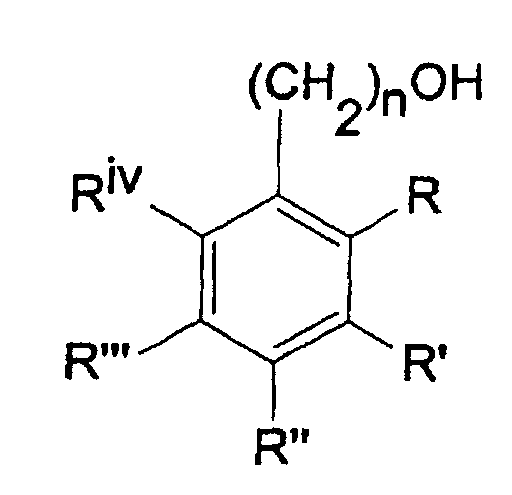
wherein n is an integer between 0 and 10, wherein R, R', R", R"' and Riv may be H or C1-C10 linear or branched alkyl chains, or C1-C10 linear or branched alkenyl or alkinyl chains.
wherein n is an integer between 0 and 10, wherein R, R', R", R"' and Riv may be H or C1-C10 linear or branched alkyl chains, or C1-C10 linear or branched alkenyl or alkinyl chains.
9. A composition according to any of the preceding claims wherein said spray-type dispenser
is a trigger spray.
10. A process of cleaning fabrics with a liquid composition comprising a peroxygen bleach
and a surfactant, said process comprising the steps of dispensing said composition
from a spray-type dispenser onto at least a portion of said fabrics, allowing said
composition to remain in contact with said fabrics and then washing said fabrics.
11. A process of cleaning fabrics with a composition according to any of claims 1 to 9
said process comprising the steps of dispensing said composition from said spray-type
dispenser onto at least a portion of said fabrics, allowing said composition to remain
in contact with said fabrics and then washing said fabrics.
1. Flüssige Zusammensetzung, verpackt in einem Dispenser vom Sprühtyp, zur Vorbehandlung
von Textilien, wobei die Zusammensetzung eine Persauerstoffbleiche, ein Tensid und
einen Bleichaktivator umfasst.
2. Zusammensetzung nach Anspruch 1, worin die Persauerstoffbleiche Wasserstoffperoxid
oder eine wasserlösliche Quelle dafür oder Mischungen davon ist und in einer Menge
von 0.5 Gew.-% bis 20 Gew.-% der Gesamtzusammensetzung, bevorzugt von 2 Gew.-% bis
15 Gew.-%, vorliegt.
3. Zusammensetzung nach mindestens einem der vorangehenden Ansprüche, worin das Tensid
oder die Mischungen davon in einer Menge bis 40 Gew.-% der Gesamtzusammensetzung,
bevorzugt von 0,05 Gew.-% bis 30 Gew.-% und ganz besonders bevorzugt von 1 Gew.-%
bis 20 Gew.-%, vorliegt.
4. Zusammensetzung nach mindestens einem der vorangehenden Ansprüche. worin der Bleichaktivator
oder die Mischungen davon In einer Menge bis 20 Gew.-% der Gesamtzusammensetzung,
bevorzugt von 1 Gew.-% bis 10 Gew.-% und besonders bevorzugt von 2 Gew.-% bis 7 Gew.-%.
vorliegt.
5. Zusammensetzung nach Anspruch 4, worin der Bleichaktivator ein flüssiger hydrophober
Bleichaktivator ist und bevorzugt Acetyltriethylcitrat ist.
6. Zusammensetzung nach Anspruch 5, worin die Zusammensetzung als eine Mikroemulsion
des hydrophoben flüssigen Bleichaktivators in einer Matrix, umfassend Wasser, die
Persauerstoffbleiche und als das Tensid ein hydrophiles Tensidsystem, umfassend ein
anionisches und ein nichtionisches Tensid, formuliert ist.
7. Zusammensetzung nach Anspruch 6, worin mindestens eines der Tenside in dem System
einen HLB-Wert aufweist, welcher sich um mindestens eine HLB-Einheit, bevorzugt um
2, gegenüber dem des Bleichaktivators unterscheidet.
8. Zusammensetzung nach mindestens einem der vorangehenden Ansprüche, worin die Zusammensetzung
weiterhin umfaßt 1 Gew.-% bis 10 Gew.-% der Gesamtzusammensetzung, bevorzugt 2 Gew.-%
bis 4 Gew.-%, eines Alkohols gemäß der Formel HO-CR'R"-OH, worin R' und R" unabhängig
voneinander H oder eine C2-C10-Kohlenwasserstoffkette und/oder Ring darstellen, oder Mischungen davon. und/oder
bis zu 20 Gew.-% der Gesamtzusammensetzung, bevorzugt 0.1 Gew.-% bis 10 Gew.-%, ganz
besonders bevorzugt 0.5 Gew.-% bis 5 Gew.-%, eines Alkohols mit der folgenden Formel
oder Mischungen davon:
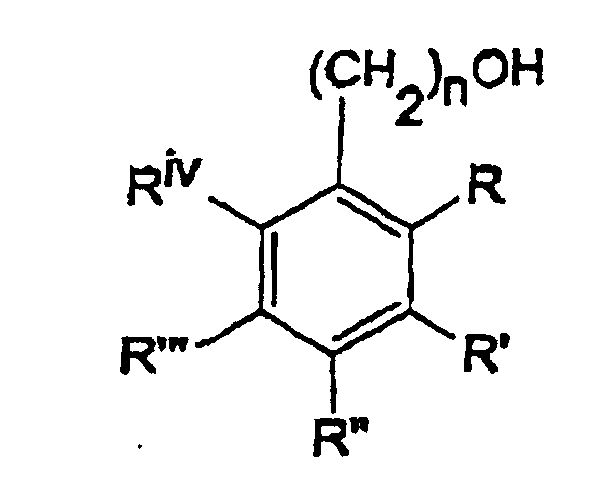
worin n eine ganze Zahl zwischen 0 und 10 ist, worin R, R', R", R''' und Riv H oder lineare oder verzweigte C1-C10-Alkylketten oder lineare oder verzweigte C1-C10-Alkenyl- oder -Alkinylketten sein können.
worin n eine ganze Zahl zwischen 0 und 10 ist, worin R, R', R", R''' und Riv H oder lineare oder verzweigte C1-C10-Alkylketten oder lineare oder verzweigte C1-C10-Alkenyl- oder -Alkinylketten sein können.
9. Zusammensetzung nach mindestens einem der vorangehenden Ansprüche, worin der Dispenser
vom Sprühtyp ein Triggersprüher ist.
10. Verfahren zum Reinigen von Textilien mit einer flüssigen Zusammensetzung. umfassend
eine Persauerstoffbleiche und ein Tensid, wobei das Verfahren die Schritte des Ausgebens
der Zusammensetzung aus dem Dispenser vom Sprühtyp auf mindestens einen Teil der Textilien.
das Belassen der Zusammensetzung in Kontakt mit den Textilien und das anschließende
Waschen der Textilien umfasst.
11. Verfahren zum Reinigen von Textilien mit einer Zusammensetzung nach mindestens einem
der Ansprüche 1-9, wobei das Verfahren die Schritte des Ausgebens der Zusammensetzung
aus dem Dispenser vom Sprühtyp auf mindestens einen Teil der Textilien, das Belassen
der Zusammensetzung in Kontakt mit den Textilien und das anschließende Waschen der
Textilien umfasst.
1. Composition liquide conditionnée dans un distributeur de type atomiseur destinée au
pré-traitement de tissus, ladite composition comprenant un agent de blanchiment au
peroxygène, un tensioactif et un activateur de blanchiment.
2. Composition selon la revendication 1, dans laquelle ledit agent de blanchiment au
peroxygène est un peroxyde d'hydrogène, ou une source hydrosoluble de celui-ci, ou
des mélanges de ceux-ci, et est présent dans une quantité comprise entre 0,5 % et
20 % en poids de la composition totale et de préférence entre 2 % et 15 %.
3. Composition selon l'une quelconque des revendications précédentes, dans laquelle ledit
tensioactif, ou les mélanges de ceux-ci, est (sont) présent(s) dans une quantité allant
jusqu'à 40 % en poids de la composition totale, de préférence comprise entre 0,05
% et 30 %, et de façon plus préférentielle entre 1 % et 20 %.
4. Composition selon l'une quelconque des revendications précédentes, dans laquelle ledit
activateur de blanchiment ou des mélanges de ceux-ci est (sont) présent(s) dans une
quantité allant jusqu'à 20 % en poids de la composition totale, de préférence comprise
entre 1 % et 10 %, et de façon plus préférentielle entre 2 % et 7 %.
5. Composition selon la revendication 4, dans laquelle ledit activateur de blanchiment
est un activateur de blanchiment hydrophobe liquide et est de préférence le citrate
d'acétyltriéthyle.
6. Composition selon la revendication 5, dans laquelle ladite composition est formulée
en tant que micro-émulsion dudit activateur de blanchiment hydrophobe liquide dans
une matrice comprenant de l'eau, ledit agent de blanchiment au peroxygène et en tant
que dit tensioactif, un système tensioactif hydrophile comprenant un tensioactif anionique
et un tensioactif non ionique.
7. Composition selon la revendication 6, dans laquelle au moins un desdits tensioactifs
dudit système possède une valeur d'équilibre hydrophile lipophile (HLB) qui diffère
d'au moins une unité HLB, de préférence 2, par rapport à celle dudit activateur de
blanchiment.
8. Composition selon l'une quelconque des revendications précédentes, dans laquelle ladite
composition comprend en outre 1 % à 10 % en poids de la composition totale, de préférence
2 % à 4 % d'un alcool correspondant à la formule HO - CR'R" - OH, dans laquelle R'
et R" sont indépendamment H ou une chaîne et/ou un cycle hydrocarboné(e) en C2 à C10, ou des mélanges de ceux-ci, et/ou jusqu'à 20 % en poids de la composition totale,
de préférence de 0,1 % à 10 %, et de façon plus préférentielle de 0,5 % à 5 % d'un
alcool répondant à la formule suivante, ou de mélanges de ceux-ci :
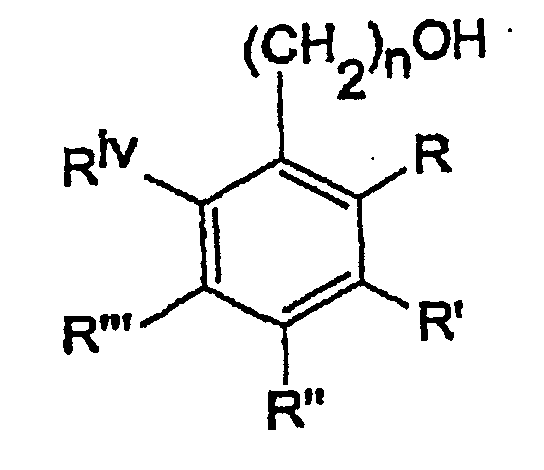
dans laquelle n est un entier compris entre 0 et 10, où R, R', R", R"' et RIV peuvent être H ou des chaînes alkyle linéaires ou ramifiées en C1 à C10, ou des chaînes alcényle ou alcinyle linéaires ou ramifiées en C1 à C10.
dans laquelle n est un entier compris entre 0 et 10, où R, R', R", R"' et RIV peuvent être H ou des chaînes alkyle linéaires ou ramifiées en C1 à C10, ou des chaînes alcényle ou alcinyle linéaires ou ramifiées en C1 à C10.
9. Composition selon l'une quelconque des revendications précédentes, dans laquelle ledit
distributeur de type atomiseur est un atomiseur à gâchette.
10. Procédé de nettoyage de tissus avec une composition liquide comprenant un agent de
blanchiment au peroxygène et un tensioactif, ledit procédé comprenant les étapes consistant
à distribuer ladite composition depuis un distributeur de type atomiseur sur au moins
une portion desdits tissus, à permettre à ladite composition de rester en contact
avec lesdits tissus et puis à laver lesdits tissus.
11. Procédé de nettoyage de tissus avec une composition selon l'une quelconque des revendications
1 à 9, ledit procédé comprenant les étapes consistant à distribuer ladite composition
depuis un distributeur de type atomiseur sur au moins une portion desdits tissus,
à permettre à ladite composition de rester en contact avec lesdits tissus et puis
à laver lesdits tissus.