|
(11) | EP 0 777 503 B1 |

| (12) | EUROPEAN PATENT SPECIFICATION |
|
|
| (54) |
RADIOPAQUE POLYMERS AND METHODS FOR PREPARATION THEREOF STRAHLENUNDURCHLÄSSIGE POLYMERE UND VERFAHREN ZU IHRE HERSTELLUNG POLYMERES OPAQUES AUX RAYONS X ET LEURS PROCEDES DE FABRICATION |
|
|
|||||||||||||||||||||||||||||||
| Note: Within nine months from the publication of the mention of the grant of the European patent, any person may give notice to the European Patent Office of opposition to the European patent granted. Notice of opposition shall be filed in a written reasoned statement. It shall not be deemed to have been filed until the opposition fee has been paid. (Art. 99(1) European Patent Convention). |
[0001] The present invention relates to a class of polymeric materials exhibiting radiopacity due to the fact that molecules containing covalently-bound iodine were built-in during polymerisation. Fields of application of such radiopaque polymers include: medical materials (e.g. bone cements, catheters, and implants such as blood vessel prostheses and endovascular stents); veterinary materials (e.g. implants, catheters), and toys, especially small objects with the associated danger of being swallowed. Due to the presence of covalently bound iodine in the polymer post-operative assessment of the fate of implants, using X-ray scanning, is possible.
[0002] In the literature some experiments have been described, dealing with the polymerization of iodine containing monomers. These experiments did not result in any suitable materials, as the polymerization did not proceed to a sufficient high molecular weight, or the resulting material did possess hemolytic properties, which makes the material unsuitable for biomedical applications.
[0003] The British patent application 609156 discloses an acrylic monomer having at least one iodine group covalently bound thereto and a process for obtaining polymers therefrom. WO-A-82 01006 discloses a radiopaque homo or copolymers of iodo substituted meth(acrylate)esters and a cement for joining fractured bone comprising said radiopaque polymer. The British patent application 1,060,365 discloses a monomer, 5-iodopentene, for preparing a polymer.
[0004] The present invention relates to a class of radiopque biomedical polymeric materials having a number average molecular weight of at least 7500. These radiopaque materials are either: (i) polymers of a monomer molecule that contains covalently-bound iodine, or (ii) copolymers in which at least one of the different monomers contains covalently-bound iodine, or (iii) terpolymers or polymers of even higher complexity, in which at least one of the different monomers contains covalently-linked iodine.
[0005] This group of polymers encompasses a wide variety of materials since a virtually unlimited variation is possible for iodine containing monomers. Furthermore, the composition of copolymers, terpolymers, and other polymers such as mentioned under (ii) and (iii) can be varied, both in terms of relative concentration, and in terms of molecular structure of the different constitutents.
[0006] Radiopaque polymers according to this invention are clearly distinguished with respect to prior art ("Preparation and evaluation of radiopaque hydrogel microspheres based on pHEMA/iothalamic acid and pHEMA/iopanoic acid as particulate emboli" A. Jayakrishnan et al., Journal of Biomedical Materials Research, 24, 993-1004 (1990); "Synthesis and polymerization of some iodine-containing monomers for biomedical applications" A. Jayakrishnan et al., Journal of Applied Polymer Science 44, 743-748 (1992)) in which it was reported that only low-molecular-weight products are obtained when acrylic derivatives of triiodophenol or iodothalamic acid are copolymerised with methyl methacrylate (MMA) or 2-hydroxyethyl methacrylate (HEMA).
[0007] The invention specifically relates to a biomedical polymer having a number average molecular weight of at least 7.500, said polymer being substantially non-porous and having polymerized therein at least one monomer having at least one but not more than two iodine groups covalently bound to an aromatic ring.
[0008] The invention is explained in detail in the following: Although radiopaque polymers of different structural types are subject to this invention, the most predominant ones are polyacrylates and derivatives thereof. Preparation of radiopaque polyacrylates starts with synthesis of a monomer in which iodine is covalently bound. Molecules of this type include, but are not limited to the group of structures represented in Scheme I
wherein
R = H, CH3 or C2H5.
R' = I, O-C6H4I, O-C6H3I2, NH-C6H4I, NH-C6H3I2, O-CH2-CH2-C(O)-C6H4I, O-CH2-CH2-O-C(O)-C6H3I2, NH-CH2-CH2-C(O)-C6H4I, NH-CH2-CH2-O-C(O)-C6H3I2.
[0009] The first method of preparation of monomers of Scheme I starts our with an acylic acid chloride, e.g. methacryloyl chloride. These reactive compounds can be coupled to a variety of iodine-containing alcohols, in a reaction in which hydrogen chloride is formed along with the product. As an example, reaction of methacryloyl chloride with 4-iodophenol in the presence of a base (triethylamine) yields (4-iodophenyl) methacrylate. The latter compound clearly belongs to the Scheme I. A variety of analogous monomers can be prepared according to this method. The only essential requirement is that one or more iodine atoms but no more than two must be present in the alcohol. Use of an iodine containing amine instead of the alcohol will generate an amide bond. For example: reaction of methacryloyl chloride with 4-iodo-aniline in the presence of a strong base will lead to (4-iodophenyl) methacrylamide which also belongs to Scheme I. Amides, derived from an acrylic acid chloride and an iodine-containing amine are explicitly included in Scheme I.
[0010] The second method for generating compounds from subgroup a. in Scheme I starts our with an acrylate that is available, for instance from a commercial source. The acrylate is treated with an excess of an iodine-containing alcohol. Such a procedure leads to cleavage of the ester bond in the acrylate, and subsequently to substitution of the side-chain by the iodine containing group (trans-esterification). For example, methyl methacrylate can be treated with excess 4-iodophenol, and this reaction then affords 4-(iodophenyl) methacrylate. As said, the latter compound belongs to Scheme I. The reaction can also be carried out with an iodine-containing amine, instead of the iodine-containing alcohol; an amide bond is generated in this case.
[0011] The third method for synthesising monomers of Scheme I. is based on coupling of an acrylic compound with a free hydroxyl group or a free amino group, with an iodine-containing carboxylic acid. Two examples illustrate this approach. The first example relates to reaction of 2-hydroxyethyl methacrylate (HEMA) with 4-iodocarboxylic acid. This reaction, a normal esterification, can be carried out in many ways. It has been observed by the inventors that the reaction proceeds with excellent yield in the presence of N,N'-dicyclohexyl carbodiimide (DCC). Special care should be taken to isolate the product in pure form, i.e. to quantitatively remove the side product N,N'-dicyclohexyl urea. The second example relates to the analogous reaction of 2-aminoethyl methacrylate with 4-iodocarboxylic acid. This reaction also proceeds in the presence of DCC. Products obtained in reactions according to both examples belong to Scheme I.
[0012] The fourth method of synthesis of monomers of Scheme I is based on coupling of acrylate molecules with a free hydroxyl-, amino-, or other reactive nucleophilic group, with an iodine-containg acid chloride. In fact, this approach is the opposite of the first method of synthesis (vide supra). The procedure for executing the fourth method is therefore identical to the procedures for executing the first method.
Polymer synthesis.
[0013] Two procedures for preparation of radiopaque acrylate polymers are disclosed. One method refers to synthesis in bulk, the other method refers to synthesis in solution. In the bulk procedure, an iodine-containing monomer (viz. Scheme I) is mixed with one or more other reactive monomers (e.g. MMA, HEMA, styrene), an initiator (e.g. molecules with the property of undergoing homolytic bond cleavage upon raising the temperature, e.g. acyl peroxides, cumyl- or tert. butyl peroxides, tetrazenes, AIBN, also: reagents that can be used in photopolymerisations, redoxinitiation), and a chain-transfer agent (e.g. mercapto ethanol). The reaction mixture is transferred into a Teflon tube which is tightly closed with a glass stopper on one end. The tube is then subjected to a controlled heat treatment. This affords the radiopaque materials as transparent glassy rods.
[0014] In the solution procedure, an iodine-containing monomer (viz. Scheme I) is mixed with one or more other reactive monomers (e.g. MMA, HEMA, styrene), an initiator (vide supra), and a chain-transfer agent (e.g. mercapto ethanol). This mixture is dissolved in a clean, high-boiling solvent (e.g. dimethylformamide, dimethyl-sulfoxide). The resulting solution is stirred continuously and subjected to a controlled heat treatment. After work-up, this renders a radiopaque polymer as a white solid. Work-up can be cumbersome, since removal of the last traces of high-boiling solvent is often difficult. Pure product can be obtained after repeated washing steps, and lyophilisation.
[0015] With respect to the polymers that were obtained according to both procedures, it was found that a content of ca. 20 mol% of iodine-containing monomer ensures sufficient visibility using clinically common imaging techniques based on X-ray absorption. Thin fibers of materials as described above (content of iodine-containing monomer ca. 20 mol %) were clearly visible under routine fluoroscopy, even when a correction was applied for X-absorption due to the human body (a 15-cm thick layer of PMMA glass was placed in the X-ray beam). It must be noted that the content of 20 mol % refers to monomers with one iodine per molecule. Evidently, use of a monomer with two iodine atoms per molecule will lead to clear visibility at a content of only 10 mol %.
[0016] The polymers of the present invention can, as has been indicated above, be used for various biomedical purposes, which means that they have to be compatible in the human or animal body. More in particular suitable biomedical materials do not possess hemolytic properties. More in partiular the materials according to the invention are suitable as bone cements, catheters, and implants such as blood vessel prostheses and endovascular stents (in general medical materials); veterinary materials (e.g. implants, catheters), and toys, especially small objects with the associated danger of being swallowed.
[0017] The invention also relates to a monomer mixture that is suitable for preparing a biomedical polymer containing covalently bound iodine, said monomer mixture comprising at least one monomer having at least one iodine group but no more than two covalently bound thereto, at least one reaction initiator and/or catalyst, optionally one or more other monomers not containing iodine and fillers. Preferably said monomer mixture is provided in the form of a two-pack system that is suitable for in-situ use, for example as bone cement, as dental filling material, or as biomedical construction material.
[0018] The invention is elucidated on the basis of the following examples that are not intended to restrict the invention.
Examples
Example 1
[0019] Polymers A, B and C were prepared using the bulk polymerization method. The composition of the polymers is as follows:
Polymer A: 80 mol % MMA, 20 mol % [4-iodophenyl]methacrylate;
Polymer B: 65 mol % MMA, 15 mol % HEMA, 20 mol % [4-iodophenyl]methacrylate;
Polymer C: 60 mol % MMA, 19 mol % HEMA, 21 mol % 2-[4-iodobenzoyl]ethyl methacrylate.
Some physico-chemical data on these polymers are summarized in Table I.Table I
| Physico-chemical properties of some iodine-containing radiopaque polymers. | ||||||
| Pol1 | Mw2 | Mn2 | Xray-visibility3 | contact angle4 | purity check5 | monomer content |
| A | 61.5 | 22.7 | ++ | 52.4 | NMR, GPC | < 1 % |
| B | 41.3 | 12.2 | ++ | 43.1 | NMR, GPC | < 1 % |
| C | 43.1 | 7.9 | ++ | 42.8 | NMR, GPC | < 1 % |
| 1Polymer A: 80 mol % MMA, 20 mol % [4-iodophenyl]methacrylate; Polymer B: 65 mol %
MMA, 15 mol % HEMA, 20 mol % [4-iodophenyl]methacrylate; Polymer C: 60 mol % MMA, 19 mol % HEMA, 21 mol % 2-[4-iodobenzoyl]ethyl methacrylate. |
||||||
| 2Determined by gel permeation chromatography, using polystyrene standards; expressed in kg/mol. | ||||||
| 3Visibility under routine fluoroscopy, absorption of X-rays due to surrounding bone and tissue mimicked by 15 cm of Plexi glass. | ||||||
| 4 Measured according to the dynamic Wilhelmy plate technique; listed data are receding contact angles, expressed in degrees. | ||||||
| 5Proton NMR measurements at 400 MHz, measured on solutions of polymers A-C in DMSO solution. |
[0020] Some biochemical data on these polymers are summarized in Table II.
Table II
| Biochemical properties of some iodine-containing radiopaque polymers. | |||
| Polymer1 | Clotting time2 | platelet adhesion3 | platelet morphology3 |
| A | 392 | 10 % | unchanged |
| B | 553 | no | ------- |
| C | 700 | 10 % | spreaded |
| 1See legend Table 1. | |||
| 2Measured in a routine thrombin generation test procedure, expressed in seconds. | |||
| 3Determined by scanning electron microscopy. Polymers B and C were designed such that they combine X-ray visibility with enhanced biocompatibility. This is a unique feature. |
Example 2
[0021] A copolymer, composed of methylmethacrylate (MMA, 51 mole %), and 2-[2'-iodobenzoyl] ethylmethacrylate (49 mole %), was prepared in a typical bulk synthesis (vide supra). The material showed Mw = 80.000 and Mn = 36000 (GCP analysis) while the residual monomer content was substantially smaller than 1%. The material was first granulated and subsequently powdered. The powder was then thoroughly mixed with polymethylmethacrylate (pMMA) powder, in the ratio 1:8 (w/w). A peroxide was added in the ratio 1:200 (w/w). The resulting powder was used to replace the solid component of a commercial bone cement kit. The commercial liquid bone cement component was mixed with the powder. This yielded a cement, which hardened in 10-20 minutes. Mechanical tests of the material revealed that the tensile strength of the cement containing the radiopaque copolymer is 58 MPa, which is substantially larger than that for the commercial bone cement (48 MPa). The commercial bone cement was made radiopaque through addition of 10% (by weight) of barium sulfate. Apparently, the addition of barium sulfate (which does not mix with the polymeric cement matrix, and tends to form clumps) in fact weakens the cement. This problem can be solved via the use of a radiopaque (copolymer) as described in this example. Moreover, leaching a toxic barium sulfate cannot occur with the proposed new cement.
1. Biomedical polymer having a number average molecular weight of at least 7.500, said
polymer being substantially non-porous and having polymerized therein at least one
monomer having at least one but not more than two covalently bound iodine groups,
said monomer having the formula
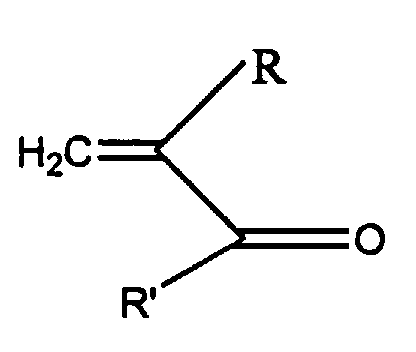
wherein R = H, CH3 or C2H5 and R' = O-C6H4I, O-C6H3I2, NH-C6H4I, NH-C6H3I2, O-CH2-CH2-C(O)-C6H4I, O-CH2-CH2-O-C(O)-C6H3I2, NH-CH2-CH2-C(O)-C6H4I or NH-CH2-CH2-O-C(O)-C6H3I2.
wherein R = H, CH3 or C2H5 and R' = O-C6H4I, O-C6H3I2, NH-C6H4I, NH-C6H3I2, O-CH2-CH2-C(O)-C6H4I, O-CH2-CH2-O-C(O)-C6H3I2, NH-CH2-CH2-C(O)-C6H4I or NH-CH2-CH2-O-C(O)-C6H3I2.
2. Polymer according to claim 1, wherein at least 20% of the number of polymerized monomers
contains said covalently bound iodine.
3. Monomer mixture suitable for preparing a polymer according to claims 1-3, comprising
at least one monomer as defined in claim 1, at least one reaction initiator and/or
catalyst, optionally one or more other monomers not containing iodine and fillers.
4. Toy having improved radiopacity having incorporated therein a polymer material according
to each of the claims 1-3.
5. Small objects with the associated danger of being swallowed having improved radiopacity
having incorporated therein a polymer material according to claims 1-3.
6. Medical material comprising an implant or catheter having improved radiopacity having
incorporated therein a polymer material according to claims 1-3.
7. Bonecement having improved radiopacity having incorporated therein compounds according
to claims 1-4.
8. Use of compounds according to claims 1-4 for improvement of radiopacity of objects.
9. Use of compounds according to claims 1-3 for improvement of radiopacity of toys.
10. Use of compounds according to claims 1-4 for improvement of radiopacity of medical
material comprising an implant or catheter.
11. Use of compounds according to claim 4 for the preparation of bonecement having radiopacity.
1. Biomedizinisches Polymer mit einem Zahlenmittel des Molekulargewichts von wenigstens
7500, wobei das Polymer im wesentlichen nichtporös ist und wenigstens ein Monomer
darin einpolymerisiert ist, das wenigstens eine, aber nicht mehr als zwei kovalent
gebundene Iodgruppen aufweist, wobei das Monomer die Formel
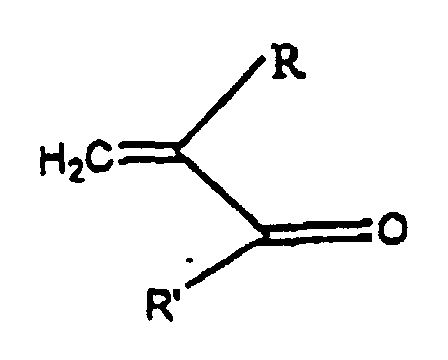
hat, wobei R = H, CH3 oder C2H5 und R' = O-C6H4I, O-C6H3I2, NH-C6H4I, NH-C6H3I2, O-CH2-CH2-C(O)-C6H4I, O-CH2-CH2-O-C(O)-C6H3I2, NH-CH2-CH2-C(O)-C6H4I oder NH-CH2-CH2-O-C(O)-C6H3I2.
hat, wobei R = H, CH3 oder C2H5 und R' = O-C6H4I, O-C6H3I2, NH-C6H4I, NH-C6H3I2, O-CH2-CH2-C(O)-C6H4I, O-CH2-CH2-O-C(O)-C6H3I2, NH-CH2-CH2-C(O)-C6H4I oder NH-CH2-CH2-O-C(O)-C6H3I2.
2. Polymer gemäß Anspruch 1, wobei wenigstens 20 Mol-% der polymerisierten Monomere das
kovalent gebundene Iod enthalten.
3. Monomergemisch, das zur Herstellung eines Polymers gemäß Anspruch 1-2 geeignet ist
und das wenigstens ein Monomer, wie es in Anspruch 1 definiert ist, wenigstens einen
Reaktionsinitiator und/oder Katalysator, gegebenenfalls ein oder mehrere andere Monomere,
die kein Iod enthalten, sowie Füllstoffe umfaßt.
4. Spielzeug mit verbesserter Strahlenundurchlässigkeit, in das ein Polymermaterial gemäß
jedem der Ansprüche 1-2 eingebaut ist.
5. Kleinteile, bei denen die Gefahr des Verschluckens besteht und die eine verbesserte
Strahlenundurchlässigkeit aufweisen, wobei in die Kleinteile ein Polymermaterial gemäß
den Ansprüchen 1-2 eingebaut ist.
6. Medizinisches Material, das ein Implantat oder Katheter umfaßt und das eine verbesserte
Strahlenundurchlässigkeit aufweist, wobei in das Material ein Polymermaterial gemaß
den Ansprüchen 1-2 eingebaut ist.
7. Knochenzement mit verbesserter Strahlenundurchlässigkeit, in den Verbindungen gemäß
den Ansprüchen 1-3 eingebaut sind.
8. Verwendung von Verbindungen gemäß den Ansprüchen 1-3 zur Verbesserung der Strahlenundurchlässigkeit
von Gegenständen.
9. Verwendung von Verbindungen gemäß den Ansprüchen 1-2 zur Verbesserung der Strahlenundurchlässigkeit
von Spielzeugen.
10. Verwendung von Verbindungen gemäß den Ansprüchen 1-3 zur Verbesserung der Strahlenundurchlässigkeit
von medizinischem Material, das ein Implantat oder Katheter umfaßt.
11. Verwendung von Verbindungen gemäß Anspruch 3 zur Herstellung eines strahlenundurchlässigen
Knochenzements.
1. Polymère biomédical ayant une masse moléculaire moyenne en nombre d'au moins 7 500,
ledit polymère étant pratiquement non poreux et ayant, polymérisé dans celui-ci, au
moins un monomère ayant au moins un mais pas plus de deux groupes iodés liés de façon
covalente, ledit monomère ayant la formule :
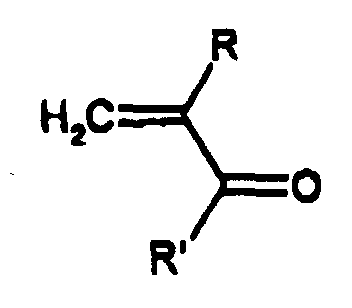
dans laquelle R = H, CH3 ou C2H5, et R' = O-C6H4I, O-C6H3I2, NH-C6H4I, NH-C6H3I2, O-CH2-CH2-C(O)-C6H4I, O-CH2-CH2-O-C(O)-C6H3I2, NH-CH2-CH2-C(O)-C6H4I ou NH-CH2-CH2-O-C(O)-C6H3I2.
dans laquelle R = H, CH3 ou C2H5, et R' = O-C6H4I, O-C6H3I2, NH-C6H4I, NH-C6H3I2, O-CH2-CH2-C(O)-C6H4I, O-CH2-CH2-O-C(O)-C6H3I2, NH-CH2-CH2-C(O)-C6H4I ou NH-CH2-CH2-O-C(O)-C6H3I2.
2. Polymère selon la revendication 1, dans lequel au moins 20 % du nombre de monomères
polymérisés contiennent ledit iode lié de façon covalente.
3. Mélange de monomères convenant à la préparation d'un polymère selon les revendications
1 à 3, comprenant au moins un monomère tel que défini dans la revendication 1, au
moins un amorceur et/ou catalyseur réactionnel, éventuellement un ou plusieurs autres
monomères ne contenant pas d'iode, et des charges.
4. Jouet ayant une opacité aux rayons X améliorée dans lequel est incorporé un matériau
polymère selon chacune des revendications 1 à 3.
5. Petits objets présentant le danger associé d'être avalés, ayant une opacité aux rayons
X améliorée, dans lesquels est incorporé un matériau polymère selon les revendications
1 à 3.
6. Matériau médical, comprenant un implant ou cathéter ayant une opacité, aux rayons
X améliorée, dans lequel est incorporé un matériau polymère selon les revendications
1 à 3.
7. Ciment osseux ayant une opacité aux rayons X améliorée, dans lequel est incorporé
un matériau polymère selon les revendications 1 à 4.
8. Utilisation de composés selon les revendications 1 à 4, Pour améliorer la opacité
aux rayons X d'objets.
9. Utilisation de composés selon les revendications 1 à 3, pour améliorer la opacité
aux rayons X de jouets.
10. Utilisation de composés selon les revendications 1 à 4, pour améliorer la opacité
aux rayons X de matériel médical comprenant un implant ou cathéter.
11. Utilisation de composés selon la revendication 4, pour la préparation de ciment osseux
ayant une opacité aux rayons X.