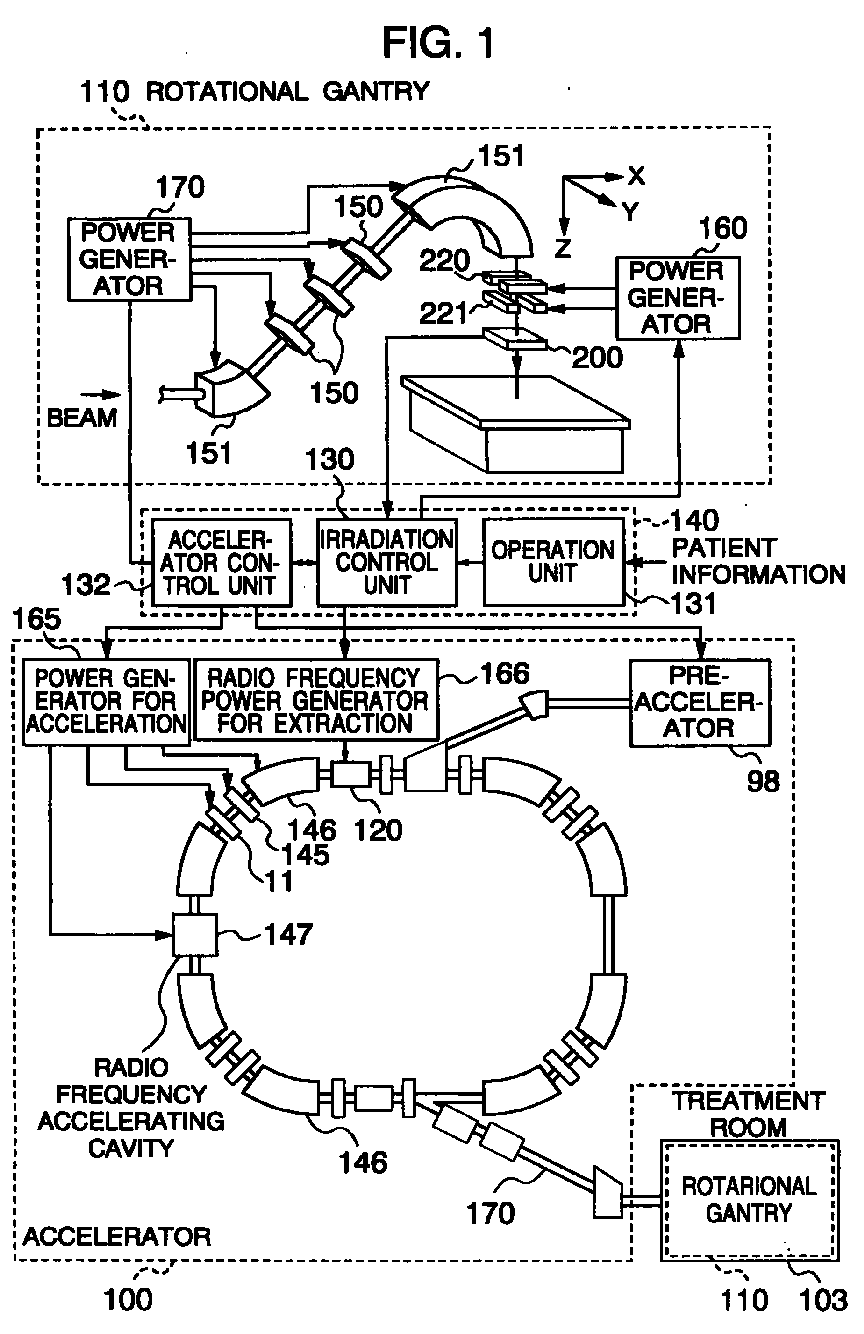
(57) A charged particle accelerator (100) has a switching device (166) for switching on
and off the extraction of a charged particle beam, an irradiation unit (110) has electromagnets
(220, 221) for setting an irradiation point of the charged particle beam to be irradiated
on an irradiation target, and a control unit (130) controls the switching device to
cause it to switch on and off the beam extraction and the electromagnets (220, 221)
to cause them to change the irradiation point. When the switching device (166) switches
on the extraction of the charged particle beam circulating through the charged particle
accelerator (100) into the irradiation unit (100), the charged particle beam is irradiated
on the irradiation target in the irradiation unit. When the switching device switches
off the beam extraction from the charged particle accelerator into the irradiation
unit, the irradiation of the charged particle beam on the irradiation target is also
stopped. Accordingly, when the control unit (130) controls the switching device to
cause it to switch on and off the beam extraction, the irradiation on the irradiation
target can also be switched on and off. Since the electromagnets (220, 221) set the
irradiation point of the charged particle beam in the irradiation unit (110), the
charged particle beam extracted from the charged particle accelerator into the irradiation
unit can be irradiated on the irradiation target. Since the control unit (130) controls
the electromagnets (220, 221) to cause them to change the irradiation point, the charged
particle beam can be irradiated on another irradiation point of the irradiation target.
Even when the irradiation target has a complicated shape, the irradiation target can
be irradiated with high accuracy through simplified control. The irradiation is continued
until a target of irradiation dose is reached and therefore, even when the beam intensity
changes temporally, the irradiation target can be irradiated with uniform beam density.
|
|
