|
(11) | EP 0 781 749 B1 |

| (12) | EUROPEAN PATENT SPECIFICATION |
|
|
| (54) |
Process for producing optically active benzhydrol compounds Verfahren zur Herstellung von optisch aktiven Benzhydrolverbindungen Procédé pour la préparation de composés de benzhydrol optiquement actifs |
|
|
|||||||||||||||||||||||||||||||
|
||||||||||||||||||||||||||||||||
| Note: Within nine months from the publication of the mention of the grant of the European patent, any person may give notice to the European Patent Office of opposition to the European patent granted. Notice of opposition shall be filed in a written reasoned statement. It shall not be deemed to have been filed until the opposition fee has been paid. (Art. 99(1) European Patent Convention). |
[0001] This invention relates to a process for producing optically active benzhydrol compounds. More particularly, it relates to a novel and practically useful process for producing optically active benzhydrol compounds which are useful in various purposes, for example, as intermediates in the synthesis of drugs or liquid crystal materials.
BACKGROUND OF THE INVENTION
[0002] Known processes for synthesizing optically active alcohols include: 1) methods wherein enzymes (bread yeast, etc.) are employed; and 2) those wherein carbonyl compounds are asymmetrically hydrogenated with the use of metal complexes. Regarding the latter asymmetric hydrogenation methods, in particular, there have been presented a number of proposals, for example, (1) a method of the asymmetric hydrogenation of a carbonyl compound having a functional group with the use of an optically active ruthenium catalyst described in detail in Asymmetric Catalysis In Organic Synthesis, 56 - 82, (1994), Ed. R. Noyori; (2) a hydrogen transfer reduction with the use of ruthenium, rhodium and iridium asymmetric complex catalysts described in Chem, Rev., vol. 92, 1051 - 1069 (1992); (3) a method of the asymmetric hydrogenation using a modified nickel catalyst described in Yu-Kagaku (Oil Chemistry), 828 - 831 (1980) and Advances in Catalysis, vol. 32, 215 (1983), Ed. by Y.Izumi; (4) a method of asymmetric hydrosilylation described in Asymmetric Synthesis, vol. 5, chap. 4 (1985), Ed. J. D. Morrison and J. Organomet. Chem., vol. 346, 413 - 424 (1988); (5) a method of borane reduction in the presence of an asymmetric ligand described in J. Chem. Soc., Perin Trans. I., 2039 - 2044 (1985) and J. Am. Chem. Soc., vol. 109, 5551 - 5553 (1987); and (6) a method of asymmetric hydrogenation of acetophenone by using potassium hydroxide, an optically active diamine and a ruthenium asymmetric complex described in J. Am. Chem. Soc., vol. 117, 2675 - 2676 (1995).
[0003] Another process for producing optically active secondary alcohols is disclosed in US-A-3968147. Hydrogenation of ketones in the presence of rhodium or ruthenium posphine complexes is described in Houben-Weyl, Methoden der Organischen Chemie, Vol. VI/1b, p. 52-55.
[0004] Among the above-mentioned methods for synthesizing optically active alcohols, however, those with the use of enzymes have some disadvantages, i.e., troublesome operations should be employed therein, the reaction substrates are limited and the obtained alcohols are restricted in the absolute configuration. On the other hand, the methods with the use of asymmetric hydrogenation catalysts of transition metals are insufficient in the reaction rate. In these methods, furthermore, attentions should be paid to the substrate specificity. That is to say, they are unexpectedly less efficacious in the case of relatively simple carbonyl compounds.
[0005] There have been reported a number of transition metal complexes to be used in the asymmetric hydrogenation of carbonyl compounds. These catalysts are considerably efficacious in the asymmetric hydrogenation of carbonyl compounds (i.e., the reaction substrates) which are ketones having an aromatic ring group and an aliphatic group (acetophenone derivatives, etc.).
[0006] On the other hand, it is expected that benzhydrol compounds, which are useful in various purposes, for example, as intermediates in the synthesis of drugs or liquid crystal materials, might be produced by hydrogenating benzophenone compounds by using a transition metal complex. However, this process falls within the above-mentioned category and, therefore, any good result can be scarcely achieved.
[0007] When a compound of a specific absolute configuration is exclusively useful as in the case of a drug, in particular, the obtained product cannot be utilized unless it is an optically active compound, even though the hydrogenation has been successfully completed. Accordingly, the above-mentioned methods are seemingly not applicable to the synthesis of such specific ketones.
[0008] Accordingly, an object of the present invention is to provide a novel process wherein a benzophenone compound is asymmetrically hydrogenated by a simple procedure to thereby give an optically active benzhydrol compound of the desired absolute configuration at a high optical purity.
[0009] Under these circumstances, the present inventors have conducted extensive studies. As a result, they have successfully found out that the above-mentioned object can be achieved by hydrogenating a benzophenone compound in the presence of an asymmetric hydrogenation catalyst consisting of a transition metal complex, a base and an optically active amine compound, thus completing the present invention
SUMMARY OF THE INVENTION
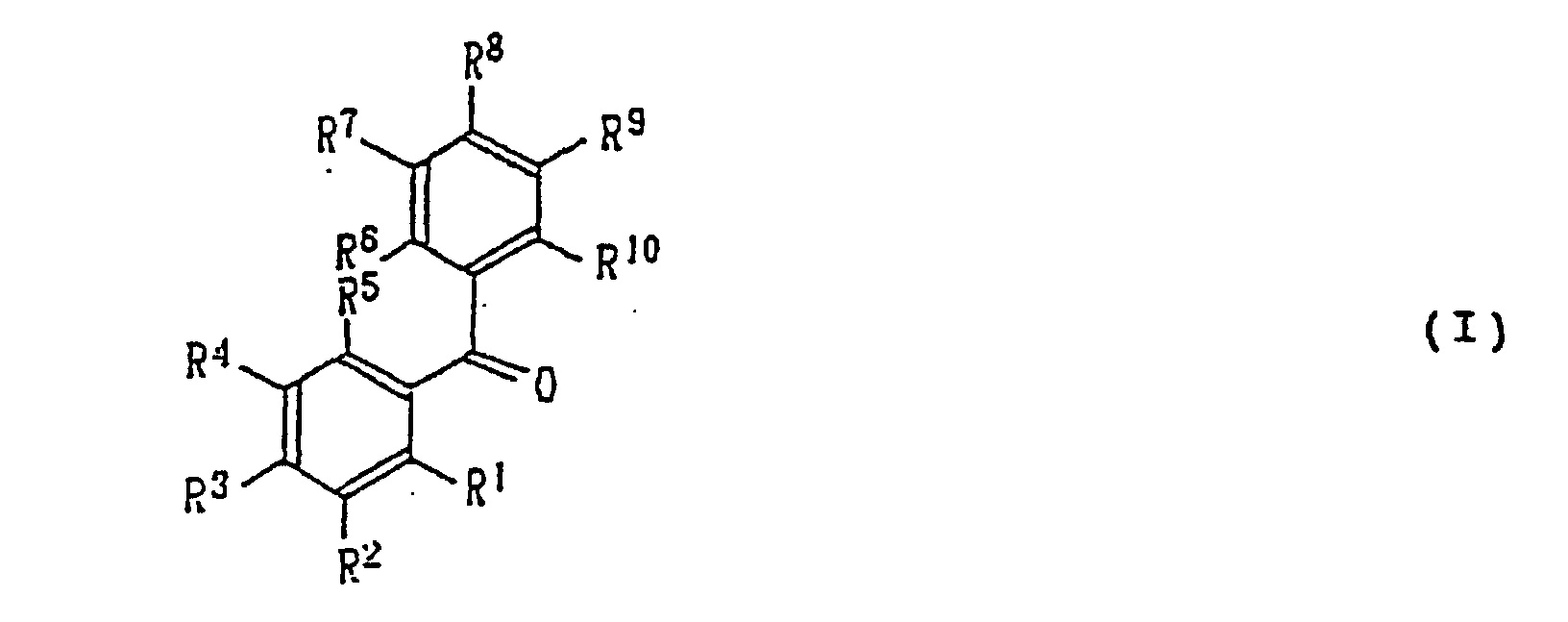
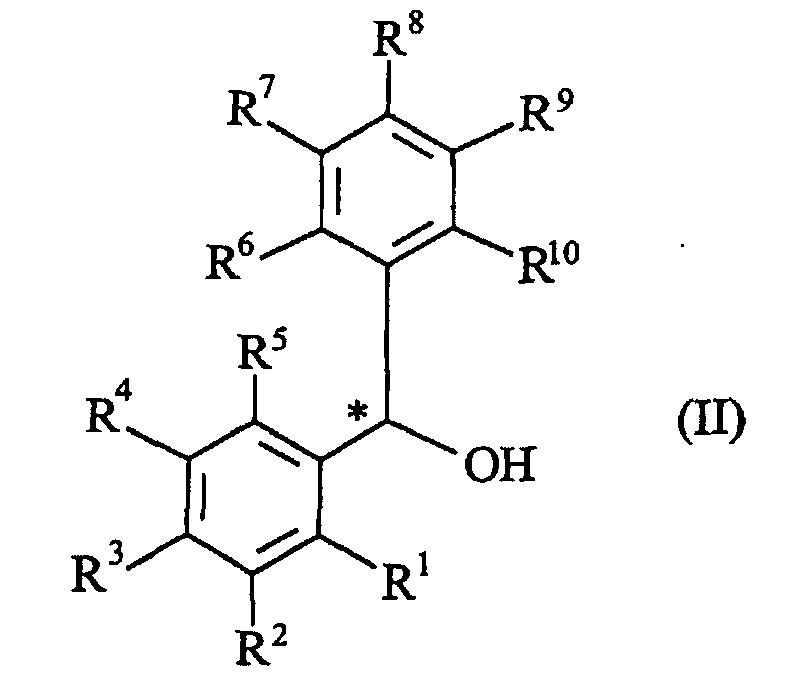
[0010] Accordingly, the present invention provides a process for producing an optically active benzhydrol compound represented by formula (II):
wherein R1, R5, R6 and R10 are the same or different and each represents a hydrogen atom, a halogen atom, a hydroxyl group, a lower alkyl group having 1 to 4 carbon atoms, a lower alkoxy group having 1 to 4 carbon atoms or a lower alkanoyl group having 1 to 5 carbon atoms; R2, R3, R4, R7, R8 and R9 are the same or different and each represents a hydrogen atom, a halogen atom, a hydroxyl group, a lower alkyl group having 1 to 4 carbon atoms, a lower alkoxy group having 1 to 4 carbon atoms, a lower alkanoyl group having 1 to 5 carbon atoms or an amino group optionally substituted by a lower alkyl group having 1 to 4 carbon atoms, a lower alkanoyl group having 1 to 5 carbon atoms or a lower alkoxycarbonyl group having 1 to 4 carbon atoms R2 and R3, and R8 and R9 may be bonded to each other to thereby form -CH=OH-CH=CH- and any two of R1 to R9 adjacent to each other may be bonded to thereby form -OCH2O- or -(CH2)3-; and * shows the location of an asymmetric carbon atom;
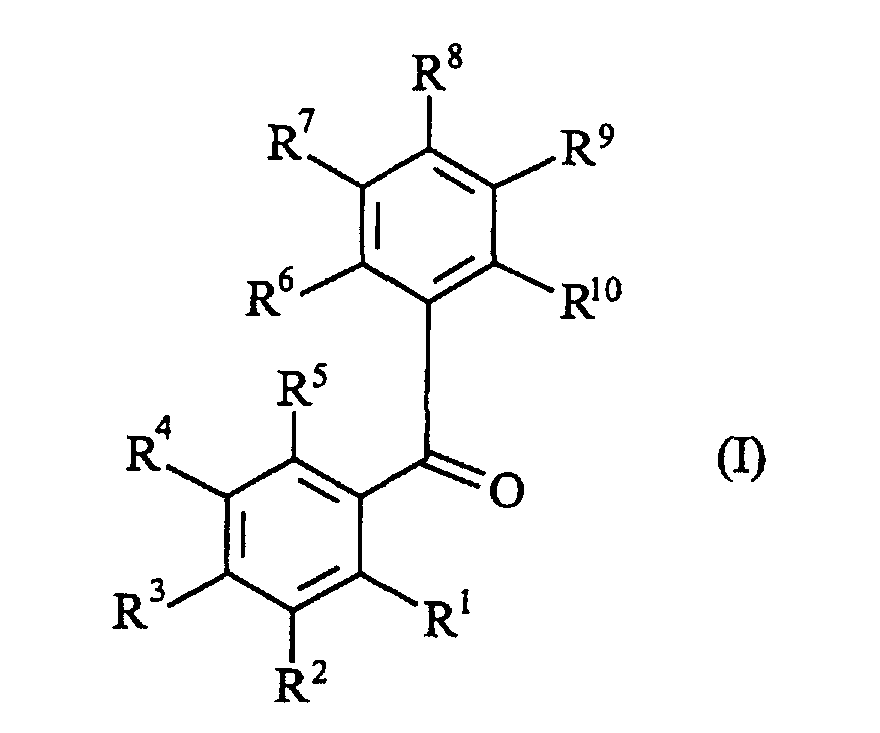
which comprises hydrogenating a benzophenone compound represented by formula (I):
wherein R1, R2, R3, R4, R5, R6, R7, R8, R9 and R10 are each as defined above;
in the presence of a hydrogenation catalyst consisting of a transition metal complex, represented by the following general formula (III), (IV), (V) or (VI):
[Ru2X4(L)2](A) (III)
wherein X represents a halogen atom; L represents an optically active phosphine ligand; and A represents a tertiary amine;
[RuX(E)(L)]X (IV)
wherein X and L are each as defined above; and E represents an optionally substituted benzene or p-cymene;
[Ru(G)2(L)] (V)
wherein L is as defined above; and G represents a halogen atom or an acetoxy group; or
[RuX(L)]+J- (VI)
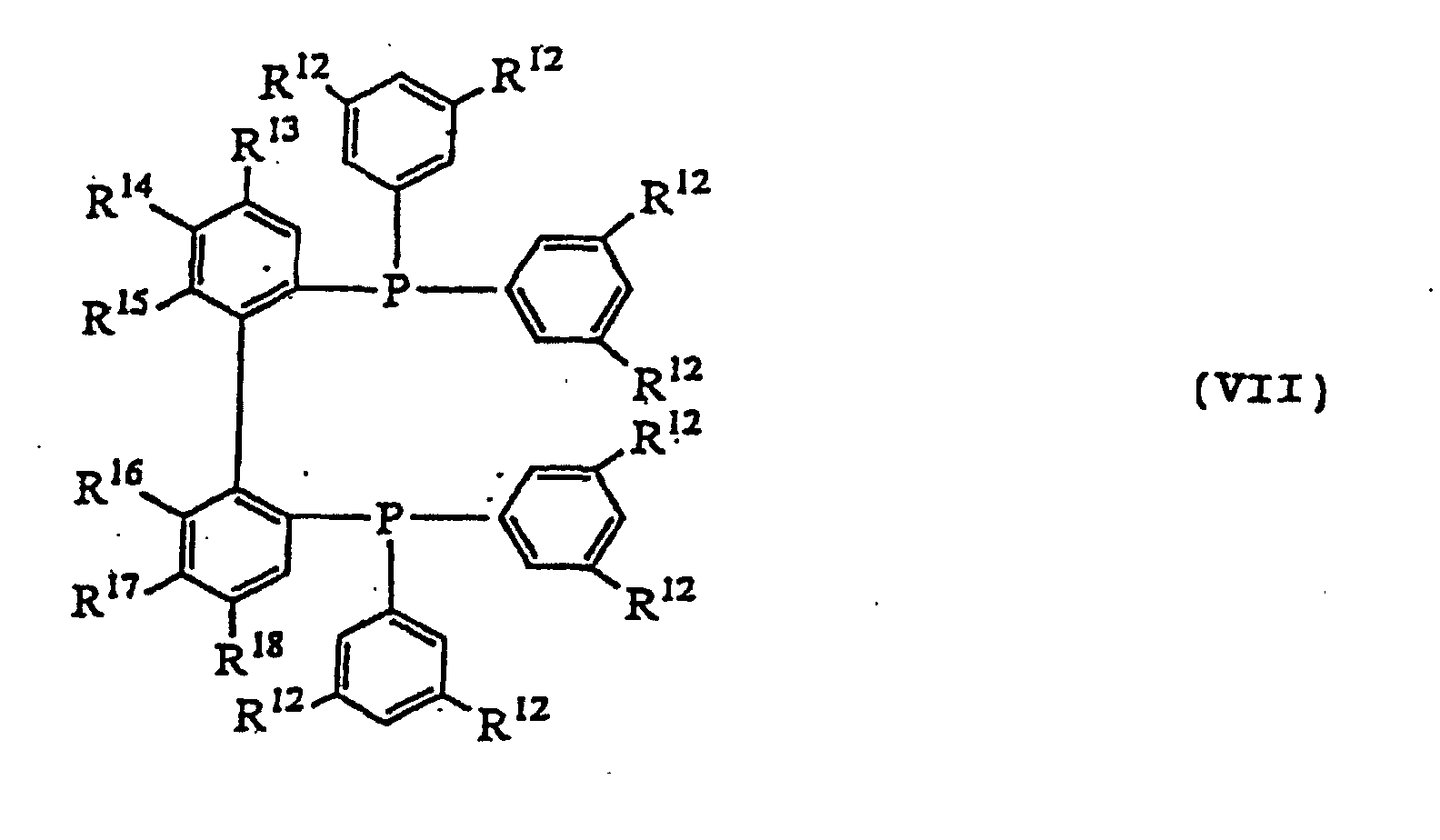
wherein X and L are each as defined above; and J- represents BF4-, ClO4-, PF6- or BPh4- wherein Ph represents a phenyl group, a base and an optically active diamine compound having at least one primary amine end and wherein said optically active phosphine ligand is one represented by formula (VII):
wherein R12 represents a lower alkyl group having 1 to 4 carbon atoms ; R13, R14, R15, R16, R17 and R18 are the same or different and each represents a hydrogen atom, a lower alkyl group having 1 to 4 carbon atoms, a lower alkoxy group having 1 to 4 carbon atoms or a halogen atom, or R14 and R15, and R16 and R17 may be bonded to each other to thereby form a ring.
DETAILED DESCRIPTION OF THE INVENTION
[0011] In the above-mentioned benzophenone compound serving as the substrate in the reaction, examples of the halogen atom as R1, R5, R6 and R10 include fluorine, chlorine, bromine and iodine atoms. Among all, chlorine and bromine atoms are particularly preferable and a chlorine atom is still preferable therefor.
[0012] Examples of the lower alkyl group having 1 to 4 carbon atoms include methyl, ethyl, propyl, isopropyl, n-butyl, isobutyl and tert-butyl groups and a methyl group is preferable therefor.
[0013] Examples of the lower alkoxy group having 1 to 4 carbon atoms include methoxy, ethoxy, propyloxy, isopropyloxy, n-butyloxy, isobutyloxy and tert-butyloxy groups and a methoxy group is preferable therefor.
[0014] Examples of the lower alkanoyl group having 1 to 5 carbon atoms include formyl, acetyl, ethyl carbonyl, propylcarbonyl, isopropylcarbonyl, butyl carbonyl, isobutylcarbonyl and pivaloyl groups and acetyl and pivaloyl groups are preferable therefor.
[0015] Examples of the halogen atom, lower alkyl group having 1 to 4 carbon atoms, lower alkoxy group having 1 to 4 carbon atoms and lower alkanoyl group having 1 to 5 carbon atoms, and the lower alkyl group having 1 to 4 carbon atoms and lower alkanoyl group having 1 to 5 carbon atoms which are the substituent of the amino group in R2, R3, R4, R7, R8 and R9 are the same as those cited above. Also, preferable examples thereof are the same as those cited above.
[0016] Examples of the lower alkoxycarbonyl group having 1 to 4 carbon atoms which is the substituent of the amino group include methoxycarbonyl, ethoxycarbonyl, propoxycarbonyl, isopropyloxycarbonyl, butoxycarbonyl, isobutoxycarbonyl, and tert-butyloxycarbonyl groups. In particular, a tert-butyloxycarbonyl group is preferable therefor.
[0017] Examples of the substituted amino group include a monosubstituted amino group having one substituent and a disubstituted amino group having two substituents and the former is preferred therefor to the latter.
[0018] Examples of the benzophenone compound (I) serving as the starting compound in the present invention are those listed in the following Table 1, though the present invention is not restricted thereto. In Table 1, Me stands for a methyl group.
Table 1
| Compound | Substituent on the ring carrying R6 etc. | Substituent on the ring carrying R1 etc. |
| 1 | R6 = OMe | R1 = Cl |
| 2 | R6 = R7 = OMe | " |
| 3 | R6 = R8 = OMe | " |
| 4 | R6 = R9 = OMe | " |
| 5 | R6 = R10 = OMe | " |
| 6 | R6 = R8 = R10 = OMe | " |
| 7 | R6, R7 = -OCH2O- | " |
| 8 | R7, R8 = -OCH2O- | " |
| 9 | R6 = OMe | R1 = R3 = Cl |
| 10 | R6 = F | R1 = Cl |
| 11 | R6 = Br | " |
| 12 | R8 = Cl | " |
| 13 | R7 = Cl | " |
| 14 | R6 = Cl | " |
| 15 | R6 = R8 = Cl | " |
| 16 | R6 = Cl | R1 = F |
| 17 | " | R1 = Br |
| 18 | R6 = CF3 | R1 = Cl |
| 19 | - | " |
| 20 | R8 = Cl | - |
| 21 | R6 = Cl | - |
| 22 | " | R1 = Me |
| 23 | " | R3, R4 = -(CH2)3- |
| 24 | R6 = F | - |
| 25 | R6 = Cl | R1 = OMe |
| 26 | - | R1 = CF3 |
| 27 | R8 = NH2 | - |
| 28 | R8 = NHMe | - |
| 29 | R6 = Me | - |
| 30 | R7 = Me | - |
| 31 | R8 = Me | - |
| 32 | R6 = OMe | - |
| 33 | R8 = OMe | - |
| 34 | R6 = OH | - |
| 35 | R7 = OH | - |
| 36 | R8 = OH | - |
| 37 | R8, R9 = -CH=CH-CH=CH- | - |
| 38 | R6 = COOMe | - |
| 39 | - | - |
[0019] As the benzophenone compound (I), it is preferable to use one carrying a substituent which is a halogen atom or a lower alkyl group having 1 to 4 carbon atoms, still preferably a chlorine atom or a methyl group, at the 2-position of the phenyl ring.
[0020] The benzophenone compound (I) can be synthesized in accordance with the method described in D.A. Walsh, Synthesis, p. 677 (1980) or a method similar thereto.
[0021] Examples of halogen atoms in the hydrogenation catalyst consisting of a transition metal complex of general formula (III), (IV), (V) or (VI) include fluorine, chlorine, bromine and iodine atoms. Among all, chlorine, bromine and iodine atoms are preferable and a chlorine atom is still preferable therefor.
[0022] Examples of the tertiary amine include tri(lower alkyl)amines, in particular, trimethylamine, triethylamine, tripropylamine, etc. Among all, triethylamine is preferable therefor.
[0023] Examples of the substituent of the optionally substituted benzene include lower alkyl groups having 1 to 4 carbon atoms, lower alkoxy groups having 1 to 4 carbon atoms, alkoxycarbonyl groups and halogen atoms. Among all, lower alkyl groups having 1 to 4 carbon atoms are preferable therefor.
[0024] Examples of the substituted benzene include toluene, xylene, trimethylbenzene (in particular, mesitylene), durene, hexamethylbenzene, ethylbenzene, tert-butylbenzene, cymene (in particular, p-cymene), cumene, methyl benzoate, methyl methylbenzoate, methyl chlorobenzoate, anisole, methylanisole, chlorobenzene, dichlorobenzene, trichlorobenzene, bromobenzene, fluorobenzene, etc.
[0025] Examples of the complexes (III) to (VI) are as follows.
- Complex (III):
- [Ru2Cl4(L)2]NEt3, [Ru2Br4(L)2]NEt3, [Ru2I4(L)2]NEt3.
- Complex (IV):
- [RuI(p-cymene)(L)]I, [RuCl(p-cymene)(L)]Cl, [RuBr(p-cymene)(L)]Br, [RuI(benzene)(L)]I, [RuCl(benzene)(L)]Cl, [RuBr(benzene)(L)]Br, [RuI(toluene)(L)]I, [RuCl(xylene)(L)]Cl, [RuBr(mesitylene) (L)]Br, [RuI(hexamethylbenzene) (L)]I.
- Complex (V):
- [RuBR2(L)], [Ru(OAc)2(L)] (Ac represents an acetyl group).
- Complex (VI):
- [RuCl(L)]+BF4-, [RuCl(L)]+ClO4-, [RuCl(L)]+PF6-, [RuCl(L)]+BPh4-.
[0026] Among the above-mentioned complexes (III) to (VI), the complexes (III) and (IV) are preferable and the complexes (III) are still preferable.
[0027] Examples of the lower (C1-4) alkyl groups represented by R12 to R18 in the above-mentioned ligand (VII) include methyl, ethyl, propyl, isopropyl, n-butyl, isobutyl and tert-butyl groups. Among all, a methyl group is preferable therefor.
[0028] Examples of the lower (C1-4) alkoxy substituents include methoxy, ethoxy, propyloxy, isopropyloxy, n-butyloxy, isobutyloxy and tert-butyloxy groups. Among all, a methoxy group is preferable therefor.
[0029] Examples of the halogen substituents include fluorine, chlorine, bromine and iodine atoms. Among all, chlorine and bromine atoms are preferable therefor.
[0030] In the ligand (VII), R14 and R15, and R16 and R17 may be bonded together to thereby form each a ring, for example, a 6-membered ring composed of -CH=CH-CH=CH-, -(CH2)4, etc.
[0031] As particular examples of the ligand (VII), optically active phosphine ligands represented by the following general formulae (IX) and (X) may be cited.
wherein R12 is as defined above; and R20 and R21 represent each a hydrogen atom or a methyl group, or R20 and R21 may be bonded together to thereby form -CH=CH-CH=CH-; and
wherein R12 is as defined above.
[0032] In the substituted phenyl group bonded to the phosphorus atom of such an optically active phosphine ligand, the substituents are located at the m-positions, as in the cases of the substituents R12 in the ligands (VII), (IX) and (X). Thus, it is possible to obtain a target compound at a high optical purity (% e.e.).
[0033] The optically active phosphine ligands include those having binaphthyl skeletons such as the ligand (IX) and those having octahydrobinaphthyl skeletons such as the ligand (X). It is preferable to use one having a binaphthyl skeleton and thus a target compound can be obtained at a high conversion ratio and a high optical purity (% e.e.).
[0034] Accordingly, it is the most desirable to use an optically active phosphine ligand which has substituents located at the m-positions and a binaphthyl skeleton.
[0035] The above-mentioned ligands (VII) to (X) can be synthesized by publicly known methods. For example, an optically active biphenyl ligand (VII) wherein neither R14/R15 nor R16/R17 forms any ring can be obtained by performing the reaction in accordance with the following reaction scheme and then optically resolving the reaction product, as described in JP-A-59-65051 (the term "JP-A" as used herein means an "unexamined published Japanese patent application"):
wherein R12, R13, R14, R15, R16, R17 and R18 are each as defined above; and D represents a leaving group.
[0036] That is to say, a 2,2'-lithium-1,1'-biphenyl compound (XI) is reacted with a di(3,5-disubstituted phenyl)phosphine compound (XII) and the product thus obtained is optically resolved to thereby give a ligand (VII).
[0037] The ligand (X) can be synthesized in accordance with, for example, the following reaction scheme as described in JP-A-4-139140:
wherein R12 are as defined above; and X1 and X2 represent each a halogen atom.
[0038] That is to say, a 2,2'-halogeno-1,1'-binaphthyl (XIII) is hydrogenated in the presence of a ruthenium/carbon catalyst to thereby give a 2,2'-halogeno-5,5',6,6',7,7',8,8'-octahydro-1,1'-binaphthyl (XIV). Then this compound (XIV) is converted into a Grignard reagent (XV) by reacting with metal magnesium. The Grignard reagent (XV) is. condensed with a diphenylphosphino halide compound (XVI) and then the product thus obtained is optically resolved. After reduction of the optically pure product thus obtained, a ligand (X) can be obtained.
[0039] The ligands (IX), from among the ligands (VII), are still preferable followed by the ligands (X) from among the ligands (VII).
[0040] The ligands (VII) are roughly classified into biphenyl ligands wherein neither R14/R15 nor R16/R17 forms any ring and those wherein R14/R15 and/or R16/R17 form ring(s). The latter ones are preferred to the former ones.
[0041] Examples of the ligands with the ring formation include the ligands (IX) and (X). The ligands (IX) are particularly preferable therefor.
[0042] In the ligands (VII), particular examples of the biphenyl ligands (VII) wherein neither R14/R15 nor R16/R17 forms any ring include 6,6'-dimethyl-2,2'-bis[di(3,5-dimethylphenyl)phosphino]-1,1'-biphenyl and 6,6'-dimethoxy-2,2'-bis[di(3,5-dimethylphenyl)phosphino]-1,1'-biphenyl.
[0043] Particular examples of the ligands (IX), i.e., the ligands (VII) wherein R14/R15 and/or R16/R17 form ring (s), include 2,2'-bis[di(3,5-di(lower alkyl)phenyl)phosphino]-1,1'-binaphthyls such as 2,2'-bis[di(3,5-dimethylphenyl)phosphino]-1,1'-binaphthyl (DM-BINAP); 7,7'-dimethyl-2,2'-bis[di(3,5-di(lower alkyl)phenyl)phosphino]-1,1'-binaphthyls such as 7,7'-dimethyl-2,2'-bis[di(3,5-dimethylphenyl)phosphino]-1,1'-binaphthyl; 8,8'-dimethyl-2,2'-bis[di(3,5-di(lower alkyl)phenyl)phosphino]-1,1'binaphthyls such as 8,8'-dimethyl-2,2'-bis[di(3,5-dimethylphenyl)phosphino]-1,1'-binaphthyl; and 3,3'-bis[di(3,5-di(lower alkyl)phenyl)phosphino]-4,4'-biphenanthryl such as 3,3'-bis[di(3,5-dimethylphenyl)phosphino]-4,4'-biphenanthryl. Among all, 2,2'-bis[di(3,5-di(lower alkyl)phenyl)phosphino]-1,1'-binaphthyls are preferable and 2,2'-bis[di(3,5-dimethylphenyl)phosphino]-1,1'-binaphthyl (DM-BINAP) is particularly preferable therefor. The term "lower alkyl" as used herein means a lower alkyl having 1 to 4 carbon atoms.
[0044] Examples of the ligands (X), i.e., the ligands (VII) wherein R14/R15 and/or R16/R17 form ring(s) include 2,2'-bis [di(3,5-di(lower alkyl)phenyl)phosphino]-5,5',6,6',7,7',8,8'-octahydro-1,1'-binaphthyls such as 2,2'-bis[di(3,5-dimethylphenyl)phosphino]-5,5',6,6',7,7',8,8'-octahydro-1,1'-binaphthyl (OcH-DM-BINAP). Among all, 2,2'-bis[di(3,5-di(lower alkyl)phenyl)phosphino]-5,5',6,6',7,7',8,8'-octahydro-1,1'-binaphthyls are preferable therefor. The term "lower alkyl" as used herein means a lower alkyl having 1 to 4 carbon atoms.
[0045] These ligands occur each (R)- and (S)-isomers from which the desired one may be appropriately selected depending on the purpose.
[0046] Particular examples of the transition metal complex to be used in the present invention include [Ru2Cl4(DM-BINAP)2]NEt3 (wherein Et represents an ethyl group), [Ru2Cl4(OcH-DM-BINAP)2]NEt3, [RuI(p-cymene) (DM-BINAP)]I, [RuCl(p-cymene)(DM-BINAP)]Cl, [RuBr(p-cymene) (DM-BINAP)]Br, [RuI(benzene) (DM-BINAP)]I, [RuCl(benzene) (DM-BIMAP)]Cl, [RuBr(benzene) (DM-BINAP)]Br, [RuI(p-cymene)(OcH-DM-BINAP)]I, [RuCl(p-cymene) (OcH-DM-BINAP)]Cl, [RuBr(p-cymene) (OcH-DM-BINAP)]Br, [RuI(benzene) (OcH-DM-BINAP)]I, (RuCl(benzene) (OcH-DM-BINAP)]Cl, [RuBr(benzene)(OcH-DM-BINAP)]Br, [RuBr2(DM-BINAP)], [RuBr2(OcH-DM-BINAP)], [Ru(OAc)2(DM-BINAP)], [Ru(OAc)2(OcH-DM-BINAP)], [RuCl(DM-BINAP)]+BF4-, [RuCl(OcH-DM-BINAP)]+BF4-, [RuCl(DM-BINAP)]+ClO4-, [RuCl(OcH-DM-BINAP)]+ClO4-, [RuCl(DM-BINAP)]+PF6- and [RuCl(OcH-DM-BINAP)]+PF6-.
[0047] Among these transition metal complexes, preferable ones incluse [Ru2Cl4(DM-BINAP)2]NEt3, [Ru2Cl4(OcH-DM-BINAP)2]NEt3, [RuI(p-cymene) (DM-BINAP)]I, [RuCl(p-cymene) (DM-BINAP)]Cl, [RuBr (p-cymene) (DM-BINAP)]Br, [RuI(benzene) (DM-BINAP)]I, [RuCl(benzene) (DM-BINAP)]Cl, [RuBr(benzene) (DM-BINAP)]Br, [RuI(p-cymene) (OcH-DM-BINAP)]I, [RuCl(p-cymene)(OcH-DM-BINAP)]Cl, [RuBr(p-cymene) (OcH-DM-BINAP)]Br, [RuI(benzene)(OcH-DM-BINAP)]I, [RuCl(benzene)(OcH-DM-BINAP)]Cl and [RuBr(benzene)(OcH-DM-BINAP)]Br, and still preferable ones include [Ru2Cl4(DM-BINAP)2]NEt3, and [Ru2Cl4(OcH-DM-BINAP)2]NEt3.
[0048] Although the amount of the transition metal complex to be used in the present invention varies depending on the reaction vessel, reaction type and economy, it may be employed at a molar ratio to the benzophenone compound (I), i.e., the reaction substrate of from 1/100 to 1/100,000, preferably from 1/500 to 1/10,000.
[0049] Examples of the base to be used in the asymmetric hydrogenation catalyst in the present invention include a compound represented by the following general formula (XVIII):
MYn (XVIII)
wherein M represents an alkali metal atom or an alkaline earth metal atom; Y represents a hydroxyl group, an alkoxyl group or a mercapto group; and n is 1 or 2; or a quaternary ammonium salt. It is particularly preferable to use the compound (XVIII) therefor, though the present invention is not restricted thereto.
[0050] Examples of the alkali metal atom in the base (XVIII) include lithium, sodium, potassium, rubidium and caesium. Sodium and potassium are preferable therefor and potassium is still preferable. Examples of the alkaline earth metal atom in the base (XVIII) include magnesium, calcium, strontium and barium and calcium is preferable therefor. An alkali metal atom is preferred to an alkaline earth metal.
[0051] Examples of the alkoxyl group include those having 1 to 4 carbon atoms such as methoxy, ethoxy, propoxy, isopropyloxy, n-butyloxy and tert-butyloxy groups and methoxy, isopropyloxy and tert-butyloxy groups are preferable therefor.
[0052] Particular examples of the base (XVIII) include potassium hydroxide, sodium hydroxide, cesium hydroxide, lithium methoxide, sodium methoxide, potassium methoxide, lithium ethoxide, sodium ethoxide, potassium ethoxide, lithium propoxide, sodium propoxide, potassium propoxide, lithium isopropoxide, sodium isopropoxide, potassium isopropoxide, potassium tert-butoxide and sodium thiomethoxide. Among all, sodium hydroxide, potassium hydroxide, potassium isopropoxide and potassium tert-butoxide are preferable therefor and potassium hydroxide and potassium tert-butoxide are still preferable.
[0053] The base may be used in an amount of from 0.001 to 0.5 mol equivalent, preferably from 0.01 to 0.5 mol equivalent and still preferably from 0.03 to 0.1 mol equivalent, to the benzophenone compound (I), i.e., the reaction substrate.
[0054] As the optically active diamine compound to be used in the asymmetric hydrogenation catalyst, it is preferable to employ a compound wherein two carbon atoms having amino and/or substituted amino groups are adjacent to each other (i.e., an ethylenediamine compound).
[0055] It is preferable to use therefor an optically active diamine compound wherein one or two of the carbon atoms having amino and/or substituted amino groups are asymmetric carbon atom(s) and one having two asymmetric carbon atoms is particularly preferable. For example, citation may be made of ethylenediamine compounds, propanediamine compounds, butanediamine compounds, cyclic hydrocarbon diamine compounds and phenylenediamine compounds. Among all, ethylenediamine compounds are preferable therefor.
[0056] More particularly, it is preferable to use an optically active diamine compound represented by, for example, the following general formula (XIX):
wherein R22, R23, R24 and R25 each represents a hydrogen atom, an alkyl group having 1 to 4 carbon atoms, a benzyl group, an aryl group or a cycloalkyl group having 5 to 7 carbon atoms, or R23 and R24 may be bonded together to thereby form a ring; and R26, R27, R28 and R29 each represents a hydrogen atom, an unsaturated hydrocarbon group, an aryl group or a sulfonyl group, provided that R22 and R23, and R24 and R25 are not the same as each other at the same time.
[0057] Examples of the alkyl group having 1 to 4 carbon atoms represented by the substituents R22, R23, R24, R25, R26, R27, R28 and R29 in the optically active diamine compound (XIX) include methyl, ethyl, propyl, isopropyl and tert-butyl groups. A methyl group is particularly preferable therefor.
[0058] Examples of the aryl group include optionally substituted phenyl and optionally substituted naphthyl groups. Among all, optionally substituted phenyl groups are preferable and a phenyl group is still preferable therefor. Examples of the substituted phenyl groups include those substituted by lower alkyl groups having 1 to 4 carbon atoms such as p-tolyl and 3,5-dimethylphenyl groups. A p-tolyl group is particularly preferable therefor.
[0059] Examples of the cycloalkyl group having 5 to 7 carbon atoms include cylopentyl, cyclohexyl and cycloheptyl groups. Among all, a cyclohexyl group is preferable therefor.
[0060] R23 and R24 may be bonded together to thereby form a ring. Examples of the ring include cyclohexyl and cycloheptane rings.
[0061] As the unsaturated hydrocarbon group, citation may be made of linear unsaturated hydrocarbon groups such as an allyl group.
[0062] Particular examples of such optically active diamine compounds include 1,2-diphenylethylenediamine, 1,2-cyclohexylethylenediamine, 2,3-butanediamine, 1,2-diaminocylohexane, 1,2-diaminocycloheptane, 1-methyl-2,2-diphenylethylenediamine, 1-isobutyl-2,2-diphenylethylenediamine, 1-isopropyl-2,2-diphenylethylenediamine, 1-methyl-2,2-di(p-methoxyphenyl)ethylenediamine, 1-isobutyl-2,2-di(p-methoxyphenyl)ethylenediamine, 1-isopropyl-2,2-di(p-methoxyphenyl)ethylenediamine, 1-benzyl-2,2-di(p-methoxyphenyl)ethylenediamine, 1-methyl-2,2-dinaphthylethylenediamine, 1-isobutyl-2,2-dinaphthylethylenediamine, 1-isopropyl-2,2-dinaphthylethylenediamine, etc. Among all, 1,2-diphenylethylenediamine is preferable therefor.
[0063] It is considered that the above-mentioned optically active diamine compound (XIX) wherein two of the carbon atoms having amino and/or substituted amino groups are asymmetric carbon atoms occurs in the form of four isomers, namely, (R,R)-, (S,S)-, (R,S)- and (S,R)-isomers. Among them, (R,R)-and (S,S)-isomers are preferable. Such an isomer may be appropriately selected depending on the purpose.
[0064] To select the isomer, it is important to consider the combination thereof with the optically active phosphine ligand in the transition metal complex to be employed. Although there are seemingly various combinations thereof, the most desirable combinations include the (R)-isomer of the optically active phosphine ligand with the (R,R)-isomer of the optically active amine compound, and the (S)-isomer of the optically active phosphine ligand with the (S,S)-isomer of the optically active amine compound. It is important to select such a combination to achieve a high asymmetric yield.
[0065] In the reaction of the present invention, the optically active amine compound may be used in an amount of from 1 to 20 mol equivalent, preferably from 4 to 12 mol equivalent to the transition metal complex.
[0066] In the present invention, it is essentially required to employ the three catalytic components (i.e., transition metal complex, base and optically active diamine compound) in order to perform the asymmetric hydrogenation reaction smoothly and achieve a high asymmetric yield. Unless all of these three components are employed, no optically active benzhydrol compound of a high purity can be obtained at a sufficiently high reaction activity.
[0067] The solvent to be used in the asymmetric hydrogenation of the benzphenone compound (I) may be an arbitrary one without restriction, so long as the reactants and the catalyst system can be solubilized thereby. Examples thereof include aromatic hydrocarbon solvents such as toluene and xylene; aliphatic hydrocarbon solvents such as heptane and hexane; halogenated hydrocarbon solvents such as methylene chloride; ether solvents such as diethyl ether and tetrahydrofuran; alcohol solvents such as methanol, ethanol, 2-propanol, butanol and benzyl alcohol; acetonitrile; and organic solvents having heteroatoms such as DMF (dimethylformamide) and DMSO (dimethyl sulfoxide). These solvents may be used either alone or as a mixture thereof. Since the reaction product is an alcohol, it is preferable to use an alcohol solvent and 2-propanol is particularly preferable therefor.
[0068] The amount of the solvent employed in the reaction is determined depending on the solubilities of the reaction substrate and economics. For example, when 2-propanol is used as the solvent, the reaction may be carried out at a low concentration (1 % by volume or below) or in an almost solvent-free state in the cases of some substrates. However, it is preferable to use 2-propanol in an amount 2 to 5 times
[0069] The reaction of the present invention may be performed either batchwise or continuously. The reaction is carried out in the presence of hydrogen and the hydrogen pressure may be regulated to 1.01 x 10⁵ to 1.01 x 10⁷ Pa (1 to 100 atm), preferably from 2.03 x 10⁶ to 5.07 x 10⁶ Pa, (20 to 50 atm). The reaction temperature preferably ranges from 20 to 90°C, still preferably from 35 to 60°C. The reaction time preferably ranges from 2 to 48 hours, still preferably from 16 to 30 hours.
[0070] To further illustrate the present invention in greater detail, and not by way of limitation, the following Examples will be given. In these Examples, spectra were measured by using the following instruments.
- 1H-NMR spectrum:
- Model AM-400, manufactured by Bruker Inc.
internal standard: tetramethylsilane, solvent: CDCl3. - Mass spectrum (MS) :
- M-80B mass spectrometer, manufactured by Hitachi, Ltd.
[0071] In each Example, the conversion ratio and optical purity of the product were measured by high performance liquid chromatography (HPLC) under the following conditions. Conversion ratio:
High performance liquid chromatography: HITACHI L-4000.
[0072]
| Column | INERTSI1 DOS, 4.6 x 250 mm. |
| Developer | acetonitrile/H2O (90/10 by volume). |
| Wavelength | 254 nm. |
| Temperature | room temperature. |
| Flow rate | 0.5 ml/min. |
Optical purity:
High performance liquid chromatography: HITACHI 655A.
[0073]
| Column | CIRAL CEL OD-H, 4.6 x 250 mm. |
| Developer | hexane/2-propanol (80/20 by volume). |
| Wavelength | 254 nm. |
| Temperature | room temperature. |
| Flow rate | 1 ml/min. |
EXAMPLE 1: Asymmetric hydrogenation of 4-methylbenzophenone
[0074] Into a 100 ml stainless autoclave were fed a 0.2 M solution of potassium hydroxide in 2-propanol (1.4 ml, containing 0.28 mmol of potassium hydroxide), (1S,2S)-1,2-diphenylethylenediamine (4.03 mg, 0.019 mmol), 4-methylbenzophenone (0.98 g, 5.0 mmol), 2-propanol (2.28 ml), benzene (1.23 ml) and Ru2Cl4[(S)-DM-BINAP]2NEt3 (9.07 mg, 0.00474 mmol) under a nitrogen atmosphere. Then hydrogen gas was supplied thereinto so as to achieve a hydrogen pressure of 5.07 x 10⁶ Pa (50 atm). After stirring at a reaction temperature of 50°C for 20 hours, the reaction mixture was returned to ordinary temperatures and then concentrated under reduced pressure.
[0075] 1.01 g of the residue thus obtained was purified by silica gel column chromatography (developer: hexane/ethyl acetate = 4/1 to 2/1 by volume) to thereby give optically active 4-methylbenzhydrol in the form of an oily product (0.871 g, yield: 88.0 %). The optical purity of this product measured by high performance liquid chromatography was 98 % e.e.
1H-NMR (400 MHz, CDCl3, δ ppm):
2.21 (broad s, 1H), 2.33 (s, 3H), 5.81 (broad s, 1H), 7.1 - 7.4 (m, 9H).
ME (m/e): 198 (M+).
EXAMPLES 2 TO 6
[0076] The reaction of Example 1 was repeated but using the starting compounds as listed in Table 2 and replacing the (1S,2S)-1,2-diphenylethylenediamine and Ru2Cl4[(S)-DM-BINAP]2NEt3 respectively by (1R,2R)-1,2-diphenylethylenediamine and Ru2Cl4[(R)-DM-BINAP]2NEt3 to thereby give the corresponding optically active hydrogenation products. Table 2 shows the results.
TABLE 2
| Example No. | Starting compound | Conversion ratio | Optical purity |
| (%) | (% e.e.) | ||
| 2 | 2-methylbenzophenone | 100 | > 98.0 |
| 3 | 3-methylbenzophenone | 92.29 | > 98.0 |
| 4 | 2,4'-dichlorobenzophenone | 96.63 | 75.24 |
| 5 | 2-methoxycarbonylbenzophenone | 6.70 | 91.02 |
| 6 | 2-naphthylphenyl ketone | 98.80 | 64.60 |
COMPARATIVE EXAMPLE 1: Asymmetric hydrogenation of 2,4'-dichlorobenzophenone
[0077] Into a 100 ml stainless autoclave were fed a 0.2 M solution of potassium hydroxide in 2-propanol (1.4 ml, containing 0.28 mmol of potassium hydroxide), (R,R)-diphenylethylenediamine (4.03 mg, 0.019 mmol), 2,4'-dichlorobenzophenone (1.26 g, 5.0 mmol), 2-propanol (3.31 ml), benzene (1.37 ml) and Ru2Cl4[(R)-BINAP]2NEt3 (8.45 mg, 0.005 mmol) under a nitrogen atmosphere. Then hydrogen gas was supplied thereinto so as to achieve a hydrogen pressure of 5.07 x 10⁶ Pa (50 atm). After stirring at a reaction temperature of 50°C for 20 hours, the reaction mixture was returned to ordinary temperatures and then concentrated under reduced pressure.
[0078] 1.30 g of the residue thus obtained was purified by silica gel column chromatography (developer: hexane/ethyl acetate = 4/1 to 2/1 by volume) to thereby give optically active 2,4'-dichlorobenzhydrol (1.183 g, yield: 93.4 %). The optical purity of this 2,4'-dichlorobenzhydrol measured by high performance liquid chromatography was 60.62 % e.e.
COMPARATIVE EXAMPLE 2: Asymmetric hydrogenation of 2,4'-dichlorobenzophenone
[0079] Into a 100 ml stainless autoclave were fed a 0.2 M solution of potassium hydroxide in 2-propanol (1.4 ml, containing 0.28 mmol of potassium hydroxide), (R,R)-diphenylethylenediamine (4.03 mg, 0.019 mmol), 2,4'-dichlorobenzophenone (1.26 g, 5.0 mmol), 2-propanol (3.31 ml), benzene (1.37 ml) and Ru2Cl4[(R)-Tol-BINAP]2NEt3 (9.02 mg, 0.005 mmol) under a nitrogen atmosphere. Then hydrogen gas was supplied thereinto so as to achieve a hydrogen pressure of 5.07 x 10⁶ Pa (50 atm). After stirring at a reaction temperature of 50 °C for 20 hours, the reaction mixture was returned to ordinary temperatures and then concentrated under reduced pressure.
[0080] 1.41 g of the residue thus obtained was purified by silica gel column chromatography (developer: hexane/ethyl acetate = 4/1 to 2/1 by volume) to thereby give optically active 2,4'-dichlorobenzhydrol (1.170 g, yield: 92.5 %). The optical purity of this 2,4'-dichlorobenzhydrol measured by high performance liquid chromatography was 62.02 % e.e.
1. A process for producing an optically active benzhydrol compound represented by formula
(II) :
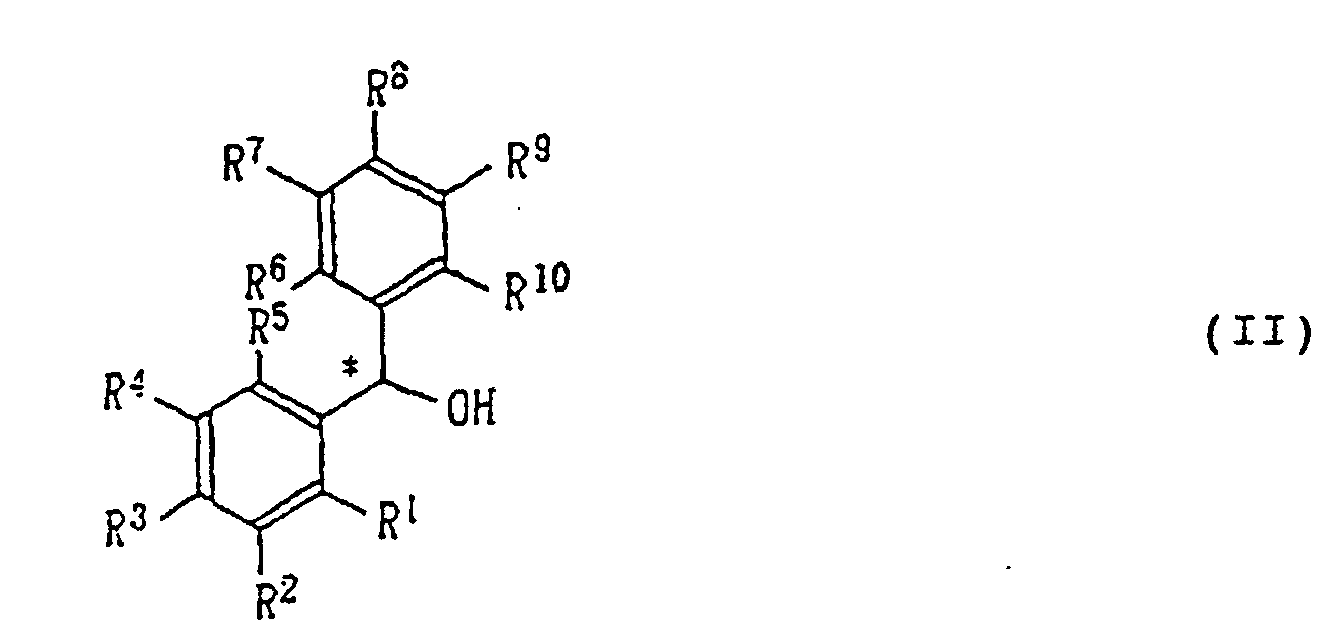
wherein R1, R5, R6 and R10 are the same or different and each represents a hydrogen atom, a halogen atom, a hydroxyl group, a lower alkyl group having 1 to 4 carbon atoms, a lower alkoxy group having 1 to 4 carbon atoms or a lower alkanoyl group having 1 to 5 carbon atoms; R2, R3, R4, R7, R8 and R9 are the same or different and each represents a hydrogen atom, a halogen atom, a hydroxyl group, a lower alkyl group having 1 to 4 carbon atoms, a lower alkoxy group having 1 to 4 carbon atoms, a lower alkanoyl group having 1 to 5 carbon atoms or an amino group optionally substituted by a lower alkyl group having 1 to 4 carbon atoms, a lower alkanoyl group having 1 to 5 carbon atoms or a lower alkoxycarbonyl group having 1 to 4 carbon atoms R2 and R3, and R8 and R9 may be bonded to each other to thereby form -CH=CH-CH=CH-, and any two of R1 to R9 adjacent to each other may be bonded to thereby form -OCH2O- or -(CH2)3-; and * shows the location of an asymmetric carbon atom;
which comprises hydrogenating a benzophenone compound represented by formula (I) :
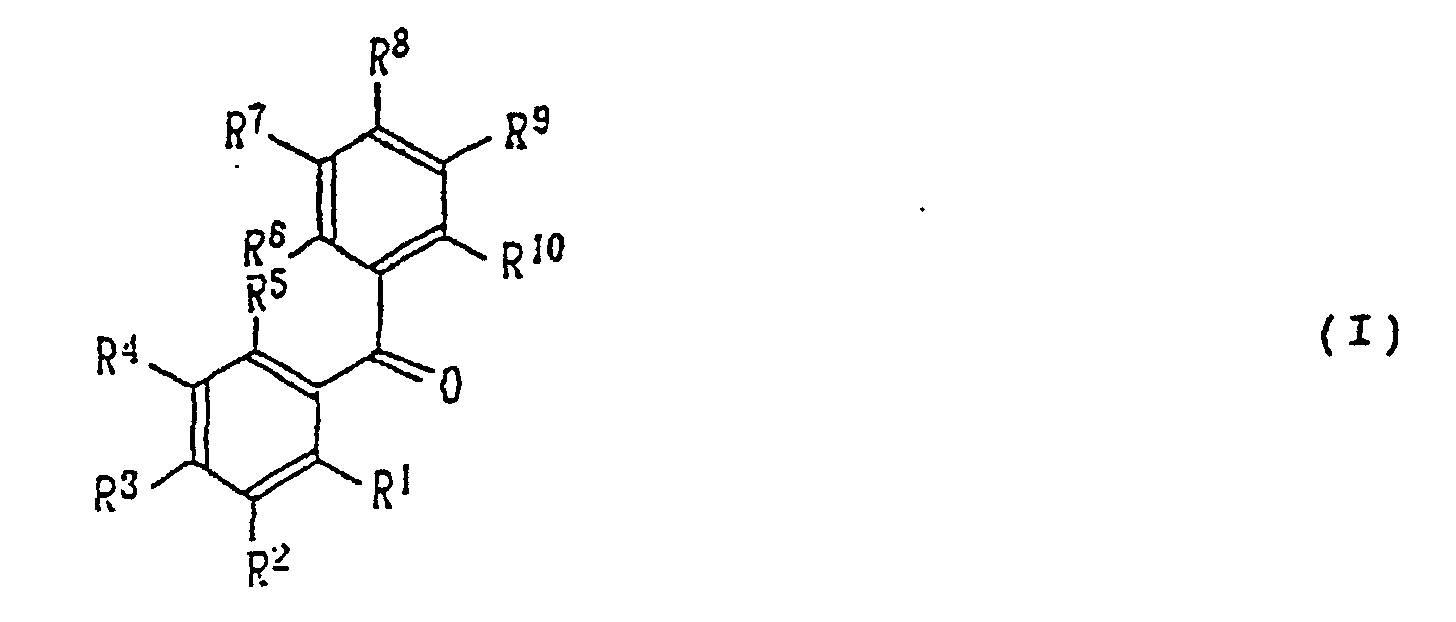
wherein R1, R2, R3, R4, R5, R6, R7, R8, R9 and R10 are each as defined above;
in the presence of a hydrogenation catalyst consisting of a transition metal complex, represented by the following general formula (III), (IV), (V) or (VI):
[Ru2X4(L)2](A) (III)
wherein X represents a halogen atom; L represents an optically active phosphine ligand; and A represents a tertiary amine;
[RuX(E)(L)]X (IV)
wherein X and L are each as defined above; and E represents an optionally substituted benzene or p-cymene;
[Ru(G)2(L)] (V)
wherein L is as defined above; and G represents a halogen atom or an acetoxy group; or
[RuX(L)]+J- (VI)
wherein X and L are each as defined above; and J- represents BF4-, ClO4-, PF6- or BPh4- wherein Ph represents a phenyl group a base and an optically active diamine compound having at least one primary amine end and wherein said optically active phosphine ligand is one represented by formula (VII):
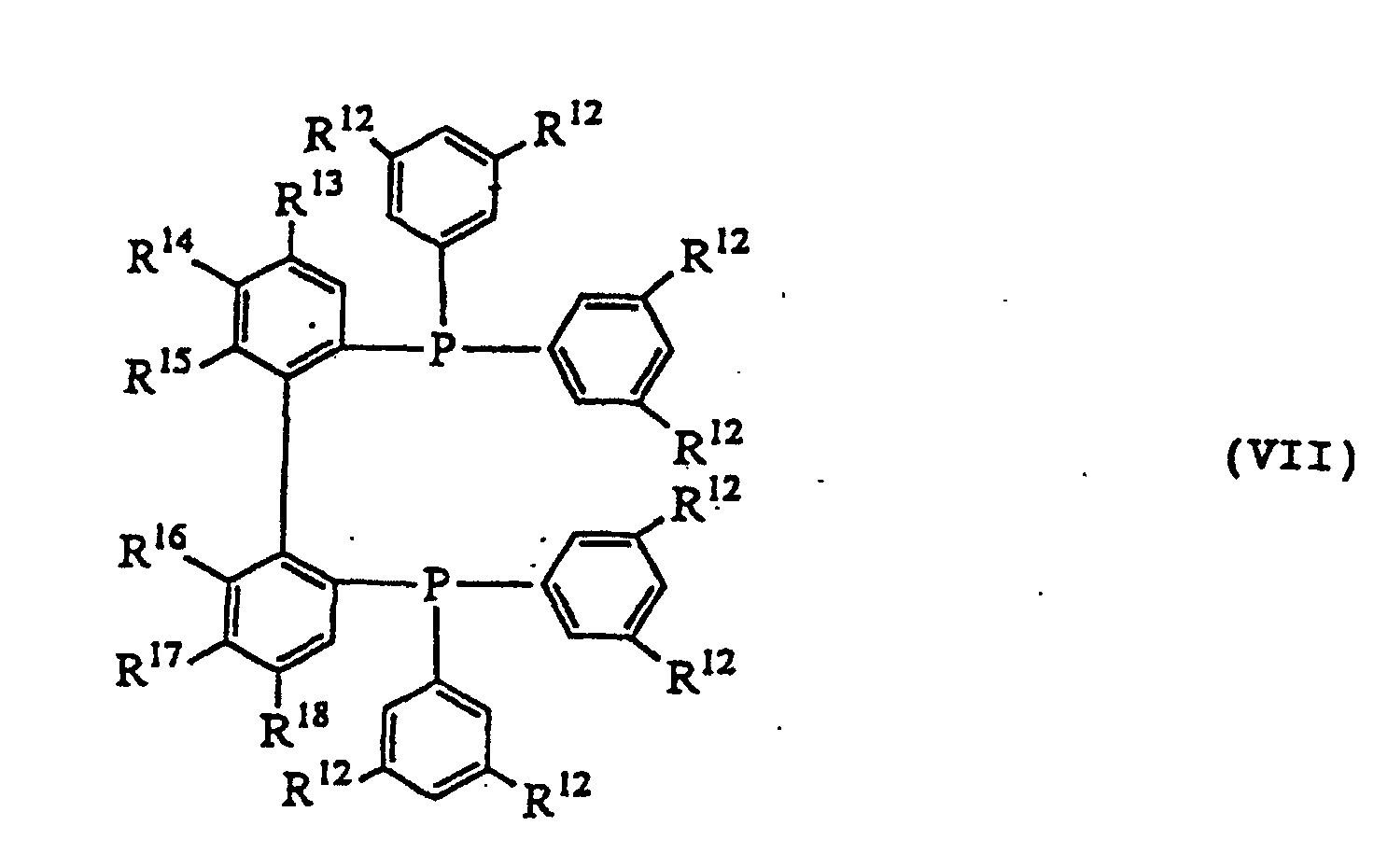
wherein R12 represents a lower alkyl group having 1 to 4 carbon atoms; R13, R14, R15, R16, R17 and R18 are the same or different and each represents a hydrogen atom, a lower alkyl group having 1 to 4 carbon atoms, a lower alkoxy group having 1 to 4 carbon atoms or a halogen atom, or R14 and R15, and R16 and R17 may be bonded to each other to thereby form a ring.
wherein R1, R5, R6 and R10 are the same or different and each represents a hydrogen atom, a halogen atom, a hydroxyl group, a lower alkyl group having 1 to 4 carbon atoms, a lower alkoxy group having 1 to 4 carbon atoms or a lower alkanoyl group having 1 to 5 carbon atoms; R2, R3, R4, R7, R8 and R9 are the same or different and each represents a hydrogen atom, a halogen atom, a hydroxyl group, a lower alkyl group having 1 to 4 carbon atoms, a lower alkoxy group having 1 to 4 carbon atoms, a lower alkanoyl group having 1 to 5 carbon atoms or an amino group optionally substituted by a lower alkyl group having 1 to 4 carbon atoms, a lower alkanoyl group having 1 to 5 carbon atoms or a lower alkoxycarbonyl group having 1 to 4 carbon atoms R2 and R3, and R8 and R9 may be bonded to each other to thereby form -CH=CH-CH=CH-, and any two of R1 to R9 adjacent to each other may be bonded to thereby form -OCH2O- or -(CH2)3-; and * shows the location of an asymmetric carbon atom;
which comprises hydrogenating a benzophenone compound represented by formula (I) :
wherein R1, R2, R3, R4, R5, R6, R7, R8, R9 and R10 are each as defined above;
in the presence of a hydrogenation catalyst consisting of a transition metal complex, represented by the following general formula (III), (IV), (V) or (VI):
[Ru2X4(L)2](A) (III)
wherein X represents a halogen atom; L represents an optically active phosphine ligand; and A represents a tertiary amine;
[RuX(E)(L)]X (IV)
wherein X and L are each as defined above; and E represents an optionally substituted benzene or p-cymene;
[Ru(G)2(L)] (V)
wherein L is as defined above; and G represents a halogen atom or an acetoxy group; or
[RuX(L)]+J- (VI)
wherein X and L are each as defined above; and J- represents BF4-, ClO4-, PF6- or BPh4- wherein Ph represents a phenyl group a base and an optically active diamine compound having at least one primary amine end and wherein said optically active phosphine ligand is one represented by formula (VII):
wherein R12 represents a lower alkyl group having 1 to 4 carbon atoms; R13, R14, R15, R16, R17 and R18 are the same or different and each represents a hydrogen atom, a lower alkyl group having 1 to 4 carbon atoms, a lower alkoxy group having 1 to 4 carbon atoms or a halogen atom, or R14 and R15, and R16 and R17 may be bonded to each other to thereby form a ring.
2. A process for producing an optically active benzhydrol compound as claimed in Claim
1, wherein said optically active phosphine ligand is 2,2'-bis[di(3,5-di(lower alkyl)phenyl)
phosphino]-1,1'-binaphthyl.
3. A process for producing an optically active benzhydrol compound as claimed in Claim
1, wherein said optically active phosphine ligand is 2,2'-bis [di(3,5-di(lower alkyl)phenyl)phosphino]-5,5',6,6',7,7',8,8'-octahydro-1,1'-binaphthyl.
4. A process for producing an optically active benzhydrol compound as claimed in any
of Claims 1 to 3, wherein said base is a compound represented by formula (XVIII) :
MYn (XVIII)
wherein M represents an alkali metal atom or an alkaline earth metal atom; Y represents a hydroxyl group, an alkoxyl group or a mercapto group; and n is 1 or 2; or a quaternary ammonium salt.
MYn (XVIII)
wherein M represents an alkali metal atom or an alkaline earth metal atom; Y represents a hydroxyl group, an alkoxyl group or a mercapto group; and n is 1 or 2; or a quaternary ammonium salt.
5. A process for producing an optically active benzhydrol compound as claimed in any
of Claims 1 to 4, wherein two carbon atoms having amino and/or substituted amino groups
in the optically active diamine compound are adjacent to each other.
1. Verfahren zum Herstellen einer optisch aktiven Benzhydrolverbindung, die durch die
Formel (II) wiedergegeben wird:
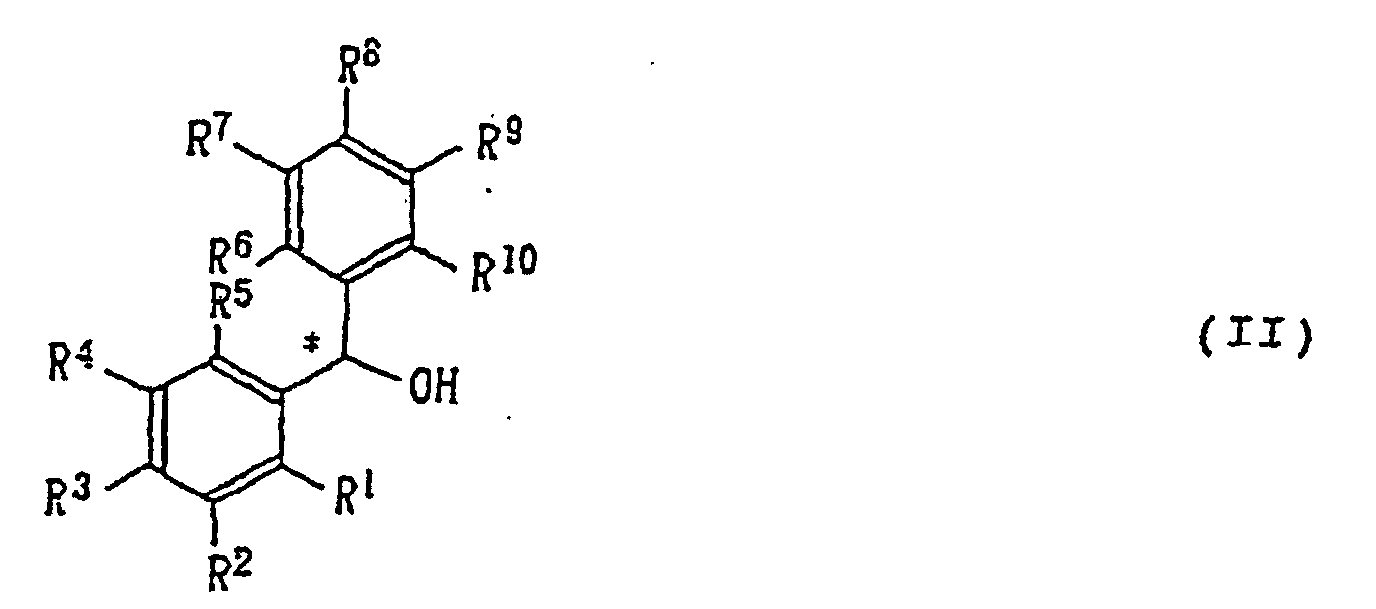
worin R1, R5, R6 und R10 gleich oder verschieden sind und jeweils ein Wasserstoffatom, ein Halogenatom, eine Hydroxylgruppe, eine Niederalkylgruppe mit 1 bis 4 Kohlenstoffatomen, eine Niederalkoxygruppe mit 1 bis 4 Kohlenstoffatomen oder eine Niederalkanoylgruppe mit 1 bis 5 Kohlenstoffatomen bedeuten; R2, R3, R4, R7, R8 und R9 gleich oder verschieden sind und jeweils ein Wasserstoffatom, ein Halogenatom, eine Hydroxylgruppe, eine Niederalkylgruppe mit 1 bis 4 Kohlenstoffatomen, eine Niederalkoxygruppe mit 1 bis 4 Kohlenstoffatomen, eine Niederalkanoylgruppe mit 1 bis 5 Kohlenstoffatomen oder eine Aminogruppe bedeuten, die gegebenenfalls mit einer Niederalkylgruppe mit 1 bis 4 Kohlenstoffatomen, einer Niederalkanoylgruppe mit 1 bis 5 Kohlenstoffatomen oder einer Niederalkoxycarbonylgruppe mit 1 bis 4 Kohlenstoffatomen substituiert ist, wobei R2 und R3, und R8 und R9 aneinander gebunden sein können, um dadurch -CH=CH-CH=CH- zu bilden, und beliebige zwei von R1 bis R9, die aneinander angrenzen, verbunden sein können, um dadurch -OCH2O- oder -(CH2)3- zu bilden; und * die Lage eines asymmetrischen Kohlenstoffatoms anzeigt; welches das Hydrieren einer Benzophenonverbindung, die durch die Formel (I) wiedergegeben wird:
worin R1, R2, R3, R4, R5, R6, R7, R8, R9 und R10 jeweils wie vorstehend definiert sind;
in Gegenwart eines Hydrierungskatalysators umfasst, welcher aus einem Übergangsmetallkomplex, der durch die folgende allgemeine Formel (III), (IV), (V) oder (VI) wiedergegeben wird:
[Ru2X4(L)2](A) (III)
worin X ein Halogenatom bedeutet; L einen optisch aktiven Phosphinliganden bedeutet; und A ein tertiäres Amin bedeutet;
[RuX(E)(L)]X (IV)
worin X und L jeweils wie vorstehend definiert sind; und E ein gegebenenfalls substituiertes Benzol oder p-Cymol bedeutet;
[Ru(G)2(L)] (V)
worin L wie vorstehend definiert ist; und G ein Halogenatom oder eine Acetoxygruppe bedeutet; oder
[RuX(L)]+J- (VI)
worin X und L jeweils wie vorstehend definiert sind; und J- BF4-, ClO4-, PF6- oder BPh4- bedeutet, wobei Ph eine Phenylgruppe bedeutet,
einer Base und einer optisch aktiven Diaminverbindung mit mindestens einem primären Amin-Ende besteht, wobei der optisch aktive Phosphinligand ein Ligand ist, der durch die Formel (VII) wiedergegeben wird:
worin R12 eine Niederalkylgruppe mit 1 bis 4 Kohlenstoffatomen bedeutet; R13, R14, R15, R16, R17 und R18 gleich oder verschieden sind und jeweils ein Wasserstoffatom, eine Niederalkylgruppe mit 1 bis 4 Kohlenstoffatomen, eine Niederalkoxygruppe mit 1 bis 4 Kohlenstoffatomen oder ein Halogenatom bedeuten, oder R14 und R15, und R16 und R17 aneinander gebunden sein können, um dadurch einen Ring zu bilden.
worin R1, R5, R6 und R10 gleich oder verschieden sind und jeweils ein Wasserstoffatom, ein Halogenatom, eine Hydroxylgruppe, eine Niederalkylgruppe mit 1 bis 4 Kohlenstoffatomen, eine Niederalkoxygruppe mit 1 bis 4 Kohlenstoffatomen oder eine Niederalkanoylgruppe mit 1 bis 5 Kohlenstoffatomen bedeuten; R2, R3, R4, R7, R8 und R9 gleich oder verschieden sind und jeweils ein Wasserstoffatom, ein Halogenatom, eine Hydroxylgruppe, eine Niederalkylgruppe mit 1 bis 4 Kohlenstoffatomen, eine Niederalkoxygruppe mit 1 bis 4 Kohlenstoffatomen, eine Niederalkanoylgruppe mit 1 bis 5 Kohlenstoffatomen oder eine Aminogruppe bedeuten, die gegebenenfalls mit einer Niederalkylgruppe mit 1 bis 4 Kohlenstoffatomen, einer Niederalkanoylgruppe mit 1 bis 5 Kohlenstoffatomen oder einer Niederalkoxycarbonylgruppe mit 1 bis 4 Kohlenstoffatomen substituiert ist, wobei R2 und R3, und R8 und R9 aneinander gebunden sein können, um dadurch -CH=CH-CH=CH- zu bilden, und beliebige zwei von R1 bis R9, die aneinander angrenzen, verbunden sein können, um dadurch -OCH2O- oder -(CH2)3- zu bilden; und * die Lage eines asymmetrischen Kohlenstoffatoms anzeigt; welches das Hydrieren einer Benzophenonverbindung, die durch die Formel (I) wiedergegeben wird:
worin R1, R2, R3, R4, R5, R6, R7, R8, R9 und R10 jeweils wie vorstehend definiert sind;
in Gegenwart eines Hydrierungskatalysators umfasst, welcher aus einem Übergangsmetallkomplex, der durch die folgende allgemeine Formel (III), (IV), (V) oder (VI) wiedergegeben wird:
[Ru2X4(L)2](A) (III)
worin X ein Halogenatom bedeutet; L einen optisch aktiven Phosphinliganden bedeutet; und A ein tertiäres Amin bedeutet;
[RuX(E)(L)]X (IV)
worin X und L jeweils wie vorstehend definiert sind; und E ein gegebenenfalls substituiertes Benzol oder p-Cymol bedeutet;
[Ru(G)2(L)] (V)
worin L wie vorstehend definiert ist; und G ein Halogenatom oder eine Acetoxygruppe bedeutet; oder
[RuX(L)]+J- (VI)
worin X und L jeweils wie vorstehend definiert sind; und J- BF4-, ClO4-, PF6- oder BPh4- bedeutet, wobei Ph eine Phenylgruppe bedeutet,
einer Base und einer optisch aktiven Diaminverbindung mit mindestens einem primären Amin-Ende besteht, wobei der optisch aktive Phosphinligand ein Ligand ist, der durch die Formel (VII) wiedergegeben wird:
worin R12 eine Niederalkylgruppe mit 1 bis 4 Kohlenstoffatomen bedeutet; R13, R14, R15, R16, R17 und R18 gleich oder verschieden sind und jeweils ein Wasserstoffatom, eine Niederalkylgruppe mit 1 bis 4 Kohlenstoffatomen, eine Niederalkoxygruppe mit 1 bis 4 Kohlenstoffatomen oder ein Halogenatom bedeuten, oder R14 und R15, und R16 und R17 aneinander gebunden sein können, um dadurch einen Ring zu bilden.
2. Verfahren zum Herstellen einer optisch aktiven Benzhydrolverbindung nach Anspruch
1, wobei der optisch aktive Phosphinligand 2,2'-Bis[di(3,5-di(niederalkyl)-phenyl)phosphino]-1,1'-binaphthyl
ist.
3. Verfahren zum Herstellen einer optisch aktiven Benzhydrolverbindung nach Anspruch
1, wobei der optisch aktive Phosphinligand 2,2'-Bis[di(3,5-di(niederalkyl)-phenyl)phosphino]-5,5',6,6',
7,7',8,8'-octahydro-1,1'-binaphthyl ist.
4. Verfahren zum Herstellen einer optisch aktiven Benzhydrolverbindung nach einem der
Ansprüche 1 bis 3, wobei die Base eine Verbindung, die durch die Formel (XVIII) wiedergegeben
wird:
MYn (XVIII)
wobei M ein Alkalimetallatom oder ein Erdalkalimetallatom bedeutet; Y eine Hydroxylgruppe, eine Alkoxylgruppe oder eine Mercaptogruppe bedeutet; und n 1 oder 2 ist; oder ein quaternäres Ammoniumsalz ist.
MYn (XVIII)
wobei M ein Alkalimetallatom oder ein Erdalkalimetallatom bedeutet; Y eine Hydroxylgruppe, eine Alkoxylgruppe oder eine Mercaptogruppe bedeutet; und n 1 oder 2 ist; oder ein quaternäres Ammoniumsalz ist.
5. Verfahren zum Herstellen einer optisch aktiven Benzhydrolverbindung nach einem der
Ansprüche 1 bis 4, wobei zwei Kohlenstoffatome mit Amino- und/oder substituierten
Aminogruppen in der optisch aktiven Diaminverbindung aneinander angrenzen.
1. Procédé pour la production d'un composé de benzhydrol optiquement actif représenté
par la formule (II):
dans laquelle R1, R5, R6 et R10 sont identiques ou différents et chacun représente un atome d'hydrogène, un atome d'halogène, un groupe hydroxy, un groupe alkyle inférieur ayant de 1 à 4 atomes de carbone, un groupe alcoxy inférieur ayant de 1 à 4 atomes de carbone ou un groupe alcanoyle inférieur ayant de 1 à 5 atomes de carbone; R2, R3, R4, R7, R8 et R9 sont identiques ou différents et chacun représente un atome d'hydrogène, un atome d'halogène, un groupe hydroxy, un groupe alkyle inférieur ayant de 1 à 4 atomes de carbone, un groupe alcoxy inférieur ayant de 1 à 4 atomes de carbone, un groupe alcanoyle inférieur ayant de 1 à 5 atomes de carbone ou un groupe amino éventuellement substitué par un groupe alkyle inférieur ayant de 1 à 4 atomes de carbone, un groupe alcanoyle inférieur ayant de 1 à 5 atomes de carbone ou un groupe alcoxycarbonyle inférieur ayant de 1 à 4 atomes de carbone, R2 et R3 et R8 et R9 peuvent être reliés l'un à l'autre pour former ainsi un groupe -CH=CH-CH=CH- et deux parmi n'importe lesquels des groupes R1 à R9 adjacents l'un à l'autre peuvent être reliés pour former ainsi un groupe -OCH2O- ou -(CH2)3-; et * indique l'emplacement d'un atome de carbone asymétrique;
qui comprend l'hydrogénation d'un composé de benzophénone représenté par la formule (I):
dans laquelle R1, R2, R3, R4, R5, R6, R7, R8, R9 et R10 sont tels que définis ci-dessus;
en présence d'un catalyseur d'hydrogénation constitué par un complexe d'un métal de transition, représenté par la formule générale suivante (III), (IV), (V) ou (VI):
[Ru2X4(L)2](A) (III)
dans laquelle X représente un atome d'halogène; L représente un ligand phosphine optiquement actif; et A représente une amine tertiaire;
[RuX(E)(L)]X (IV)
dans laquelle X et L sont chacun tels que définis ci-dessus; et E représente un reste benzène ou p-cymène éventuellement substitué;
[Ru(G)2(L)] (V)
dans laquelle L est tel que défini ci-dessus; et G représente un atome d'halogène ou un groupe acétoxy; ou
[RuX(L)]+J- (VI)
dans laquelle X et L sont chacun tels que définis ci-dessus; et J- représente BF4-, ClO4-, PF6- ou BPh4- où Ph représente un groupe phényle,
d'une base et d'un composé diamine optiquement actif comportant au moins un groupe amine primaire terminal et dans lequel ledit ligand phosphine optiquement actif est un ligand représenté par la formule (VII):
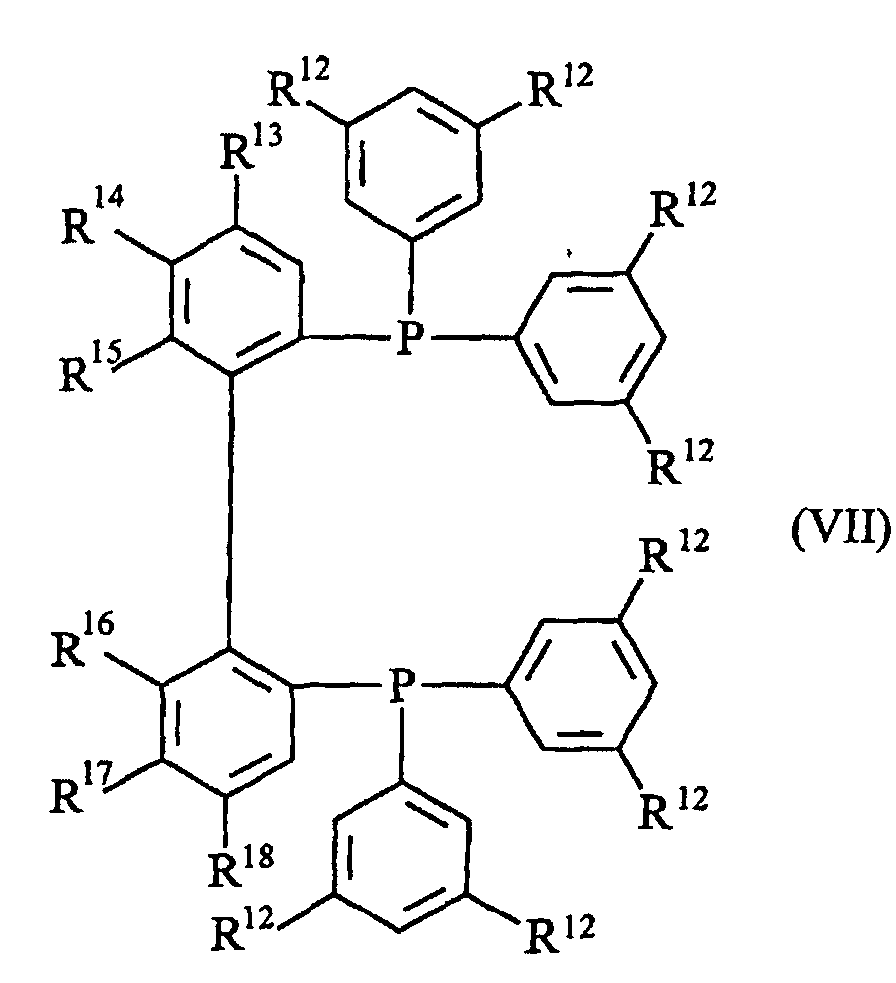
dans laquelle R12 représente un groupe alkyle inférieur ayant de 1 à 4 atomes de carbone; R13, R14, R15, R16, R17 et R18 sont identiques ou différents et chacun représente un atome d'hydrogène, un groupe alkyle inférieur ayant de 1 à 4 atomes de carbone, un groupe alcoxy inférieur ayant de 1 à 4 atomes de carbone ou un atome d'halogène ou R14 et R15 et R16 et R17 peuvent être reliés l'un à l'autre pour former ainsi un cycle.
dans laquelle R1, R5, R6 et R10 sont identiques ou différents et chacun représente un atome d'hydrogène, un atome d'halogène, un groupe hydroxy, un groupe alkyle inférieur ayant de 1 à 4 atomes de carbone, un groupe alcoxy inférieur ayant de 1 à 4 atomes de carbone ou un groupe alcanoyle inférieur ayant de 1 à 5 atomes de carbone; R2, R3, R4, R7, R8 et R9 sont identiques ou différents et chacun représente un atome d'hydrogène, un atome d'halogène, un groupe hydroxy, un groupe alkyle inférieur ayant de 1 à 4 atomes de carbone, un groupe alcoxy inférieur ayant de 1 à 4 atomes de carbone, un groupe alcanoyle inférieur ayant de 1 à 5 atomes de carbone ou un groupe amino éventuellement substitué par un groupe alkyle inférieur ayant de 1 à 4 atomes de carbone, un groupe alcanoyle inférieur ayant de 1 à 5 atomes de carbone ou un groupe alcoxycarbonyle inférieur ayant de 1 à 4 atomes de carbone, R2 et R3 et R8 et R9 peuvent être reliés l'un à l'autre pour former ainsi un groupe -CH=CH-CH=CH- et deux parmi n'importe lesquels des groupes R1 à R9 adjacents l'un à l'autre peuvent être reliés pour former ainsi un groupe -OCH2O- ou -(CH2)3-; et * indique l'emplacement d'un atome de carbone asymétrique;
qui comprend l'hydrogénation d'un composé de benzophénone représenté par la formule (I):
dans laquelle R1, R2, R3, R4, R5, R6, R7, R8, R9 et R10 sont tels que définis ci-dessus;
en présence d'un catalyseur d'hydrogénation constitué par un complexe d'un métal de transition, représenté par la formule générale suivante (III), (IV), (V) ou (VI):
[Ru2X4(L)2](A) (III)
dans laquelle X représente un atome d'halogène; L représente un ligand phosphine optiquement actif; et A représente une amine tertiaire;
[RuX(E)(L)]X (IV)
dans laquelle X et L sont chacun tels que définis ci-dessus; et E représente un reste benzène ou p-cymène éventuellement substitué;
[Ru(G)2(L)] (V)
dans laquelle L est tel que défini ci-dessus; et G représente un atome d'halogène ou un groupe acétoxy; ou
[RuX(L)]+J- (VI)
dans laquelle X et L sont chacun tels que définis ci-dessus; et J- représente BF4-, ClO4-, PF6- ou BPh4- où Ph représente un groupe phényle,
d'une base et d'un composé diamine optiquement actif comportant au moins un groupe amine primaire terminal et dans lequel ledit ligand phosphine optiquement actif est un ligand représenté par la formule (VII):
dans laquelle R12 représente un groupe alkyle inférieur ayant de 1 à 4 atomes de carbone; R13, R14, R15, R16, R17 et R18 sont identiques ou différents et chacun représente un atome d'hydrogène, un groupe alkyle inférieur ayant de 1 à 4 atomes de carbone, un groupe alcoxy inférieur ayant de 1 à 4 atomes de carbone ou un atome d'halogène ou R14 et R15 et R16 et R17 peuvent être reliés l'un à l'autre pour former ainsi un cycle.
2. Procédé pour la production d'un composé de benzhydrol optiquement actif tel que revendiqué
dans la revendication 1, dans lequel ledit ligand phosphine optiquement actif est
le ligand 2,2'-bis[di(3,5-di(alkyl inférieur)phényl)phosphino]-1,1'-binaphtyle.
3. Procédé pour la production d'un composé de benzhydrol optiquement actif tel que revendiqué
dans la revendication 1, dans lequel ledit ligand phosphine optiquement actif est
le ligand 2,2'-bis[di(3,5-di(alkyl inférieur)phényl)phosphino]-5,5', 6,6',7,7',8,8'-octahydro-1,1'-binaphtyle.
4. Procédé pour la production d'un composé de benzhydrol optiquement actif tel que revendiqué
dans l'une quelconque des revendications 1 à 3, dans lequel ladite base est un composé
représenté par la formule (XVIII):
MYn (XVIII)
dans laquelle M représente un atome d'un métal alcalin ou un atome d'un métal alcalino-terreux; Y représente un groupe hydroxy, un groupe alcoxy ou un groupe mercapto; et n est 1 ou 2; ou un sel d'ammonium quaternaire.
MYn (XVIII)
dans laquelle M représente un atome d'un métal alcalin ou un atome d'un métal alcalino-terreux; Y représente un groupe hydroxy, un groupe alcoxy ou un groupe mercapto; et n est 1 ou 2; ou un sel d'ammonium quaternaire.
5. Procédé pour la production d'un composé de benzhydrol optiquement actif tel que revendiqué
dans l'une quelconque des revendications 1 à 4, dans lequel, dans le composé diamine
optiquement actif, deux atomes de carbone comportant des groupes amino et/ou amino
substitués sont adjacents l'un à l'autre.