|
(11) | EP 0 781 816 A1 |

| (12) | EUROPEAN PATENT APPLICATION |
|
|
|
|
||||||||||||
| (54) | New dyes for use in diverse applications |
| (57) The synthesis and the application of new dyes is described. In particular said new
dyes can be incorporated in non-migratory state in hydrophilic colloid layers of photographic
materials wherefrom they can be rapidly removed after being quickly decolourised in alkaline aqueous liquids used in the processing of said materials. In photographic applications dyes of the general formula (I) are provided with at least one ionisable group which permits solubilisation in aqueous and/or alkaline medium. The meanings of the symbols are as defined in the claims and in the description. |
1. Field of the invention.
2. Background of the Invention
[0002] Dyes may be used for the dyeing of several very different materials like e.g. natural and synthetic fibers, textiles, plastics and leather. Dyes may be used further as acid-base indicators, as biological stains, as filter dyes, antihalation dyes or dyes providing more sharp images in photographic applications, for information recording, printing inks, camouflage, as light-collecting elements, for the colouring of food, as an analytical reagent, as a transfer dye in dye-transfer photographic materials and in many other applications.
Light-absorbing dyes incorporated in silver halide photographic materials in general can accomplish a variety of goals, including their use as filter dyes, acutance dyes or anti-halation dyes.
[0003] In photography dyes may be divided into spectrally and non-spectrally sensitising dyes, indicating whether the dyes are adsorbed or not at the surface of the light-sensitive silver halide crystals used in photographic elements.
[0004] Non-spectrally sensitising dyes e.g. are widely used in a photosensitive silver halide emulsion layer as screening dyes, in an undercoat adjacent to the photosensitive layer and/or in a backing layer on the side of the support opposite to the photosensitive layer(s) to absorb reflected and scattered light. Its function as antihalation dye or in an overcoat or interlayer to shield a particular photosensitive layer against undesired exposure being therefore referred to as filter or absorber dye is highly appreciated. The adjustment of the sensitivity of a photographic element as required in the production specifications is another application.
[0005] When present in a non-photosensitive top layer or intermediate layer they typically serve as filter dyes eliminating an unwanted part of the light spectrum of the exposure source. A well-known example is the yellow filter layer usually present in colour photographic materials in order to prevent blue light from reaching the green sensitive and red sensitive layers. Another example is formed by UV-absorbing compounds, usually present in the top protective layer, which prevent photochemical deterioration of the image dyes formed by colour development. Examples of useful UV-absorbers include the cyanomethyl sulfone-derived merocyanines of US-P 3,723,154, the thiazolidones, benzotriazoles and thiazolothiazoles of US-P 2,739,888, 3,253,921, 3,250,617 and 2,739,971, the triazoles of US-P 3,004,896, and the hemioxonols of US-P 3,125,597.
[0006] On the other hand light-absorbing dyes when present in the emulsion layer can serve as so-called "acutance dyes" or "screening dyes" improving the image sharpness by reducing the sidewise scattering of light by the emulsion grains.
[0007] In a third application light-absorbing dyes act as "anti-halation dyes" improving the image sharpness by diminishing the upward reflection of light by the support into the emulsion layer. For this purpose the dye can be incorporated in an undercoat, being a non-photosensitive layer between the emulsion layer and the support, or it can be incorporated in the base itself, or preferably, it can be present in one or more backing layers of the photographic material. For example in order to improve image sharpness an absorber dye can be present in one or more filter layers between silver halide emulsion layers that are coated at opposite sides of a transparent film support of an X-ray recording material. The imagewise exposure of said recording material proceeds in a cassette between a pair of X-ray intensifying screens that each are held in contact with an adjacent silver halide emulsion layer. By said arrangement the imaging light that would cross the support and to some extent becomes scattered thereby, is considerably attenuated and cannot give rise to an unsharp image in an opposite silver halide emulsion layer.
[0008] Spectrally the dye absorption spectrum should approximately be equal to the sensitivity spectrum of the corresponding silver halide emulsion in the layer of which a sharp image has to be reproduced.
[0009] On one hand it is very important that filter dyes remain i.e. that they are non-migratory, in the layer wherein they have been incorporated especially when this layer is in direct contact with the silver halide emulsion layer in order to prevent a desensitising action on the silver halide. On the other hand the filter dyes may not stain the photographic material after image processing. Therefore preference is given to filter dyes that decolourise or can be removed from the photographic element in the processing cycle. This requirement is nowadays becoming more and more stringent as rapid processing times are of increasing interest.
[0010] As described in US-P 3,560,214 dyes comprising a carboxyl and phenyl substituted pyrazoline nucleus linked through a methine group to a dialkylaminophenyl group can be removed relatively easily in alkaline aqueous processing liquids but lack sufficient fastness to diffusion in hydrophilic colloid layers.
[0011] Other filter dyes characterised by the presence of a 2-pyrazolin-5-one nucleus substituted with a carboxyphenyl group and including a methine group or chain linked to a dialkylamino group are described in US-P 4,857,446.
[0012] Recently in EP-A's 0 586 748, 0 587 229, 0 587 230 and 0 656 401 the synthesis and the application of new dyes has been described, wherein the filter dyes have an ester, an amide a nitrile function or a derivative therefrom as a substituent at the mono- or trimethine chain, or wherein said dyes show the presence of a pyrrolo[2,3-c] pyrrazolone ring. When said new dyes are incorporated in the non-migratory state in hydrophilic colloid layers of photographic materials they can be rapidly removed after being quickly decolourized under the influence of sulphite ions in alkaline aqueous liquids used in the processing of said materials.
[0013] As is well-known the monomethine dyes have an absorption spectrum of which the maximum is in the shorter wavelength range of the visible spectrum so that normally a second filter dye is needed to block or absorb green light and even a third one to absorb radiations of longer wavelengths e.g. radiations in the red or even in the infrared region. Another aspect concerning decolouration under the influence of sulphite ions in alkaline aqueous liquids is related to the decreasing reaction velocity with sulphite ions going from mono- to trimethine dyes.
[0014] Once a filter dye has been selected, the problem is how to get that filter dye in a coated layer so that all the requirements mentioned previously are met.
[0015] One of the possibilities is to make use of solid particle dispersions of water insoluble dyes as has been described in EP-A's 0 384 633; 0 323 729; 0 274 723; 0 276 566 and 0 351 593 and in US-Patents 4,900,653; 4,904,565; 4,949,654; 4,940,654: 4,948,717; 4,988,611 and 4,803,150.
[0016] Another possibility is offered in Research Disclosure 19551 (July 1980) which describes an approach of associating hydrophobic compounds with latex polymer particles.
[0017] EP-A 0 401 709 describes the dissolution of hydrophobic dyes into oil droplets being substantially insoluble in water and the preparation of the corresponding oilformer dispersions or loaded polymer latex dispersions.
[0018] To prevent dye wandering, the dye is often coated with a mordant to bind the dye in the layer in which it is coated as is e.g. illustrated in US-P 2,527,583. As dye mordants polymers are often used.
[0019] Another possibility is offered by adsorption of dyes at the surface of very fine light-insensitive silver halide crystals with the expectable disadvantages of the coating of more silver halide crystals and possibly fixation difficulties.
[0020] More recently methods of preparing dispersions of photographically useful compounds have been given in e.g. EP-Application No. 95202034, filed July 24, 1995. Methods of manufacturing a silver halide photographic material suitable for rapid processing applications have been described in EP-Application No. 95201822, filed July 4, 1995.
[0021] Very few dyes satisfy the above requirements especially when rapid processing is concerned. Moreover, apart from the requirement of non-diffusibility and of rapid decolourising or removal by rapid processing that the dyes should meet, they should have high stability in the photographic material, not only under the influence of the ingredients present in the emulsion layers prior to coating, but especially under severe storage conditions of the packed material e.g. under circumstances of high temperatures and high degrees of humidity. The task thus remains to synthesise new dyes and to get them in dispersed form into a photographic material.
3. Objects and Summary of the Invention
[0022] It is an object of the present invention to provide new dyes suitable for diverse applications. In particular it is an object of this invention to provide non-spectrally sensitising dyes that can be incorporated in non-migratory state in hydrophilic colloid layers of photographic materials wherefrom they can be rapidly removed in alkaline aqueous liquids used in the processing of said materials.
[0023] It is a further object of this invention to provide new dyes providing high density in the required spectral region, thereby reducing the scattering of incident light in photographic elements.
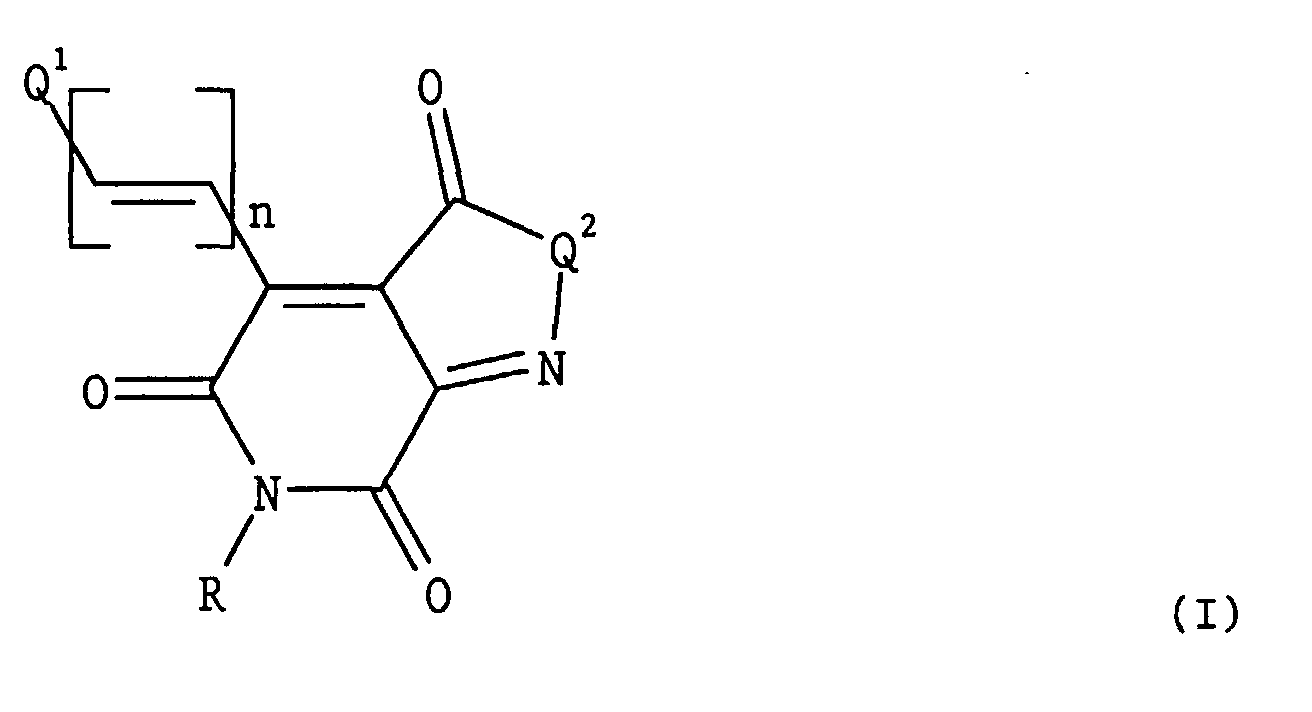
[0025] In accordance with the present invention dyes are provided corresponding to the following general formula (I):
wherein n equals 0 or 1;
wherein Q1 represents a substituted or unsubstituted aromatic or heterocyclic aromatic ring;
wherein Q2 represents at least one atom necessary to close a ring, which is further substituted or unsubstituted;
and whereinR represents hydrogen, substituted or unsubstituted alkyl;
substituted or unsubstituted alkenyl; substituted ot unsubstituted alkynyl; substituted or unsubstituted aryl; substituted or unsubstituted heterocyclyl; substituted or unsubstituted vinyl or one of the following substituents being
C(=N-R1)-R2; CH=(N+)(-R3)2; CR1=(N+)(-R2)2; C≡N+-O-; CO-H and the acetals and thioacetals derived therefrom; CO-NH-R3; CO-NH-SO2-R3 and the corresponding salts; CO-O-R3; CO-R3 and the acetals,
thioacetals, aminals and 1,3-oxathiolans derived therefrom; CO-S-R3; CS-H; CS-NH-R3; CS-O-R3; CS-R3; CS-S-R3; F, Cl, Br, I, CN; N=C=N-R3; N=C=O; N=C=S; N=N(O)-R3; N=N-R3; NH-CO-NH-R3; NH-CO-R3; NH-CS-NH-R3; NH-CS-R3; NH-R3; NH-SO2-R3; NO2; NR1-CO-R2; NR1-CS-R2; NR32; O-CN; O-CO-R3; O-R3; O-SO2-R3; P(OR3)2; PO-(OR3)2; S-CN; S-CO-R3; S-CS-R3; S-R3; SO-R3; SO2-NHR3 and the salts derived therefrom; SO2-R3; SO3H and the salts derived therefrom;
and wherein each of R1, R2 and R3 independently represent hydrogen;
substituted or unsubstituted alkyl; substituted or unsubstituted alkenyl; substituted or unsubstituted alkynyl; substituted or unsubstituted aryl; substituted or unsubstituted heterocyclyl;
substituted or unsubstituted vinyl.
[0026] In accordance with the present invention a photographic element is provided comprising a support and at least one photo-sensitive silver halide emulsion layer, wherein said element comprises, dispersed in a hydrophilic water-permeable colloid binder e.g. gelatin, at least one dye according to the above general formula (I).
[0027] Further in accordance with the present invention a photographic element is provided comprising a support and at least one photo-sensitive silver halide emulsion layer, wherein said element comprises said at least one dye according to the above formula in a solid particle state.
4. Detailed description of the Invention
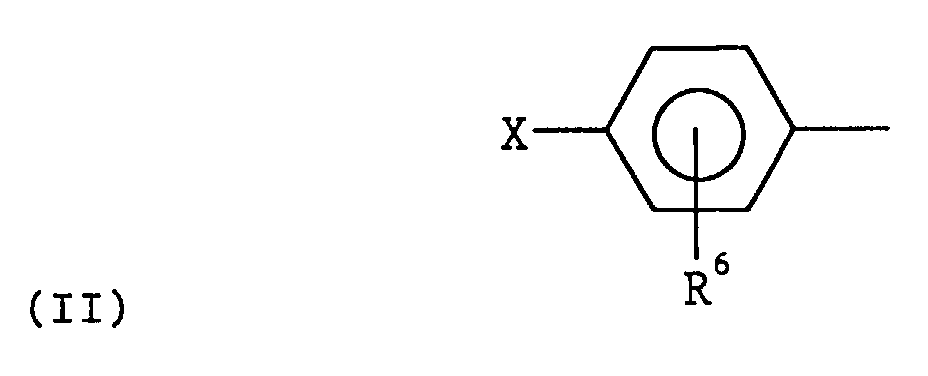
[0028] In a preferred embodiment in the general formula (I) Q1 is an aromatic group corresponding to the general formula (II)
wherein X represents NR4R5 , OR4, SR4 wherein
R4 and R5 each independently represent hydrogen, substituted or unsubstituted alkyl; substituted or unsubstituted alkenyl;
substituted or unsubstituted alkynyl; substituted or unsubstituted aryl; substituted or unsubstituted heterocyclyl; substituted or unsubstituted vinyl
or wherein R4 and R5 are form a ring or wherein R4 or R5 form a ring with R6, wherein R6 has the same meaning as R4 and R5.
[0029] Dyes according to this invention show the presence of a substituted pyridine-dione-ring. The presence of this group clearly affects the spectral behaviour, shifting the absorption to longer wavelenghts. Particularly in photographic materials the dyes according to this invention are decolourised quickly enough, as required in rapid processing conditions. Especially for 38 s processing cycles the dyes according to this invention, containing one or more ionisable groups, are used advantageously. The said ionisable groups make the dye become soluble in aqueous and/or in aqueous alkaline medium. A typical example of an aqueous soluble group is -SO3H, whereas characteristic aqueous alkali soluble groups are
-COOH, phenolic -OH, sulfonamide, imide, sulfamoyl, acylsulfamoyl, sulfonylcarbamoyl, sulfonimide, carbamoyl-sulfamoyl etc. being not restricted thereto.
[0031] The synthesis of the compounds (I.1), (I.2) and (I.5), a pyridino[3,4-c]isoxazolon dye, is given hereinafter.
Synthesis of compound (I.1)
[0033] Compound B was prepared according to the general procedure described in J. Wright. E. Gutsell; J. Org. Chem. 24, 265 (1959). 11.8 g of compound B and 11.6 g of the commercially available compound A were refluxed in 250 ml of toluene for 4 hours. The reaction mixture was then allowed to cool to room temperature, whereafter 250 ml of methyl t.butyl ether was added. After filtration, 11 g of the pure dye compound C was obtained.
[0034] 14 g of dye compound C were dissolved in 150 ml of isopropanol together with 2 ml of triethylamine and refluxed for one hour. After cooling to room temperature, 8 g of the dye compound (I.1) crystallised and was filtered off, and rinsed twice with isopropanol. Compound I.1 has a pyridino[3,4-c]-pyrazolon structure.
Synthesis of compound (I.2)
[0036] Compound D was prepared according to the method described in EP-Application No. 95201479, filed June 6, 1995. 75 g of compound D and 105 g of compound A were dissolved in 1200 ml acetic acid and heated to 60°C for 3 days. After allowing to cool to room temperature, the reaction mixture was diluted with 1 l of a saturated aqueous sodium chloride solution and extracted with dichloromethane. The combined extracts were evaporated and the residue purified by chromatography to give 114.6 g of pure compound E.
[0037] 42.6 g of compound E and 12.8 ml of triethylamine were dissolved in 500 ml of isopropanol and the mixture was refluxed for 1 hour. After cooling, the precipitate was filtered and washed twice with isopropanol. 24.7 g of compound I.2 was obtained. Compound I.2 has a pyridino[3,4-c]-pyrazolon structure.
After preparing a solid particle dispersion from compound I.2 and coating said dispersion in a hydrophilic layer onto a polyester support, it was illustrated that said layer was decolourising extremely well in an alkaline developer.
Synthesis of compound I.5.
[0039] Compound B was synthesised by reaction of compound A with hydroxylamine in water with sodium hydrogenbicarbonate.
After extraction with MTBE and evaporation of that solvent an oily substance (60 %) was obtained. Reaction of compound C with compound B in acetic acid medium was leading to compound D. Said compound D was isolated by extraction with water/MTBE, followed by evaporation of the organic layer. After cyclisation (in butylacetate containing triethylamine) and precipitation with hexane, compound I.5 was obtained (yield: 20 % after purification).
[0040] Spectral data for compound D and compound I.5 are given in Table 1.
Table 1
| Compound | Maximum absorption wavelength (in nm) | Extinction Maximum | Solvent |
| D | 532 | 18661 | CH3OH |
| D | 560 | H2O | |
| I.1 | 652 | 22258 | CH3OH |
| I.2 | 654 | 21342 | CH3OH |
| I.5 | 636 | 25934 | CH3OH |
[0041] A common aspect in the preparation method of compounds (I.1), (I.2) and (I.5) is the use as a basic reagent of a compound according to the formula (III)
Q1-CO-CO-Y (III)
wherein Q1 has the same meaning as in the formula (I) , and wherein -Y represents -N(R7)(R8) or -OR9, wherein each of R7, R8 and R9 independently represents H, substituted or unsubstituted alkyl or substituted or unsubstituted aryl.
[0042] The choice of the substituents may cause a more hypsochromic shift of the absorption spectrum if required: e.g. by replacement of a dimethylamino-group by an alkoxy-group.
[0043] From the prior art it is known that the presence of one or more anionic, weakly-acidic groups in the dyes is important to provide sufficient non-migratory character at coating pH values in the range of 4 to 8, which are especially preferred for the coating of photographic materials.
[0044] In the acid pH range the filter dyes according to the present invention can be incorporated in aqueous coating compositions in dispersed form by using commercial mixing devices for making colloidal dispersions e.g. in gelatin.
The size of the dye particles obtained is chosen to facilitate coating and rapid decolouration of the dye. Where the dyes are initially crystallised in the form of particles larger than desired for use, conventional techniques for achieving smaller particle sizes can be employed, such as ball milling, roller milling, sand milling and the like. The solid particle dispersions cannot only be prepared in the presence of gelatin as a colloidal medium but also e.g. in colloidal silica. A method of preparing an aqueous solid particle dispersion of a dye according to this invention, for incorporation in one of the layers of a photographic silver halide material may comprise the steps of
- dissolving a non-watersoluble but alkali-soluble dye in an aqueous alkaline solution, if necessary with the help of an organic water soluble solvent
- precipitating the said dye from said solution in the presence of colloidal silica sol, preferably in the further presence of a dispersing agent by lowering the pH of the solution, e.g. by neutralising with an aqueous acidic solution
- removing water-soluble salts formed by the precipitation and any organic solvent used, and
- concentrating the dispersion either during or after the precipitation by dialysis or ultrafiltration or after precipitation by flocculation and decantation, followed by washing and further decantation.
[0045] Said precipitation in the presence of colloidal silica sol preferably occurs in the further presence of a dispersing agent, like e.g. a 2-N,N,N-trialkylamino-acetic acid and can be performed by simultaneous addition of an aqueous alkaline solution comprising the alkaline-soluble compound and an aqueous acidic solution, to a stirred solution comprising the total or partial amount of colloidal silica sol and of dispersing agent while keeping the pH constant, preferably at a value of less than 6.0, the rest of said amount if any being present in at least one of said solutions.
[0046] Preferred dispersing agents used during the preparation of solid silica dispersions are one or more partially ionisable polymer(s) or one or more surfactant(s) or a combination thereof.
[0047] Another possibility to obtain ultra fine dye dispersions may consist in acidifying a slightly alkaline coating composition during the preparation of the coating composition or "in situ" just before coating it onto the supporting layer. It has been found that the application of this dosage technique allows us to obtain the dyes in a very fine solid particle form, homogeneously divided into the coated layer so that solid particles can hardly be observed even by means of microscopic techniques.
[0048] The non-diffusing dyes the synthesis of which has been described hereinbefore and which are added to a hydrophilic layer of a photographic element as a solid particle have a mean diameter of less than 10 µm, more preferably less than 1 µm and still more preferably less than 0.1 µm.
[0049] At a pH of at least 10 the dispersed filter dyes are easily solubilised so that they are removed almost completely from a hydrophilic waterpermeable colloid layer of a photographic silver halide emulsion material by its common alkaline aqueous liquid processing and leave almost no residual stain. The presence of sulfite in the processing solution contributes to a more rapid discoloration of the filter dyes.
[0050] Photographic elements with dyes according to this invention in one or more hydrophilic layers are very rapidly discoloured in 38 s processing cycles, comprising a development, fixing, rinsing and drying step as applied in radiography.
[0051] The hydrophilic colloidal layer(s) in which the dye(s) is (are) incorporated in accordance with the present invention can be a backing layer, an antihalation undercoat layer, a silver halide emulsion layer, an intermediate layer and a protective outermost - layer. Preferred amounts of dye(s) present in the hydrophilic colloid layer(s) mentioned hereinbefore are in the range of from 0.01 to 1.0 mmole/m2.
[0052] Emulsion layers used in accordance with this invention may contain light-sensitive silver halide crystals with a diameter of at least 0.1 µm. In a layer arrangement comprising intermediate layers very fine light-insensitive silver halide particles with a diameter of 10 to 100 nm known as Lippmann emulsions, may be incorporated e.g. to serve as scavangers to prevent oxidised developer products to migrate into adjacent layers.
[0053] The layers previously mentioned as suitable layers comprising a filter or antihalation dye may be incorporated in e.g. X-ray materials, graphic arts materials, diffusion transfer materials, black and white or colour cinematographic materials etc.
[0054] According to a preferred embodiment the dye or dyes are incorporated in a antihalation back coating layer for single-coated materials or a antihalation undercoating layer or layers, especially for double-coated materials as e.g. X-ray photographic materials.
[0055] In an outermost layer or layers or in an emulsion layer or layers one or more dyes according to this invention may be used to adjust the sensitivity of the photographic material as required by the production specifications. So it is possible to apply a dosing feeder just before coating the hydrophilic layer concerned and to control the production of the photographic material in this way, the dye(s) being present in the form of a gelatinous dispersion or in a solid particle state.
[0056] Dyes according to this invention absorbing in the green spectral range can be used advantageously between silver halide emulsion layers of double-side coated (duplitized) photographic film material applied in X-ray recording for use with green light emitting X-ray conversion phosphor screens. By said arrangement the green light that would cross the support and to some extent become scattered thereby, is considerably attenuated and cannot give rise to an unsharp image into an opposite silver halide emulsion layer.
[0057] Green light emitting phosphor screens and their use in combination with green sensitive silver halide emulsion layers of a double side coated (duplitized) film are described e.g. in US-P 4,130,428, wherein also several measures e.g. the use of filter dyes, to reduce cross-over light have been described.
A method of manufacturing such material has e.g. been described in EP-Application No. 95201822, filed July 4, 1995.
[0058] In a particular embodiment of the present invention the dyes are incorporated into a radiographic material that is provided at both sides of the support with a silver halide emulsion layer and an antistress layer as a protective layer coated thereover. The radiographic material preferably has on both sides of the film support silver halide emulsion coatings that are split into two distinctive emulsion layers having silver halide crystals of different average grain size one of which is a high speed emulsion layer and the other is a low speed emulsion layer; the high speed emulsion layer being situated at a larger distance from the support than the low speed emulsion layer. In this way the sensitometric curve can be fine-tuned, giving the perfect profile for the specific application. The layer arrangement may also be opposite to the previously cited sequence in order to get a higher contrast. Moreover even without using a separate anticrossover layer this layer arrangement reduces crossover, especially in the critical low density area. In the presence of cross-over preventing antihalation undercoat layers containing the dyes according to this invention the crossover reduction is improved without leaving a colour stain upon processing, especially upon rapid processing in less than 60 seconds, preferably in 38 seconds as a reference processing time of materials with high-throughput.
[0059] All combinations of symmetrically double-sized films with a symmetric or asymmetric set of intensifying screens or combinations of double-sized films with asymmetric emulsion layers, whether or not duplitized, in combination with a symmetric or asymmetric set of intensifying screens can be used, depending on the specific needs required.
[0060] According to another embodiment the green-light absorbing dyes can be used in a antihalation layer of a photographic silver halide emulsion material in order to improve image sharpness by absorbing exposure light penetrating the emulsion layer(s) into the direction of the support. The use of said mainly green light absorbing dyes in an antihalation layer is particularly advantageous in silver halide emulsion materials that are made spectrally sensitive to green light and of which the exposure proceeds with a green light emitting laser e.g. argon ion laser the main power of which is emitted at 488 and 514 nm.
[0061] The dyes according to this invention may not only be used as filter dyes, antihalation dyes or dyes providing more sharp images in photographic applications but also for information recording, printing inks, camouflage, as light-collecting elements, for the colouring of food, as an analytical reagent, as a transfer dye in dye-transfer (photographic) materials and in many other applications.
[0062] The dyes according to this invention may further be used for the dyeing of several very different materials like e.g. natural and synthetic fibers, textiles, plastics and leather and may also be used as acid-base indicators, as biological stains etc.
[0063] The present invention also relates to the use of these dyes in dye donor elements suitable for thermal dye transfer methods, in particular thermal dye diffusion or thermal dye sublimation transfer. The novel heterocyclic dyes according to this invention are thermally transferable and have a high molar extinction coefficient: in combination with substantial side absorption the said heterocyclic dyes exhibit a broad absorption in the visual part of the spectrum.
[0064] Dyes for use in dye donor elements suitable for thermal dye transfer process comprise at a heterocyclic dye according to the general formula (I), but instead of a C=O double bond in α-position versus N-R and Q2 respectively a C=S bond can occur in at least one of the two positions. Image formation by means of the thermal dye transfer technique can occur as has e.g. been described in EP-A 0 670 225.
1. A dye corresponding to the following general formula (I):
R represents hydrogen, substituted or unsubstituted alkyl; substituted or unsubstituted alkenyl; substituted ot unsubstituted alkynyl;
substituted or unsubstituted aryl; substituted or unsubstituted heterocyclyl; substituted or unsubstituted vinyl or one of the following substituents being
C(=N-R1)-R2; CH=(N+)(-R3)2; CR1=(N+)(-R2)2; C≡N+-O-; CO-H and the acetals and thioacetals derived therefrom; CO-NH-R3; CO-NH-SO2-R3 and the corresponding salts; CO-O-R3; CO-R3 and the acetals, thioacetals, aminals and 1,3-oxathiolans derived therefrom; CO-S-R3; CS-H; CS-NH-R3; CS-O-R3; CS-R3; CS-S-R3; F, Cl, Br, I, CN; N=C=N-R3; N=C=O; N=C=S;
N=N(O)-R3; N=N-R3; NH-CO-NH-R3; NH-CO-R3; NH-CS-NH-R3; NH-CS-R3; NH-R3; NH-SO2-R3; NO2; NR1-CO-R2; NR1-CS-R2; NR32; O-CN;
O-CO-R3; O-R3; O-SO2-R3; P(OR3)2; PO-(OR3)2; S-CN; S-CO-R3; S-CS-R3; S-R3; SO-R3; SO2-NHR3 and the salts derived therefrom; SO2-R3; SO3H and the salts derived therefrom;
and wherein each of R1, R2 and R3 independently represent hydrogen;
substituted or unsubstituted alkyl; substituted or unsubstituted alkenyl; substituted or unsubstituted alkynyl; substituted or unsubstituted aryl; substituted or unsubstituted heterocyclyl;
substituted or unsubstituted vinyl.
wherein n equals 0 or 1:
wherein Q1 represents a substituted or unsubstituted aromatic or heterocyclic aromatic ring;
wherein Q2 represents at least one atom necessary to close a ring, which is further substituted or unsubstituted:
and whereinR represents hydrogen, substituted or unsubstituted alkyl; substituted or unsubstituted alkenyl; substituted ot unsubstituted alkynyl;
substituted or unsubstituted aryl; substituted or unsubstituted heterocyclyl; substituted or unsubstituted vinyl or one of the following substituents being
C(=N-R1)-R2; CH=(N+)(-R3)2; CR1=(N+)(-R2)2; C≡N+-O-; CO-H and the acetals and thioacetals derived therefrom; CO-NH-R3; CO-NH-SO2-R3 and the corresponding salts; CO-O-R3; CO-R3 and the acetals, thioacetals, aminals and 1,3-oxathiolans derived therefrom; CO-S-R3; CS-H; CS-NH-R3; CS-O-R3; CS-R3; CS-S-R3; F, Cl, Br, I, CN; N=C=N-R3; N=C=O; N=C=S;
N=N(O)-R3; N=N-R3; NH-CO-NH-R3; NH-CO-R3; NH-CS-NH-R3; NH-CS-R3; NH-R3; NH-SO2-R3; NO2; NR1-CO-R2; NR1-CS-R2; NR32; O-CN;
O-CO-R3; O-R3; O-SO2-R3; P(OR3)2; PO-(OR3)2; S-CN; S-CO-R3; S-CS-R3; S-R3; SO-R3; SO2-NHR3 and the salts derived therefrom; SO2-R3; SO3H and the salts derived therefrom;
and wherein each of R1, R2 and R3 independently represent hydrogen;
substituted or unsubstituted alkyl; substituted or unsubstituted alkenyl; substituted or unsubstituted alkynyl; substituted or unsubstituted aryl; substituted or unsubstituted heterocyclyl;
substituted or unsubstituted vinyl.
2. A dye according to claim 1, wherein Q1 is represented by the general formula (II)
wherein X represents NR4R5 , OR4, SR4 wherein
R4 and R5 each independently represent hydrogen, substituted or unsubstituted alkyl; substituted or unsubstituted alkenyl; substituted or unsubstituted alkynyl; substituted or unsubstituted aryl; substituted or unsubstituted heterocyclyl; substituted or unsubstituted vinyl or wherein R4 and R5 form a ring or wherein R4 or R5 form a ring with R6, wherein R6 has the same meaning as R4 and R5.
wherein X represents NR4R5 , OR4, SR4 wherein
R4 and R5 each independently represent hydrogen, substituted or unsubstituted alkyl; substituted or unsubstituted alkenyl; substituted or unsubstituted alkynyl; substituted or unsubstituted aryl; substituted or unsubstituted heterocyclyl; substituted or unsubstituted vinyl or wherein R4 and R5 form a ring or wherein R4 or R5 form a ring with R6, wherein R6 has the same meaning as R4 and R5.
3. A dye according to claim 1 or 2, wherein at least one of the substituents contains
an ionisable group.
4. A dye according to claim 3, wherein the said ionisable group is -SO3H, -COOH, phenolic -OH, sulfonamide, imide, sulfamoyl, acylsulfamoyl, sulfonylcarbamoyl,
sulfonimide, carbamoyl-sulfamoyl.
5. A photographic material comprising a support and at least one light-sensitive silver
halide emulsion layer characterised in that it comprises in a hydrophilic colloid
layer at least one dye as defined in any of claims 1 to 4.
6. A photographic material according to claim 5 wherein the dye is present in a hydrophilic
colloid layer in an amount of 0.01 to 1.0 mmole/m2.
7. A photographic material according to claim 5 or 6 wherein the dye is present as a
gelatinous dispersion.
8. A photographic material according to claims 5 or 6 wherein the filter dye is present
as solid particle dispersion.
9. A photographic material according to claim 5 or 6 wherein the filter dye is present
as solid silica particle dispersion.
10. A photographic material according to any of claims 5 to 9 wherein said photographic
material is an X-ray material.
11. A photographic material according to any of claims 5 to 10 wherein said dye is present
in an antihalation undercoat layer between the support and at least one silver halide
emulsion layer.
12. Method to prepare a dye according to any of claims 1 to 4, wherein as a basic reagent
use is made of a compound according to the formula (II)
Q1-CO-CO-Y (III)
wherein Q1 has the same meaning as in formula (I) and wherein -Y represents -N(R7)(R8) or -OR9, wherein each of R7, R8 and R9 independently represents H, substituted or unsubstituted alkyl or substituted or unsubstituted aryl.
Q1-CO-CO-Y (III)
wherein Q1 has the same meaning as in formula (I) and wherein -Y represents -N(R7)(R8) or -OR9, wherein each of R7, R8 and R9 independently represents H, substituted or unsubstituted alkyl or substituted or unsubstituted aryl.