|
(11) | EP 0 784 697 B1 |

| (12) | EUROPEAN PATENT SPECIFICATION |
|
|
| (54) |
BACTERIAL PROCESS FOR THE RESOLUTION OF RACEMIC CIS-DIOLS BAKTERIOLOGISCHES VERFAHREN ZUR TRENNUNG VON RACEMATARTIGEN CIS-DIOLEN PROCEDE BACTERIEN DE DEDOUBLEMENT DE CIS-DIOLS RACEMIQUES |
|
|
|||||||||||||||||||||||||||||||
| Note: Within nine months from the publication of the mention of the grant of the European patent, any person may give notice to the European Patent Office of opposition to the European patent granted. Notice of opposition shall be filed in a written reasoned statement. It shall not be deemed to have been filed until the opposition fee has been paid. (Art. 99(1) European Patent Convention). |
[0001] This invention relates to a process for the resolution of racemic diols, particularly to a process for the resolution of racemic cis-diols and especially to a process for the resolution of racemic aromatic, alicylic and heterocyclic cis-diols particularly dihydroxydihydroindenes and more particularly vicinal cis dihydroxydihydroindenes.
[0002] Resolved dihydroxydihydroindenes are valuable intermediates for the synthesis of biologically active compounds such as pharmaceuticals and agrochemicals.
[0003] It has now been found that resolved diols, particularly dihydroxydihydroindenes, more particularly vicinal cis dihydroxydihydroindenes may be conveniently prepared in high enantiomeric excess (e.e.) in good overall yield via biotransformations using appropriate microorganisms.
[0004] According to the present invention there is provided a process for resolution of a mixture of cis-dihydroxydihydroindene enantiomers comprising treating the mixture of enantiomers with a Pseudomonas putida species microorganism.
[0005] The mixture of dihydroxydihydroindene enantiomers preferably comprises compounds of the general Formula (1):
in which R and R4 each independently is -H, halogen, -N3,-OH, -CN, alkyl, alkenyl, aryl, -CX3, -OR1, -SR1, -NR1R2, -PR1R2, -COR1, -CO2R1, in which X is halogen, and R1 and R2 each independently is alkyl, aryl, alkenyl or aralkyl.
[0006] Each of the alkyl, alkenyl, aryl and aralkyl groups represented by R, R1, R2 and R4 may be optionally substituted by substituents selected from -NO2, -CN, -F, -Cl, -Br, -I, -C1-6-alkyl, -C1-6-alkoxy, -CF3, -OH, -OR3 in which R3 is alkyl, aryl, alkenyl or aralkyl.
[0007] Where one of R, R1, R2, R3 or R4 is alkyl it is preferably C1-10alkyl, more preferably C1-6-alkyl and especially C1-4-alkyl.
[0008] Where one of R, R1, R2, R3 or R4 is alkenyl it is preferably C2-10alkenyl, more preferably C2-6-alkenyl. Where one of R, R1, R2, R3 or R4 is aryl it is preferably phenyl.
[0009] Where one of R1, R2 or R3 is aralkyl it is preferably C1-6-alkylphenyl more preferably benzyl.
[0010] R and R4 each independently is preferably -H, -F, -Cl,-Br, -I, -N3, -OH, -CN, alkyl, alkenyl, aryl, -CX3, -OR1, -SR1 or -COR1 in which X is halogen and R1 is alkyl, aryl, alkenyl or aralkyl, more preferably -H, -F, -Cl, -Br, -I, -N3, -OH, -CN, C1-6-alkyl, C2-6-alkenyl, phenyl, -CF3, -CCl3, -OC1-6-alkyl, -SC1-6-alkyl or -COC1-6-alkyl; and especially -H, -F, -Cl, -Br, -I, -N3, -OH, -CN, -CH3, -C2H5, -OCH3, -SCH3 or -COCH3.
[0011] The compound of Formula (1) is preferably of Formula (2):
in which R and R4 are as hereinbefore defined.
[0012] Especially preferred compounds of Formulae (1) and (2) are those in which R is as hereinbefore defined and R4 is -H, alkyl or alkoxy.
[0013] Where R is a substituent other than -H the carbon atom to which R is attached is a chiral centre. The present process provides a means of resolving dihydroxydihydroindenes which have three chiral centres at the 1-, 2- and 3- positions of the 5 membered ring and accordingly forms a further feature of the present invention.
[0014] Where one of R, R4 or X is halogen it is preferably -F, -Cl, -Br or -I, more preferably -F, -Cl or -Br.
[0015] The process is preferably performed in an aqueous medium, more preferably in a buffered aqueous medium. Suitable buffers may be inorganic or organic and are preferably those which control the pH of the medium in the range 4 to 9, more preferably in the range 6 to 8, and especially at a pH of 7. The buffer is preferably inorganic, more preferably an alkali metal phosphate, especially potassium phosphate. A particularly suitable aqueous medium is 0.1 M potassium phosphate.
[0016] A co-substrate which provides for NADH (nicotinamide adenine dinucleotide) recycle may optionally be added to the aqueous medium. Preferred co-substrates are α-keto acids such as sodium pyruvate, and alcohols such as ethanol, isopropanol or glucose.
[0017] The process is preferably performed at a temperature from 0°C to 100°C, more preferably at from 20°C to 45°C and especially at from 28°C to 32°C.
[0018] After reaction has proceeded for a suitable period which may be from a few hours to many days it may be terminated by any convenient means such as by removing the microorganism by centrifugation and/or cooling the reaction mass to less than 5°C.
[0019] The product may be isolated from the reaction mixture by solvent extraction using an ester such as ethylacetate. The product may be purified by any convenient means such as column chromatography for example by elution from Silica gel or Kieselgel C60 using methanol or mixtures of methanol and dichloromethane as eluent or by recrystallisation from an ester/alkane mixture such as ethylacetate/hexane.
[0020] The dihydroxydihydroindene mixture is preferably a mixture of and more preferably a racemic mixture of cis-dihydroxydihydroindene enantiomers. A preferred dihydroxydihydroindene mixture is one in which the dihydroxydihydroindenes are of general Formulae (1) or (2) and both R and R4 are H. Selection of the Pseudomonas putida species allows the asymmetric destruction of one of the enantiomers. Thus in a first preferred embodiment of the present invention a mixture of cis-1,2-dihydroxy-1,2-dihydroindenes is treated with Pseudomonas putida NCIMB8859 to give cis-[1S:2R]-dihydroxy-1,2-dihydroindene.
[0021] In a second preferred embodiment of the present invention a mixture of cis-1,2-dihydroxydihydroindenes is treated with Pseudomonas putida NCIMB 11767 or NCIMB 12190 to give cis-[1R:2S]-dihydroxy-1,2-dihydroindene.
Example 1
Biotransformation with Pseudomonas putida NCIMB 8859
1. Source of microorganism
[0023] Pseudomonas putida NCIMB 8859 (hereinafter known as NCIMB 8859) was obtained as a freeze-dried culture from The National Collections of Industrial and Marine Bacteria Ltd., 23, St Machar Drive, Aberdeen, Scotland, AB2 1RY.
2. Growth of strain NCIMB 8859
[0024] The NCIMB 8859 was grown on a defined minimal medium, with solid naphthalene added as carbon source. The minimal medium comprised:
| KH2PO4 | 0.96g/l |
| K2HPO4 | 1.23g/l |
| NH4Cl | 3.00g/l |
| MgSO4.7H2O | 0.40g/l |
| Trace elements solution | 1.9ml/l |
| The trace elements solution comprised: | |
| Na2EDTA | 50.00g/l |
| ZnSO4.7H2O | 2.20g/l |
| CaCl2 | 5.54g/l |
| MnCl2.4H2O | 5.06g/l |
| FeSO4.7H2O | 5.00g/l |
| (NH4)6Mo7O24.4H2O | 1.10g/l |
| CuSO4.5H2O | 1.57g/l |
| CoCl2.6H2O | 1.61g/l |
[0025] Components were dissolved into solution in the order shown above. The pH was adjusted to pH 6.0 with 2M KOH after addition of the EDTA salt, and after addition of the last component.
[0026] After sterilisation, 2g/l of naphthalene was added to the minimal medium as a sole carbon source. Cultures were inoculated with either a single colony from agar plates or with a naphthalene grown liquid culture of strain NCIMB 8859.
[0027] The NCIMB 8859 was grown in 21 shakeflasks containing 400ml of minimal medium in batch culture at 30°C on an orbital shaker (300 rpm). Before use for biotransformations the NCIMB 8859 mixture was harvested in the late-exponential phase of growth and initially filtered through glass wool to remove excess naphthalene.
3. Preparation of racemic (1R:2S/1S:2R)-1,2-dihydroxy-1,2-dihydroindene
[0028] To a stirred solution of indene (0.5g, 4.3m mol), in a mixture of water (2.5cm3), acetone (5cm3) and tert-butanol (1.5cm3), was added 4-methylmorpholine-N-oxide (0.6g, 5.9mmol) and a solution of osmium tetroxide in carbon tetrachloride (0.005g/0.5cm3). After stirring the reaction mixture for three days, at ambient temperature, a saturated aqueous solution of sodium metabisulphite (0.5cm3) was added and the stirring was continued for another hour. The reaction mixture was diluted with water (50cm3), extracted with ethyl acetate (2 x 50cm3) and dried (Na2SO4). Distillation of the solvent, from the organic extract, under reduced pressure, gave crude racemic (1R:25/15:2R) 1,2-dihydroxy-1,2-dihydroindene as off-white fluffy crystals (0.63g, 97%) m.pt. 98-100°C.
4. Biotransformation of racemic cis-1,2-dihydroxy-1,2-dihydroindene.
[0029] The NCIMB 8859 mixture obtained after Step 2 (above) was centrifuged (8k rpm, 15 min, 25°C) to obtain a cell pellet. The bacterial cells were then resuspended in 0.1 M potassium phosphate buffer (pH 7.0) to give a final optical density at 600nm of 3.08. The racemic cis-1,2-dihydroxy-1,2-dihydroindene substrate (which had been dissolved in the buffer) was then added to the reaction mixture to give a final concentration of 0.42g/l.
[0030] Sodium pyruvate was added as a cosubstrate. To a 380cm3 reaction volume, 15.2cm3 of a 10% sodium pyruvate solution was added to give a final concentration of 35mM.
[0031] The biotransformation mixture (395.2cm3) was incubated at 30°C in a 21 shakeflask, on an orbital shaker (300rpm) for 24 hours. At the end of this period the reaction was terminated by centrifugation (8k rpm, 15 minutes, 4°C) and the supernatant liquor was stored at 4°C prior to product purification.
5. Product purification
[0032] The supernatant liquor from 4 above was concentrated to one fifth of its volume under reduced pressure and the concentrate was saturated with sodium chloride. The saturated solution was extracted twice with ethylacetate (2 x 80cm3) and the combined extract was dried over anhydrous sodium sulphate before evaporating to dryness. The crude product was recrystallised from ethylacetate/hexane to give cis-[1S:2R]-dihydroxy-1,2dihydroindene (35%, >98% e.e.) (The e.e. value was obtained by the 1H-NMR analysis of the dimethylterephthalic acid ester derivatives and chiral stationary phase HPLC).
6. Biotransformation of racemic 3-substituted cis-1,2-dihydroxy-1,2-dihydroindenes
[0033] Separate partial kinetic resolutions of the racemic substrates, [1S:2R:3R/1R: 2S:3S]-3-methyl-cis-1,2-dihydroxy-1,2-dihydroindene or [1 S:2R:3S/1 R:2S:3R]-3-methyl-cis-1,2-dihydroxy-1,2-dihydroindene (obtained by OsO4 oxidation of the corresponding alkene, 1-methylindene were carried out under similar conditions to those reported in Section 4 using Pseudomonas putida NCIMB 8859 but over a shorter biotransformation period (16h). The recovered substrates were in each case found to be enriched in one enantiomer i.e. the (-)-[1S:2R:3R] (50% e.e) and the (+)-[1S:2R:3S] (48% e.e) by chiral stationary phase HPLC analysis in yields of 30% and 54% respectively. Time - course studies of this enzyme-catalysed kinetic resolution procedure on racemic cis-1,2-dihydroxy-1,2-dihydroindene showed that given sufficient time and sufficiently high cell density, a total resolution could be achieved. No similar attempt has been made to optimize the kinetic resolution of either racemic substrates, [1S:2R:3R/1R:2S:3S]-3-methyl-cis-1,2-dihydroxy-1,2-dihydroindene or [1 S:2R:3S/1 R:2S:3R]-3-methyl-cis-1,2-dihydroxy-1,2-dihydroindene, and a total resolution will require the latter type of optimization.
1. A process for resolution of a mixture of cis-dihydroxydihydroindene enantiomers comprising treating the mixture of enantiomers
with a Pseudomonas putida species micro-organism.
2. A process according to Claim 1 in which the cis-dihydroxydihydroindene mixture comprises compounds of Formula (1)
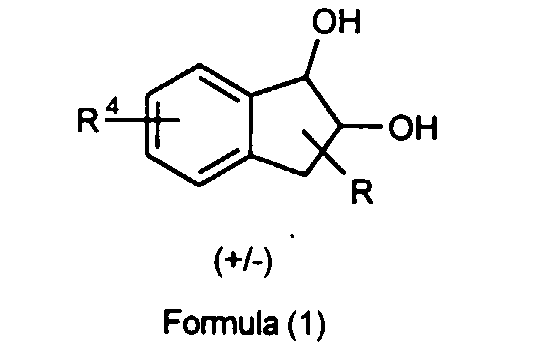
in which R and R4 each independently is -H, halogen, -N3, -OH, -CN, alkyl, alkenyl, aryl, -CX3, -OR1, -SR1, -NR1R2, -PR1R2, -COR1, -CO2R1, in which X is halogen, and R1 and R2 each independently is alkyl, aryl, alkenyl or aralkyl.
in which R and R4 each independently is -H, halogen, -N3, -OH, -CN, alkyl, alkenyl, aryl, -CX3, -OR1, -SR1, -NR1R2, -PR1R2, -COR1, -CO2R1, in which X is halogen, and R1 and R2 each independently is alkyl, aryl, alkenyl or aralkyl.
3. A process according to Claim 2 in which the compound of Formula (1) is of Formula
(2):
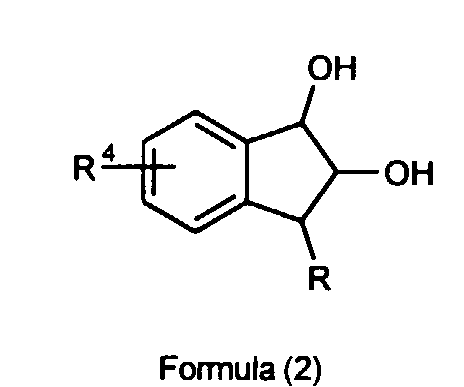
wherein R and R4 are as defined in Claim 2.
wherein R and R4 are as defined in Claim 2.
4. A process according to any one of Claims 1 to 3 in which the Pseudomonas putida species is selected from NCIMB 8859, NCIMB 11767 and NCIMB 12190.
5. A process according to Claim 1 in which the cis-dihydroxydihydroindene is cis-1,2-dihydroxy-1,2-dihydroindene and the Pseudomonas putida species is Pseudomonas putida NCIMB 8859.
6. A process according to Claim 1 in which the cis-dihydroxydihydroindene is cis-1,2-dihydroxy-1,2-dihydroindene and the Pseudomonas putida species is Pseudomonas putida NCIMB 11767.
7. A process according to Claim 1 in which the cis-dihydroxydihydroindene is cis-1,2-dihydroxy-1,2-dihydroindene and the Pseudomonas putida species is Pseudomonas putida NCIMB 12190.
8. A process according to any one of Claims 1 to 7 performed in an aqueous buffer medium
in which the pH is controlled in the range 4 to 9.
9. A process according to any one of Claims 1 to 8 in which the temperature is from 0°C
to 100°C.
1. Verfahren zur Trennung einer Mischung aus cis-Dihydroxydihydroinden-Enantiomeren,
das die Behandlung der Mischung der Enantiomere mit einem Mikroorganismus der Pseudomonas
putida-Art umfaßt.
2. Verfahren gemäß Anspruch 1, in dem die cis-Dihydroxydihydroinden-Mischung Verbindungen
der Formel (1) umfaßt:
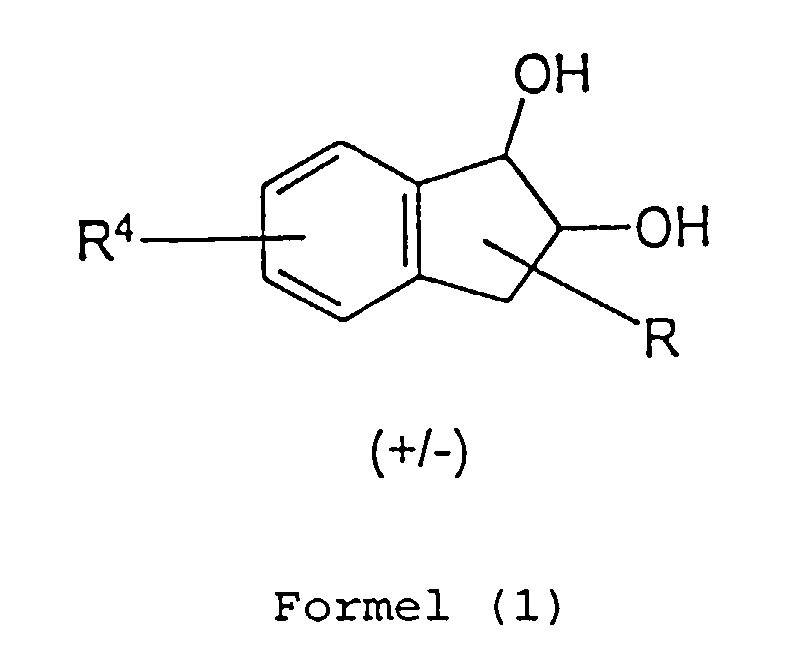
worin R und R4 jeweils unabhängig -H, Halogen, -N3, -OH, -CN, Alkyl, Alkenyl, Aryl, -CX3, -OR1, -SR1, -NR1R2, -PR1R2, -COR1, -CO2R1 sind, worin X Halogen ist und R1 und R2 jeweils unabhängig Alkyl, Aryl, Alkenyl oder Aralkyl sind.
worin R und R4 jeweils unabhängig -H, Halogen, -N3, -OH, -CN, Alkyl, Alkenyl, Aryl, -CX3, -OR1, -SR1, -NR1R2, -PR1R2, -COR1, -CO2R1 sind, worin X Halogen ist und R1 und R2 jeweils unabhängig Alkyl, Aryl, Alkenyl oder Aralkyl sind.
3. Verfahren gemäß Anspruch 2, in dem die Verbindung der Formel (1) die Formel (2) hat:
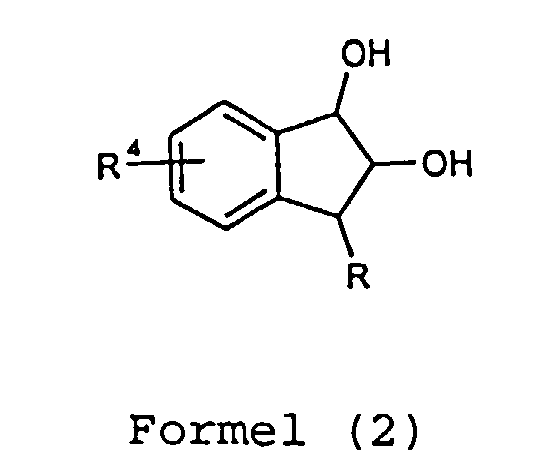
worin R und R4 wie in Anspruch 2 definiert sind.
worin R und R4 wie in Anspruch 2 definiert sind.
4. Verfahren gemäß einem der Ansprüche 1 bis 3, in dem die Pseudomonas putida-Art ausgewählt
ist aus NCIMB 8859, NCIMB 11767 und NCIMB 12190.
5. Verfahren gemäß Anspruch 1, in dem das cis-Dihydroxydihydroinden cis-1,2-Dihydroxy-1,2-dihydroinden
ist und die Pseudomonas putida-Art Pseudomonas putida NCIMB 8859 ist.
6. Verfahren gemäß Anspruch 1, in dem das cis-Dihydroxydihydroinden cis-1,2-Dihydroxy-1,2-dihydroinden
ist und die Pseudomonas putida-Art Pseudomonas putida NCIMB 11767 ist.
7. Verfahren gemäß Anspruch 1, in dem das cis-Dihydroxydihydroinden cis-1,2-Dihydroxy-1,2-dihydroinden
ist und die Pseudomonas putida-Art Pseudomonas putida NCIMB 12190 ist.
8. Verfahren gemäß einem der Ansprüche 1 bis 7, das in einem wäßrigen Puffermedium durchgeführt
wird, in dem der pH im Bereich von 4 bis 9 eingestellt ist.
9. Verfahren gemäß einem der Ansprüche 1 bis 8, in dem die Temperatur 0 bis 100°C beträgt.
1. Procédé de dédoublement d'un mélange d'énantiomères de cis-dihydroxydihydroindène comprenant le traitement du mélange d'énantiomères avec un
micro-organisme d'une espèce de Pseudomonas putida.
2. Procédé selon la revendication 1, dans lequel le mélange de cis-dihydroxydihydroindènes comprend des composés de formule (1) :
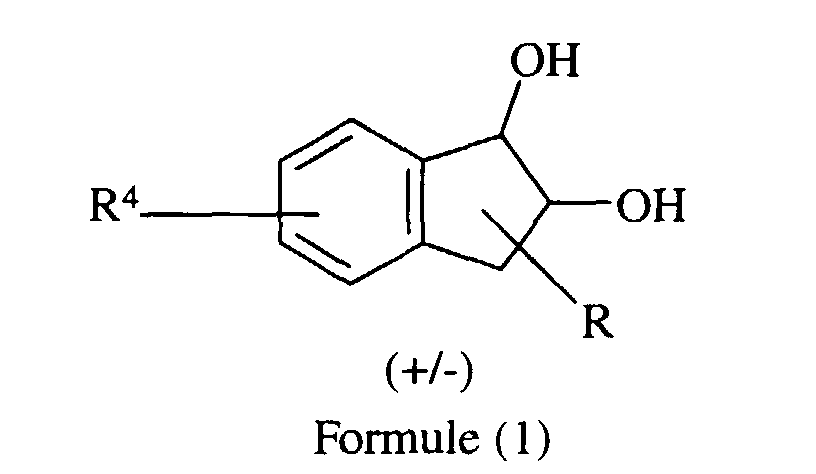
dans laquelle R et R4 sont chacun indépendamment -H, halogène, -N3, -OH, -CN, alkyle, alcényle, aryle, -CX3, -OR1, -SR1, -NR1R2, -PR1R2, -COR1, -CO2R1, où X est halogène, et R1 et R2 sont chacun indépendamment alkyle, aryle, alcényle ou aralkyle.
dans laquelle R et R4 sont chacun indépendamment -H, halogène, -N3, -OH, -CN, alkyle, alcényle, aryle, -CX3, -OR1, -SR1, -NR1R2, -PR1R2, -COR1, -CO2R1, où X est halogène, et R1 et R2 sont chacun indépendamment alkyle, aryle, alcényle ou aralkyle.
3. Procédé selon la revendication 2, dans lequel le composé de formule (1) est de formule
(2) :
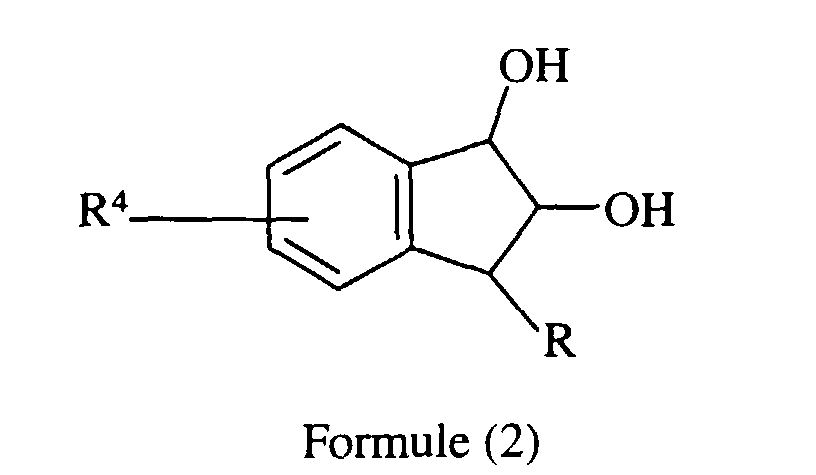
dans laquelle R et R4 sont tels que définis dans la revendication 2.
dans laquelle R et R4 sont tels que définis dans la revendication 2.
4. Procédé selon l'une quelconque des revendications 1 à 3, dans lequel l'espèce de Pseudomonas putida est choisie parmi NCIMB 8859, NCIMB 11767 et NCIMB 12190.
5. Procédé selon la revendication 1, dans lequel le cis-dihydroxydihydroindène est le cis-1,2-dihydroxy-1,2-dihydroindène et l'espèce de Pseudomonas putida est Pseudomonas putida NCIMB 8859.
6. Procédé selon la revendication 1, dans lequel le cis-dihydroxydihydroindène est le cis-1,2-dihydroxy-1,2-dihydroindène et l'espèce de Pseudomonas putida est Pseudomonas putida NCIMB 11767.
7. Procédé selon la revendication 1, dans lequel le cis-dihydroxydihydroindène est le cis-1,2-dihydroxy-1,2-dihydroindène et l'espèce de Pseudomonas putida est Pseudomonas putida NCIMB 12190.
8. Procédé selon l'une quelconque des revendications 1 à 7, mis en oeuvre dans un milieu
tampon aqueux dans lequel le pH est contrôlé dans le domaine de 4 à 9.
9. Procédé selon l'une quelconque des revendications 1 à 8, dans lequel la température
est de 0°C à 100°C.