| (19) |
 |
|
(11) |
EP 0 785 833 B9 |
| (12) |
CORRECTED EUROPEAN PATENT SPECIFICATION |
|
Note: Bibliography reflects the latest situation |
| (15) |
Correction information: |
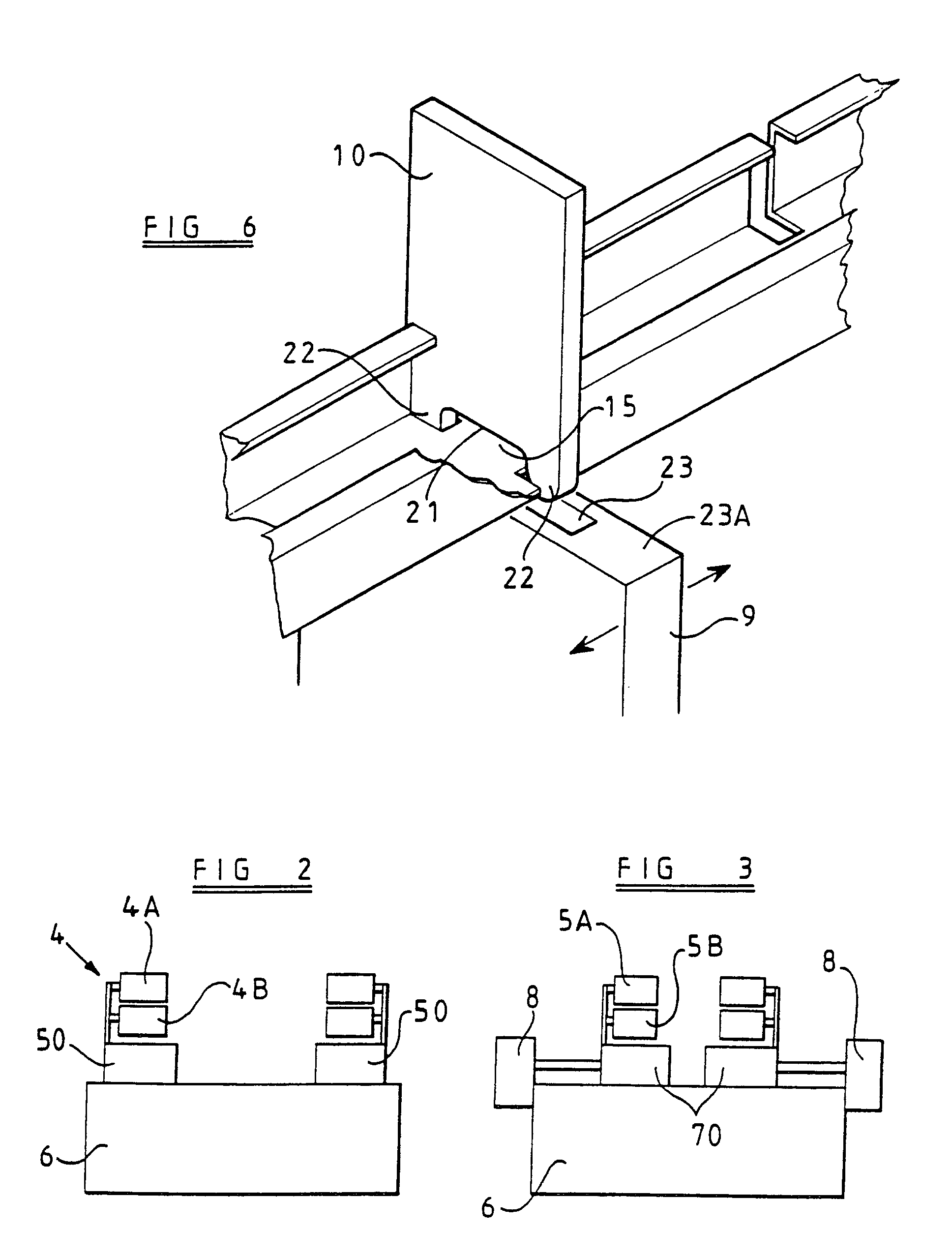
|
Corrected version no 1 (W1 B1) |
|
Corrections, see
|
| (48) |
Corrigendum issued on: |
|
13.11.2002 Bulletin 2002/46 |
| (45) |
Mention of the grant of the patent: |
|
06.02.2002 Bulletin 2002/06 |
| (22) |
Date of filing: 10.10.1995 |
|
| (51) |
International Patent Classification (IPC)7: B21D 5/08 |
| (86) |
International application number: |
|
PCT/GB9502/397 |
| (87) |
International publication number: |
|
WO 9601/1758 (25.04.1996 Gazette 1996/18) |
|
| (54) |
STRIP FORMING METHOD AND APPARATUS
VERFAHREN UND VORRICHTUNG ZUM BLECHFORMEN
PROCEDE ET DISPOSITIF DE FACONNAGE DE BANDES
|
| (84) |
Designated Contracting States: |
|
AT BE CH DE DK ES FR GB GR IE IT LI LU MC NL PT SE |
| (30) |
Priority: |
15.10.1994 GB 9420832
|
| (43) |
Date of publication of application: |
|
30.07.1997 Bulletin 1997/31 |
| (73) |
Proprietor: Banro Holdings Public Limited Company |
|
Walsall,
West Midlands WS3 9ES (GB) |
|
| (72) |
Inventor: |
|
- HAYWARD, John
Midland Industrial Holdings Limited
West Midlands WS3 9ES (GB)
|
| (74) |
Representative: Mosey, Stephen George et al |
|
MARKS & CLERK
Alpha Tower
Suffolk Street Queensway
Birmingham B1 1TT
Birmingham B1 1TT (GB) |
| (56) |
References cited: :
LU-A- 61 061
|
US-A- 3 068 336
|
|
| |
|
|
|
|
| |
|
| Note: Within nine months from the publication of the mention of the grant of the European
patent, any person may give notice to the European Patent Office of opposition to
the European patent
granted. Notice of opposition shall be filed in a written reasoned statement. It shall
not be deemed to
have been filed until the opposition fee has been paid. (Art. 99(1) European Patent
Convention).
|
[0001] This invention relates to a method of and apparatus for the production of articles
in continuous succession by forming from strip material and parting-off the formed
articles from the strip.
[0002] In some conventional arrangements for forming articles such as generally channel
shaped ducting, studding and the like, a special parting-off head is required to support
the particular profile of the formed article to enable parting-off to be carried out
without deformation or collapse of the article. When a different size or shape of
product is required, the head has to be modified or interchanged with another to accommodate
the new product, giving rise to a very significant "stand-still" time for the machine,
possibly of several hours, while the conversion takes place. Similar problems arise
when changing the forming tools, such as rolls, particularly when the channel-shaped
profile to be formed has its free edges turned inwardly parallel to its base, requiring
additional tools to produce the necessary forming.
[0003] Luxembourg Patent No. 61061 discloses the formation of profiles from strip material
in which the lengths of the individual profiles are delimited by the formation of
transverse impressions on the strip prior to the forming operation, and subjecting
the formed profiles to a bending force applied by an array of rollers, causing separation
of the profiles by breakage along the transverse impressions.
[0004] US-A-4,553,418 (closest prior art) discloses forming identical workpieces from metal
strip material by roller forming and punching to leave successive workpieces connected
together by strap-like portions of the strip which are subsequently removed by shearing
to separate the workpieces.
[0005] An object of the invention is to provide a method of producing articles, such as
generally channel-shaped ducting, studding and the like, which enables parting-off
of the differently shaped and/or sized articles to be performed without substantial
modification to the parting-off head, as well as apparatus for carrying out the method
and in which the forming tools may be readily modified for changing the shape and/or
size of the product.
[0006] According to the invention, a method of producing articles in continuous succession
by forming from strip material comprises the combination of features according to
claim 1.
[0007] Preferably, the or each connecting portion is formed with the strip stationary and,
conveniently, prior to commencement of the forming operation.
[0008] In a particularly convenient form of the method, cutting through the strip is effected
on a stationary part of the strip during the performance of the forming operation
on another moving part of the strip.
[0009] From a further aspect of the invention, apparatus for carrying out the method comprises
the combination of features according to claim 10.
[0010] Preferably, parting-off is effected on the moving strip by means of the cutting unit
which is conveniently accelerated to the speed of the moving strip prior to parting-off.
[0011] The invention will now be described, by way of example, with reference to the accompanying
drawings in which:-
Figure 1 is a diagrammatic representation of one form of apparatus for carrying out
the method of the invention;
Figure 2 is an enlarged diagrammatic view of part of the apparatus of Figure 1;
Figure 3 is an enlarged view, similar to Figure 2, of another part of the apparatus
of Figure 1;
Figure 4 illustrates alternative results of one operational step in the method;
Figure 5 is an enlarged diagrammatic perspective view of part of the apparatus of
Figure 1 seen from the opposite side to that shown in Figure 1, and
Figure 6 is a further enlarged view of part of the apparatus of Figure 5 seen from
the same side as Figure 5.
[0012] In the apparatus illustrated in Figure 1, coated steel strip 1 is supplied from a
drum 2 which is driven in rotation by a suitable conventional drive means 3, such
as an electric motor, in order to unwind the strip in use. The strip is first fed
through a succession of operational stations A, B, C, at which various operations
are performed on the strip, as will be described hereafter. Feeding of the strip through
the stations A, B, C is effected by a pair of feed rollers 2A driven intermittently
under computer control to bring successive locations on the strip beneath the stations
A, B, C at which operations are performed while the strip is stationary. Alternative
locations for the rollers 2A are shown in broken lines respectively at either end
of the stations A, B, C, the chosen location depending upon whether the strip is to
be pushed or pulled through the stations.
[0013] The strip is then fed through a series of forming rolls, indicated collectively by
the reference 4, which act upon the strip in conventional manner to form it into a
desired profile, such as a part-rectangular channel, of which the free longitudinal
edges may be inwardly or outwardly turned.
[0014] In practice, each roll has an upper roll 4A and a lower roll 4B, the rolls being
arranged in pairs transversely of the longitudinal direction of the strip, as illustrated
in Figure 2. Each roll 4A, 4B is carried on a bed 5 mounted on a main frame 6 for
adjustment in opposed directions transversely of the frame. Adjustment may be effected
by any suitable means such as screw devices or fluid-actuated cylinders (not shown).
The rolls 4A, 4B forming the sides of the channel relative to the base are all mounted
on the respective beds 50 for simultaneous adjustment as a group at either side of
the strip, although they may be sub-divided, if required, depending upon the particular
form of the article to be produced. Some of the rolls, indicated at 5 in Figure 1
and each having a pair of rolls 5A, 5B, provide additional forming to turn inwardly
the free edges of the channel. In this embodiment of the invention, these rolls are
arranged for independent movement relative to the remaining rolls.
[0015] Figure 3 shows one possible arrangement for this, wherein the rolls 5A, 5B are mounted
on beds 70 distinct from the beds 50 of Figure 2 and movable transversely of the frame
6 by, for example, hydraulic cylinders 8, which may be remotely controlled, so that
the rolls 5A, 5B may be brought into or out of action separately from the remaining
rolls, depending upon whether the product to be formed has in turned edges or not.
These possibilities for adjustment of the rolls provide an extremely adaptable arrangement,
which may be rapidly modified to produce products, within limits, of different shapes
and/or dimensions, without the necessity for removing existing rolls and replacing
them with different ones. This can reduce the down time of the apparatus very significantly
as compared with some conventional apparatus.
[0016] The formed strip leaving the forming rolls requires parting-off into desired lengths
and this is effected at a parting-off station by a die 9 cooperating with a cutting
device 10. It is advantageous, for continuity of production, to perform the cutting
operation on the moving strip, for which purpose it is necessary prior to each cutting
operation to accelerate the die 9 to match the speed of travel of the strip. in order
to achieve this, the die is coupled to a drive device, illustrated as a screw 11 driven,
for example, by an electrical stepper motor 12 which, under automatic computer control,
accelerates the die to the required speed and returns it to its starting position
after the parting-off operation. The parted off product sections are fed onto a run-out
table 13 which can include means 14 for moving the products off the table surface
to one side or the other, at will.
[0017] It is an important feature of the invention that the strip is partially severed prior
to completion of forming by the rollers 4, 5 and preferably prior to the commencement
of such forming, by cutting widthwise through the entire thickness of the strip so
as to leave successive strip portions 1A, 1B, each of the required length, connected
together by only a small localised connecting portion or lug, or possibly a plurality
thereof. The partial severing of the strip, which takes place at station C, can be
effected in a plurality of ways, of which three alternatives are illustrated in Figures
4A to 4C. Each manner of partial severing leaves in the strip one or more gaps 14
and one or more connecting lugs 15 between the successive strip portions 1A, 1B. The
preferred manner of severing the strip is that shown in Figure 4A and will be used
to illustrate the performance of the method using the apparatus of the invention in
the following description.
[0018] The forming method of the invention is carried out, using the apparatus described,
in the following manner. Strip 1 unwound from the reel 2 is allowed to form a loop
L1 prior to being fed through the stations A, B and C. This allows for the intermittent
feeding of the strip passing through these stations, by the feed rollers 2A, the strip
being stopped momentarily, as governed by suitable automatic computer controlled timing
means applied to the roller drive, to enable the necessary functions to be completed
at stations A, B and C. Tools arranged at stations A and B can, for example, perforate
the strip where required, and a partial severing operation is performed at station
C leaving successive lengths of strip 1A, 1B spaced by the gaps 14 and connected only
by the remaining lug 15. Following these steps, the strip is once again set in motion
and forms a second loop L2 prior to entering the rolls 4 so that the strip passing
through the rolls can remain in a continuously moving state, even when the strip is
stopped at stations A, B and C. As can be seen more clearly from Figure 5, the flat
strip 1 is progressively formed by the rolls 4 and 5 to produce a succession of channel-shaped
articles each, in the particular form illustrated, having inwardly turned longitudinal
upper edges.
[0019] The formed articles leaving the rolls 4 and 5 approach a cutting station to be separated
by the cutter 10 cooperating with the die 9. Again, in order to achieve continuity
of operation, it is desirable to perform the cutting operation with the strip in continuous
motion and, for this purpose, the die 9 is accelerated by the stepper motor 12 and
screw drive 11 to the speed of the travelling strip, prior to separating successive
articles by severing the connecting lug 15 between them while the articles continue
in motion. Initiation of movement of the die 9 is effected in response to sensing
the presence of the gap 14 between successive articles by means of sensors 20, preferably
of an optical or infra-red type, signals from which are fed to the controlling computer
which then initiates acceleration of the die and cutter assembly by way of the screw
11 and motor 12. By careful timing of commencement of acceleration of the die and
cutter assembly, these latter can be brought into very close proximity with the lug
to be severed. As can be seen more clearly in Figure 6, the thickness of the cutting
blade is substantially the same as the width of the slot 14, so that the blade is
effectively guided during its movement through the slot. The lower edge 21 of the
blade forms the cutting edge and this is bounded by a pair of ears 22 which are spaced
by substantially the width of the lug 15 so that the lug is embraced by the ears during
the initial part of the descent of the blade for accurate location of the blade relative
to the lug. Moreover, the die 9 has a degree of free movement in the direction of
strip movement. The die is provided with a slot 23, which again is of substantially
the same width as the blade thickness, and this enables a final location of the blade
relative to the die and lug to be effected as the ears 22 enter the slot 23, causing
a small longitudinal adjustment of the die to take place, if necessary, prior to the
final downward movement of the blade 10 to effect parting-off of the articles. The
articles to be severed are supported adjacent the lug by a plain flat surface 23A
of the die 9 surrounding the slot 23, obviating the need for complex support apparatus.
The timing of the cut in relation to the various other movements and adjustments is
effected by the controlling computer.
[0020] A severed article is illustrated at P (Figures 1 and 5) and this falls onto a run-off
table 13 from which it may be removed by an ejector mechanism in the form of one or
more projections 24 extending radially from a body 14 carried by a drive shaft 25
rotatable in one direction or the other, again under the control of the computer,
to eject an article laterally of the table to one side or the other thereof. The direction
of rotation of the shaft may be computer controlled to enable one or more articles
to be ejected at one side of the table, followed by ejection of one or more articles
at the opposite side of the table.
[0021] It will be seen that, with the arrangement described, parting-off of a variety of
sizes and shapes of article can be effected by a single blade and die assembly, without
modification of the latter, thereby avoiding the significant down times experienced
in conventional forming apparatus having die heads designed to sever through the entire
product. It will be understood that the invention is not limited by the size and shape
of product, large variations in which may be accommodated.
1. A method of producing articles in continuous succession by forming from strip material,
comprising cutting entirely through the strip (1) in a widthwise direction, prior
to completion of the forming, so as to leave adjacent strip portions (1A, 1B) joined
only by at least one localised connecting portion (15), and parting-off a pair of
successive formed articles (P) by severing the or each connecting portion (15) using
a cutting unit comprising a co-acting cutter device (10) and die (9), the die having
an opening (23) of substantially the same width as the cutter device thickness for
receiving the cutter device (10) therein, the method characterised by causing at least one projecting portion (22) of the cutter device to enter the opening
(23) prior to parting-off the articles (P) by co-action between the cutter device
and the die.
2. A method according to Claim 1, wherein the or each connecting portion (15) is formed
with the strip (1) stationary.
3. A method according to Claim 1 or Claim 2, wherein the connecting portion (15) is formed
prior to commencement of the forming operation.
4. A method according to any one of Claims 1 to 3, wherein said cutting through the strip
(1) is effected on a stationary part of the strip during the performance of the forming
operation on another moving part of the strip.
5. A method according to any one of the preceding claims, wherein severing of the connecting
portion (15) is effected on the moving strip.
6. A method according to Claim 5, wherein the cutting unit is accelerated to match the
speed of the strip (1) prior to severing of the connecting portion (15).
7. A method according to any one of the preceding claims, wherein said cutting through
of the strip is effected so as to leave a single localised connecting portion (15)
disposed generally centrally of the strip (1).
8. A method according to any one of Claims 1 to 5, wherein said cutting through of the
strip is effected in such a manner that a gap (14) is formed between the adjacent
ends of successive articles (P) and the cutter device (10) has a thickness substantially
the same as the width of said gap, so that the cutter device is guided during its
movement within the gap (14) prior to severing the or each connecting portion (15).
9. A method according to any one of Claims 1 to 8, wherein severing of the or each connecting
portion (15) is carried out with a part of the formed strip adjacent the portion (15)
supported on a surface and the connecting portion unsupported.
10. Apparatus for carrying out the method of any one of Claims 1 to 9, comprising forming
means (4, 5) for forming the strip to a desired profile, means (C) for cutting entirely
through the strip (1) in a widthwise direction, prior to completion of the forming,
so as to leave adjacent strip portions (1A, 1B) joined only by at least one localised
connecting portion (15), and means (9, 10) for parting-off a pair of successive formed
articles (P) by severing the or each connecting portion (15), said means for parting-off
comprising a cutting unit in the form of a cutter device (10) and die (9), the die
having an opening (23) of substantially the same width as the cutter device thickness
for receiving the cutter device (10), characterised in that the cutter device is provided with at least one projecting portion (22), and that,
in use, said at least one projecting portion (22) enters the die opening (23) prior
to parting-off the articles (P) by co-action between the cutter device and the die.
11. Apparatus according to Claim 10, wherein drive means (2A) are provided for advancing
the strip (1) intermittently between cutting operations by a distance equal to the
length of a severed article (P).
12. Apparatus according to Claim 11, wherein the drive means is a pair of opposed rollers
(2A).
13. Apparatus according to any one of Claims 10 to 12, wherein means (11, 12) are provided
for accelerating the cutting unit, in use, to the speed of the moving strip prior
to parting-off of the moving articles.
14. Apparatus according to any one of Claims 10 to 13, wherein a cutting edge (21) of
the cutter device (10) is bounded by a pair of spaced projecting ears (22), such that,
in use, the ears embrace a connecting portion (15) prior to a cutting operation so
as to effect accurate location of the cutter device (10) relative to the connecting
portion (15).
15. Apparatus according to any one of Claims 10 to 14, wherein the opening in the die
(9) is a slot (23) of substantially the same cross-sectional dimensions as an opposed
end of the cutter device (10), the die being capable of movement to permit longitudinal
location of the die relative to the cutter device during entry of the cutter device
into said slot (23).
16. Apparatus according to any one of Claims 10 to 15, wherein the die has a surface (23A)
on which, in use, a part of the formed strip adjacent a connecting portion (15) is
supported, with the portion (15) lying over the opening (23), when the ears (22) of
the cutter device embrace the connecting portion (15) and are engaged within the opening
(23)
17. Apparatus according to any one of Claims 10 to 16, wherein the forming means are rolls
(4A, 4B, 5A, 5B), and means are provided for adjusting some of the rolls relative
to others in order to modify the format of the formed article without substantial
dismantling of the rolls.
18. Apparatus according to Claim 17, wherein the roll-adjusting means are fluid-operated.
19. Apparatus according to Claim 17 or Claim 18, wherein the roll -adjusting means are
remotely operable.
1. Verfahren zur Herstellung von Artikeln in einer kontinuierlichen Folge durch Formung
von Streifenmaterial, das folgendes umfaßt: vollständiges Durchschneiden des Streifen
(1) in einer Breitenrichtung, bevor die Formung abgeschlossen ist, so daß aneinandergrenzende
Streifenabschnitte (1A, 1B) nur durch wenigstens einen lokalisierten Verbindungsabschnitt
(15) miteinander verbunden bleiben, und Abtrennen eines Paares von aufeinanderfolgenden
geformten Artikeln (P) durch Durchtrennen des oder jedes Verbindungsabschnitts (15)
unter Anwendung einer Schneideinheit, die einen zusammenwirkenden Schneidmechanismus
(10) und ein Unterwerkzeug (9) umfaßt, wobei das Unterwerkzeug eine Öffnung (23) von
im wesentlichen derselben Breite wie die Dicke des Schneidmechanismus' hat, um darin
den Schneidmechanismus (10) aufzunehmen, wobei das Verfahren dadurch gekennzeichnet ist, daß der Eintritt wenigstens eines vorspringenden Abschnitts (22) des Schneidmechanismus'
in die Öffnung (23) bewirkt wird, bevor die Artikel (P) durch das Zusammenwirken zwischen
dem Schneidmechanismus und dem Unterwerkzeug abgetrennt werden.
2. Verfahren nach Anspruch 1, bei dem der oder jeder Verbindungsabschnitt (15) gebildet
wird, während der Streifen (1) stationär ist.
3. Verfahren nach Anspruch 1 oder Anspruch 2, bei dem der Verbindungsabschnitt (15) vor
Beginn des Formungsvorgangs gebildet wird.
4. Verfahren nach einem der Ansprüche 1 bis 3, bei dem das Durchschneiden des Streifens
(1) an einem stillstehenden Teil des Streifens während der Durchführung des Formungsvorgangs
an einem anderen, sich bewegenden Teil des Streifens ausgeführt wird.
5. Verfahren nach einem der vorhergehenden Ansprüche, bei dem das Durchtrennen des Verbindungsabschnitts
(15) an dem sich bewegenden Streifen ausgeführt wird.
6. Verfahren nach Anspruch 5, bei dem die Schneideinheit beschleunigt wird, um sie vor
dem Durchtrennen des Verbindungsabschnitts (15) der Geschwindigkeit des Streifens
(1) anzupassen.
7. Verfahren nach einem der vorhergehenden Ansprüche, bei dem das Durchschneiden des
Streifens so ausgeführt wird, daß ein einzelner, lokalisierter Verbindungsabschnitt
(15) verbleibt, der allgemein in der Mitte des Streifens (1) angeordnet ist.
8. Verfahren nach einem der Ansprüche 1 bis 5, bei dem das Durchschneiden des Streifens
auf eine solche Weise ausgeführt wird, daß zwischen aneinandergrenzenden Enden von
aufeinanderfolgenden Artikeln (P) ein Spalt (14) gebildet wird, und der Schneidmechanismus
(10) eine Dicke hat, die im wesentlichen gleich der Breite des Spaltes ist, so daß
der Schneidmechanismus während seiner Bewegung innerhalb des Spaltes (14) geführt
wird, bevor er den oder jeden Verbindungsabschnitt (15) durchtrennt.
9. Verfahren nach einem der Ansprüche 1 bis 8, bei dem das Durchtrennen des oder jedes
Verbindungsabschnitts (15) durchgeführt wird, während ein Teil des geformten Streifens
angrenzend an den Abschnitt (15) auf einer Oberfläche aufgelagert wird und der Verbindungsabschnitt
nicht aufgelagert ist.
10. Vorrichtung zur Ausführung des Verfahrens nach einem der Ansprüche 1 bis 9, die folgendes
aufweist: Formungsmittel (4, 5) zur Formung des Streifens in ein gewünschtes Profil,
Mittel (C) zum vollständigen Durchschneiden des Streifens (1) in einer Breitenrichtung,
bevor die Formung abgeschlossen ist, so daß aneinandergrenzende Streifenabschnitte
(1A, 1B) nur durch wenigstens einen lokalisierten Verbindungsabschnitt (15) miteinander
verbunden bleiben, und Mittel (9, 10) zum Abtrennen eines Paares von aufeinanderfolgenden
geformten Artikeln (P) durch Durchtrennen des oder jedes Verbindungsabschnitts (15),
wobei die Mittel zum Abtrennen eine Schneideinheit in Form eines Schneidmechanismus'
(10) und eines Unterwerkzeugs (9) umfassen, wobei das Unterwerkzeug eine Öffnung (23)
von im wesentlichen derselben Breite wie die Dicke des Schneidmechanismus' hat, um
den Schneidmechanismus (10) aufzunehmen, dadurch gekennzeichnet, daß der Schneidmechanismus mit wenigstens einem vorspringenden Abschnitt (22) versehen
ist und daß bei der Arbeit der wenigstens eine vorspringende Abschnitt (22) in die
Unterwerkzeug-Öffnung (23) eintritt, bevor die Artikel (P) durch das Zusammenwirken
zwischen dem Schneidmechanismus und dem Unterwerkzeug abgetrennt werden.
11. Vorrichtung nach Anspruch 10, bei der Antriebsmittel (2A) bereitgestellt werden, um
den Streifen (1) zwischen den Schneidvorgängen aussetzend um eine Entfernung vorwärts
zu bewegen, die gleich der Länge eines abgetrennten Artikels (P) ist.
12. Vorrichtung nach Anspruch 11, bei der die Antriebsmittel ein Paar gegenüberliegender
Rollen (2A) sind.
13. Vorrichtung nach einem der Ansprüche 10 bis 12, bei der Mittel (11, 12) bereitgestellt
werden, um die Schneideinheit bei der Arbeit auf die Geschwindigkeit des sich bewegenden
Streifens zu beschleunigen, bevor die sich bewegenden Artikel abgetrennt werden.
14. Vorrichtung nach einem der Ansprüche 10 bis 13, bei der eine Schneidkante (21) des
Schneidmechanismus' (10) durch ein Paar von mit Zwischenraum angeordneten vorspringenden
Ösen (22) begrenzt wird, derartig, daß die Ösen bei der Arbeit einen Verbindungsabschnitt
(15) vor einem Schneidvorgang umfassen, um so eine genaue Lokalisierung des Schneidmechanismus'
(10) im Verhältnis zum Verbindungsabschnitt (15) zu bewirken.
15. Vorrichtung nach einem der Ansprüche 10 bis 14, bei der die Öffnung im Unterwerkzeug
(9) ein Schlitz (23) mit im wesentlichen denselben Querschnittabmessungen wie ein
gegenüberliegendes Ende des Schneidmechanismus' (10) ist, wobei das Unterwerkzeug
bewegt werden kann, um die Längsausrichtung des Unterwerkzeugs im Verhältnis zum Schneidmechanismus
während des Eintritts des Schneidmechanismus' in den Schlitz (23) zu erlauben.
16. Vorrichtung nach einem der Ansprüche 10 bis 15, bei der das Unterwerkzeuge eine Oberfläche
(23A) hat, auf der bei der Arbeit ein Teil des geformten Streifens anschließend an
einen Verbindungsabschnitt (15) aufgelagert wird, wobei der Abschnitt (15) über der
Öffnung (23) liegt, wenn die Ösen (22) des Schneidmechanismus' den Verbindungsabschnitt
(15) umfassen und innerhalb der Öffnung (23) ineinandergreifen.
17. Vorrichtung nach einem der Ansprüche 10 bis 16, bei der die Formungsmittel Walzen
(4A, 4B, 5A, 5B) sind und Mittel bereitgestellt werden, um einige der Walzen im Verhältnis
zu anderen einzustellen, um das Format des geformten Artikels zu modifizieren, ohne
die Walzen wesentlich zu demontieren.
18. Vorrichtung nach Anspruch 17, bei der die Walzeneinstellmittel fluid-betätigt sind.
19. Vorrichtung nach Anspruch 17 oder Anspruch 18, bei der die Walzeneinstellmittel fernbedient
werden können.
1. Procédé de production d'articles dans une succession continue par formage à partir
d'un matériau en bande, comprenant un découpage complet à travers la bande (1) dans
une direction de la largeur, avant l'achèvement du formage, de sorte à que les parties
de bande adjacentes (1A, 1B) sont reliées uniquement par une partie de raccordement
localisée (15), et de séparation d'une paire d'articles formés successivement (P)
par détachement de la ou de chaque partie de raccordement (15) par l'intermédiaire
d'une unité de coupe comprenant un dispositif de coupe (10) et une filière (9) à coopération,
la filière comportant une ouverture (23) ayant une largeur pratiquement égale à l'épaisseur
du dispositif de coupe pour recevoir le dispositif de coupe (10), le procédé étant
caractérisé par l'entrée d'au moins une partie en saillie (22) du dispositif de coupe dans l'ouverture
(23) avant la séparation des articles (P) par l'intermédiaire de la coopération entre
le dispositif de coupe et la filière.
2. Procédé selon la revendication 1, dans lequel la ou chaque partie de raccordement
(15) est formée lorsque la bande (1) est stationnaire.
3. Procédé selon les revendications 1 ou 2, dans lequel la partie de raccordement (15)
est formée avant de commencer l'opération de formage.
4. Procédé selon l'une quelconque des revendications 1 à 3, dans lequel ledit découpage
à travers la bande (1) est réalisé sur une partie stationnaire de la bande au cours
de l'exécution de l'opération de formage sur une autre partie en déplacement de la
bande.
5. Procédé selon l'une quelconque des revendications précédentes, dans lequel le détachement
de la partie de raccordement (15) est réalisé sur la bande en déplacement.
6. Procédé selon la revendication 5, dans lequel l'unité de coupe est accélérée en vue
d'une adaptation à la vitesse de la bande (1) avant le détachement de la partie de
raccordement (15).
7. Procédé selon l'une quelconque des revendications précédentes, dans lequel ledit découpage
à travers la bande est réalisé de sorte à laisser une seule partie de raccordement
localisée (15) agencée en général au centre de la bande (1).
8. Procédé selon l'une quelconque des revendications 1 à 5, dans lequel ledit découpage
à travers la bande est réalisé de sorte qu'un espace (14) est établi entre les extrémités
adjacentes d'articles successifs (P), le dispositif de coupe (10) ayant une épaisseur
correspondant pratiquement à la largeur dudit espace, de sorte que le dispositif de
coupe est guidé pendant son déplacement dans l'espace (14) avant le détachement de
la ou de chaque partie de raccordement (15).
9. Procédé selon l'une quelconque des revendications 1 à 8, dans lequel le détachement
de la ou de chaque partie de raccordement (15) est réalisé pendant qu'une partie de
la bande formée adjacente à la partie (15) est supportée sur une surface, la partie
de raccordement n'étant pas supportée.
10. Dispositif destiné à l'exécution du procédé selon l'une quelconque des revendications
1 à 9, comprenant un moyen de formage (4, 5) pour former la bande selon un profil
voulu, un moyen (C) pour découper entièrement la bande (1) dans une direction de la
largeur, avant l'achèvement du formage, de sorte que les parties de bande adjacentes
(1A, 1B) sont reliées uniquement par au moins une partie de raccordement localisée
(15), et un moyen (9, 10) pour séparer une paire d'articles formés successivement
(P) par détachement de la ou de chaque partie de raccordement (15), ledit moyen destiné
au détachement comprenant une unité de coupe sous forme d'un dispositif de coupe (10)
et une filière (9), la filière comportant une ouverture (23) ayant une largeur pratiquement
égale à l'épaisseur du dispositif de coupe pour recevoir le dispositif de coupe (10),
caractérisé en ce que le dispositif de coupe comporte au moins une partie en saillie (22) et en ce qu'en service ladite au moins une partie en saillie (22) rentre dans l'ouverture de la
filière (23) avant la séparation des articles (P) par l'intermédiaire de la coopération
entre le dispositif de coupe et la filière.
11. Dispositif selon la revendication 10, comportant des moyens d'actionnement (2A) pour
faire avancer la bande (1) par intermittence entre les opérations de coupe d'une distance
égale à la longueur de l'article détaché (P).
12. Dispositif selon la revendication 11, dans lequel le moyen d'entraînement est constitué
par une paire de rouleaux opposés (2A).
13. Dispositif selon l'une quelconque des revendications 10 à 12, comportant des moyens
(11, 12) pour accélérer l'unité de coupe en service en vue de l'adaptation à la bande
en déplacement avant le détachement des articles en déplacement.
14. Dispositif selon l'une quelconque des revendications 10 à 13, dans lequel une arête
de coupe (21) du dispositif de coupe (10) est délimitée par une paire de pattes en
saillie espacées (22), de sorte qu'en service les pattes entourent une partie de raccordement
(15) avant l'opération de coupe, afin d'assurer un positionnement précis du dispositif
de coupe (10) par rapport à la partie de raccordement (15).
15. Dispositif selon l'une quelconque des revendications 10 à 14, dans lequel l'ouverture
dans la filière (9) est une fente (23) ayant pratiquement les mêmes dimensions de
section transversale qu'une extrémité opposée du dispositif de coupe (10), la filière
pouvant se déplacer pour permettre le positionnement longitudinal de la filière par
rapport au dispositif de coupe pendant l'entrée du dispositif de coupe dans ladite
fente (23).
16. Dispositif selon l'une quelconque des revendications 10 à 15, dans lequel la filière
comporte une surface (23A) supportant en service une partie de la bande formée près
d'une partie de raccordement (15), la partie (15) étant située au-dessus de l'ouverture
(23) lorsque les pattes (22) du dispositif de coupe entourent la partie de raccordement
(15) et sont engagées dans l'ouverture (23).
17. Dispositif selon l'une quelconque des revendications 10 à 16, dans lequel les moyens
de formage sont des rouleaux (4A, 4B, 5A, 5B), et comportant des moyens pour ajuster
certains des rouleaux par rapport à d'autres en vue de modifier le format de l'article
formé sans désassembler pratiquement les rouleaux.
18. Dispositif selon la revendication 17, dans lequel les moyens d'ajustement des rouleaux
sont actionnés par un fluide.
19. Dispositif selon les revendications 17 ou 18, dans lequel les moyens d'ajustement
des rouleaux peuvent être actionnés à distance.