|
(11) | EP 0 802 961 B1 |

| (12) | EUROPEAN PATENT SPECIFICATION |
|
|
| (54) |
FUEL COMPOSITIONS KRAFTSTOFFZUSAMMENSETZUNGEN COMPOSITIONS DE CARBURANT |
|
|
|||||||||||||||||||||||||||||||
| Note: Within nine months from the publication of the mention of the grant of the European patent, any person may give notice to the European Patent Office of opposition to the European patent granted. Notice of opposition shall be filed in a written reasoned statement. It shall not be deemed to have been filed until the opposition fee has been paid. (Art. 99(1) European Patent Convention). |
[0001] This invention relates to the use of an additive for providing a low sulphur fuel oil with improved lubricity and other benefits and to fuel oil compositions containing the additives.
[0002] US-A-4,409,000 describes additives for normally liquid fuels for providing carburettor and engine detergency. A combination of at least one hydroxyl amine of specified formula and at least one hydrocarbon soluble carboxylic dispersant is proposed for inhibiting the formation of sludge in the carburettor and engine. The sole exemplification relates to the use of such combinations of ingredient in gasoline. Apart from the statement that the compositions provide carburettor and engine detergency no other information is provided as to properties provided by these compositions.
[0003] US-A-2,527,889 describes polyhydroxy alcohol esters as primary anti-corrosion additives in diesel engine fuel, and GB-A-1,505,302 describes ester combinations including, for example, glycerol monoesters and glycerol diesters as diesel fuel additives, for combinations being described as leading to advantage including less wear of the fuel-injection equipment, piston rings and cylinder liners.
[0004] GB-A-1,505,302 is, however, concerned with overcoming the operational disadvantages of corrosion and wear by acidic combustion products, residues in the combustion chamber and in the exhaust system. The document states that these disadvantages are due to incomplete combustion under certain operating conditions. Typical diesel fuels available at the date of the document contained, for example, from 0.5 to 1 % by weight of sulphur, as elemental sulphur, based on the weight of the fuel.
[0005] The sulphur content of diesel fuels has now been or will be lowered in a number of countries for environmental reasons, i.e. to reduce sulphur dioxide emissions. Thus, heating oil and diesel fuel sulphur content are being harmonised by the CEC at a maximum of 0.2% by weight, and, at a second stage, the maximum content in diesel fuel will be 0.05% by weight. Complete conversion to the 0.05% maximum may be required during 1996.
[0006] The process for preparing low sulphur content fuels, in addition to reducing sulphur content, also reduces the content of other components of the fuel such as polyaromatic components and polar components. Reducing one or more of the sulphur, polyaromatic and polar component content of the fuel creates a new problem in use of the fuel, i.e. the ability of the fuel to lubricate the injection system of the engine is reduced such that, for example, the fuel injection pump of the engine can fail relatively early in the life of an engine, failure being, e.g. in rotary distributor pumps, in high pressure fuel injection systems such as high pressure rotary distributors, in-line pumps and unit injectors and injectors. Such severe failures are not due to corrosive wear as described in GB-A-1,505,302.
[0007] As stated, such failure can occur early in the life of an engine; in contrast, the wear problems referred to in GB-A-1,505,302 occur late in the life of an engine. The problem created by adopting low sulphur content diesel fuels is described in, for example D. Wei and H. Spikes, Wear, Vol. 111, No. 2, p. 217, 1986; and R. Caprotti, C. Bovington, W. Fowler and M. Taylor, SAE Paper 922183; SAE fuels and lubes meeting Oct. 1992; San Francisco, USA.
[0008] It has now been found that the above-mentioned wear problem due to use of fuels having a low sulphur content can be lessened or met by providing certain additives in the fuel. Additional benefits also arise from the use of the same additives.
[0009] According to the present invention there is provided a fuel oil composition comprising major proportion of a liquid hydrocarbon middle distillate fuel oil having a sulphur content of between 0.2% and 0.005% by weight of the fuel oil and a minor proportion of at least one hydroxy amine of formula.
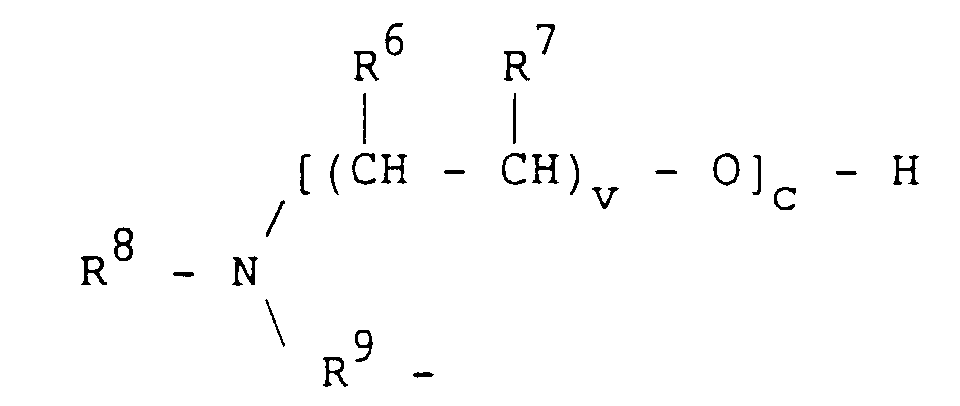
where R1 is an alkenyl radical having one or more double bonds or an alkyl radical and containing from 12 to 50 carbon atoms, or a radical of the formula:
where each of R2, R3, R4, R5, R6 and R7 is independently hydrogen or a lower alkyl radical; R8 is an alkenyl radical having one or more double bonds or an alkyl radical and containing from 12 to 50 carbon atoms; R9 is an alkylene radical containing from 2 to 35, e.g. 2 to 6, carbon atoms; each of p, q and v is an integer between 1 and 4; and each of a, b and c may be 0, providing that at least one of a, b or c is an integer between 1 and 75.
[0010] A second aspect of the invention is the use of a fuel oil composition as defined in the first aspect of the invention as the fuel in a compression-ignition (diesel) engine for controlling wear rate in the injection system of the engine in operation of the engine.
[0011] A third aspect of the invention is a method of operating a compression-ignition (diesel) engine comprising providing a fuel oil composition as defined in the first aspect of the invention as the fuel in the engine thereby to control wear rate in the injection system of the engine.
[0012] The examples of this specification will demonstrate the efficacy of the hydroxy amine additives defined under the first aspect of the invention in reducing wear when fuel oils having a sulphur content of not greater than 0.2% by weight are used.
[0013] Whilst not wishing to be bound by any theory, it is believed that the additive, in use of the composition in a compression-ignition internal combustion engine, is capable of forming over the range of operating conditions of the engine, at least partial mono- or multi-molecular layers of the additive on surfaces of the injection system, particularly the injector pump that are in moving contact with one another, the composition being such as to give rise, when compared with a composition lacking the additive, to one or more of a reduction in wear, a reduction in friction, or an increase in electrical contact resistance in any test where two or more loaded bodies are in relative motion under non-hydrodynamic lubricating conditions.
[0014] The inclusion of the additive in the fuel oil has been found to give rise to the further advantage that the tendency of the fuel oil to foam is markedly reduced, whereby the antifoaming agents conventionally added thereto may be reduced or even eliminated.
ADDITIVE
[0016] As stated, it is believed that the additive, which may be a single hydroxy amine compound or mixture of compounds, is capable of forming at least partial layers on certain surfaces of the engine. By this is meant that the layer formed is not necessarily complete on the contacting surface. Thus, it may cover only part of the area of that contacting surface, for example 10% or more, or 50% or more. The formation of such layers and the extent of their coverage of a contacting surface can be demonstrated by, for example, measuring electrical contact resistance or electrical capacitance.
[0017] An example of a test that can be used to demonstrate one or more of a reduction in wear, a reduction in friction or an increase in electrical contact resistance according to this invention is the High Frequency Reciprocating Rig test which will be referred to hereinafter.
[0018] The hydroxy amine compounds identified above as suitable for use in the invention must contain a group, R1 or R8, attached to a nitrogen atom which is an alkyl or alkenyl group having one or more double bonds, containing 12 to 50, preferably 12 to 30, and more preferably 12 to 25 carbon atoms. The hydroxy functionality is provided by at least one hydroxy alkyl group attached to a nitrogen atom, either directly (as illustrated, for example, by the moiety
when a is 1, or indirectly via an oxyalkylene or polyoxyalkylene linking group (when, for example, a is 2 or more. The hydroxy alkyl group and the oxyalkylene units of any linking group may contain from 2 to 6 carbon atoms, optionally substituted with lower alkyl radicals. By 'lower' alkyl is meant an alkyl group containing 6 or less carbon atoms. Preferably, p, q and v, if present, are equal to 1.
[0019] The hydroxy alkyl group and the oxyalkylene units of any linking group may together form a chain having up to 75 units including the terminal hydroxy alkyl group. Preferably the number of oxyalkylene units does not exceed 10. The most preferred number represented by a, b and c in the structural formula is 1 for each of a, b and when present, c.
[0021] In the structural formula, R9, if present, is preferably an alkylene radical containing from 2 to 6 carbon atoms, which may be a straight or branched chain of carbon atoms.
[0022] Suitable hydroxy amines may be prepared by reaction of amine, substituted with an appropriate R1 or R8 group and having residual amine functionality, with an alkylene oxide, such as ethylene oxide or propylene oxide. Suitable ethoxyamines are commercially available from Armak Company under the trade names 'Ethomeen' and 'Ethanolomeen'.
[0023] The concentration of hydroxy amine which is effective in significantly improving the lubricity of the fuel is extremely low and may readily be determined by the wear tests identified in the Examples. In general, a noticeable reduction in wear is observed using as little as 5 ppm of additive by weight of fuel. Preferred concentrations range from 10 ppm to 0.2% by weight. Although higher concentrations may be used the wear test should be used to determine the optimum concentration. For reasons of economics the minimum effective amount should be used. A concentration between 25 ppm and 1000 ppm is preferred.
[0024] Noticeable reductions in foaming tendency of the fuel are observed at even lower concentrations of the additive and as little as 1 ppm can have a significant foam reducing effect.
FUEL OIL
[0025] The additives of the invention are effective when used with a liquid hydrocarbon middle distillate fuel oil containing not greater than 0.2% by weight of sulphur.
[0026] Preferably, the sulphur concentration is 0.05% by weight or less, such as 0.01% by weight or less, and may be as low as 0.005% by weight. The art describes methods of reducing the sulphur concentration of hydrocarbon distillate fuel oils, such methods including for example solvent extraction, sulphuric acid treatment, and hydrodesulphurisation.
[0027] Middle distillate fuel oils to which this invention is applicable generally boil within the range of 100°C to 500°C, e.g. 150°C to 400°C. The fuel oil can comprise atmospheric distillate or vacuum distillate, or cracked gas oil or a blend in any proportion of straight run and thermally and/or catalytically cracked distillates. The most common petroleum distillates are kerosene, jet fuels, diesel fuels, heating oils and heavy fuel oils, diesel fuels being preferred in the practice of the present invention for the above-mentioned reasons. The heating oil may be a straight atmospheric distillate, or it may contain amounts, e.g. up to 35% by weight of vacuum gas oil or of cracked gas oils or of both.
[0028] The additive may be incorporated into bulk fuel oil by methods known in the art. Conveniently, the additive may be so incorporated in the form of a concentrate comprising an admixture of the additive and a liquid carrier medium compatible with the fuel oil, the additive being dispersed in the liquid medium. Such concentrates preferably contain from 3 to 75 wt %, more preferably 3 to 60 wt %, most preferably 10 to 50 wt % of the additive, preferably in solution in the oil. Examples of carrier liquid are organic solvents including hydrocarbon solvents, for example petroleum fractions such as naphtha, kerosene and heater oil; aromatic hydrocarbons; paraffinic hydrocarbons such as hexane and pentane; alkahols; isoparaffins; and alkoxyalkanols. The carrier liquid must of course be selected having regard to its compatibility with the additive and with the fuel.
CO-ADDITIVES
[0029] The additives of the invention may be used singly or as mixtures of more than one additive. They may also be used in combination with one or more co-additives such as known in the art, for example the following: detergents, antioxidants (to avoid fuel degradation), corrosion inhibitors, dehazers, demulsifiers, metal deactivators, antifoaming agents, cetane improvers, cosolvents, package compatibilisers, and middle distillate cold flow improvers.
EXAMPLES
[0030] The following examples illustrate the invention. The following materials and procedures were used and the results are tabulated below.
Additives
Fuels
[0032]
I: a middle distillate fuel oil having the following characteristics-
- sulphur content (wt %) <0.01
- viscosity at 20°C (cSt) 2.486
- density at 15°C (Kg/dm3) 0.8136
II: a standard kerosene fuel such as commercially available
III: a middle distillate fuel oil having the following characteristics-
- sulphur content (wt %) 0.18
- viscosity at 20°C (cSt) 4.904
- density at 15°C (Kg/dm3) 0.8462
Example 1
[0033] The Additive A was dissolved in the fuels I and II at various concentrations and the resulting compositions tested using the High Frequency Reciprocating Rig (or HFRR) test described in D. Wei and H. Spikes, Wear, Vol. 111, No. 2, p. 217, 1986; and R. Caprotti, C. Bovington, W. Fowler and M. Taylor, SAE paper 922183. SAE fuels and lubes meeting Oct. 1992, San Francisco, USA.
HFRR Test
[0035] The results are expressed as wear scar diameter. Additionally the coefficient of friction was measured. Tests were done at different temperatures as indicated. The concentration of additive used is shown in the table below.
| Additive A Concentration (ppm, weight/weight) | Coefficient of Friction | Wear Scar Diameter (mm) | |||
| 20°C | 60°C | 20°C | 60°C | ||
| Fuel I | Nil | 0.48 | 0.55 | 0.58 | 0.67 |
| 50 | 0.37 | 0.38 | 0.52 | 0.60 | |
| 100 | 0.24 | 0.32 | 0.38 | 0.58 | |
| 500 | 0.22 | 0.22 | 0.31 | 0.42 | |
| Fuel II | Nil | 0.34 | 0.35 | 0.59 | 0.77 |
| 50 | 0.32 | 0.32 | 0.53 | 0.52 | |
| 100 | 0.26 | 0.26 | 0.35 | 0.50 | |
| 500 | 0.24 | 0.24 | 0.34 | 0.45 | |
Example 2
[0037] Additive A was added to fuel oil III at various concentrations and the antifoam performance was measured at 0°C. The test used was as follows:
[0038] Each sample was agitated vigorously for a period and the time, in seconds, for the foam to collapse was then observed. The results of the untreated and treated fuels are compared in the table below.
| Additive A Concentration (ppm, weight/weight) | Foam Collapse Time (sec) (Average of 2 readings) | |
| Fuel III | 0 | 83.5 |
| 5 | 40 | |
| 50 | 35 | |
| 500 | 15.5 |
1. A fuel oil composition comprising a major proportion of a liquid hydrocarbon middle
distillate fuel oil having a sulphur content of between 0.2% and 0.005% by weight
of the fuel oil and a minor proportion of at least one hydroxy amine of formula:
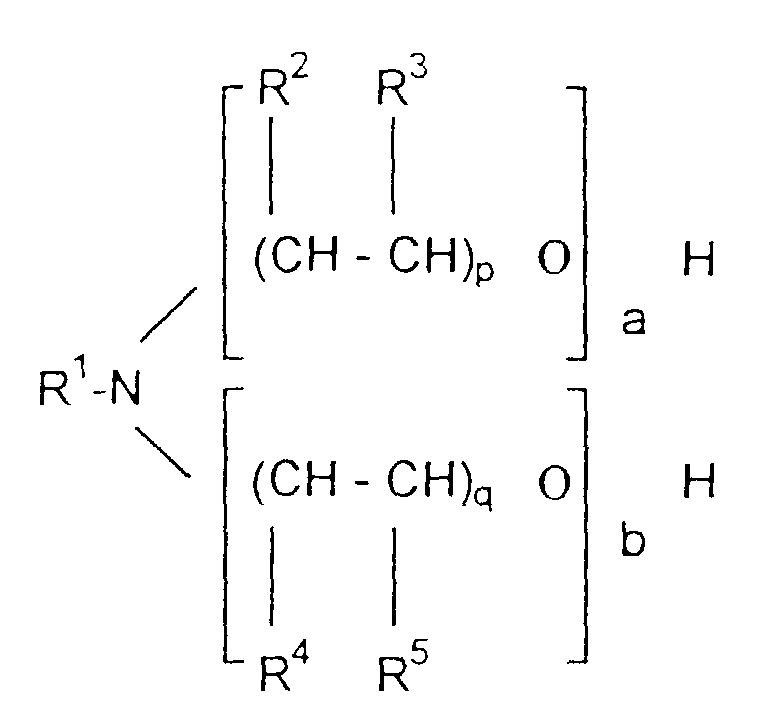
where R1 is an alkenyl radical having one or more double bonds or an alkyl radical and containing from 12 to 50 carbon atoms, or a radical of the formula:
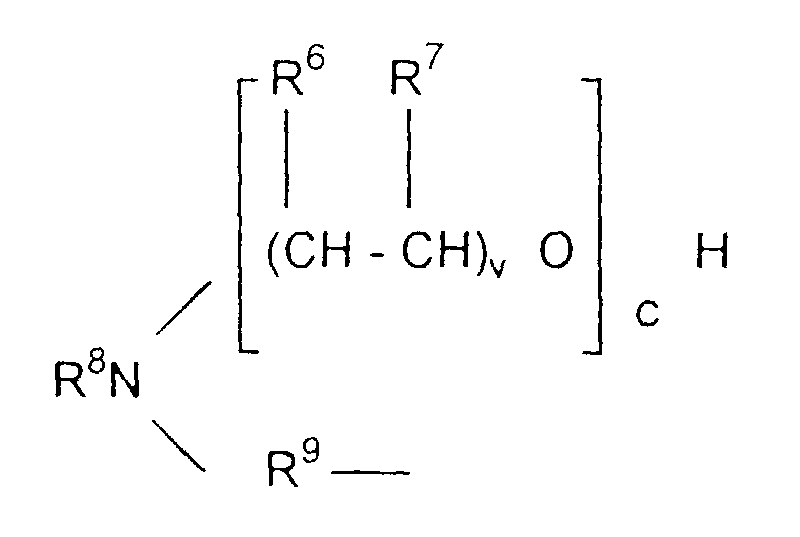
where each of R2, R3, R4, R5, R6 and R7 is independently hydrogen or a lower alkyl radical; R8 is an alkenyl radical having one or more double bonds or an alkyl radical and containing from 12 to 50 carbon atoms; R9 is an alkylene radical containing from 2 to 35 carbon atoms; each of p, q and v is an integer between 1 and 4 and each of a, b and c may be 0, providing that at least one of a, b or c is an integer between 1 and 75.
where R1 is an alkenyl radical having one or more double bonds or an alkyl radical and containing from 12 to 50 carbon atoms, or a radical of the formula:
where each of R2, R3, R4, R5, R6 and R7 is independently hydrogen or a lower alkyl radical; R8 is an alkenyl radical having one or more double bonds or an alkyl radical and containing from 12 to 50 carbon atoms; R9 is an alkylene radical containing from 2 to 35 carbon atoms; each of p, q and v is an integer between 1 and 4 and each of a, b and c may be 0, providing that at least one of a, b or c is an integer between 1 and 75.
2. A fuel oil composition according to claim 1 wherein the sulphur content is not greater
than 0.05% by weight.
3. A fuel oil composition according to claim 2 wherein the sulphur content is not greater
than 0.01 % by weight.
4. A fuel oil composition according to any one of the preceding claims wherein R1 or R8, if present, contains from 12 to 25 carbon atoms.
5. A fuel oil composition according to any one of the preceding claims wherein a, b and
c, if present, do not exceed 10.
6. A fuel oil composition according to any one of the preceding claims in which R2 to R7 are either hydrogen or methyl.
7. A fuel oil composition according to any one of the preceding claims in which the concentration
of hydroxy amine is from 1 ppm to 2000 ppm by weight of the fuel oil.
8. A fuel oil composition according to any of the preceding claims wherein the hydroxy
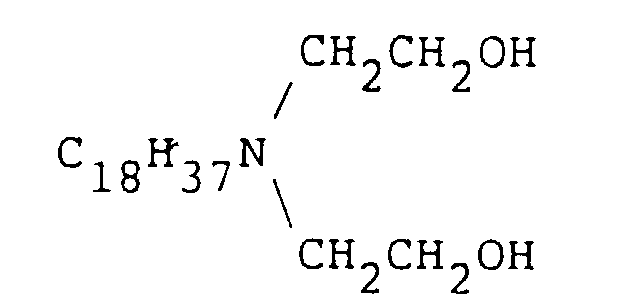
amine is of the formula:
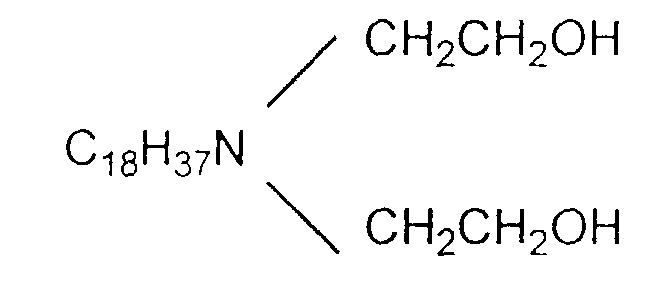
9. The use of a fuel oil composition as claimed in any one of the preceding claims as
the fuel in a compression-ignition engine for controlling wear rate in the injection
system of the engine in operation of the engine.
10. A method of operating a compression-ignition engine comprising providing a fuel oil
composition according to any one of claims 1 to 8 as the fuel in the engine thereby
to control wear rate in the injection system of the engine.
1. Brennstoffölzusammensetzung, die einen größeren Anteil eines flüssigen Kohlenwasserstoffmitteldestillatbrennstofföls
mit einem Schwefelgehalt von 0,2 bis 0,005 Gew.% des Brennstofföls und einen geringeren
Anteil von mindestens einem Hydroxyamin mit der Formel
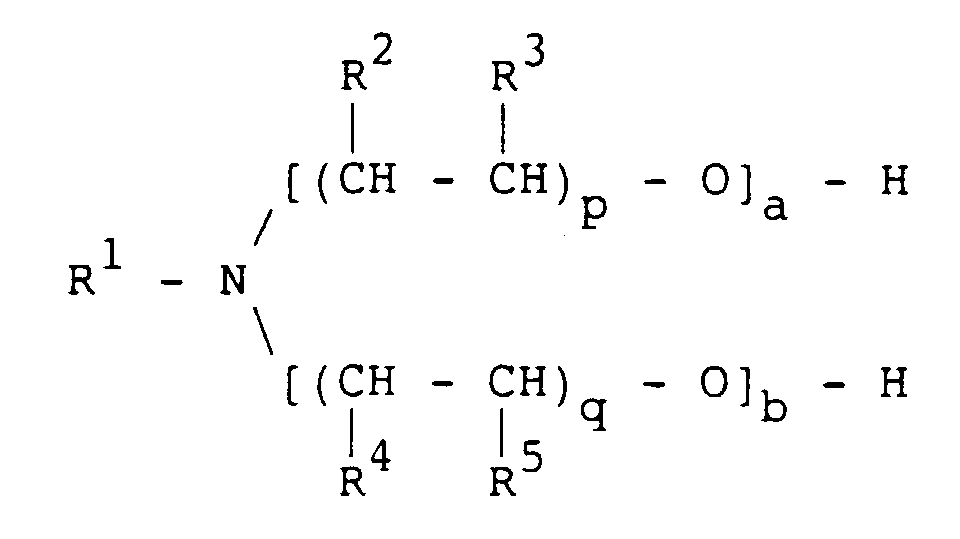
umfaßt, wobei R1 ein Alkenylrest mit einer oder mehreren Doppelbindungen oder ein Alkylrest ist und 12 bis 50 Kohlenstoffatome enthält, oder ein Rest mit der Formel
ist, wobei jeder von R2, R3, R4, R5, R6 und R7 unabhängig Wasserstoff oder ein niederer Alkylrest ist, R8 ein Alkenylrest mit einer oder mehreren Doppelbindungen oder ein Alkylrest ist und 12 bis 50 Kohlenstoffatome enthält, R9 ein Alkylenrest ist, der 2 bis 35 Kohlenstoffatome enthält, jedes von p, q und v eine Zahl zwischen 1 und 4 ist und jedes von a, b und c 0 sein kann mit der Maßgabe, daß mindestens eines von a, b oder c eine Zahl zwischen 1 und 75 ist.
umfaßt, wobei R1 ein Alkenylrest mit einer oder mehreren Doppelbindungen oder ein Alkylrest ist und 12 bis 50 Kohlenstoffatome enthält, oder ein Rest mit der Formel
ist, wobei jeder von R2, R3, R4, R5, R6 und R7 unabhängig Wasserstoff oder ein niederer Alkylrest ist, R8 ein Alkenylrest mit einer oder mehreren Doppelbindungen oder ein Alkylrest ist und 12 bis 50 Kohlenstoffatome enthält, R9 ein Alkylenrest ist, der 2 bis 35 Kohlenstoffatome enthält, jedes von p, q und v eine Zahl zwischen 1 und 4 ist und jedes von a, b und c 0 sein kann mit der Maßgabe, daß mindestens eines von a, b oder c eine Zahl zwischen 1 und 75 ist.
2. Brennstoffölzusammensetzung nach Anspruch 1, bei der der Schwefelgehalt nicht größer
als 0,05 Gew.% ist.
3. Brennstoffölzusammensetzung nach Anspruch 2, bei der der Schwefelgehalt nicht größer
als 0,01 Gew.% ist.
4. Brennstoffölzusammensetzung nach einem der vorhergehenden Ansprüche, bei der R1 oder R8, falls vorhanden, 12 bis 25 Kohlenstoffatome enthält.
5. Brennstoffölzusammensetzung nach einem der vorhergehenden Ansprüche, bei der a, b
und c, falls vorhanden, 10 nicht überschreiten.
6. Brennstoffölzusammensetzung nach einem der vorhergehenden Ansprüche, in der R2 bis R7 entweder Wasserstoff oder Methyl sind.
7. Brennstoffölzusammensetzung nach einem der vorhergehenden Ansprüche, bei der die Konzentration
an Hydroxyamin 1 ppm bis 2000 ppm, bezogen auf das Gewicht des Brennstoffs, beträgt.
8. Brennstoffölzusammensetzung nach einem der vorhergehenden Ansprüche, bei der das Hydroxyamin
die Formel
hat.
hat.
9. Verwendung einer Brennstoffölzusammensetzung gemäß einem der vorhergehenden Ansprüche
als Brennstoff in einem kompressionsgezündeten Motor zum Kontrollieren der Verschleißrate
des Einspritzsystems des Motors bei Betrieb des Motors.
10. Verfahren zum Betreiben eines kompressionsgezündeten Motors, bei dem eine Brennstoffölzusammensetzung
gemäß einem der Ansprüche 1 bis 8 als Brennstoff in dem Motor bereitgestellt wird,
um dadurch die Verschleißrate in dem Einspritzsystem des Motors zu kontrollieren.
1. Composition de fuel-oil, comprenant une proportion dominante d'un fuel-oil distillé
moyen hydrocarboné liquide ayant une teneur en soufre comprise dans l'intervalle de
0,2 % à 0,005 % en poids du fuel-oil et une petite proportion d'au moins une hydroxyamine
de formule :
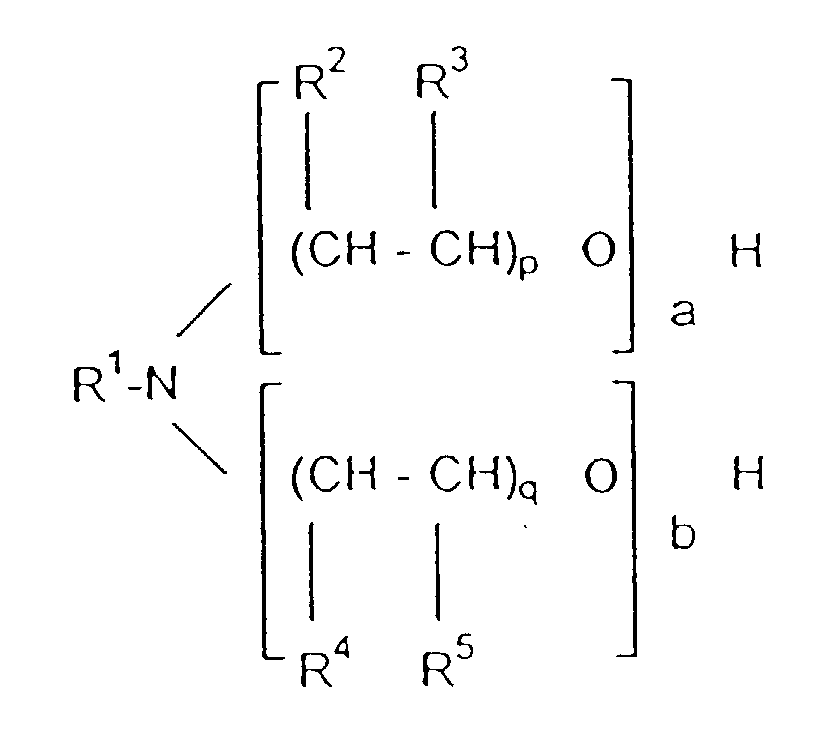
dans laquelle R1 représente un radical alcényle ayant une ou plusieurs doubles liaisons ou un radical alkyle et contenant 12 à 50 atomes de carbone, ou un radical de formule :
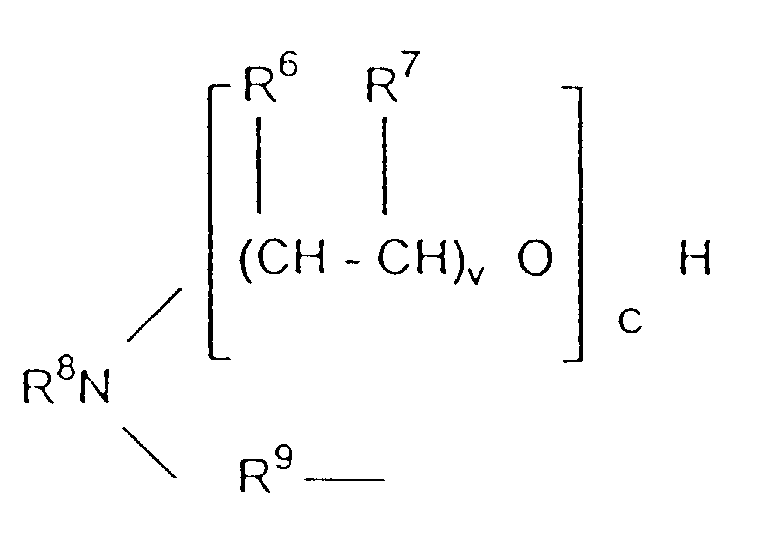
dans laquelle chacun des groupes R2, R3, R4, R5, R6 et R7 représente indépendamment l'hydrogène ou un radical alkyle inférieur ; R8 représente un radical alcényle ayant une ou plusieurs doubles liaisons ou un radical alkyle contenant 12 à 50 atomes de carbone ; R9 représente un radical alkylène contenant 2 à 35 atomes de carbone ; chacun des indices p, q et v représente un nombre entier de 1 à 4 et chacun des indices a, b et c peut être égal à 0, sous réserve qu'au moins un des indices a, b et c représente un nombre entier de 1 à 75.
dans laquelle R1 représente un radical alcényle ayant une ou plusieurs doubles liaisons ou un radical alkyle et contenant 12 à 50 atomes de carbone, ou un radical de formule :
dans laquelle chacun des groupes R2, R3, R4, R5, R6 et R7 représente indépendamment l'hydrogène ou un radical alkyle inférieur ; R8 représente un radical alcényle ayant une ou plusieurs doubles liaisons ou un radical alkyle contenant 12 à 50 atomes de carbone ; R9 représente un radical alkylène contenant 2 à 35 atomes de carbone ; chacun des indices p, q et v représente un nombre entier de 1 à 4 et chacun des indices a, b et c peut être égal à 0, sous réserve qu'au moins un des indices a, b et c représente un nombre entier de 1 à 75.
2. Composition de fuel-oil suivant la revendication 1, dans laquelle la teneur en soufre
est non supérieure à 0,05 % en poids.
3. Composition de fuel-oil suivant la revendication 2, dans laquelle la teneur en soufre
est non supérieure à 0,01 % en poids.
4. Composition de fuel-oil suivant l'une quelconque des revendications précédentes, dans
laquelle R1 ou R8, s'il est présent, contient 12 à 25 atomes de carbone.
5. Composition de fuel-oil suivant l'une quelconque des revendications précédentes, dans
laquelle a, b et c, s'ils sont présents, ont un valeur ne dépassant pas 10.
6. Composition de fuel-oil suivant l'une quelconque des revendications précédentes, dans
laquelle R2 à R7 représentent l'hydrogène ou un groupe méthyle.
7. Composition de fuel-oil suivant l'une quelconque des revendications précédentes, dans
laquelle la concentration d'hydroxyamine est comprise dans l'intervalle de 1 ppm à
2000 ppm en poids du fuel-oil.
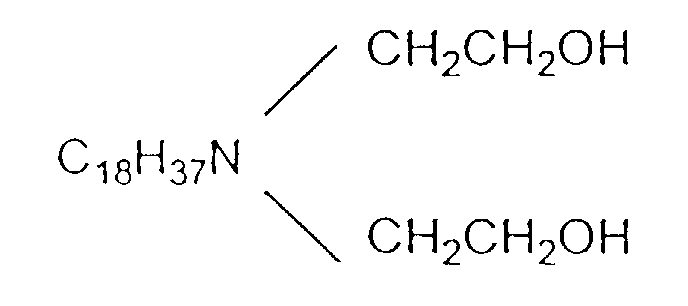
8. Composition de fuel-oil suivant l'une quelconque des revendications précédentes, dans
laquelle l'hydroxyamine répond à la formule :
9. Utilisation d'une composition de fuel-oil suivant l'une quelconque des revendications
précédentes comme carburant dans un moteur à allumage par compression pour limiter
la vitesse d'usure dans le système d'injection du moteur lors du fonctionnement de
ce moteur.
10. Procédé pour faire fonctionner un moteur à allumage par compression, comprenant l'utilisation
d'une composition de fuel-oil suivant l'une des quelconques des revendications 1 à
8 comme carburant dans ce moteur pour limiter ainsi la vitesse d'usure dans le système
d'injection du moteur.