|
(11) | EP 0 805 198 A1 |

| (12) | EUROPEAN PATENT APPLICATION |
|
|
|
|
|||||||||||||||||||
| (54) | Cleaning compositions |
| (57) A cleaning composition which provides effective cleaning and shine performance, said
composition comprising a surfactant system comprising an amine oxide and a betaine
or sulphobetaine surfactant in a weight ratio of amine oxide to betaine or sulphobetaine
of 6:1 to 100:1. Preferably, the composition comprises a solvent for enhanced cleaning
and shine performance of the composition. More preferably, the composition further
comprises an antimicrobial compound and/or a peroxygen bleach for enhanced disinfection
performance. |
Technical field of the Invention
[0001] The present invention relates to a cleaning composition which provides an effective cleaning and shine performance on surfaces, especially hard surfaces.
Background of the invention
[0002] The formulation of compositions which provide cleaned shiny surfaces is a problem known in the art to the formulator of a cleaning composition. More particularly, the problem of providing shiny surfaces is often compromised by residues of the compositions which are left on said surfaces and which appear as streaks as water evaporation is completed. The problem of the residuality is even more noticeable where the composition is used to clean surfaces made of glossy materials, such as glossy ceramic tiles, windows and mirrors, or such materials as polyurethane-coated PVC which is widely used in Northern America. Furthermore, nowadays, many products are formulated or can be used as no-rinse products. In such conditions or with such products, the problem of residuality has become more acute.
[0003] Accordingly, there is a need for a composition which provides effective cleaning performance but also provides the cleaned surfaces with a shiny effect without any residues.
[0004] Numerous solutions have been proposed in the art to solve this need, including the use of an acid, magnesium ions, or the use of certain solvents as described in WO 95/21229, EP 0 639 833 or US 3,839,234.
[0005] The applicant has now surprisingly found that this need could also be met by formulating a composition which comprises a surfactant system comprising an amine oxide surfactant and a betaine or a sulphobetaine surfactant in specific ratios.
[0006] This finding is especially surprising as the use of amine oxide surfactants, which provide effective cleaning, has been found to form crystals upon drying, which resulted in spotting residues on the cleaned surface; while on the other hand the use of betaine or sulphobetaine surfactants, also effective cleaning components, left amorphous residues resulting in a greasy film on the surface. Surprisingly, the use of a mixture of an amine oxide and a betaine or a sulphobetaine surfactant in specific ratios not only provides an effective cleaning of the surfaces but also causes said residues to appear less, or even not to appear anymore.
[0007] The applicant has further found that the addition of solvents to this surfactant system provides an enhanced cleaning and shine benefit.
[0008] It is therefore an advantage of the invention to provide a composition which provides effective cleaning and shine performance on surfaces.
[0009] The applicant has also found that the addition of a peroxygen bleach and/or an antimicrobial compound like antimicrobial essential oils or actives thereof provides enhanced disinfection on a surface, even at high dilution levels, e.g., up to dilution levels of from 1:100 (composition: water).
[0010] It is thus another advantage of the invention to provide a composition with effective disinfection performance.
[0011] It is yet another advantage of the invention to provide a composition which is mild to the skin.
Summary of the Invention
[0012] The present invention relates to a cleaning composition comprising a surfactant system comprising an amine oxide and a betaine or a sulphobetaine surfactant in a weight ratio of amine oxide to betaine or sulphobetaine of 6:1 to 100:1.
[0013] In a preferred embodiment of the invention, the composition comprises a solvent for enhanced cleaning and shine performance of the composition.
[0014] In another preferred embodiment of the invention, the composition further comprises a peroxygen bleach and/or an antimicrobial compound like an antimicrobial essential oil or actives thereof or mixtures thereof for providing the composition with effective disinfecting performance.
Detailed description of the invention
[0015] An essential feature of the invention is a surfactant system, said system comprising an amine oxide and a betaine or a sulphobetaine surfactant in specific weight ratios of amine oxide to betaine or a sulphobetaine surfactant.
Amine oxide surfactant
[0016] Amine oxides to be used herein are compounds corresponding to the formula:
R R' R'' N→O
wherein R is a primary alkyl group containing 6-24 carbons, preferably 10-18 carbons, and wherein R' and R'' are, each, independently selected from methyl, ethyl and 2-hydroxyethyl. The arrow in the formula is a conventional representation of a semi-polar bond.
[0017] The preferred amine oxides are those in which the primary alkyl group has a straight chain in at least most of the molecules, generally at least 70%, preferably at least 90% of the molecules, and the amine oxides which are especially preferred are those in which R contains 10-18 carbons and R' and R'' are both methyl.
[0018] Exemplary of the preferred amine oxides are the N-hexyldimethylamine oxide, N-octyldimethylamine oxide, N-decyldimethylamine oxide, N-dodecyl dimethylamine oxide, N-tetradecyldimethylamine oxide, N-hexadecyl dimethylamine oxide, N-octadecyldimethylamine oxide, N-eicosyldimethylamine oxide, N-docosyldimethylamine oxide, N-tetracosyl dimethylamine oxide, the corresponding amine oxides in which one or both of the methyl groups are replaced with ethyl or 2-hydroxyethyl groups and mixtures thereof. A most preferred amine oxide for use herein is N-decyldimethylamine oxide.
Betaine or a sulphobetaine surfactant
[0019] The composition according to the present invention comprises a betaine or a sulphobetaine surfactant, or derivatives thereof, or mixtures thereof. A further advantage of the invention is the mild action profile of said betaine and/or sulphobetaine surfactants. Accordingly, the compositions herein may be particularly suitable for the cleaning of delicate surfaces, e.g. delicate laundry or surfaces in contact with food and/or babies. Furthermore, betaine and/or sulphobetaine surfactants are also extremely mild to the skin, and thus contribute to the convenience of use of the compositions of the present invention by the user.
[0020] Suitable betaine/sulphobetaine surfactants to be used in the compositions of the present invention are the betaine/sulphobetaine and betaine-like detergents wherein the molecule contains both basic and acidic groups which form an inner salt giving the molecule both cationic and anionic hydrophilic groups over a broad range of pH values. Some common examples of these detergents are described in U.S. Pat. Nos. 2,082,275, 2,702,279 and 2,255,082, incorporated herein by reference. Preferred betaine or sulphobetaine surfactants have the formula
wherein R1 is an alkyl radical containing from about 1 to about 24 carbon atoms, preferably from 8 to 18, and more preferably from 12 to 14, wherein R2 and R3 contain from 1 to 3 carbon atoms, and preferably 1 carbon atom, wherein n is an integer of from 1 to 10, preferably from 1 to 6 and more preferably is 1, Y is selected from the group consisting of carboxyl and sulfonyl radicals and wherein the sum of R1, R2 and R3 radicals is from about 14 to about 24 carbon atoms, or mixtures thereof.
[0021] Examples of particularly suitable betaine surfactants include C12-C18 alkyl dimethyl betaine such as the coconut betaine and C10-C16 alkyl dimethyl betaine such as the lauryl betaine.
[0022] Coconut betaine and Lauryl betaine are commercially available from Seppic and Albright & Wilson respectively, under the trade name of Amonyl 265® and Empigen BB/L® respectively.
[0023] Typically, the compositions herein comprise at least 0.005% by weight of the total composition of said betaine or sulphobetaine surfactant, or derivatives thereof, or mixtures thereof, preferably from 0.01% to 10%, and more preferably from 0.1% to 5%.
[0024] The weight ratios of amine oxide to betaine or sulphobetaine are an important feature of the invention. Hence, ratios outside the range below, such as those where the betaine or sulphobetaine surfactant is in higher proportion than the amine oxide, would not provide the cleaning and shine benefit but only the cleaning benefit while still leaving greasy residues. On the other hand, a ratio above 100:1 of amine oxide to betaine or sulphobetaine surfactant would result in a surface showing spotty residues of the crystalline type. Thus, it is an important feature that the amine oxide and betaine or sulphobetaine surfactant be present within the composition in a weight ratio of 1:1 to 100:1, preferably from 10:1 to 50:1, more preferably 15:1 to 30:1.
Additional components
[0025] The composition of the invention may, optionally, contain additional components such as solvents, peroxygen bleach, chelants, antimicrobial compounds and mixtures thereof.
Solvents
[0026] When used, solvents will, advantageously, give an enhanced cleaning and shine performance to the composition. Suitable solvents for incorporation in the compositions according to the present invention include propylene glycol derivatives such as n-butoxypropanol or n-butoxypropoxypropanol, water-soluble CARBITOL® solvents or water-soluble CELLOSOLVE® solvents. Water-soluble CARBITOL® solvents are compounds of the 2-(2-alkoxyethoxy)ethanol class wherein the alkoxy group is derived from ethyl, propyl or butyl. A preferred water-soluble carbitol is 2-(2-butoxyethoxy)ethanol also known as butyl carbitol. Water-soluble CELLOSOLVE® solvents are compounds of the 2-alkoxyethoxyethanol class, with 2-butoxyethoxyethanol being preferred. Other suitable solvents are benzyl alcohol, ethanol, isopropyl alcohol and diols such as 2-ethyl-1,3-hexanediol and 2,2,4-trimethyl-1,3-pentanediol and mixture thereof. Preferred solvents for use herein are n-butoxypropoxypropanol, butyl carbitol® and mixtures thereof. A most preferred solvent for use herein is butyl carbitol®.
[0027] The solvents may typically be present within the undiluted composition of the invention at a level of 0.01% to 10% by weight, preferably 3% to 7% by weight of the composition.
Peroxygen bleach
[0028] Another suitable additional component for use herein is a peroxygen bleach. Peroxygen bleach, especially hydrogen peroxide, persulfate and the like, in the compositions of the present invention advantageously contribute to the disinfection properties of said compositions. Hence, not to be bound by theory, it is believed that said peroxygen bleach may attack the vital function of the micro-organism cells, for example, it may inhibit the assembling of ribosomes units within the cytoplasm of the micro-organism cells. Also, said peroxygen bleach like hydrogen peroxide, is a strong oxidizer that generates hydroxyl free radicals which attack proteins and nucleic acids. Furthermore, the presence of said peroxygen bleach, especially hydrogen peroxide, provides strong stain removal benefits which are particularly noticeable for example in laundry and hard surfaces applications.
[0029] As used herein, a hydrogen peroxide source refers to any compound which produces hydrogen peroxide when said compound is in contact with water. Suitable water-soluble sources of hydrogen peroxide for use herein include percarbonates, persilicate, persulphate such as monopersulfate, perborates and peroxyacids such as diperoxydodecandioic acid (DPDA), magnesium perphthalic acid and mixtures thereof.
[0030] A preferred peroxygen bleach is hydrogen peroxide, or a water soluble source thereof, or mixtures thereof. A most preferred peroxygen bleach is hydrogen peroxide.
[0031] In addition to the peroxygen bleach, other classes of peroxides can be used as an alternative to hydrogen peroxide and sources thereof or in combination with hydrogen peroxide and sources thereof. Suitable classes include dialkylperoxides, diacylperoxides, preformed percarboxylic acids, organic and inorganic peroxides.
[0032] Typically, the compositions herein may comprise at least 0.01% by weight of the total composition of said peroxygen bleach or mixtures thereof, preferably from 0.1% to 15%, more preferably from 0.8% to 10% and most preferably 1% to 5%.
Chelating agents
[0033] Chelating agents are also additional components which may be suitable for use herein. Preferred chelating agents are those selected from the group of aminophosphonates. Suitable amino phosphonate compounds for use herein include amino alkylene poly (alkylene phosphonate), alkali metal ethane 1-hydroxy diphosphonates, nitrilo trimethylene phosphonates, ethylene diamine tetra methylene phosphonates, and diethylene triamine penta methylene phosphonates. The phosphonate compounds may be present either in their acid form or as salts of different cations on some or all of their acid functionalities. Preferred amino phosphonate chelants to be used herein are diethylene triamine penta methylene phosphonate. Such phosphonate chelant is commercially available from Monsanto under the trade name DEQUEST®.
[0034] Said chelating agents, especially phosphonate chelating agents like diethylene triamine penta methylene phosphonates, are particularly preferred in the compositions according to the present invention as they have been found to further contribute to the disinfecting properties of hydrogen peroxide.
[0035] Typically, the compositions according to the present invention may comprise up to 5% by weight of the total composition of a chelating agent, or mixtures thereof, preferably from 0.002% to 3% by weight and more preferably from 0.002% to 1.5% by weight of the composition.
Antimicrobial compounds
[0036] Another suitable additional component for use herein is an antimicrobial compound or mixtures thereof.
[0037] Suitable antimicrobial compounds to be used herein include antimicrobial essential oils, actives thereof and mixtures thereof. Suitable antimicrobial essential oils to be used herein are those essential oils which exhibit antimicrobial activity. By "actives of essential oils" it is meant herein any ingredient of essential oils that exhibit antimicrobial activity. It is speculated that said antimicrobial essential oils and actives thereof act as proteins denaturing agents. Also said antimicrobial oils and actives thereof are compounds which contribute to the safety profile of a composition according to the present invention when used to disinfect any surface. A further advantage of said antimicrobial oils and actives thereof is that they impart pleasant odor to a composition comprising them without the need of adding a perfume.
[0038] Such essential oils include, but are not limited to, those obtained from thyme, lemongrass, citrus, lemons, oranges, anise, clove, aniseed, cinnamon, geranium, roses, mint, lavender, citronella, eucalyptus, peppermint, camphor, sandalwood and cedar and mixtures thereof.
[0039] Actives of essential oils to be used herein include, but are not limited to, thymol (present for example in thyme), eugenol (present for example in cinnamon and clove), menthol (present for example in mint), geraniol (present for example in geranium and rose), verbenone (present for example in vervain), eucalyptol and pinocarvone (present in eucalyptus), cedrol (present for example in cedar), anethol (present for example in anise), carvacrol, hinokitiol, berberine, ferulic acid, cinnamic acid, methyl salycilic acid, methyl salycilate, terpineol and mixtures thereof. Preferred actives of essential oils to be used herein are thymol, eugenol, verbenone, eucalyptol, terpineol, cinnamic acid, methyl salycilic acid and/or geraniol.
[0040] Thymol may be commercially available for example from Aldrich, eugenol may be commercially available for example from Sigma, Systems - Bioindustries (SBI) - Manheimer Inc.
[0041] Typically, the antimicrobial essential oil or actives thereof or mixture thereof may be present in the composition herein at a level of at least 0.003% by weight of the total composition, preferably from 0.006% to 10%, more preferably from 0.01% to 4% and most preferably from 0.02% to 2%.
[0042] Other antimicrobial compounds may be used in the compositions of the present invention like glutaraldehyde and/or paraben including ethyl paraben, methyl paraben, propyl paraben or mixtures thereof up to a level of 5% by weight of the total composition.
[0043] In the embodiment of the present invention where the compositions herein comprise an antimicrobial compound, especially an antimicrobial essential oil or an active thereof or mixtures thereof, effective disinfection is obtained on a variety of microorganisms including Gram positive bacteria like Staphylococcus aureus, and Gram negative bacteria like Pseudomonas aeroginosa as well as on fungi like Candida albicans present on a surface, even if used in highly diluted conditions.
[0044] The following disinfecting test method may be applied to measure the disinfection property of the composition:
Disinfecting test method
[0045] Disinfection properties of a composition may be measured by the bactericidal activity of said composition. A test method to evaluate the bactericidal activity of a composition is described in European Standard, prEN 1040, CEN/TC 216 N 78, dated November 1995 issued by the European committee for standardisation, Brussels. European Standard, prEN 1040, CEN/TC 216 N 78, specifies a test method and requirements for the minimum bactericidal activity of a disinfecting composition. The test is passed if the bacterical colonies forming units (cfu) are reduced from a 107 cfu (initial level) to a 102 cfu (final level after contact with the disinfecting product), i.e. a 105 reduction of the viability is necessary.
Optional compounds
[0046] The compositions herein may further comprise a variety of other optional compounds including builders, buffers, bactericides, enzymes, hydrotropes, colorants, stabilizers, bleach activators, soil suspenders, dye transfer agents, brighteners, perfumes, anti dusting agents, dispersant, dye transfer inhibitors, pigments, perfumes, dyes and mixtures thereof.
Formulation form of the compositions
[0047] The compositions according to the present invention may be formulated either as solids or liquids. In the case where the compositions are formulated as solids, they will be mixed with an appropriate solvent, typically water, before use. In liquid form, the compositions are preferably but not necessarily formulated as aqueous compositions. Liquid compositions are preferred herein for convenience of use.
Packaging form of the compositions
[0048] The compositions herein may be packaged in a variety of suitable detergent packaging known to those skilled in the art. The liquid compositions herein may desirably be packaged in manually operated spray dispensing containers, which are usually made of synthetic organic polymeric plastic materials. Accordingly, the present invention also encompasses liquid cleaning compositions of the invention packaged in a spray dispenser, preferably in a trigger spray dispenser. Indeed, said spray-type dispensers allow to uniformly apply to a relatively large area of a surface to be cleaned the liquid cleaning compositions suitable for use according to the present invention; thereby contributing to the cleaning properties of said compositions. Such spray-type dispensers are particularly suitable to clean vertical surfaces.
[0049] Suitable spray-type dispensers to be used according to the present invention include manually operated foam trigger-type dispensers sold for example by Specialty Packaging Products, Inc. or Continental Sprayers, Inc. These types of dispensers are disclosed, for instance, in US-4,701,311 to Dunnining et al. and US-4,646,973 and US-4,538,745 both to Focarracci. Particularly preferred to be used herein are spray-type dispensers such as T 8500® commercially available from Continental Spray International or T 8100® commercially available from Canyon, Northern Ireland. In such a dispenser the liquid composition is divided in fine liquid droplets resulting in a spray that is directed onto the surface to be treated. Indeed, in such a spray-type dispenser the composition contained in the body of said dispenser is directed through the spray-type dispenser head via energy communicated to a pumping mechanism by the user as said user activates said pumping mechanism. More particularly, in said spray-type dispenser head the composition is forced against an obstacle, e.g. a grid or a cone or the like, thereby providing shocks to help atomise the liquid composition, i.e. to help the formation of liquid droplets.
[0050] The compositions of the present invention may also be executed in the form of wipes. By "wipes" it is meant herein disposable towels, e.g., paper towels, incorporating a composition according to the present invention. Accordingly, the present invention also encompasses wipes, e.g. disposable paper towels, incorporating a liquid composition according to the present invention. In the preferred execution said wipes are impregnated, more preferably wetted with said liquid compositions. Preferably said wipes are packaged in a plastic box. The advantage of this execution is a faster usage of a cleaning composition by the user, this even outside the house, i.e. there is no need to pour the liquid compositions according to the present invention on the surfaces to be treated and to dry it out with a cloth. In other words, wipes allow cleaning of surfaces in one step.
[0051] The present invention encompasses a process for cleaning surfaces wherein a composition according to the present invention is applied onto said surfaces.
[0052] By "surface" it is meant herein any surface including hard-surfaces like bathroom, kitchen, floors, table tops, refrigerators, walls, tiles, wash surfaces and the like.
[0053] In the process of cleaning surfaces according to the present invention said compositions may be applied to the surface to be disinfected in its neat form or in its diluted form.
[0054] By "diluted form" it is meant herein that the compositions to be used in the cleaning process herein being either in a liquid or solid form may be diluted by the user typically up to 1000 times their weight of water, preferably up to 300 times, more preferably into 80 to 30 times their weight of water, and most preferably 60 to 40 times.
[0055] In a preferred embodiment, the compositions according to the present invention are aqueous liquid cleaning compositions. Said aqueous compositions preferably have a pH as is of not more than 12.0, more preferably from 4 to 12, and most preferably from 4 to 10. The pH of the compositions can be adjusted by using organic or inorganic acids, or alkalinising agents.
[0056] In a preferred embodiment of the process of the present invention wherein said composition is applied to a surface to be cleaned, such as a hard-surface, in its diluted form, it is not necessary to rinse the surface after the composition has been applied; indeed, no visible residues are left onto the surface.
[0057] The invention is illustrated in the following non limiting examples, in which all percentages are on a weight basis unless otherwise stated.
Cleaning test method
[0059] Standard enamel plates were soiled by applying on them a grease/particulate matter and then baking them. The tested compositions were then applied on a sponge and then placed onto a Gardner Machine. The Gardner machine measured the number of strokes needed to reach 95-99% clean plates. The performance was measured as such (i.e undiluted) and upon dilution at 1.5% in water.
Shine test method
[0060] Five millimeters of test product are applied to one face of a wetted sponge. The wetted sponge is applied in one motion with even pressure from top to bottom of a previously cleaned, with isopropyl alcohol, black tile. The tile with the applied product(s) is allowed to dry for ten minutes before grading by expert judges. The control reference is made by repeating the above test with a wetted sponge but without the tested product.
[0061] Expert judges are employed to evaluate the specific area of product application for amount of filming/streaking. A numerical value describing the amount of filming/streaking is assigned to each product. For the test results, a 0-4 scale is used
0=There is no difference between the tested product and the control reference, i.e. poor filming/streaking performance of the tested product.
4=There is a clear difference between the product and the control reference, i.e. no filming/streaking with the tested product.
[0062] In the examples, the abbreviated component identifications have the following meanings:
- amine oxide
- : N-decyldimethyl amine oxide
- betaine
- : Coco alkyldimethyl betaine available from Albright & Wilson under the trade name of Empigen BB/L®
- butyl carbitol®
- : 2-(2-butoxyethoxy)ethanol
Example 1
[0063] The following composition, according to the present invention, was made by mixing the listed ingredients in the listed proportions :
| A | B | C | D | E | F | |
| Amine oxide | 1 | 1 | 1 | 0.9 | 1 | 1 |
| betaine | 0.05 | 0.05 | 0.05 | 0.05 | 0.05 | 0.05 |
| butyl carbitol® | - | 5 | 5 | 5 | - | 5 |
| eugenol | - | - | 0.05 | 0.08 | - | - |
| hydrogen peroxide | - | - | 1 | - | 2 | 2 |
| Water and minors up to 100 | ||||||
| H2SO4 up to pH 4 | ||||||
Example 2
[0064] The following compositions are in accordance with the invention:
| G | H | I | J | K | |
| Amine oxide | 1 | 1 | 2 | 8 | 5 |
| betaine | 0.05 | 0.05 | 0.1 | 0.5 | 0.2 |
| butyl carbitol® | - | 5 | 5 | - | 5 |
| eugenol | - | 0.05 | - | - | - |
| hydrogen peroxide | - | 1 | - | 1 | 2 |
| Water and minors up to 100 | |||||
| H2SO4 up to pH 5 | |||||
| L | M | N | O | P | Q | |
| Amine oxide | 1 | 2 | 1 | 0.9 | 5 | 8 |
| betaine | 0.05 | 0.1 | 0.05 | 0.05 | 0.2 | 0.5 |
| butyl carbitol® | - | 5 | 5 | 5 | 5 | - |
| eugenol | - | - | 0.05 | 0.08 | - | - |
| hydrogen peroxide | - | - | 1 | - | 2 | 1 |
| Water and minors up to 100 | ||||||
| H2SO4 up to pH 9 | ||||||
1. A cleaning composition comprising a surfactant system comprising an amine oxide and
a betaine or sulphobetaine surfactant in a weight ratio of amine oxide to betaine
or sulphobetaine of 6:1 to 100:1.
2. A cleaning composition according to claim 1, wherein said ratio of amine oxide to
betaine or sulphobetaine is of 10:1 to 50:1, preferably 15:1 to 30:1.
3. A cleaning composition according to either one of claims 1 or 2, wherein said amine
oxide is according to the formula: R R' R'' N→O wherein R is a primary alkyl group
containing 6-24 carbons, preferably 10-18 carbons, and wherein R' and R'' are, each,
independently selected from methyl, ethyl and 2-hydroxyethyl.
4. A cleaning composition according to any one of claims 1-3, wherein said betaine or
sulphobetaine surfactant is according to the formula
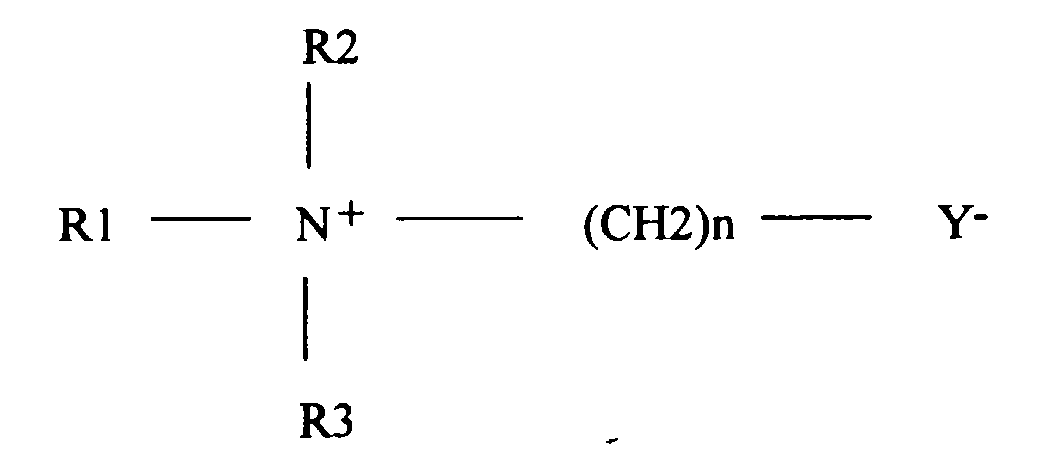
wherein R1 is an alkyl radical containing from about 1 to about 24 carbon atoms, preferably from 8 to 18, and more preferably from 12 to 14, wherein R2 and R3 contain from 1 to 3 carbon atoms and preferably 1 carbon atom, wherein n is an integer of from 1 to 10, preferably from 1 to 6 and more preferably is 1, Y is selected from the group consisting of carboxyl and sulfonyl radicals and wherein the sum of R1, R2 and R3 radicals is from about 14 to about 24 carbon atoms, or mixtures thereof.
wherein R1 is an alkyl radical containing from about 1 to about 24 carbon atoms, preferably from 8 to 18, and more preferably from 12 to 14, wherein R2 and R3 contain from 1 to 3 carbon atoms and preferably 1 carbon atom, wherein n is an integer of from 1 to 10, preferably from 1 to 6 and more preferably is 1, Y is selected from the group consisting of carboxyl and sulfonyl radicals and wherein the sum of R1, R2 and R3 radicals is from about 14 to about 24 carbon atoms, or mixtures thereof.
5. A cleaning composition according to any one of Claims 1-4, wherein said composition
further comprises a solvent.
6. A cleaning composition according to claim 5, wherein said solvent is selected from
the propylene glycol derivatives, 2-(2-alkoxyethoxy)ethanol class, 2-alkoxyethoxyethanol
class, benzyl alcohol, ethanol, isopropyl alcohol, diols and mixtures thereof, preferably
selected from the propylene glycol derivatives and 2-(2-alkoxyethoxy)ethanol class.
7. A cleaning composition according to any of the preceding claims wherein said composition
further comprises an antimicrobial compound or mixtures thereof.
8. A cleaning composition according to claim 7 wherein said antimicrobial compound is
an antimicrobial essential oil preferably selected from the group consisting of thyme
oil, lemongrass oil, citrus oil, lemon oil, orange oil, anise oil, clove oil, aniseed
oil, cinnamon oil, geranium oil, rose oil, lavender oil, citronella oil, eucalyptus
oil, peppermint oil, mint oil, camphor oil, sandalwood oil, cedar oil, rosmarin oil,
pine oil, vervain oil, fleagrass oil, lemongrass oil, ratanhiae oil and mixtures thereof,
and/or an active of essential oil preferably selected from the group consisting of
thymol, eugenol, menthol, carvacrol, verbenone, eucalyptol, cedrol, anethol, pinocarvone,
geraniol, hinokitiol, berberine, ferulic acid, cinnamic acid, methyl salycilic acid,
methyl salycilate, terpineol and mixtures thereof.
9. A cleaning composition according to claim 8 wherein said antimicrobial essential oil,
or active thereof or a mixture thereof, is present at a level of at least 0.003% by
weight of the total composition, preferably from 0.006% to 10%, more preferably from
0.01% to 4%, and most preferably from 0.02% to 2%.
10. A cleaning composition according to any one of the preceding claims wherein said composition
further comprises a peroxygen bleach, preferably hydrogen peroxide.
11. A wipe incorporating a cleaning composition according to any one of Claims 1-10.
12. A cleaning composition according to any one of Claims 1-10, wherein said composition
is liquid and is preferably packaged in a spray dispenser, more preferably in a trigger
spray dispenser.
13. A process for cleaning a surface by applying on said surface a composition as defined
in any one of claims 1-10.
14. A process for cleaning a surface according to claim 13, wherein said composition is
diluted up to 1000 times its weight of water, preferably up to 300 times, more preferably
into 80 to 40 times its weight of water, and most preferably 60 to 30 times, before
it is applied to said surface.
15. A process according to claim 14, wherein said surface is not rinsed after said composition
has been applied.
16. The use of an amine oxide and betaine or sulphobetaine surfactant system in a cleaning
composition, for providing cleaning and shine to the surfaces being cleaned with said
composition.
17. The use of a solvent in a cleaning composition as defined in any one of Claims 1-10,
for providing cleaning and shine to the surfaces being cleaned with said composition.