| (19) |
 |
|
(11) |
EP 0 806 105 B1 |
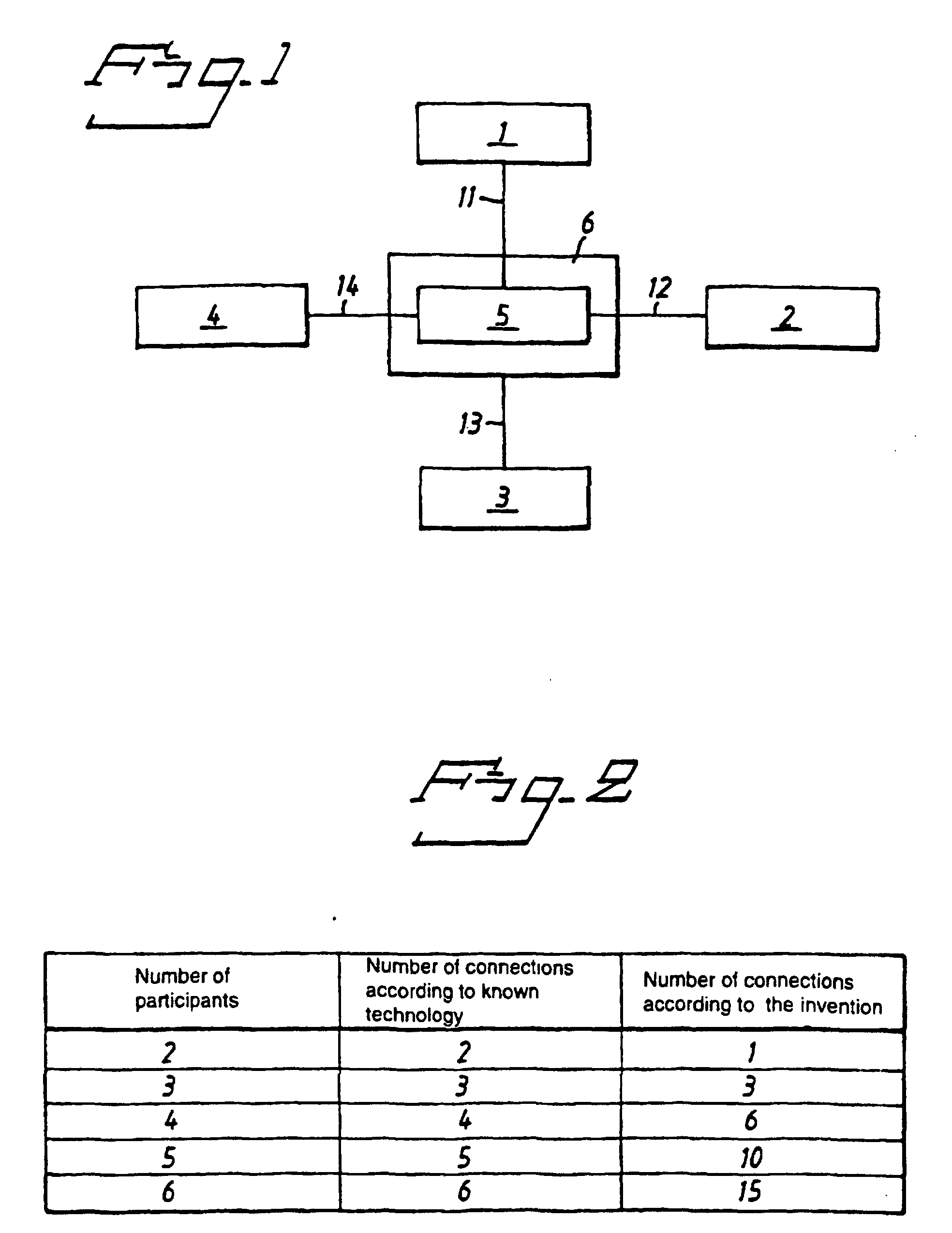
| (12) |
EUROPEAN PATENT SPECIFICATION |
| (45) |
Mention of the grant of the patent: |
|
28.04.2004 Bulletin 2004/18 |
| (22) |
Date of filing: 22.01.1996 |
|
| (86) |
International application number: |
|
PCT/SE1996/000058 |
| (87) |
International publication number: |
|
WO 1996/023383 (01.08.1996 Gazette 1996/35) |
|
| (54) |
TELECONFERENCE SYSTEM AT TELECOMMUNICATIONS SYSTEM, METHOD FOR ESTABLISHING OF TELECONFERENCE
AND TELECONFERENCE EQUIPMENT FOR USE IN A TELECONFERENCE SYSTEM
TELEKONFERENZSYSTEM IN TELEKOMMUNIKATIONSSYSTEM, VERFAHREN ZUM AUFBAU EINER TELEKONFERENZ
UND TELEKONFERENZGERÄT ZUR ANWENDUNG IN EINEM TELEKONFERENZSYSTEM
SYSTEME DE TELECONFERENCE FAISANT APPEL A UN SYSTEME DE TELECOMMUNICATIONS, PROCEDURE
POUR ETABLIR UNE TELECONFERENCE ET INSTALLATION POUR TELECONFERENCE UTILISABLE DANS
UN SYSTEME DE TELECONFERENCE
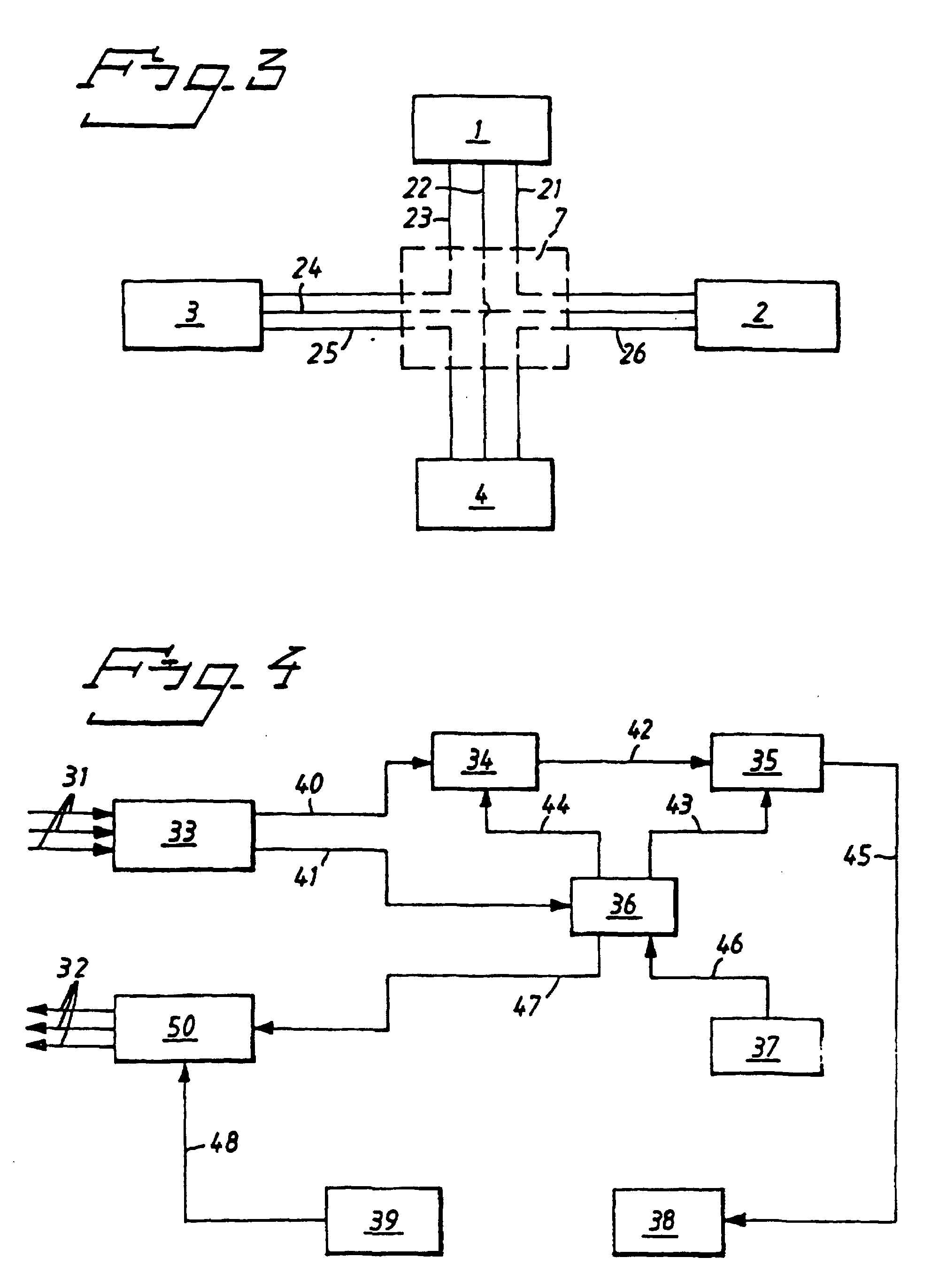
|
| (84) |
Designated Contracting States: |
|
CH DE DK ES FR GB LI NL |
| (30) |
Priority: |
26.01.1995 SE 9500266
|
| (43) |
Date of publication of application: |
|
12.11.1997 Bulletin 1997/46 |
| (73) |
Proprietor: TELIA AB |
|
126 80 Farsta (SE) |
|
| (72) |
Inventor: |
|
- HAGSTRÖM, Bengt
S-136 80 HANINGE (SE)
|
| (74) |
Representative: Hopfgarten, Nils |
|
Groth & Co.KB
P.O. Box 6107
102 32 Stockholm
102 32 Stockholm (SE) |
| (56) |
References cited: :
EP-A- 0 351 757
|
US-A- 4 736 407
|
|
| |
|
|
|
|
| |
|
| Note: Within nine months from the publication of the mention of the grant of the European
patent, any person may give notice to the European Patent Office of opposition to
the European patent
granted. Notice of opposition shall be filed in a written reasoned statement. It shall
not be deemed to
have been filed until the opposition fee has been paid. (Art. 99(1) European Patent
Convention).
|
TECHNICAL FIELD
[0001] The present invention relates to a teleconference system where subscribers have possibility
to establish contact with each other via in the system arranged connecting devices
and connections according to the preamble of claim 1. Especially does the invention
relate to a system where teleconferences can be established in a flexible and for
the subscriber controllable way. The information which is transmitted consists of
multimedia information, i.e. speech, video, data etc can be transmitted simultaneously
between the different participants. The invention also relates to a teleconference
equipment for use in such a system according to the preamble of claim 12.
PRIOR ART
[0002] Teleconference systems of different kinds are previously known. The teleconference
systems which are known and used in the public telephone networks are characterized
by conferences being established via central equipments in the telecommunications
networks. The number of conference participants is in this case restricted by the
capacity of the teleconference equipment; further the number of possible conferences
are restricted to the number of conference equipments which the telecommunications
operator has installed in his network.
[0003] From patent document US5003532 it is previously known to arrange conference systems
where individual connections are arranged between each of the conference equipments.
This technique, however, is related to establishing of fixed connections between the
different conference equipments. In the document an idea is presented of arranging
a central unit which attends to the connection of the different conference participants.
The information transmitted in this case relates to sound and picture.
[0004] In the patent document US4965819 a video conference system is described for example
for a room in a court where each participant is not having a control unit.
[0005] In the patent document US4805205 establishing of communication between geographically
separated persons is described. A number of stations maintain communications between
them. The stations communicate with each other. Figure 1 in the present application
shows a network comprising five stations 1, 2, 3, 4, 5 arranged in a star configuration
with a control station 5 connected to each other station 1, 2, 3, 4. The connection
11, 12, 13, 14 of the conference participants is in this case performed via central
functions in the telecommunications network 6.
[0006] In patent document US4400724 a teleconference system is described with separate stations
which are connected to each other via six links. The connections are in this case
permanently connected.
[0007] US 4 736 407 discloses a telephone conferencing system between a plurality of subscribers.
The conference equipments are adapted to individually call all other participants
in a conference. Each conference equipment includes a modem having a receiver and
a transmitter section for receiving and transmitting information from and to other
subscribers. Computers of each conference equipment are provided to control the communication
with other subscribers in accordance with self contained software or in response to
a received command.
DESCRIPTION OF THE INVENTION
TECHNICAL PROBLEM
[0008] In future telecommunications network conferences of different kinds will to a greater
extent be desirable and established. The teleoperators possibility to measure future
need and wishes is limited. To establish permanent connections between different possible
conference participants is an impossibility. The utilization of central conference
equipments in the telecommunications systems is further restricted to the number of
conference participants which respective equipment can serve. Further such a system
is dictated by the teleoperator.
Possibilities for the conference participants themselves to decide which formats that
shall be used are wanted to be considered to a greater extent. Further there is a
need for the different participants to individually be able to receive different kinds
of information from the different participants. This can be exemplified by a teleconference
between a number of different participants including simultaneous transmission of
different kinds of information. Each of the participants shall then have the possibility
to select how the information is presented at each of the receiver places. Further,
each of the receivers shall have the possibility to exclude certain information which
is not relevant for the receiver place in question. At teleconference transmission
video, sound, data information etc shall, accordingly, be transmitted unimpededly.
[0009] The conference system shall further be possible to use for multimedia information.
[0010] The system shall further be possible to use flexibly and not be dependent on the
discretion of the teleoperator.
[0011] Further it is desirable that the teleoperator needs not provide expensive equipments
in the telecommunications network. In telecommunications network which are established
the costs for establishing of connections will be comparatively low, whereas equipments
which are arranged in the network becomes comparatively expensive. With future digital
technology and utilization of for instance fibre optic connections the possibilities
to arrange a large number of connections will increase radically in the telecommunications
network.
[0012] The present invention takes these conditions as a starting point.
THE SOLUTION
[0013] The present invention proposes a teleconference system of the kind defined in the
introductory portion of the description and having the characterizing features of
claim 1.
[0014] Thus the present invention relates to a teleconference system which is connected
to a telecommunications network. The connection in the telecommunications network
is established by subscribers connected to the telecommunications network by indicating
for instance call number. Call numbers can be given via key pads on for instance telephones.
The transmitted information from the subscribers are received in the connecting devices
in the telecommunications network which establish connections via which the subscribers
can communicate with each other. In this way a subscriber can establish a contact
with any subscriber in the telecommunications network. At least some of the subscriber
equipments in the telecommunications network are arranged as conference equipments.
The conference equipments are arranged to establish individual communication with
every other conference equipment which is arranged to participate in a conference.
Accordingly a number of individual connections are established between a first conference
equipment and each of the rest of the conference equipments which participates in
the conference. In a corresponding way connections are established between the other
conference equipments.
[0015] Each of the conference equipments in the teleconference system is further equipped
with transmission - and reception devices for transmission and reception respectively
of information from/to the other conference equipments. Control devices in respective
teleconference equipments further allow that an individual control of the conference
can be achieved. It is consequently possible to present the information in different
ways at each of the conference equipments independent of each other. The information
which is transmitted between the different conference equipments preferably consists
of so called multimedia information.
[0016] The teleconference system accordingly allows video conferences and audio conferences.
The subscriber equipment includes editing equipment and combination equipment for
editing and combination of received information from every other subscriber who participates
in the teleconference. The editing equipment and the combination equipment can be
programmed by the user for presentation of conference information to the user in one
of a number of formats.
[0017] In a further development of the invention the mentioned editing device and combination
device is preprogramable by the user to present conference information in a format
constructed by the user. The control device is further arranged to initiate or at
command from the users connect connections to a number of subscribers and to transmit
identification codes for mentioned selected subscribers to each of the mentioned subscribers.
The control device is further arranged to appoint which of the mentioned number of
subscribers who shall initate communication links with other subscribers who participate
in the conference equipment and to transmit identification codes to the subscribers
as an individual subscriber must initiate in a communications link. The control device
is further arranged to receive identification codes for the subscribers from a conference
initiating equipment to establish connection to each of the selected subscribers and
when connection has been established transmit connection signal to the mentioned initiated
subscriber equipment.
[0018] Conference connection can for instance be established with the public telephone system
or ISDN-network or broadband ISDN-networks etc.
[0019] The invention also relates to a teleconference equipment according to claim 12.
[0020] Thus reception devices for reception of data are arranged for simultaneous reception
from a number of subscribers. Transmission devices for transmission of data to a number
of subscribers, and control devices for communication with a number of other subscribers
and established communication connections with a number of other subscribers are further
provided. The conference equipment is arranged to be in charge of video communication
and/or audio communication. The teleconference equipment is further equipped with
a combination equipment for editing and combination of data received from participating
subscribers in a teleconference. The editing device and the combination device are
programable by a user to present conference information to the user in one out of
a number of preprogrammed formats.
[0021] The editing equipment and the combination equipment can be preprogrammed to be used
to present conference information to the user on format according to the user's own
wishes. A control device is further arranged to, at command of the user, initiate
connection to one out of a number of subscribers and to transmit identification codes
for mentioned selected subscribers to each of the selected subscribers. The control
device is further arranged to appoint which of the mentioned subscribers who shall
initiate communication connections with other participating subscribers in a teleconference
system and transmit identification codes to each of the subscribers and that respective
subscriber individually initiates communication connection. The control devices are
further arranged to receive identification codes for the selected subscribers and
establish connections to each of the mentioned subscribers. When the connections have
been established connection signal is transmitted.
[0022] The function of the system and equipment according for the thus includes the following
steps for establishing of conference between a number of subscribers
- a first subscriber establishes connection with each of a number of subscribers selected
in advance, and transmits to these selected subscribers an initiating signal identifying
the participants, and
- at reception of said initiating signal each of said selected subscribers establishes
a communication connection with the subscribers which are identified by the initiating
signal.
[0023] Each of the subscribers decides the format on which the conference shall be presented
to him.
[0024] Establishing of connections between participants is made over a public telecommunications
network where the subscriber can order auomatic connection between just any subscribers
in the telecommunications network.
ADVANTAGES
[0025] Conference systems according to the present invention uses more connections than
the known technology according to Figure 1. In Figure 2 a table is shown where the
number of connections according to the conventional technology and the here suggested
technology is compared. The invention allows the participants in a teleconference
to configure screens and control the conference in the way they want.
[0026] At transmission with large bandwidth such as optical fibre a number of necessary
connections can be established which are not critical cost parameters.
[0027] The provision of expensive and complicated control equipments in the telephone stations
is however cost critical. Distributed subscriber control is always cheaper and more
flexible than a central control. A good analogy is to compare expensive central computers
with PC-computers.
[0028] The present invention consequently has the advantage of being cheaper to arrange
and operate than now used system. The invention further allows that the user has a
bigger freedom.
[0029] The invention accordingly allows the subscriber to aquire conference equipment which
is adapted just for his/her own need.
DESCRIPTION OF FIGURES
[0030]
Figure 1 shows a conventional teleconference system.
Figure 2 is a table which shows the number of necessary connections according to the
conventional technology respective according to the present invention.
Figure 3 shows a schematic construction according to the invention.
In Figure 4 is shown the schematic construction of a subscriber equipment.
DETAILED EMBODIMENT
[0031] In Figure 3 is shown a schematic presentation and the conference system according
to the invention. In the illustrated example four participants 1, 2, 3 and 4 are arranged
in a conference. A larger or smaller number of participants can also be allowed. The
conference is established by arranging communication connections 21-26 between each
pair of participants according to the following.
[0032] Participant 1 to 2 communication link 21.
[0033] Participant 1 to 3 communication link 23.
[0034] Participant 1 to 4 communication link 22.
[0035] Participant 2 to 3 communication link 24.
[0036] Participant 2 to 4 communikation link 26.
[0037] Participant 3 to 4 communication link 25.
[0038] The used subscriber equipment at each subscriber is shown schematically in Figure
4. Incoming data from each participant on the connections/channels 31 is received
by receiver 33 and outgoing information for other participants is transmitted on the
connections/channels 32. The subscriber equipment is controlled by a control unit
36 which can be programmed via the user console 37. Incoming data from the receiver
33 is distributed in the data- and signal control unit of the conference system and
transmitted via the lines 40 and 41 to a mixer unit 34 and control unit 36. The mixer
unit 34 combines signals which are received from the conference participants in the
way which is decided by the control unit 36. The formatted video signal passes the
video display 38 over the connection 45. The camera microphone unit 39 transmits data
for transmission to transmitter 50 via line 48. A conference system according to the
present invention can provide multimedia facilities. It can also be used together
with telefax equipment, PCs and VCRs in a way that documetary information created
in PCs and also on video tape can be shown during present conference.
[0039] The control unit 36 can be programmed to present each participant with incoming data
which each transmits in any format independent of which formats other participants
utilize- The shown format can be decided by the user or selected from a programmed
menu of formats. The video formatting is obtained by signal processing performed by
the combination unit 34 and the editor 35.
[0040] Connections used between different participants are partly decided by the type of
the conference, i.e. video or audio and the wished picture quality at video conferences.
The communication links can be physical links established over optical fibres, coaxial
cabels or at audio conferences ordinary physical connections. At most communications
media the connections are established via channels in the form of multiplex. virtual
links established over packet switch network can also be used provided the delays
are well controlled.
[0041] An important aspect for each conference system which operates over the telecommunications
network is to process the use at established connections. The control unit 36, in
the present invention, initiates the subscriber unit, the control unit and the conference
set. The control unit in the subscriber equipment 1, see Figure 3, transmits a signal
to each the other participants and informs them about the connections which shall
be established. For instance the connections 21, 22 and 23 for connection towards
subscriber 1 and initiates the control unit of the subscriber by transmitting a signal
to subscriber 2 and instruct him/her to establish connections with subscriber 3 and
4 and a signal to subscriber 3 instructs him/her to establish a connection with subscriber
4. Subscriber 4 will have all connections established via other subscribers.
When establishing a video conference the subscriber 1 according to Figure 3 calls
the telecommunications network 7. The telecommunications network which is a conventional
telecommunications network with possibility to connect different subscribers, receives
information on for instance connection 23. On this connection the subscriber 1 transfers
the call number to subscriber 3. Connecting devices in the telecommunications network
then establish call to subscriber 3. When the subscriber 3 answers the call the connection
23 is connected between subscriber 1 and 3. Information is then transmitted between
subscriber 1 and 3 regarding the establishing of the conference. The information which
is transmitted is among other things information regarding which other participants
who shall participate in the conference and a request that subscriber 3 establishes
connection with other participants in the conference. In a corresponding way are after
that communication links established between each of the conference equipments 1,
2, 3, and 4. When all connections have been established and the participants have
configured their equipments according to their wishes and needs the conference starts.
The presentation of the information which is transmitted between respective conference
equipments can accordingly be individually configured. Further different kinds of
information can be transmitted individually between individual conference equipments
or to all conference equipments.
[0042] In the above mentioned description the conference system has been described from
the starting point of a conventional public telecommmunications network. The mentioned
telecommunications network can of course consist of different kinds of telephone networks
such as an ordinary telephone network, a data network or other, allowed in an automatic
and by the subscriber controlled way.
1. Teleconference system comprising a telecommunications network which comprises connecting
devices arranged to establish communications between any subscriber equipments in
the telecommunications network (7) where at least some of the subscriber equipments
are also arranged as conference equipments, arranged to establish individual communication
between every other conference equipment, each of the conference equipments being
provided with transmission (50) and reception (33) devices for transmission and reception
respectively of information to/from the other conference equipments, and control devices
(36) being provided to initiate or at command from a user set up connections to a
number of subscribers having conference equipments, characterized in that, when establishing of teleconference between a number of subscribers, the control
device (36) of the conference equipment of a first subscriber (1) is adapted to establish
connections (21,22,23) with each of a number of other subscribers (2,3,4) selected
in advance among subscribers having conference equipments to transmit to these selected
subscribers an initiating signal identifying participants of the conference, and in that at reception of said initiating signal the control devices (36) of each of said selected
subscribers are adapted to establish a communication connection with subscribers who
are identified by said initiating signal.
2. Teleconference system according to claim 1, characterized in that a control device (36) is arranged in each of the teleconference equipments for individual
control of the conference.
3. Teleconference system according to claims 1 or 2, characterized in that transmitted information comprises multimedia information.
4. Teleconference system according to claims 1 or 2, characterized in that the teleconference system is arranged for video conferences.
5. Teleconference system according to claims 1 or 2, characterized in that the teleconference system is arranged for audio conferences.
6. Teleconference system according to claim 1, characterized in that said subscriber equipment includes an editing device (35) and combination device
(34) for editing and combination of received data from every other subscriber who
participates in the teleconference.
7. Teleconference system according to claim 6, characterized in that said editing device (35) and combination device (34) are programmable by the user
to present conference information in one of a number of preprogrammed formats.
8. Teleconference system according to claims 6 or 7, characterized in that said editing device (35) is programmable by the user to present conference information
in a format constructed by the user.
9. Teleconference system according to claim 8, characterized in that the control device (36) is adapted to upon receipt of said initiating signal, initiate
communication links (21-26) with other subscribers who participate in the teleconference
and transmit identification codes to the subscribers regarding communication links
which an individual subscriber must initiate.
10. Teleconference system according to any of the previous claims, characterized in that said control device (36) is arranged to receive identification codes for the subscribers
(1,2,3,4) from the conference equipment of a conference initiating subscriber (1)
to establish connection to each of said selected subscribers and, when connection
has been established, to transmit a connection signal to said initiating subscriber
(1).
11. Teleconference system according to any of the previous claims, characterized in that conference connection is established with a public telephone network or ISDN-network
or broadband ISDN-network.
12. Teleconference equipment for use in a teleconference system comprising a telecommunications
network which comprises connecting devices arranged to establish communication between
any subscriber equipments in the telecommunications network (7) where at least some
of he subscriber equipments are arranged also as teleconference equipments, said teleconference
equipments being arranged to establish individual communication between every other
teleconference equipment each teleconference, equipment comprising a receiving device
(33) for reception of data arranged for simultaneous reception from a number of other
subscribers, a transmission device (50) for transmission of data to a number of subscribers,
and a control device (36) for communication with a number of other subscribers and
establishing of communication connections with a number of other subscribers, characterized in that the control device of a first subscriber (1) is adapted to establish connection (21,22,23)
with each of a number of other subscribers (2,3,4) selected in advance and transmit
to these selected subscribers an initiating signal identifying participants of the
conference,and in that the control devices (36) of said other subscribers (2,3,4) are adapted to receive
identification codes for the selected other subscribers to establish connections to
each of said other subscribers and, when the connection has been established, transmit
a connection signal.
13. Teleconference equipment according to claim 12, characterized in that said teleconference equipment is arranged to manage video communication.
14. Teleconference equipment according to claim 12, characterized in that said teleconference equipment is arranged to manage audio communication.
15. Teleconference equipment according to claim 14, characterized in that it is equipped with editing equipment (35) and combination equipment (34) for editing
and combination of data received from participating subscribers (1,2,3,4) of a teleconference.
16. Teleconference equipment according to claim 15, characterized in that said editing equipment (35) and combination equipment (34) are programmable by a
user to present conference information to the user in one of a number of formats,
programmed in advance.
17. Teleconference equipment according to claims 15 or 16, characterized in that said editing equipment (35) and said combination equipment (34) are programmed in
advance by the user to present conference information to the user in a format according
to the user 's own wishes.
18. Teleconference equipment according to any of claims 12 -17, characterized in that said control device (36) is arranged to, at command of the user, initiate connection
to said selected other subscribers and transmit identification codes for said selected
subscribers to each of the selected subscribers.
19. Teleconference equipment according to claim 18, characterized in that said control device is arranged to decide which of said subscribers shall initiate
communication connections with other participating subscribers in a teleconference
system and transmit identification codes to each of said participating subscribers,
the respective participating subscriber individually initiating communication connections.
1. Telekonferenzsystem mit einem Telekommunikationsnetz, das Anschlußvorrichtungen zur
Herstellung von Kommunikationen zwischen beliebigen Teilnehmereinrichtungen im Telekommunikationsnetz
(7) umfaßt, wobei mindestens einige der Teilnehmereinrichtungen auch als Konferenzeinrichtungen
zur Herstellung von Einzelkommunikation zwischen jeder anderen Konferenzeinrichtung
angeordnet sind, wobei jede der Konferenzeinrichtungen mit Übertragungs-(50) und Empfangs-(33)
Vorrichtungen zur Übertragung bzw. zum Empfangen von Informationen zu/von den anderen
Konferenzeinrichtungen vorgesehen sind und Steuervorrichtungen (36) vorgesehen sind,
um Verbindungen zu einer Anzahl von Teilnehmern mit Konferenzeinrichtungen einzuleiten
oder auf Befehl von einem Benutzer aufzubauen, dadurch gekennzeichnet, daß bei der Herstellung einer Telekonferenz zwischen einer Anzahl von Teilnehmern die
Steuervorrichtung (36) der Konferenzeinrichtung eines ersten Teilnehmers (1) zur Herstellung
von Verbindungen (21, 22, 23) mit jedem einer Anzahl von anderen Teilnehmern (2, 3,
4) geeignet ist, die im voraus unter Teilnehmern mit Konferenzeinrichtungen ausgewählt
worden sind, um zu diesen ausgewählten Teilnehmern ein Einleitungssignal zu übertragen,
das Teilnehmer an der Konferenz identifiziert, und daß bei Empfang des Einleitungssignals
die Steuervorrichtungen (36) jedes der ausgewählten Teilnehmer eine Kommunikationsverbindung
mit Teilnehmern herstellen kann, die durch das Einleitungssignal identifiziert werden.
2. Telekonferenzsystem nach Anspruch 1, dadurch gekennzeichnet, daß eine Steuervorrichtung (36) in jeder der Telekonferenzeinrichtungen zur Einzelsteuerung
der Konferenz angeordnet ist.
3. Telekonferenzsystem nach Ansprüchen 1 oder 2, dadurch gekennzeichnet, daß übertragene Informationen Multimediainformation umfassen.
4. Telekonferenzsystem nach Ansprüchen 1 oder 2, dadurch gekennzeichnet, daß das Telekonferenzsystem für Videokonferenzen angeordnet ist.
5. Telekonferenzsystem nach Ansprüchen 1 oder 2, dadurch gekennzeichnet, daß das Telekonferenzsystem für Audiokonferenzen angeordnet ist.
6. Telekonferenzsystem nach Anspruch 1, dadurch gekennzeichnet, daß die Teilnehmereinrichtung eine Editiervorrichtung (35) und eine Kombiniervorrichtung
(34) zum Editieren und Kombinieren empfangener Daten von jedem anderen an der Telekonferenz
teilnehmenden Teilnehmer enthält.
7. Telekonferenzsystem nach Anspruch 6, dadurch gekennzeichnet, daß die Editiervorrichtung (35) und Kombiniervorrichtung (34) vom Benutzer programmierbar
sind, um Konferenzinformationen in einem von einer Anzahl von vorprogrammierten Formaten
darzustellen.
8. Telekonferenzsystem nach Ansprüchen 6 oder 7, dadurch gekennzeichnet, daß die Editiervorrichtung (35) vom Benutzer programmierbar ist, um Konferenzinformationen
in einem vom Benutzer aufgebauten Format darzustellen.
9. Telekonferenzsystem nach Anspruch 8, dadurch gekennzeichnet, daß die Steuervorrichtung (36) bei Empfang des Einleitungssignals Kommunikationsverbindungen
(21-26) mit anderen an der Telekonferenz teilnehmenden Teilnehmern einleiten und Identifizierungscodes
zu den Teilnehmern hinsichtlich der Kommunikationsverbindungen, die ein einzelner
Teilnehmer einleiten muß, übertragen kann.
10. Telekonferenzsystem nach einem der vorhergehenden Ansprüche, dadurch gekennzeichnet, daß die Steuervorrichtung (36) Kennzeichnungscodes für die Teilnehmer (1, 2, 3, 4) von
der Konferenzeinrichtung eines eine Konferenz einleitenden Teilnehmers (1) empfangen
kann, um eine Verbindung zu jedem der ausgewählten Teilnehmer herzustellen und um,
wenn die Verbindung hergestellt worden ist, ein Verbindungssignal zu dem einleitenden
Teilnehmer (1) zu übertragen.
11. Telekonferenzsystem nach einem der vorhergehenden Ansprüche, dadurch gekennzeichnet, daß die Konferenzverbindung mit einem öffentlichen Fernsprechnetz oder ISDN-Netz oder
Breitband-ISDN-Netz hergestellt wird.
12. Telekonferenzeinrichtung zur Verwendung in einem Telekonferenzsystem mit einem Telekommunikationsnetz,
das Verbindungsvorrichtungen zur Herstellung von Kommunikation zwischen beliebigen
Teilnehmereinrichtungen im Telekommunikationsnetz (7) umfaßt, wobei mindestens einige
der Teilnehmereinrichtungen auch als Telekonferenzeinrichtungen angeordnet sind, wobei
diese Telekonferenzeinrichtungen zur Herstellung von Einzelkommunikation zwischen
jeder anderen Telekonferenzeinrichtung angeordnet sind, wobei jede Telekonferenzeinrichtung
eine Empfangsvorrichtung (33) zum Empfang von Daten, die für den gleichzeitigen Empfang
von einer Anzahl anderer Teilnehmer angeordnet sind, eine Übertragungsvorrichtung
(50) zur Übertragung von Daten zu einer Anzahl von Teilnehmern und eine Steuervorrichtung
(36) zur Kommunikation mit einer Anzahl anderer Teilnehmer und Herstellung von Kommunikationsverbindungen
mit einer Anzahl anderer Teilnehmer umfaßt, dadurch gekennzeichnet, daß die Steuervorrichtung eines ersten Teilnehmers (1) eine Verbindung (21, 22, 23) mit
jedem einer Anzahl von anderen, im voraus ausgewählten Teilnehmern (2, 3, 4) herstellen
und zu diesen ausgewählten Teilnehmern ein Teilnehmer an der Konferenz identifizierendes
Einleitungssignal übertragen kann, und daß die Steuervorrichtungen (36) der anderen
Teilnehmer (2, 3, 4) Identifizierungscodes für die ausgewählten anderen Teilnehmer
empfangen können, um Verbindungen zu jedem der anderen Teilnehmer herzustellen und,
wenn die Verbindung hergestellt worden ist, ein Verbindungssignal zu übertragen.
13. Telekonferenzeinrichtung nach Anspruch 12, dadurch gekennzeichnet, daß die Telekonferenzeinrichtung zur Verwaltung von Videokommunikation angeordnet ist.
14. Telekonferenzeinrichtung nach Anspruch 12, dadurch gekennzeichnet, daß die Telekonferenzeinrichtung zur Verwaltung von Audiokommunikation angeordnet ist.
15. Telekonferenzeinrichtung nach Anspruch 14, dadurch gekennzeichnet, daß sie mit einer Editiereinrichtung (35) und einer Kombiniereinrichtung (34) zum Editieren
und Kombinieren von von an einer Telekonferenz teilnehmenden Teilnehmern (1, 2, 3,
4) empfangenen Daten ausgerüstet ist.
16. Telekonferenzeinrichtung nach Anspruch 15, dadurch gekennzeichnet, daß die Editiereinrichtung (35) und Kombiniereinrichtung (34) von einem Benutzer programmierbar
sind, um Konferenzinformationen für den Benutzer in einem von einer Anzahl von im
voraus programmierten Formaten darzustellen.
17. Telekonferenzeinrichtung nach Ansprüchen 15 oder 16, dadurch gekennzeichnet, daß die Editiereinrichtung (35) und Kombiniereinrichtung (34) im voraus vom Benutzer
programmiert werden, um Konferenzinformation für den Benutzer in einem Format entsprechend
den eigenen Wünschen des Benutzers darzustellen.
18. Telekonferenzeinrichtung nach einem der Ansprüche 12-17, dadurch gekennzeichnet, daß die Steuervorrichtung (36) auf Befehl des Benutzers eine Verbindung zu den ausgewählten
anderen Teilnehmern einleiten und Identifizierungscodes für die ausgewählten Teilnehmer
zu jedem der ausgewählten Teilnehmer übertragen kann.
19. Telekonferenzeinrichtung nach Anspruch 18, dadurch gekennzeichnet, daß die Steuervorrichtung entscheiden kann, welcher der Teilnehmer Kommunikationsverbindungen
mit anderen teilnehmenden Teilnehmern an einem Telekonferenzsystem einleiten und Identifizierungscodes
zu jedem der teilnehmenden Teilnehmer übertragen soll, wobei der jeweilige teilnehmende
Teilnehmer einzeln die Kommunikationsverbindungen einleitet.
1. Système de téléconférence comprenant un réseau de télécommunications qui comporte
des dispositifs de connexion agencés pour établir des communications entre des équipements
d'abonné quelconques dans le réseau de télécommunications (7), au moins certains des
équipements d'abonné étant également agencés comme équipements de conférence, prévu
pour établir une communication individuelle entre chaque autre équipement de conférence,
chacun des équipements de conférence étant pourvu de dispositifs d'émission (50) et
de réception (33) pour émission et réception respectivement d'informations à destination
/ en provenance des autres équipements de conférence, et des dispositifs de commande
(36) étant prévus pour démarrer ou, sur ordre d'un utilisateur, établir des connexions
avec un certain nombre d'abonnés ayant des équipements de conférence, caractérisé en ce que, lors de l'établissement d'une téléconférence entre un certain nombre d'abonnés,
le dispositif de commande (36) de l'équipement de conférence d'un premier abonné (1)
est prévu pour établir des connexions (21, 22, 23) avec chacun d'une pluralité d'autres
abonnés (2, 3, 4), sélectionnés préalablement parmi les abonnés ayant des équipements
de conférence, pour transmettre, à ces abonnés sélectionnés, un signal de démarrage
identifiant les participants à la conférence, et en ce que, à réception du dit signal de démarrage, les dispositifs de commande (36) de chacun
des dits abonnés sélectionnés sont prévus pour établir une connexion de communication
avec les abonnés qui sont identifiés par le dit signal de démarrage.
2. Système de téléconférence selon la revendication 1, caractérisé en ce qu'un dispositif de commande (36) est agencé dans chacun des équipements de téléconférence
pour la commande individuelle de la conférence.
3. Système de téléconférence selon les revendications 1 ou 2, caractérisé en ce que des informations transmises comprennent des informations multimédia.
4. Système de téléconférence selon les revendications 1 ou 2, caractérisé en ce que le système de téléconférence est prévu pour des vidéo-conférences.
5. Système de téléconférence selon les revendications 1 ou 2, caractérisé en ce que le système de téléconférence est prévu pour des audio-conférences.
6. Système de téléconférence selon la revendication 1, caractérisé en ce que le dit équipement d'abonné comprend un dispositif d'édition (35) et un dispositif
de combinaison (34) pour éditer et combiner des données reçues en provenance de chaque
autre abonné qui participe à la téléconférence.
7. Système de téléconférence selon la revendication 6, caractérisé en ce que le dit dispositif d'édition (35) et le dit dispositif de combinaison (34) sont programmables
par l'utilisateur pour présenter des informations de conférence dans l'un d'une pluralité
de formats préprogrammés.
8. Système de téléconférence selon les revendications 6 ou 7, caractérisé en ce que le dit dispositif d'édition (35) est programmable par l'utilisateur pour présenter
des informations de conférence dans un format construit par l'utilisateur.
9. Système de téléconférence selon la revendication 8, caractérisé en ce que le dispositif de commande (36) est prévu pour démarrer, lors de la réception du dit
signal de démarrage, des liaisons de communication (21 - 26) avec d'autres abonnés
qui participent à la téléconférence, et transmettre des codes d'identification aux
abonnés en ce qui concerne les liaisons de communication qu'un abonné individuel doit
démarrer.
10. Système de téléconférence selon une quelconque des revendications précédentes, caractérisé en ce que le dit dispositif de commande (36) est prévu pour recevoir des codes d'identification
pour les abonnés (1, 2, 3, 4), en provenance de l'équipement de conférence d'un abonné
(1) démarrant une conférence, afin d'établir une connexion à chacun des dits abonnés
sélectionnés et, lorsque la connexion a été établie, pour transmettre un signal de
connexion au dit abonné de démarrage (1).
11. Système de téléconférence selon une quelconque des revendications précédentes, caractérisé en ce que la connexion de conférence est établie avec un réseau de téléphone public, ou un
réseau ISDN, ou un réseau ISDN à large bande.
12. Equipement de téléconférence utilisable dans un système de téléconférence comprenant
un réseau de télécommunications qui comporte des dispositifs de connexion agencés
pour établir une communication entre des équipements d'abonné quelconques dans le
réseau de télécommunications (7), au moins certains des équipements d'abonné étant
prévus également comme équipements de téléconférence, les dits équipements de téléconférence
étant prévus pour établir une communication individuelle entre chaque autre équipement
de téléconférence, chaque équipement de téléconférence comprenant un dispositif de
réception (33) pour réception de données prévu pour une réception simultanée en provenance
d'une pluralité d'autres abonnés, un dispositif d'émission (50) pour émission de données
vers une pluralité d'abonnés, et un dispositif de commande (36) pour communication
avec une pluralité d'autres abonnés et établissement de connexions de communications
avec une pluralité d'autres abonnés, caractérisé en ce que le dispositif de commande d'un premier abonné (1) est prévu pour établir une connexion
(21, 22, 23) avec chacun d'une pluralité d'abonnés (2, 3, 4) préalablement sélectionnés,
et pour transmettre à ces abonnés sélectionnés un signal de démarrage identifiant
les participants à la conférence, et en ce que les dispositifs de commande (36) des dits autres abonnés (2, 3, 4) sont prévus pour
recevoir des codes d'identification pour les autres abonnés sélectionnés, afin d'établir
des connexions à chacun des dits autres abonnés, et, lorsque la connexion a été établie,
pour transmettre un signal de connexion.
13. Equipement de téléconférence selon la revendication 12, caractérisé en ce que le dit équipement de téléconférence est prévu pour gérer une communication vidéo.
14. Equipement de téléconférence selon la revendication 12, caractérisé en ce que le dit équipement de téléconférence est prévu pour gérer une communication audio.
15. Equipement de téléconférence selon la revendication 14, caractérisé en ce qu'il est pourvu d'un équipement d'édition (35) et d'un équipement de combinaison (34)
pour éditer et combiner des données reçues d'abonnés (1, 2, 3, 4) participant à une
téléconférence.
16. Equipement de téléconférence selon la revendication 15, caractérisé en ce que le dit équipement d'édition (35) et le dit équipement de combinaison (34) sont programmables
par un utilisateur pour présenter des informations de conférence à l'utilisateur dans
un d'une pluralité de formats, programmés à l'avance.
17. Equipement de téléconférence selon les revendications 15 ou 16, caractérisé en ce que le dit équipement d'édition (35) et le dit équipement de combinaison (34) sont programmés
à l'avance par l'utilisateur pour présenter les informations de conférence à l'utilisateur
dans un format conforme aux propres souhaits de l'utilisateur.
18. Equipement de téléconférence selon une quelconque des revendications 12 à 17, caractérisé en ce que le dit dispositif de commande (36) est prévu pour démarrer, sur ordre de l'utilisateur,
une connexion aux dits autres abonnés sélectionnés et pour transmettre des codes d'identification
des dits abonnés sélectionnés à chacun des abonnés sélectionnés.
19. Equipement de téléconférence selon la revendication 18, caractérisé en ce que le dit dispositif de commande est agencé pour décider de celui des dits abonnés qui
démarrera les connexions de communication avec les autres abonnés participants dans
un système de téléconférence et pour transmettre des codes d'identification à chacun
des dits abonnés participants, l'abonné participant respectif démarrant individuellement
des connexions de communication.