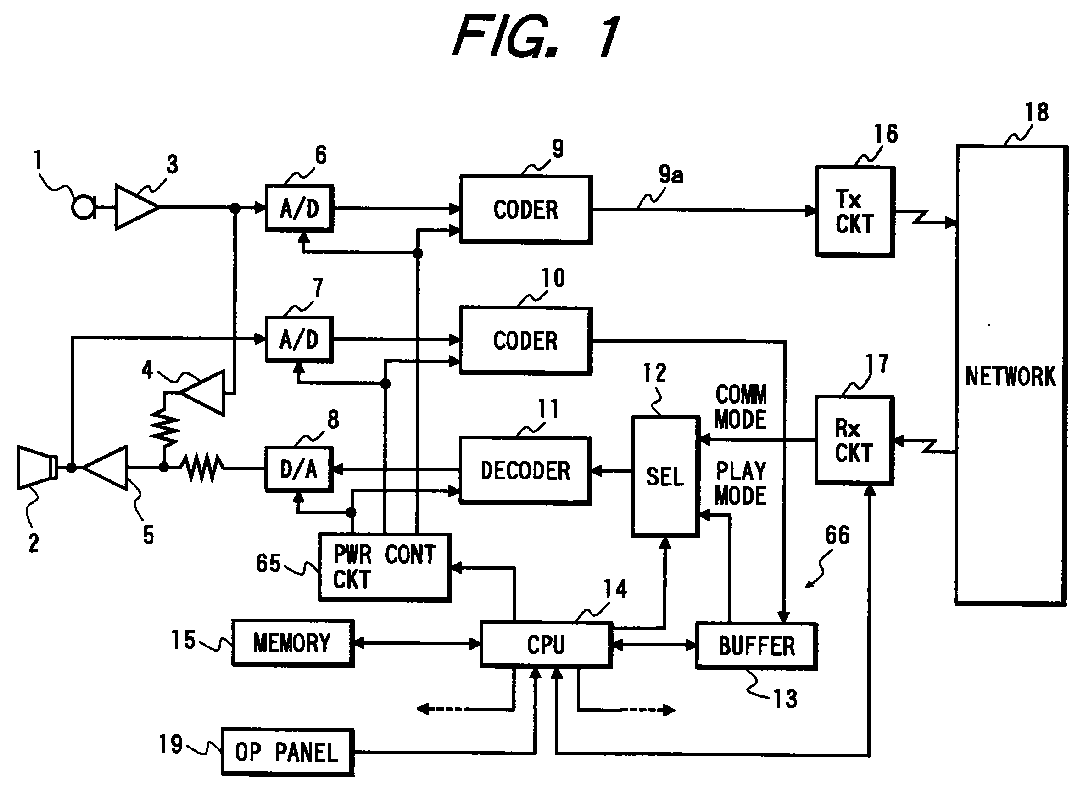
(57) A 1st telephone apparatus comprises a transmission system for transmitting a transmission
voice SIG to a network, a receiving system for receiving a reception voice SIG from
the network, a recording system for generating a recording SIG derived from the voice
SIGs from the transmission and the receiving system, a memory for storing and reading
the recording SIG, and a switch for playing back the reception voice SIG in a communication
mode and playing back the recording SIG from the memory in a playback mode. Coding
and decoding may performed by a single DSP through a time division manner. A 2nd telephone
apparatus comprises a transmission and receiving systems, 1st and 2nd switches, a
memory circuit, and a voice presence detector for detecting the presence of the voice
SIG of the transmission system, the 1st switch stores the voice SIG from the voice
SIG from the transmission system prior to the voice SIG from the receiving system.
The 2nd switch provides a playback from the voice SIG from the network directly and
from the memory circuit. The 2nd telephone apparatus may further comprise a frame
condition detector for detecting a frame condition, a data adder for adding data indicative
of the frame condition to reception SIG, and a memory control circuit. The memory
control circuit inhibits recording according to the frame condition.
|
|
