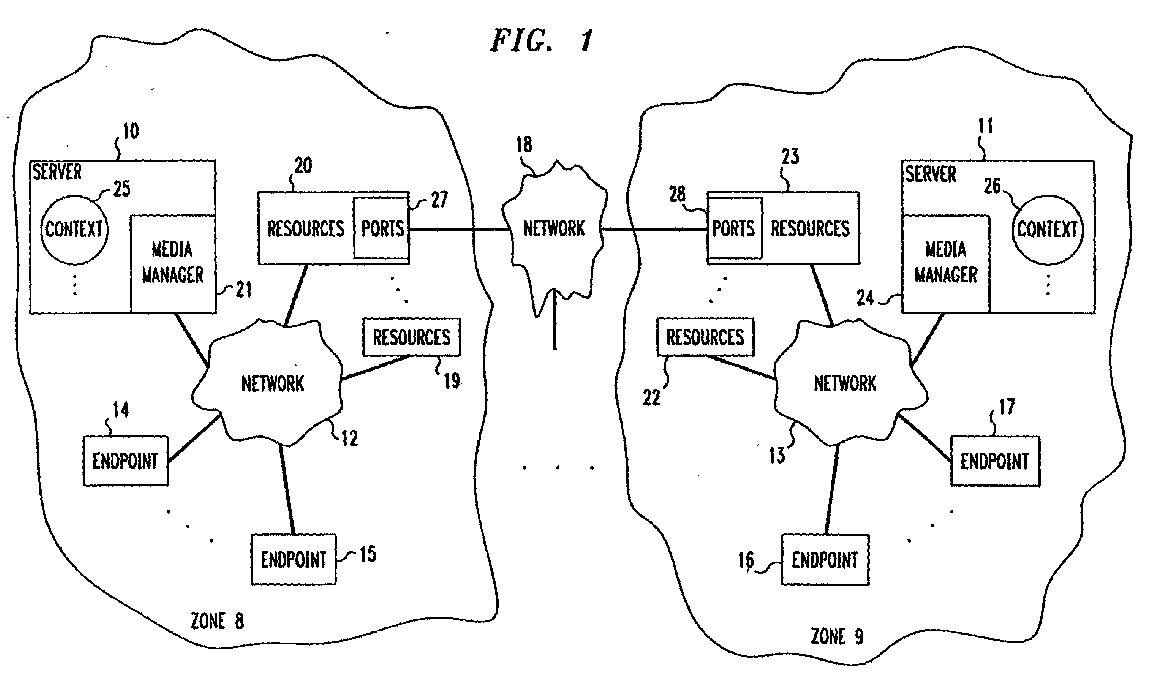
(57) In a telecommunications system (8) that comprises communications endpoints (14-15),
communications resources (18-20), a communications server (10) that includes a media
manager (21), and a network (12) that interconnects them all, a first endpoint (14)
provides the media manager with an offer of a connection to a second endpoint (15)
that specifies attributes desired for the connection by the first endpoint. The media
manager registers the request and forwards it to the second endpoint. When the second
endpoint responds with an acceptance of the connection that specifies attributes desired
for the connection by the second endpoint, the media manager compares the registered
offer with the received acceptance to determine any resources that are needed to bridge
any differences between their attributes and to effect the connection. The media manager
then marshals any needed resources for the connection, sends a modified acceptance
to any marshaled resource telling it the address of the second endpoint to connect
to, sends a modified acceptance to the first endpoint that tells it the address of
any marshaled resource, or of the second endpoint in the absence of any marshaled
resource, to connect to, and leaves it up to the endpoints and marshaled resources
to interact with the network to effect the connection through the network. The media
manager can therefore provide centralized call control for substantially any network,
and can treat all networks generically and leave it up to the endpoints to deal with
the particulars of any specific network. Communications between multiple such telecommunications
systems (8, 9) can also be effected thereby.
|
|
