| (19) |
 |
|
(11) |
EP 0 812 152 B1 |
| (12) |
EUROPEAN PATENT SPECIFICATION |
| (45) |
Mention of the grant of the patent: |
|
04.09.2002 Bulletin 2002/36 |
| (22) |
Date of filing: 08.02.1996 |
|
| (51) |
International Patent Classification (IPC)7: A61B 6/14 |
| (86) |
International application number: |
|
PCT/GB9600/279 |
| (87) |
International publication number: |
|
WO 9602/5880 (29.08.1996 Gazette 1996/39) |
|
| (54) |
DENTAL PANORAMIC IMAGING SYSTEM
PANORAMA-BILDERZEUGUNGSSYSTEM FÜR DIE ZAHNHEILKUNDE
SYSTEME D'IMAGERIE PANORAMIQUE DENTAIRE
|
| (84) |
Designated Contracting States: |
|
DE FR IT SE |
| (30) |
Priority: |
21.02.1995 GB 9503423
28.07.1995 GB 9515534
|
| (43) |
Date of publication of application: |
|
17.12.1997 Bulletin 1997/51 |
| (73) |
Proprietor: Marconi Applied Technologies Limited |
|
Chelmsford, Essex CM1 2QU (GB) |
|
| (72) |
Inventor: |
|
- ALLEN, Brian, Philip
Essex CO9 4DS (GB)
|
| (74) |
Representative: Cockayne, Gillian |
|
Marconi Intellectual Property
Marrable House
The Vineyards
Gt. Baddow
Chelmsford
Essex CM2 7QS
Chelmsford
Essex CM2 7QS (GB) |
| (56) |
References cited: :
EP-A- 0 357 944
WO-A-90/14793
|
EP-A- 0 685 201
|
|
| |
|
|
|
|
| |
|
| Note: Within nine months from the publication of the mention of the grant of the European
patent, any person may give notice to the European Patent Office of opposition to
the European patent
granted. Notice of opposition shall be filed in a written reasoned statement. It shall
not be deemed to
have been filed until the opposition fee has been paid. (Art. 99(1) European Patent
Convention).
|
[0001] This invention relates to imaging systems and more particularly to systems suitable
for dental X-ray diagnosis where the system may be used to produce panoramic radiographs
of the jaw of a patient.
[0002] In conventional dental X-ray systems for producing panoramic radiographs, an X-ray
source is directed at the patient and an image recorded on a moving X-ray film. A
secondary diaphragm having a slot is located in front of the X-ray film as an aperture
to define the part of the film where the radiation is incident. It has previously
been proposed to replace the moving X-ray film by a CCD sensor. In this system, a
unit is used which is rotatable about a vertical axis and which carries an X-ray source
at one end of an arm and a CCD sensor at the other end of the arm located behind a
secondary diaphragm. The secondary diaphragm includes an opening or secondary slot
which acts as the aperture.
[0003] WO 90/14793 describes a panoramic system which uses a linear sensor array to detect
X-rays following irradiation of an object; the known system comprises a source of
X-ray radiation; solid state detector means having a radiation sensitive region which
includes an image area at which charge accumulates which is representative of incident
radiation; means for moving the source and detector means relative to a subject to
be examined, which in use is located between them; and means for processing the output
of the detector means to obtain a panoramic image of the subject. EP-A-0357944 describes
a panoramic solid state system which uses a diaphragm to define a secondary slot.
[0004] According to the invention, there is provided an imaging system for dental use according
to claim 1.
[0005] The inventor has realised that the secondary slot previously considered to be an
essential feature may be eliminated from the system without causing image quality
deterioration to such an extent that it is no longer satisfactory and in certain cases
that elimination of the secondary slot may improve image quality.
[0006] The image area is defined substantially solely at the detector means and obviates
the need for a secondary slot or opening in a diaphragm to be used to define the aperture
area as required in the conventional moving X-ray film arrangement or the previously
proposed CCD sensor systems. This produces a more simplified system compared to previously
known arrangements which is less bulky and allows for more precise control of the
alignment and movement of the arrangement, improving reliability. Also, use of the
invention facilitates assembly and eases design constraints. In some situations a
secondary slot may be responsible for generating scattered radiation which degrades
the image. Elimination of the slot by employment of the invention can thus improve
image quality.
[0007] In the imaging system of the invention, the detector means includes scintillator
material carried on its surface for converting X-ray radiation into radiation of another
wavelength for detection by said detector means and the image area is defined at the
detector means by the extent of the scintillator material on the detector means. The
scintillator material which converts incident X-ray radiation into a wavelength to
which the detector means is responsive may be carried directly by the surface of the
detector means or on an intermediate layer laid down on the detector means.
[0008] In one advantageous embodiment of the invention, the extent of the image area is
defined by the location of charge storage means at which radiation is incident to
cause the accumulation of charge. Thus, where the detector means is a CCD sensor array,
the location of charge storage sites defines the image area. Scintillator material
may be used on the CCD array in register with it to further define the image area
extent or could alternatively extend beyond the charge storage sites in one or more
directions.
[0009] It may be advantageous in some embodiments in accordance with the invention to include
shielding material on the surface of detector means surrounding the scintillator material
to absorb stray X-ray radiation. Preferably the solid state detector means is a CCD
array but other types of sensor may be used.
[0010] Some ways in which the invention may be performed are now described by way of example
with reference to the accompanying drawing, in which:
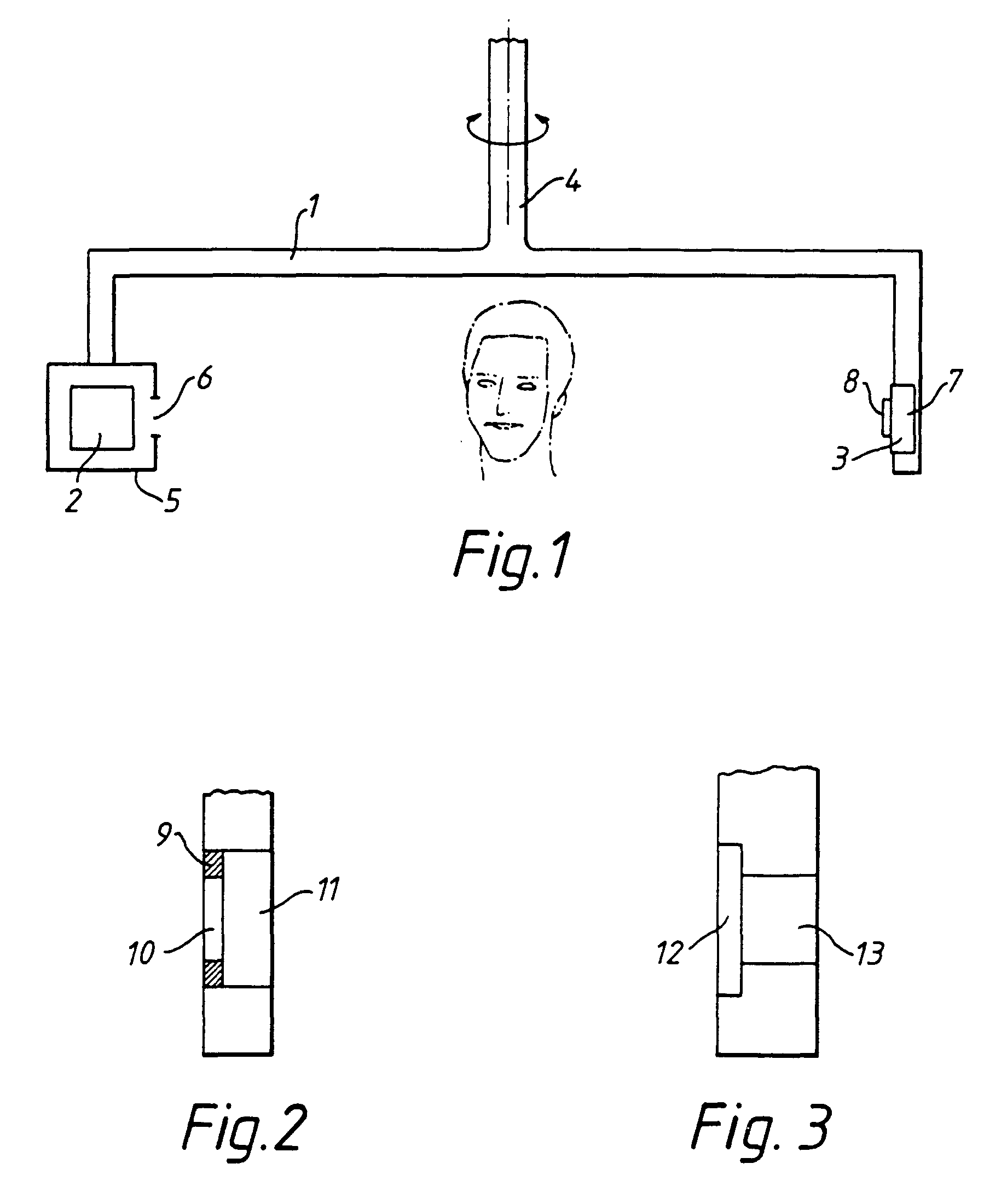
Figure 1 schematically illustrates a dental X-ray arrangement in accordance with the
invention; and
Figures 2 and 3 schematically show alternative detector means for the arrangement
of Figure 1.
[0011] With reference to Figure 1, an X-ray system for producing radiographs of a patient's
jaw includes an arm 1 carrying an X-ray source 2 at one end and a detector arrangement
3 at the other end. At the mid-point of the arm 1 a shaft 4 is vertically extensive
and in use is located over the patient's head and rotates as shown by the arrows about
its longitudinal axis. The X-ray source 2 is located within a housing 5 having a slot
6 to define a beam of X-ray radiation and is adjusted in position so that the radiation
is incident on the patient's jaw. After passing through the jaw the attenuated X-ray
radiation is then incident at the detector 3. The detector 3 includes a CCD sensor
array 7 having a layer of scintillator material 8 laid down on its surface at which
the X-ray radiation is received. The scintillator material 8 is of a configuration
which corresponds to the slot 6 in the housing 5 of the X-ray source and the extent
of the material 8 defines the image area. As the arm 1 is rotated about the axis X-X
of the shaft 4, different regions of the patient's jaw are irradiated and imaged by
the CCD sensor array 7. The image information produced at the sensor array 7 is clocked
out at an appropriate rate to produce the required panoramic image. This may be stored
for later analysis and/or displayed on a VDU.
[0012] In another detector means, as shown in Figure 2, shielding material 9 is arranged
around scintillator material 10 to absorb any X-rays incident on the CCD detector
array 11 outside the scintillator material 10.
[0013] In another arrangement, as shown in Figure 3, scintillator material 12 covers an
area larger than that defined by the slot in the X-ray housing and extends beyond
the radiation sensitive region of the CCD detector array 13. In this embodiment the
radiation sensitive region defines the image area of the X-ray system.
1. An imaging system for dental use comprising: a source (2) of X-ray radiation; solid
state detector means (7,11) having a radiation sensitive region which includes an
image area at which charge accumulates which is representative of incident radiation
and having scintillator material (8, 10) carried on its surface for converting X-ray
radiation into radiation of another wavelength for detection by said means (7, 11),
there being no secondary slot located in front of the detector means (7, 11); means
for moving the source (2) and detector means (7, 11) relative to the subject to be
examined, in which the subject can be arranged to be located between them; and means
for processing the output of the detector means (7, 11) to obtain a panoramic image
of the subject.
2. A system as claimed in claim 1 wherein the image area is defined at the detector means
(7,11) by the extent of the scintillator means (8, 10) on the detector means (7, 11).
3. A system as claimed in claim 1 wherein the extent of the image area is defined by
the location of charge storage means at which radiation is incident to cause the accumulation
of charge.
4. A system as claimed in any preceding claim wherein the solid state detector means
is a CCD array (7, 11).
5. A system as claimed in any preceding claim and including shielding material (9) against
X-rays around the image area and in substantially the same plane.
6. A system as claimed in claimed in claim 5 wherein the shielding material (9) is carried
on a common mount with the detector means (11).
7. A system as claimed in any preceding claim wherein the X-ray source (2) includes a
diaphragm having a slot (6) therein defining the configuration of the X-ray beam which
irradiates a subject and wherein the image area is of substantially the same dimensions
as the slot.
1. Bildgebungssystem für die Dentalmedizin, mit:
einer Röntgenstrahlungsquelle (2); einer Festkörperdetektor-Einrichtung (7,11), welche
ein strahlungsempfindliches Gebiet aufweist, das einen Bildbereich umfaßt, an dem
sich Ladung ansammelt, die für die einfallende Strahlung repräsentativ ist und ein
Szintillatormaterial (8,10) aufweist, das von der Oberfläche getragen wird, um Röntgenstrahlung
in Strahlung einer anderen Wellenlänge zum Zwecke der Erfassung durch die Einrichtung
(7,11) umzuwandeln, wobei sich vor der Detektoreinrichtung (7,11) kein sekundärer
Spalt befindet; einer Einrichtung zum Bewegen der Quelle (2) und der Detektoreinrichtung
(7,11) relativ zu dem zu untersuchenden Gegenstand, in welcher der Gegenstand zwischen
diesen angeordnet werden kann; und einer Einrichtung zum Bearbeiten der Ausgabe der
Detektoreinrichtung (7,11), um ein Panoramabild des Gegenstands zu erhalten.
2. System nach Anspruch 1, in welchem der Bildbereich an der Detektoreinrichtung (7,11)
durch die Ausmaße der Szintillatoreinrichtung (8,10) auf der Detektoreinrichtung (7,11)
vorgegeben ist.
3. System nach Anspruch 1, in welchem die Ausmaße des Bildbereichs durch den Ort von
Ladungsspeichereinrichtungen vorgegeben sind, auf welche Strahlung auftrifft, um das
Ansammeln von Ladung zu bewirken.
4. System nach einem der vorhergehenden Ansprüche, in welchem die Festkörperdetektoreinrichtung
ein CCD-Array (7,11) ist.
5. System nach einem der vorhergehenden Ansprüche, welches um den Bildbereich herum und
im wesentlichen in derselben Ebene ein Abschirmmaterial (9) gegen Röntgenstrahlen
umfaßt.
6. System nach Anspruch 5, in welchem das Abschirmmaterial (9) zusammen mit der Detektoreinrichtung
(11) von einer gemeinsamen Befestigung getragen wird.
7. System nach einem der vorhergehenden Ansprüche, in welchem die Röntgenstrahlungsquelle
(2) eine Trennwand mit einem Spalt (6) aufweist, wobei darin die Formung des Röntgenstrahls,
der einen Gegenstand bestrahlt, festgelegt wird, und in welcher der Bildbereich im
wesentlichen dieselben Abmessungen wie der Spalt hat.
1. Dispositif d'imageries pour une utilisation dentaire comprenant : une source (2) de
radiation de rayons X ; des moyens de détection de l'état solide (7, 11) comportant
une région sensible aux radiations qui comprend une zone d'images à laquelle la charge
s'accumule qui est représentative d'une radiation incidente et comportant un matériau
scintillant (8, 10) disposé sur sa surface pour convertir une radiation de rayons
X en une radiation à une autre longueur d'onde pour la détection par lesdits moyens
(7, 11), ceux-ci ne comportant pas de deuxième fente située devant les moyens de détection
(7, 11) ; des moyens pour déplacer la source (2) et les moyens de détection (7, 11)
relativement au sujet à examiner, dans lequel le sujet peut être situé entre ces deux
moyens ; et des moyens pour traiter la sortie des moyens de détection (7, 11) pour
obtenir une image panoramique du sujet.
2. Dispositif d'imageries selon la revendication 1 caractérisé en ce que l'image est définie aux moyens de détection (7, 11) par l'extension des moyens scintillant
(8, 10) sur les moyens de détection (7, 11).
3. Dispositif d'imageries selon la revendication 1 caractérisé en ce que l'extension de la zone d'images est définie par l'emplacement des moyens de stockage
de la charge à laquelle la radiation est incidente pour engendrer l'accumulation de
la charge.
4. Dispositif d'imageries selon l'une des revendications précédentes caractérisé en ce que le moyen de détection de l'état solide est une rangée de capteurs CCD (7, 11).
5. Dispositif d'imageries selon l'une quelconque des revendications précédentes caractérisé en ce qu'il comprend un matériau de protection (9) contre les rayons X autour de la zone d'images
et suivant substantiellement le même plan.
6. Dispositif d'imageries selon la revendication 5 caractérisé en ce que le matériau de protection (9) est porté sur un support commun avec les moyens de
détection (11).
7. 4. Dispositif d'imageries selon l'une quelconque des revendications précédentes caractérisé en ce que la source de rayons X (2) comprend un diaphragme comportant une fente (6) à l'intérieur,
définissant la configuration du faisceau de rayons X qui irradie un sujet et où la
zone d'images est substantiellement de mêmes dimensions que la fente.