|
(11) | EP 0 813 110 A1 |

| (12) | EUROPEAN PATENT APPLICATION |
|
|
|
|
||||||||||||
| (54) | Graphic arts recording film with blue base |
| (57) A graphic arts recording film is disclosed comprising a red sensitized silver halide
emulsion layer and a blue coloured support, preferably a polyethylene terephthalate
support. The material shows good antihalation properties and is especially suited
in pre-press activity for the recording of digitally stored screened images, linework
and/or text by means of red laser exposure. In a preferred embodiment a thin layer containing an antistatic compound, preferably a polythiophene, is present on the backside. |
1. Field of the invention.
[0001] The present invention relates to a photographic recording material based on silver halide chemistry for the graphic arts.
2. Background of the invention.
[0002] Light-absorbing dyes incorporated in silver halide photographic materials can accomplish a variety of goals, including their use as filter dyes, acutance dyes or anti-halation dyes.
[0003] When present in a non-photosensitive top layer or intermediate layer they typically serve as filter dyes eliminating an unwanted part of the light spectrum of the exposure source. A well-known example is the yellow filter layer usually present in colour photographic materials in order to prevent blue light from reaching the green sensitive and red sensitive layers. Another example is formed by UV-absorbing compounds, usually present in the top protective layer, which prevent photochemical deterioration of the image dyes formed by colour development. Examples of useful UV-absorbers include the cyanomethyl sulfone-derived merocyanines of US-P 3,723,154, the thiazolidones, benzotriazoles and thiazolothiazoles of US-P 2,739,888, 3,253,921, 3,250,617 and 2,739,971, the triazoles of US-P 3,004,896, and the hemioxonols of US-P 3,125,597.
[0004] On the other hand light-absorbing dyes when present in the emulsion layer can serve as so-called "acutance dyes" or "screening dyes" improving the image sharpness by reducing the sidewise scattering of light by the emulsion grains.
[0005] In a third application light-absorbing dyes act as "anti-halation dyes" improving the image sharpness by diminishing the upward reflection of light by the support into the emulsion layer. For this purpose the dye can be incorporated in an undercoat, being a non-photosensitive layer between the emulsion layer and the support, or it can be incorporated in the base itself, or preferably, it can be present in one or more backing layers of the photographic material.
[0006] Useful dyes absorbing in the visible spectral region include, for instance, the coloured pigments of US-P 2,697,037, the pyrazolone oxonol dyes of US-P 2,274,782, the styryl and butadienyl dyes of US-P 3,423,207, the diaryl azo dyes of US-P 2,956,879, the merocyanine dyes of US-P 2,527,583, the merocyanine and oxonol dyes of US-P 3,486,897, US-P 3,652,284 and 3,718,472, and the enaminohemioxonol dyes of US-P 3,976,661. Absorbing dyes can be added as particulate dispersions as disclosed in US-P 4.092,168, EP 0 274 723 and EP 0 299 435.
[0007] Infra-red absorbing dyes are described in EP 0 251 282, in EP 0 288 076, and in US-P 4,839,265.
[0008] Dyes absorbing in the red spectral region of the di- or triphenylmethane type, some of which bear an electron-withdrawing group, are disclosed in e.g. GB 769,749, US 2,282,890, DE 1,038,395, FR 2,234,585, JP-A-59-228250, US 2,252,052 and A.Guyot, Compt.Rend. Vol. 114 (1907) p. 1120. Some of the compounds disclosed contain one or more water-solubilizing groups.
[0009] In recent years new techniques of image recording have emerged wherein the exposure source of the recording apparatus is a laser unit. For instance, one application of lasers as exposure units is situated in the field of radiographic monitoring photography where a hard copy of radiographic information has to be produced. Other applications are situated in the pre-press field of phototype-setting and image-setting, where recorders are marketed which employ Ar ion lasers, He-Ne lasers or solid state semiconductor lasers, also called laserdiodes, as exposure source. Originally, the latter type of lasers was constructed for emission in the near infra-red region. However, one problem in the field of imaging by laserdiodes emitting in the near infrared is the rather high required sensitivity level of the infra-red sensitized photographic material due to the low energy output of this laserdiode type which is in the order of a few milli-Watts. A second problem consists in the usually poor storage quality of emulsions sensitized with long-chain cyanine dyes. Moreover, technicians supplying maintenance for image-setters feel the invisibility of the infra-red rays as a practical handicap for their work.
[0010] For all these reasons some manufacturers of image-setters moved to laserdiodes emitting in the visible red spectral region, and more particularly; to laserdiodes emitting at 670 nm. So the ACCUSET 1000 apparatus, marketed by Bayer USA Inc., Agfa division, is equipped with this new type of solid state laser. As a consequence photographic phototype- and image setting materials have to be adapted to this new wavelenght of laser emission. More particularly the spectral sensitivity and the absorption spectrum of acutance- and anti-halation dyes should be suitable for 670 nm. In a still more ideal case one and the same graphic arts recording material should be broadly red sensitized in such a way that it is suited both for exposure at 632 (HeNe) as for exposure at 670 nm (red laserdiode). An example of such a graphic arts recording film is ALLIANCE HN marketed by Agfa-Gevaert N.V., Belgium.
[0011] The present invention presents an alternative method for providing good antihalation properties to a graphic arts recording film, based on conventional silver halide chemistry, which is sensitized for the red spectral region.
[0012] Due to competition the producers of photographic goods are always looking for measures for manufacturing their products in a more cost-effective way.
[0013] It is the object of the present invention to provide a red sensitized graphic arts recording film which can be coated at a lower silver coverage resulting in a cheaper end product.
[0014] It is the object of the present invention to provide a red sensitized graphic arts recording film which can be manufactured in the coating alley in a more cost-effective way.
3. Summary of the invention.
[0015] The objects of the present invention are realized by providing a graphic arts recording film comprising an organic resin support and a photographic silver halide emulsion layer, spectrally sensitized for the red spectral region, characterized in that said organic resin support is blue coloured.
[0016] The scope of the present invention also extends to the use of such a recorder film for the recording by means of red laser exposure of screened images, linework and/or text, and/or PCB (printed circuit board) patterns, electronically stored in an image-setter or scanner.
[0017] In a most preferred embodiment the blue coloured support is polyethylene terephthalate. The blue density is preferably comprised between 0.1 ans 0.3 measured with a spectrophotometer at a wavelenght of 630 nm.
4. Detailed description.
[0018] Suitable organic resin supports for use in accordance with the present invention include cellulose nitrate film, cellulose acetate film, poly(vinyl acetal) film, polystyrene film, poly(ethylene terephthalate) film, polycarbonate film, polyvinylchloride film or poly-α-olefin films such as polyethylene or polypropylene film. The thickness of such organic resin film is preferably comprised between 0.025 and 0.25 mm.
[0019] In a most preferred embodiment the support is a polyethylene terephthalate support, optionally provided with a subbing layer. An example of a suitable subbing layer is a layer containing a polymer containing covalently bound chlorine. Suitable chlorine containing polymers are e.g. polyvinyl chloride, polyvinylidene chloride, a copolymer of vinylidene chloride, an acrylic ester and itaconic acid, a copolymer of vinyl chloride and vinylidene chloride, a copolymer of vinyl chloride, vinylidene chloride and itaconic acid, a copolymer of vinyl chloride, vinyl acetate and vinyl alcohol, A preferred chlorine containing polymer is co(vinylidenechloride-methylacrylate-itaconic acid ; 88 % / 10 % / 2 %). A most suitable subbing layer contains the latter polymer and a colloidal silica such as KIESELSOL 100F (Bayer AG). Optionally to this composition can be added co(methylacrylate-butadiene-itaconic acid) (49/49/2), preferably in a ratio of about 10 %. The most favourable adhesion properties are obtained when a subbing layer as described above provided with an additional primer layer containing gelatin (preferably 0.25 - 0.35 g/m2), Kieselsol 300 F (0.30 - 0.40 g/m2) and a matting agent on the base of polymethylmethacrylate (average size 2 à 3 µm) at a coverage of about 0.001 g/m2.
[0020] The use of blue coloured polyethylene terephtalate as base for radiographic recording is known for a long time in the photographic art. In the latter application however the blue colour serves psychometric reasons. To our knowledge it is the first time that a blue coloured base, preferably PET, is disclosed as support for a graphic arts recording film and in this case for antihalation purposes. By graphic arts recording film is to be understood a photographic material that by its design and composition is especially suited for the recording by means of laser exposure of digital information stored in an image-setter, phototypesetter or scanner, said information corresponding to screened images, linework and/or text, and/or PCB patterns.
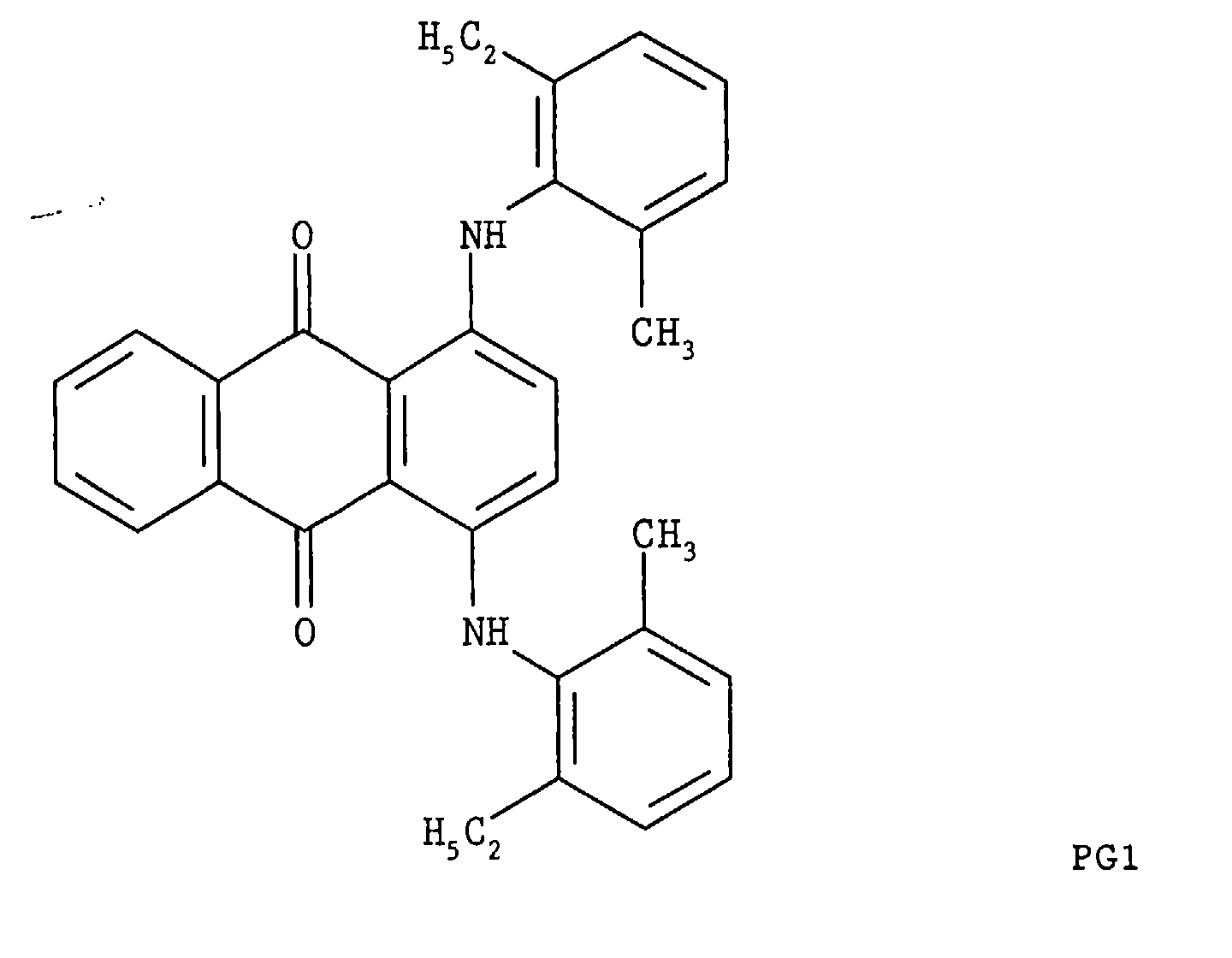
[0021] Older references on blue coloured organic resins, especially PET, for photographic purposes include Belgian patents BE 700.302 and BE 715.614. Preferred pigments, also in connection with the present application for the blue coloration of PET are anthraquinone derivatives, especially 1,4-dianilino-anthraquinone compounds. A most preferred compound belonging to the latter class is a pigment (PG1) with following chemical structure :
[0022] In the manufacturing process of PET the blue pigment is preferably added before or during the extrusion of the molten PET granules, said extrusion preceding the longitudinal and transversal stretching operations.
[0023] We come now to the description of the photosensitive layer coated on one side of the blue coloured support.
[0024] The silver halide emulsion or mixture of emulsions of the photographic material in connection with the present invention can be incorporated in one single layer but, alternatively, a double emulsion layer or even a multiple layer pack can be applied.
[0025] The halide composition of the silver halide emulsions used in accordance with the present invention is not specifically limited and may be any composition selected from e.g. silver chloride, silver bromide, silver iodide, silver chlorobromide, silver bromoiodide, and silver chlorobromoiodide. However, graphic arts recording mmaterials preferably use emulsions containing a majority of chloride, preferably between 65 % and 89 %, and a low amount of iodide, the remaining halide being bromide.
[0026] The photographic emulsion(s) can be prepared from soluble silver salts and soluble halides according to different methods as described e.g. by P. Glafkidès in "Chimie et Physique Photographique". Paul Montel, Paris (1967), by G.F. Duffin in "Photographic Emulsion Chemistry", The Focal Press, London (1966). and by V.L. Zelikman et al in "Making and Coating Photographic Emulsion", The Focal Press, London (1966). They can be prepared by mixing the halide and silver solutions in partially or fully controlled conditions of temperature, concentrations, sequence of addition, and rates of addition. The silver halide can be precipitated according to the single-jet method, the double-jet method, the conversion method or an alternation of these different methods.
[0027] The silver halide particles of the photographic emulsion(s) may have a regular crystalline form such as a cubic or octahedral form or they may have a transition form. They may also have an irregular crystalline form such as a spherical form or a tabular form, or may otherwise have a composite crystal form comprising a mixture of said regular and irregular crystalline forms.
[0028] The silver halide grains may have a multilayered grain structure. According to a simple embodiment the grains may comprise a core and a shell, which may have different halide compositions and/or may have undergone different modifications such as the addition of dopes. Besides having a differently composed core and shell the silver halide grains may also comprise different phases inbetween.
[0029] Two or more types of silver halide emulsions that have been prepared differently can be mixed for forming a photographic emulsion for use in accordance with the present invention.
[0030] The average size of the silver halide grains may range from 0.05 to 1.0 micron, preferably from 0.2 to 0.5 micron. The size distribution of the silver halide particles can be homodisperse or heterodisperse.
[0031] The silver halide emulsions can be doped with various metal salts or complexes such as Rhodium and Iridium dopants.
[0032] The emulsion can be desalted in the usual ways e.g. by dialysis, by flocculation and re-dispersing, or by ultrafiltration.
[0033] The light-sensitive silver halide emulsions are preferably chemically sensitized as described e.g. in the above-mentioned "Chimie et Physique Photographique" by P. Glafkidès, in the above-mentioned "Photographic Emulsion Chemistry" by G.F. Duffin, in the above-mentioned "Making and Coating Photographic Emulsion" by V.L. Zelikman et al, and in "Die Grundlagen der Photographischen Prozesse mit Silberhalogeniden" edited by H. Frieser and published by Akademische Verlagsgesellschaft (1968). As described in said literature chemical sensitization can be carried out by effecting the ripening in the presence of small amounts of compounds containing sulphur e.g. thiosulphate, thiocyanate, thioureas, sulphites, mercapto compounds, and rhodamines. The emulsions can be sensitized also by means of gold-sulphur ripeners or by means of reductors e.g. tin compounds as described in GB 789,823, amines, hydrazine derivatives, formamidine-sulphinic acids, and silane compounds. Chemical sensitization can also be performed with small amounts of Ir, Rh, Ru, Pb, Cd, Hg, Tl, Pd, Pt, or Au. One of these chemical sensitization methods or a combination thereof can be used.
[0034] The light-sensitive silver halide emulsions can be spectrally red sensitized with proper dyes such as those described by F.M. Hamer in "The Cyanine Dyes and Related Compounds", 1964, John Wiley & Sons. Dyes that can be used for the purpose of spectral sensitization include cyanine dyes, merocyanine dyes, complex cyanine dyes, complex merocyanine dyes, hemicyanine dyes, styryl dyes and hemioxonol dyes. Particularly valuable dyes are those belonging to the cyanine dyes, merocyanine dyes and complex merocyanine dyes.
[0035] Other dyes, which per se do not have any spectral sensitization activity, or certain other compounds, which do not substantially absorb visible radiation, can have a supersensitization effect when they are incorporated together with said spectral sensitizing agents into the emulsion. Suitable supersensitizers are i.a. heterocyclic mercapto compounds containing at least one electronegative substituent as described e.g. in US 3,457,078, nitrogen-containing heterocyclic ring-substituted aminostilbene compounds as described e.g. in US 2,933,390 and US 3,635,721, aromatic organic acid/formaldehyde condensation products as described e.g. in US 3,743,510, cadmium salts, and azaindene compounds.
[0036] In a preferred embodiment of the present invention the red sensitized emulsion shows a rather broad spectral sensitization spectrum so that the resulting recording material is suitable both for exposure by devices equipped with a HeNe laser as for devices equipped with a laserdiode emitting at 670 nm. Optionally a mixture of two red sensitizers showing different wavelenghts of maximal sensitization can be used. Useful spectral sensitizers for around 670 nm are e.g. trinuclear merocyanine dyes as disclosed in US-P 5,116,722. Other trinuclear merocyanines are described in CH 677,409. Other useful classes of sensitizers around 670 nm are rhodacyanines as disclosed in US-P 4,950,036 and in Unexamined Japanese Patent Publications (Kokai) 63-212941 and 02-02545 ; furtheron pentamethinecyanines derived from benzimidazole as disclosed in US-P 4,717,650.
[0037] The silver halide emulsion(s) for use in accordance with the present invention may comprise compounds preventing the formation of fog or stabilizing the photographic characteristics during the production or storage of photographic elements or during the photographic treatment thereof. Many known compounds can be added as fog-inhibiting agent or stabilizer to the silver halide emulsion. Suitable examples are e.g. the heterocyclic nitrogen-containing compounds such as benzothiazolium salts, nitroimidazoles, nitrobenzimidazoles, chlorobenzimidazoles, bromobenzimidazoles, mercaptothiazoles, mercaptobenzothiazoles, mercaptobenzimidazoles, mercaptothiadiazoles, aminotriazoles, benzotriazoles, nitrobenzotriazoles, mercaptotetrazoles, mercaptopyrimidines, mercaptotriazines, benzothiazoline-2-thione, oxazoline-thione, triazaindenes, tetrazaindenes and pentazaindenes, especially those described by Birr in Z. Wiss. Phot. 47 (1952), pages 2-58, triazolopyrimidines such as those described in GB 1,203,757, GB 1,209,146, JA-Appl. 75-39537, and GB 1,500,278, and 7-hydroxy-s-triazolo-[1,5-a]-pyrimidines as described in US 4,727,017, and other compounds such as benzenethiosulphonic acid, benzenethiosulphinic acid and benzenethiosulphonic acid amide. Other compounds that can be used as fog-inhibiting compounds are metal salts such as e.g. mercury or cadmium salts and the compounds described in Research Disclosure N° 17643 (1978), Chapter VI.
[0038] The fog-inhibiting agents or stabilisers can be added to the silver halide emulsion prior to, during, or after the ripening thereof and mixtures of two or more of these compounds can be used.
[0039] Besides the silver halide another essential component of a light-sensitive emulsion layer is the binder. The binder is a hydrophilic colloid, preferably gelatin. Gelatin can, however, be replaced in part or integrally by synthetic, semi-synthetic, or natural polymers. Synthetic substitutes for gelatin are e.g. polyvinyl alcohol, poly-N-vinyl pyrrolidone, polyvinyl imidazole, polyvinyl pyrazole, polyacrylamide, polyacrylic acid, and derivatives thereof, in particular copolymers thereof. Natural substitutes for gelatin are e.g. other proteins such as zein, albumin and casein, cellulose, saccharides, starch, and alginates. In general, the semi-synthetic substitutes for gelatin are modified natural products e.g. gelatin derivatives obtained by conversion of gelatin with alkylating or acylating agents or by grafting of polymerizable monomers on gelatin, and cellulose derivatives such as hydroxyalkyl cellulose, carboxymethyl cellulose, phthaloyl cellulose, and cellulose sulphates.
[0040] The binders of the photographic element, especially when the binder used is gelatin, can be hardened with appropriate hardening agents such as those of the epoxide type, those of the ethylenimine type, those of the vinylsulfone type e.g.1,3-vinylsulphonyl-2-propanol, chromium salts e.g. chromium acetate and chromium alum, aldehydes e.g. formaldehyde, glyoxal, and glutaraldehyde, N-methylol compounds e.g. dimethylolurea and methyloldimethylhydantoin, dioxan derivatives e.g. 2,3-dihydroxy-dioxan, active vinyl compounds e.g. 1,3,5-triacryloyl-hexahydro-s-triazine, active halogen compounds e.g. 2,4-dichloro-6-hydroxy-s-triazine, and mucohalogenic acids e.g. mucochloric acid and mucophenoxychloric acid. These hardeners can be used alone or in combination. The binders can also be hardened with fast-reacting hardeners such as carbamoylpyridinium salts as disclosed in US 4,063,952.
[0041] The photographic material of the present invention may further comprise various kinds of surface-active agents in the photographic emulsion layer or in another hydrophilic colloid layer. Suitable surface-active agents include non-ionic agents such as saponins, alkylene oxides e.g. polyethylene glycol, polyethylene glycol/polypropylene glycol condensation products, polyethylene glycol alkyl ethers or polyethylene glycol alkylaryl ethers, polyethylene glycol esters, polyethylene glycol sorbitan esters, polyalkylene glycol alkylamines or alkylamides, silicone-polyethylene oxide adducts, glycidol derivatives, fatty acid esters of polyhydric alcohols and alkyl esters of saccharides; anionic agents comprising an acid group such as a carboxy, sulpho, phospho, sulphuric or phosphoric ester group; ampholytic agents such as aminoacids, aminoalkyl sulphonic acids, aminoalkyl sulphates or phosphates, alkyl betaines, and amine-N-oxides; and cationic agents such as alkylamine salts, aliphatic, aromatic, or heterocyclic quaternary ammonium salts, aliphatic or heterocyclic ring-containing phosphonium or sulphonium salts. Such surface-active agents can be used for various purposes e.g. as coating aids, as compounds preventing electric charges, as compounds improving slidability, as compounds facilitating dispersive emulsification, as compounds preventing or reducing adhesion, and as compounds improving the photographic characteristics e.g higher contrast, sensitization, and development acceleration.
[0042] The photographic elements in connection with the present invention may further comprise various other additives such as e.g. compounds improving the dimensional stability of the photographic element, UV-absorbers, spacing agents and plasticisers.
[0043] Suitable additives for improving the dimensional stability of the photographic elements are e.g. dispersions of a water-soluble or hardly soluble synthetic polymer e.g. polymers of alkyl(meth)acrylates, alkoxy(meth)acrylates, glycidyl (meth)acrylates, (meth)acrylamides, vinyl esters, acrylonitriles, olefins, and styrenes, or copolymers of the above with acrylic acids, methacrylic acids, Alpha-Beta-unsaturated dicarboxylic acids, hydroxyalkyl (meth)acrylates, sulphoalkyl (meth)acrylates, and styrene sulphonic acids.
[0044] Spacing agents can be present, preferably in the top protective layer. In general the average particle size of such spacing agents is comprised between 0.2 and 10 micron. They can be soluble or insoluble in alkali. Alkali-insoluble spacing agents usually remain permanently in the photographic element, whereas alkali-soluble spacing agents usually are removed therefrom in an alkaline processing bath. Suitable spacing agents can be made e.g. of polymethyl methacrylate, of copolymers of acrylic acid and methyl methacrylate, and of hydroxypropylmethyl cellulose hexahydrophthalate. Other suitable spacing agents have been described in US 4,614,708.
[0045] Conventional graphic arts recording materials comprise one or more backing layers. In this case the antihalation dye is incorporated in one or more of these backing layers, preferably for obvious optical reasons in the first backing layer. References to suitable antihalation dyes for red sensitized photographic materials are cited in the Background section above. In the case of the present invention there is of course no longer need for the incorporation of an antihalation dye in such a backing layer since the coloured base has taken over the antihalation function. The backing layer(s) may further contain plasticizers, matting agents, spacing agents, hardeners and wetting agents as described extensively above. The backing layer(s) without antihalation dye can be coated on-line in the manufacturing alley of the organic resin support as described in US-P 5,358,834.
[0046] The backing layer(s) may further contain an antistatic agent. Suitable antistatic polymers for incorporation in a backing layer are disclosed in e.g. Research Disclosure, April 1990, Item 31237. Further references on ionic conductive polymers include US-P 4,585,730, US-P 4,701,403, US-P 4,589, 570, US-P 5,045,441, EP-A-391 402 and EP-A-420 226.
[0047] The conductivity however of an antistatic layer containing said ionic conductive polymers is moisture dependent. Relatively recently electrically conducting conjugated polymers have been developed that have electronic conductivity. Representatives of such polymers are described in the periodical Materials & Design Vol. 11, No. 3 - June 1990, p. 142-152, and in the book "Science and Applications of Conducting Polymers" - Papers from the 6th European Physical Society Industrial Workshop held in Lothus, Norway, 28-31 May 1990, Edited by W R Salaneck Linkoping University, D T Clark ICI Wilton Materials Research Centre, and E J Samuelson University of Trondheim, published under the Adam Hilger imprint by IOP Publishing Ltd Techno House, Redcliffe Way, Bristol BS1 6NX, England.
[0048] Substances having electronic conductivity instead of ionic conductivity have a conductivity independent from moisture. They are particularly suited for use in the production of antistatic layers with permanent and reproducible conductivity.
[0049] Many of the known electronically conductive polymers are highly coloured which makes them less suited for use in photographic materials, but some of them of the group of the polyarenemethylidenes, e.g. polythiophenes and polyisothianaphthene are not prohibitively coloured and transparent, at least when coated in thin layers such as subbing layers.
[0050] The production of conductive polythiophenes is described in preparation literature mentioned in the above mentioned book : "Science and Applications of Conducting Polymers", p. 92.
[0051] The production of colour neutral conducting polymers from isothionaphthene is described in J Electrochem Soc 134, (1987) 46.
[0052] For ecological reasons the coating of antistatic layers should proceed where possible from aqueous solutions by using as few as possible organic solvents. The production of antistatic coatings from aqueous coating compositions being dispersions of polythiophenes in the presence of polyanions is described in EP 0 440 957.
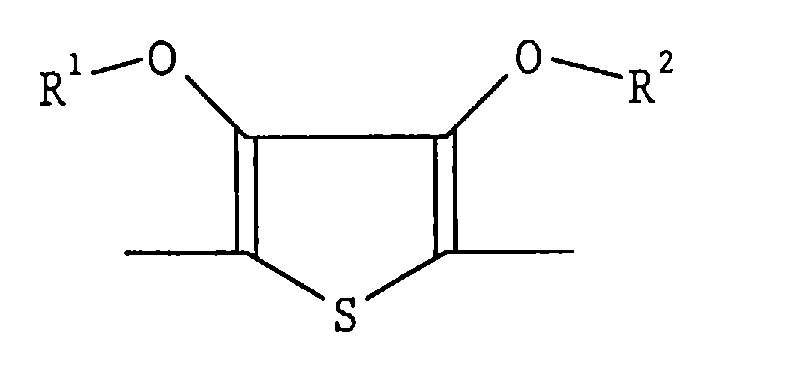
[0053] According to this reference preferred polythiophenes carry structural units corresponding to the following general formula :
in which :
each of R1 and R2 independently represents hydrogen or a C1-4 alkyl group or together represent an optionally substituted C1-4 alkylene group or a cycloalkylene group.
[0054] Preferred polymeric anions for use in admixture with the described polythiophene comprise styrene sulphonic units.
[0055] One of the important advantages of the present invention is the fact that the conventional rather thick gelatinous backing layer(s) can simply be omitted and replaced by a thin adapted subbing layer containing all functional ingredients such as :
- an antistatic, preferably a polythiophen as described above,
- a spacing agent, such as polymethylmethacrylate beads,
- colloidal silica such as Kieselsol 100F (Bayer AG),
- a slip additive such as polyethylene latex,
- a binder such as polymethylmethacrylate,
- a wetting agent such as Ultravon W.
[0056] It is thinkable to coat such a thin adapted layer on-line in the manufacturing alley of the organic resin support, preferably PET, after the manufacturing stages of the support itself, which would represent a more economic way of production. Such a method for coating a polyester suport, either before stretching, or between the first and second stretching, on one or both sides, with a transparent antistatic primer layer comprising a.o. a dispersion of a polythiophene is diclosed in EP 0 602 713. So it is clear that the present invention opens the door for the manufacturing of graphic arts recording films in a more cost-effective way. It should be well understood that when such a thin antistatic backing layer is applied appropriate measures are to be taken at the emulsion side to avoid problems with curling.
[0057] The graphic arts recording material according to the present invention can, after proper exposure be processed by any means or any chemicals known in the art depending on their particular application. In the case of red sensitive elements in the field of graphic arts for phototype- or image-setting or scanning they are preferably processed in so-called "Rapid Access" chemicals, comprising a conventional Phenidone/hydroquinone developing solution or an ascorbic acid developing solution, and a conventional sodium or ammonium thiosulphate containing fixing solution. The development time is usually between 10 and 30 seconds at a temperature of about 35 °C. Alternatively they can be processed in so-called "hard dot Rapid Access" chemistry, e.g. the AGFASTAR system marketed by Agfa-Gevaert N.V.. Preferably an automatically operated processor provided with automatic regeneration is used, e.g. a RAPILINE device marketed by Agfa-Gevaert N.V..
EXAMPLES
Example 1
- preparation of comparative photographic element
[0059] A high contrast cubic silver halide emulsion was prepared by a conventional double jet precipitation. It was sulfur plus gold sensitized and showed an average grain size of 0.30 µm. This emulsion contained 0.4 % of iodide, 16 % of bromide and 83.6 % of chloride and was doped with rhodium and iridium. The gelatin/silver ratio was 0.45. To this emulsion were added in appropriate amounts 4-hydroxy-6-methyl-1,3,3a,7-tetraazaindene as stabilizer, a plasticizing latex, KBr and a red spectral sensitizing dye (SD1) represented by following formula :
[0060] Then this emulsion was coated onto a colourless subbed polyethylene terephthalate support having a thickness of 100 µm at a coverage corresponding to 7.0 g of Ag/m2 expressed as AgNO3 and at a coverage of 3.15 g of gelatin/m2. This photosensitive layer was overcoated with a protective layer layer containing 1 g of gelatin/m2, minor amounts of 1-p-carboxy-phenyl-3-pyrazolidone and hydroquinone, and appropriate amounts of a polymeric matting agent, several surfactants and formaldehyde as gelatin hardener.
[0061] On the non-photosensitive side of the PET support two backing layers were coated. The first layer closest to the support contained 1,64 g of gelatin/m2, colloidal silica, a conventional wetting agent and a prior art blue antihalation dye (AH1) of the oxonol type represented by following formula :
[0062] The second backing layer contained 0.65 g/m2 of gelatin. conventional wetting agents and a polymeric spacing agent. The complete backing layer assemblage showed a density of 0.5 measured at 630 nm and of 0.6 measured at 670 nm.
- preparation of invention photographic element
[0063] A graphic arts recording element according to the present invention was prepared similarly to the comparative element with the following modifations. The hydrophilic photosensitive and non-photosensitive layers were coated on both sides of a subbed polyethylene terephthalate support of 100 µm thickness that was blue coloured by means of preferred pigment PG1 (see description) . The density, measured behind visual filter, was 0.21 measured at 630 nm. In the first backing layer the prior art antihalation dye AH1 was omitted. The emulsion layer was coated at a coverage of 5.4 g Ag/m2 instead of 7.0.
- photographic evaluation
[0064] Samples of the comparative and invention element were exposed for sensitometric evaluation with the appropriate light source plus a continuous wedge, or for image quality with a test pattern of varying density generated by an image setter (see table 1).
[0065] The exposed samples were developed for 20 s at 35 °C by means of a conventional hydroquinone-Phenidone developer, marketed by Agfa-Gevaert N.V., Belgium, under the trade name G101. After conventional fixing, rinsing and drying the samples were evaluated (see table 1).
TABLE 1
| Invention Sample | Comparative Sample | |
| Ag/m2 | 5.4 | 7.0 |
| Sensitometry | ||
| Exposure : HeNe (632 nm) + continuous wedge | ||
| Dmin | 0.13 | 0.03 |
| sensitivity (D=2.0+fog) | 2.11 | 2.10 |
| gamma-toe (0.1-0.5+fog) | 2.61 | 2.58 |
| gamma-linear (1.0-3.0+fog) | 9.00 | 10.3 |
| Sensitometry | ||
| Exposure : laserdiode (670 nm) + continuous wedge | ||
| Dmin | 0.13 | 0.03 |
| sensitivity (D=3.0+fog) | 1.30 | 1.37 |
| gamma-toe (0.1-0.5+fog) | 2.60 | 2.27 |
| gamma-linear (1.0-3.0+fog) | 10.3 |
| Image Quality | ||
| Exposure : CG9600* test pattern HeNe (632 nm) ; density gradient | ||
| sensitivity 52% dot | 0.82 | 0.81 |
| Dmax at 52% dot** | 3.04 | 2.94 |
| sensitivity at D = 3.0*** | 0.82 | 0.82 |
| Image Quality | ||
| Exposure : Accuset 1000* test pattern laserdiode (670 nm) ; density gradient | ||
| sensitivity 50% dot | 2.29 | 2.40 |
| Dmax at 50% dot**** | 2.93 | 3.00 |
| sensitivity at D = 3.0 | 2.30 | 2.41 |
| * : image-setters marketed by Bayer USA Inc., Agfa Division, | ||
| ** : exposure setting for obtaining a 52% dot from a 50% original (overexposure), | ||
| *** : exposure setting for reaching a full area of density 3.0, | ||
| **** : exposure setting for obtaining an exact copy of a 50% original. |
[0066] From the results of table 1 it is clear that the despite the lower silver coverage for the invention sample the sensitometric and image quality values are about equivalent for both elements. Considering gamma-toe there is even a substantial advantage (2.60 compared to 2.26) of the invention element. We note that for the invention sample the Dmin value is raised which self-evidently is due to the blue base colour which is retained after processing, and not to photographic fog. However the increase of the fog in the UV, which is essential for the further handling of the recorded image as master for the exposure of a printing plate or a contact film is neglectible.
Example 2
[0067] In this example a comparison is made between an invention sample coated on the blue PET base, a comparative sample containing again antihalation dye AH1 in its first backing layer, and another comparison element containing in its first backing layer a mixture of two antihalation dyes which best imitates the spectral distribution curve of the blue coloured PET. These antihalation dyes are represented by following formulas :
[0068] Emulsion and layer compositions were similar to example 1. In all three cases the silver coverage of the emulsion layer was 5.4 g Ag/m2.
[0069] The results of the photographic evaluation are presented in table 2.
TABLE 2
| Sensitometry | Sample 1 | Sample 2 | Sample 3 |
| Exposure : HeNe (632 nm) + continuous wedge | |||
| Dmin | 0.10 | 0.03 | 0.03 |
| sensitivity (D=2.0+fog) | 2.16 | 2.14 | 2.11 |
| gamma-toe (0.1-0.5+fog) | 2.52 | 2.55 | 2.63 |
| gamma-linear (1.0-3.0+fog) | 10.5 | 10.4 | 10.9 |
| Sensitometry | |||
| Exposure : laserdiode (670 nm) + continuous wedge | |||
| fog | 0.10 | 0.03 | 0.03 |
| sensitivity (D=3.0+fog) | 1.34 | 1.38 | 1.48 |
| gamma-toe (0.1-0.5+fog) | 2.59 | 2.45 | 2.40 |
| gamma-linear (1.0-3.0+fog) | 10.1 | 10.1 | 10.3 |
| Image Quality | |||
| Exposure : CG9600 test pattern HeNe (632 nm) ; density gradient | |||
| sensitivity 52% dot | 0.82 | 0.81 | 0.79 |
| Dmax at 52% dot | 3.29 | 3.03 | 3.09 |
| sensitivity at D=3.0 | 0.79 | 0.81 | 0.78 |
[0070] From the results of table 2 it is clear that the differences in sensitometry and image quality between the three elements are neglectable. Again it is proved that the use of a blue coloured base constituted a valuable alternative for obtaining good antihalation properties.
Example 3
[0071] In this example a blue coloured base is used (cf. previous examples) and increasing amounts of antihalation dye AH1 are incorporated in the first backing layer (BL1). Emulsion and material design are again similar to the previous examples. The most important parameters for image quality (sharpness) being gamma-toe and Dmax at just copy are illustrated in table 3.
TABLE 3
| Sample No. | 1 | 2 | 3 | 4 | 5 |
| colour PET | blue | = | = | = | = |
| mg/m2 AH1 in BL1 | 0 | 1.6 | 2.4 | 4.0 | 5.7 |
| Ag/m2 | 5.4 | = | = | = | = |
| Sensitometry | |||||
| Exposure : HeNe (632 nm) + continuous wedge | |||||
| gamma-toe | 2.49 | 2.46 | 2.44 | 2.36 | 2.43 |
| Image Quality | |||||
| Exposure: CG9600 test pattern HeNe (632 nm) ; density gradient | |||||
| Dmax just copy 52% dot | 3.12 | 3.03 | 3.03 | 3.07 | 3.08 |
[0072] The values of table 3 indicate that increasing amounts of extra dye in the backing layer do not bring extra image quality and that the antihalation effect of the blue coloured support is sufficient in itself.
Example 4
[0073] The water uptake was measured of invention samples with and without backing layers with a composition according to example 1, both coated at 5.4 g Ag/m2. The water uptake of the sample with backing layers was 9.0 g/m2 ; the water uptake of the sample without backing layers was only 4.0 g/m2, which of course is favourable for dimensional stability.
1. Graphic arts recording film comprising an organic resin support and a photographic
silver halide emulsion layer, spectrally sensitized for the red spectral region, characterized
in that said organic resin support is blue coloured.
2. Graphic arts recording film according to claim 1 wherein said blue coloured organic
resin support is polyethylene terephthalate.
3. Graphic arts recording film according to claim 1 or 2 wherein said organic resin support
is coloured blue by a pigment which is a 1, 4-bis-anilino-anthraquinone compound.
4. Graphic arts recording film according to claim 3 wherein said 1, 4-bis-anilino-anthraquinone
pigment corresponds to following chemical formula (PG1) :
5. Graphic arts recording film according to any of claims 1 to 4 wherein said blue coloured
support shows a density between 0.1 and 0.3 measured at 630 nm.
6. Graphic arts recording film according to any of claims 1 to 5 wherein said silver
halide emulsion layer is coated at a silver coverage of at most 5.5 g/m2, expressed as AgNO3.
7. Graphic arts recording film according to any of claims 1 to 6 wherein the side of
said support opposite to the emulsion side is coated with a gelatin-free subbing layer
containing an antistatic agent, and wherein said side of said support opposite to
the emulsion side comprises no additional backing layers.
8. Graphic arts recording film according to claim 7 wherein said gelatin-free subbing
layer is coated on-line after the manufacturing of said organic resin support in the
same manufacturing alley.
9. Graphic arts recording film according to claim 7 or 8 wherein said antistatic agent
is a polythiophene comprising structural units corresponding to the following general
formula (I) :
10. Graphic arts recording film according to claim 7, 8 or 9 wherein said gelatin-free
subbing layer further contains a polymethylacrylate binder, colloidal silica, a polyethylene
latex as slip agent, and polymethylacrylate beads as spacing agent.
11. Use of a graphic arts recording film according to any of the 1revious claims for the
recording of screened images, linework and/or text, and/or printed circuit board patterns,
electronically stored in an image-setter or scanner, by means of red laser exposure.