(57) An improved ship docking vessel (1) is provided that has a substantially flat, elliptical
bottom having a large beam-to-length ratio to provide a shallow draft. In addition,
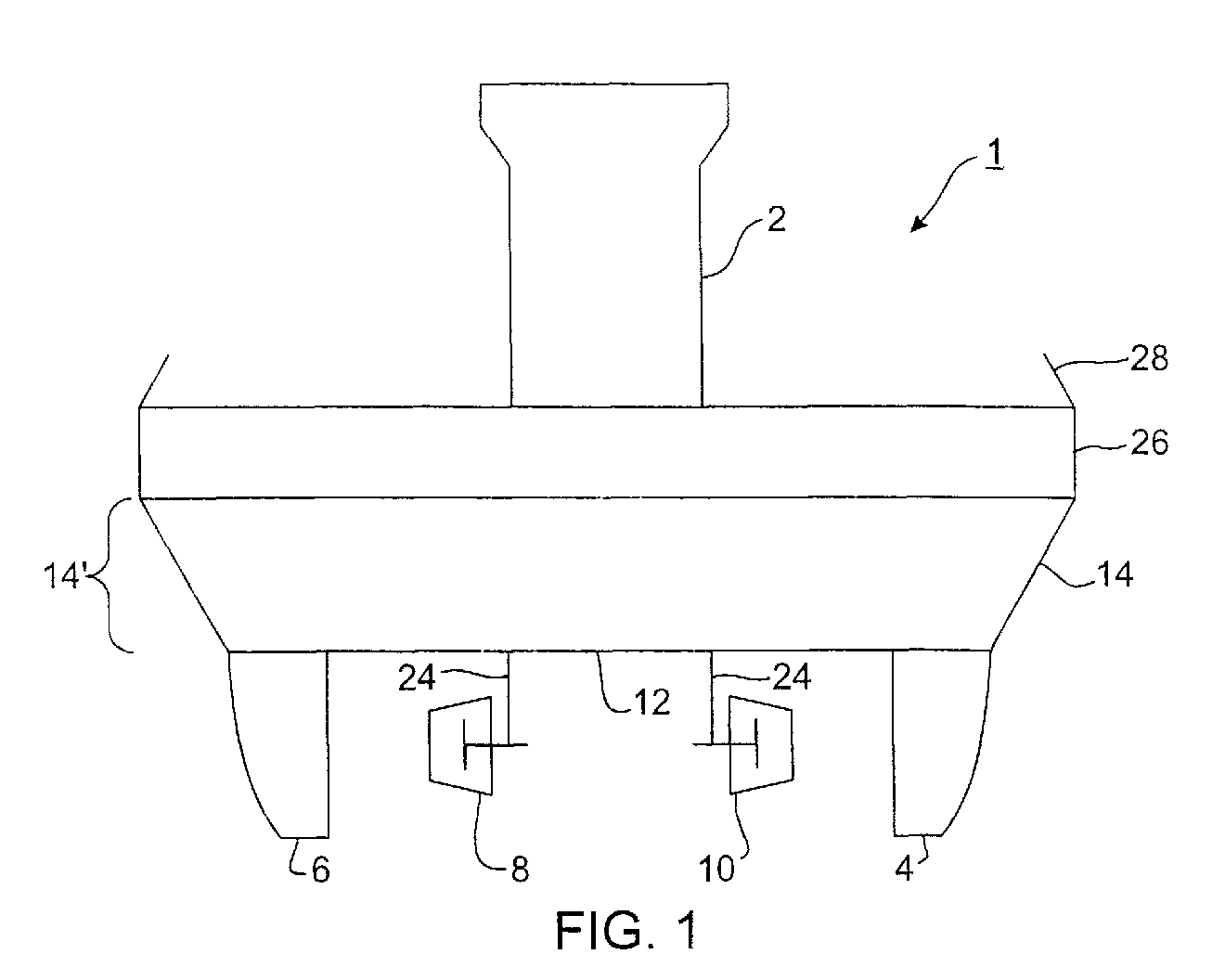
the vessel (1) of the present invention is provided with two Z-drives (8,10) disposed
diagonally opposite the longitudinal axis (20) of the bottom. Each of the drives (8,10)
is adapted to rotate 360° about its central shaft. Because there is no keel, the vessel
is provided with a pair of skegs (4,6) disposed fore and aft along the center line
of the longitudinal axis (20) of the substantially flat bottom. The skegs (4,6) are
disposed outside the Z-drives (8,10) and provide for enhanced maneuverability and
increased directional stability of the vessel (1). In a preferred embodiment,the flat
bottom has curved ends and parallel sides (16,18), and the entire flat bottom is longitudinally
and transversely symmetrical. The hull (14) includes a substantially uniform flare
between theflat bottom and the flat bumper portion (26) to facilitate movement of
the vessel in any direction and to improve vessel stability. The skegs (4,6) extend
below the drives (8,10) to protect them from bottoming out and to act as support for
the hull when the vessel (1) is dry-docked. In an alternative embodiment, a cycloidal
drive system (40) may be used instead of the Z-drive system (8,10).
|
|
