| (19) |
 |
|
(11) |
EP 0 816 232 B1 |
| (12) |
EUROPEAN PATENT SPECIFICATION |
| (45) |
Mention of the grant of the patent: |
|
09.01.2002 Bulletin 2002/02 |
| (22) |
Date of filing: 10.06.1997 |
|
|
| (54) |
A method and a device for the application of adhesive material to a wrapping material
Verfahren und Vorrichtung zum Anbringen von Klebstoffen auf Verpackungsmaterial
Procédé et appareil pour appliquer un matériau adhésif sur un matériau d'emballage
|
| (84) |
Designated Contracting States: |
|
DE FR GB IT |
| (30) |
Priority: |
25.06.1996 IT BO960349
|
| (43) |
Date of publication of application: |
|
07.01.1998 Bulletin 1998/02 |
| (73) |
Proprietor: G.D SOCIETA' PER AZIONI |
|
I-40133 Bologna (IT) |
|
| (72) |
Inventors: |
|
- Boriani, Silvano
40133 Bologna (IT)
- Minarelli, Alessandro
40053 Bazzano (Bologna) (IT)
|
| (74) |
Representative: Pederzini, Paolo |
|
c/o BUGNION S.p.A. Via Goito, 18
40126 Bologna
40126 Bologna (IT) |
| (56) |
References cited: :
EP-A- 0 523 589
GB-A- 2 093 739
|
DE-A- 4 241 176
|
|
| |
|
|
|
|
| |
|
| Note: Within nine months from the publication of the mention of the grant of the European
patent, any person may give notice to the European Patent Office of opposition to
the European patent
granted. Notice of opposition shall be filed in a written reasoned statement. It shall
not be deemed to
have been filed until the opposition fee has been paid. (Art. 99(1) European Patent
Convention).
|
[0001] The present invention relates to a method for the application of adhesive material
to wrapping material. The invention is employed advantageously in the art field of
wrapping machines for cigarettes (see DE-A-4 241 176), an area of use to which reference
is made explicitly throughout the following specification, albeit with no limitation
in general scope implied.
[0002] It is usual in machines of the aforementioned type for the wrapping material to be
decoiled from a roll and directed toward a wrapping station, passing through a cutting
station and a gumming station; at this latter station, a layer of glue is applied
to predetermined areas of the wrapping material in such a manner that the corresponding
edges of a cut sheet can be joined subsequently during the step of wrapping the product.
The gumming operation will be implemented generally by bringing the material to a
standstill at the gumming station long enough for the adhesive to be applied by relative
gumming means. The pause made by the wrapping material at the gumming station gives
rise to certain drawbacks, chief among which being a reduction in the operating speed
of the machine overall, also a jerky movement of the wrapping material that tends
to result in an erratic restart after successive applications of the adhesive material,
and ultimately in the risk of breakage.
[0003] The object of the present invention is to provide a method for the application of
adhesive material to wrapping material such as will both enable a wrapping material
to be advanced at high speeds and allow the gumming operation to be completed with
great rapidity, thereby eliminating the drawbacks described above.
[0004] The stated object is realized in a method of applying adhesive material to wrapping
material according to claim 1.
[0005] The object of the present invention is also to provide a device for the application
of adhesive material to a wrapping material.
[0006] This same object is realized in a device according to claim 9.
[0007] The invention will now be described in detail, by way of example, with the aid of
the accompanying drawings, in which:
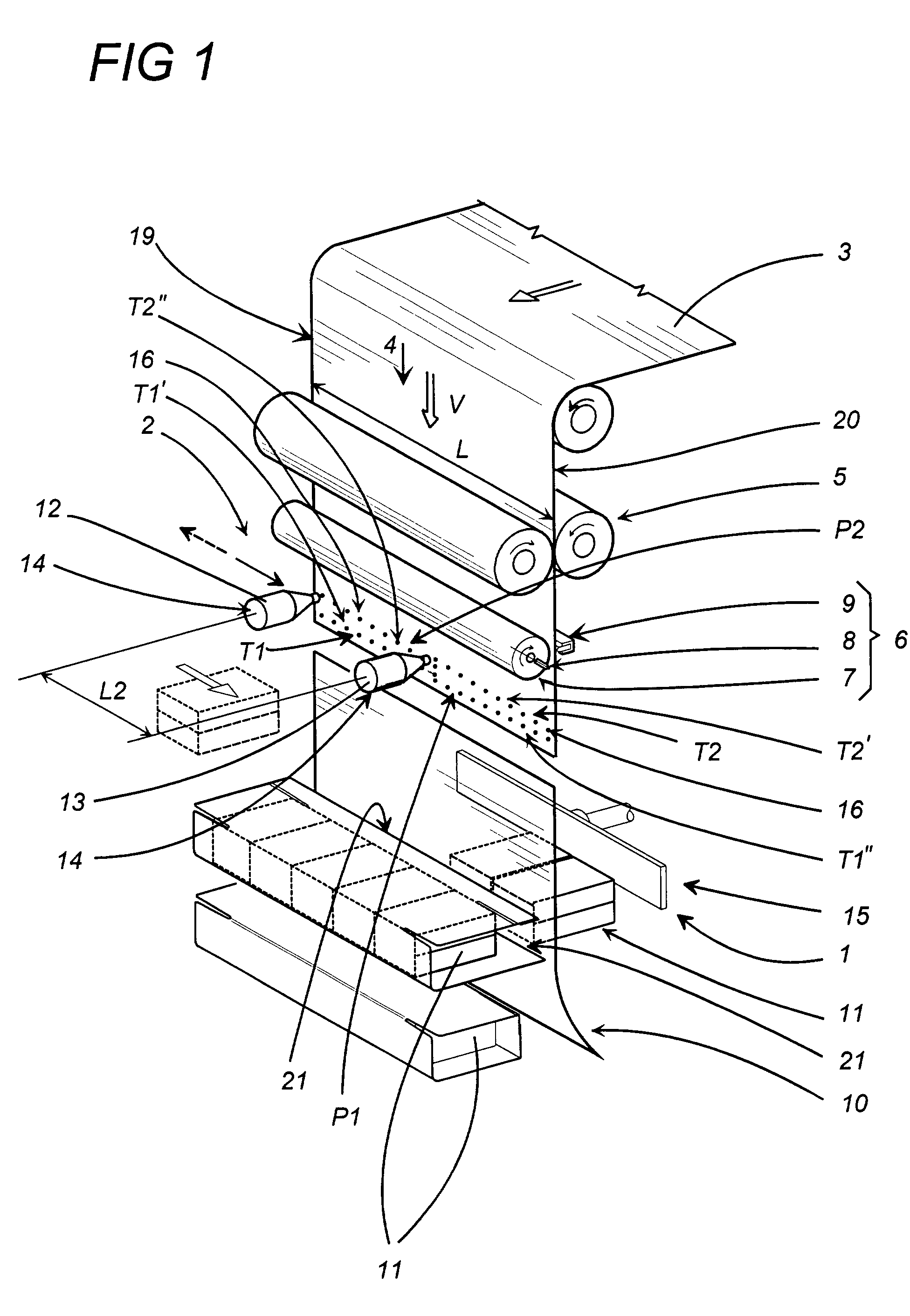
- fig 1 illustrates a preferred embodiment of a device for the application of adhesive
material according to the invention, viewed schematically in perspective and with
certain parts omitted for clarity;
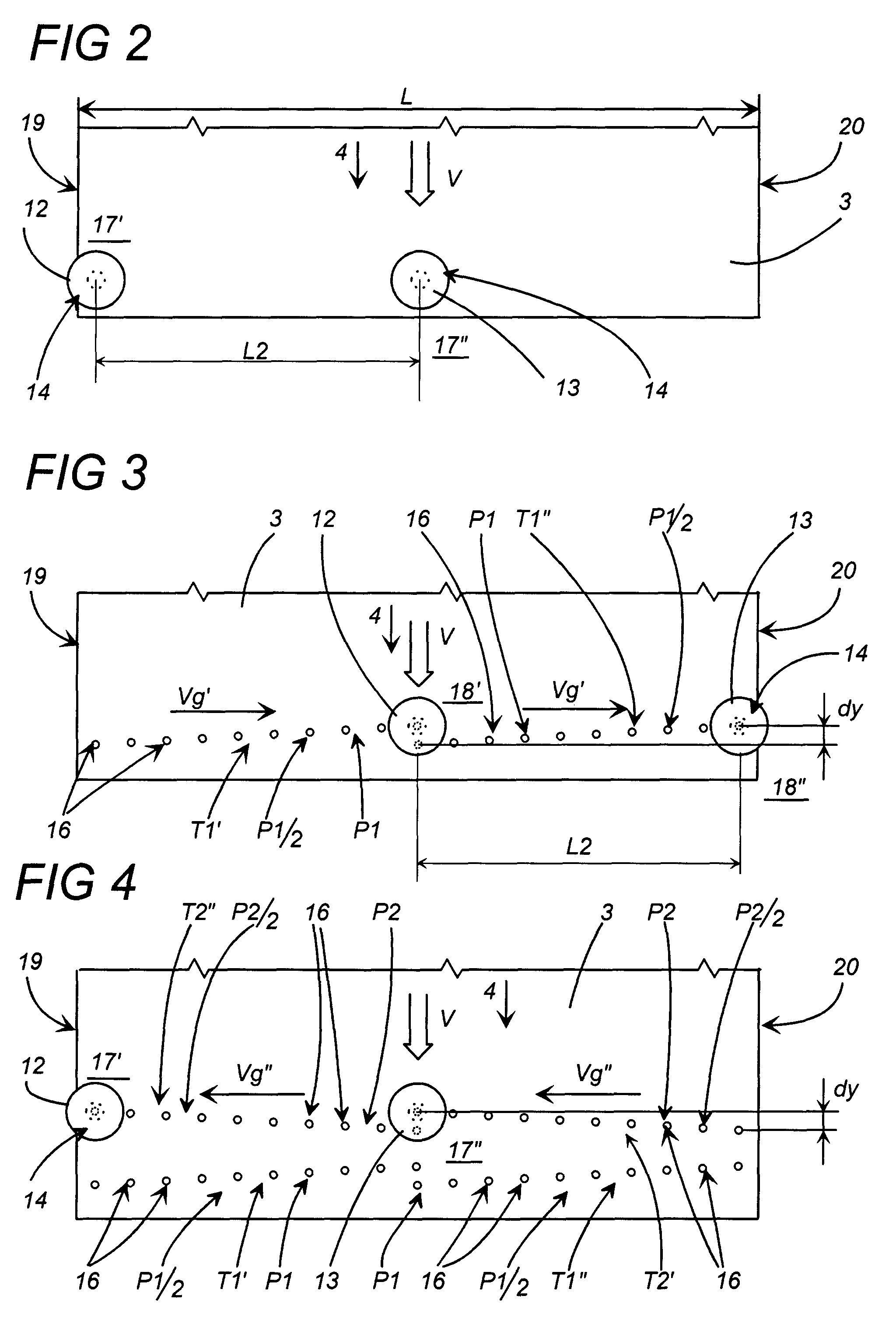
- figs 2, 3 and 4 illustrate successive stages in the application of adhesive material
to wrapping material as implemented utilizing the method and the device according
to the present invention.
[0008] With reference to fig 1 of the accompanying drawings, 1 denotes part of a wrapping
machine, in its entirety, and 2 denotes a device, likewise in its entirety, for the
application of adhesive material 16 to a wrapping material 3.
[0009] The wrapping material 3 is made to advance at a given linear velocity V along a feed
path extending in a predetermined direction denoted 4, drawn forward by a pinch roll
device 5 of conventional embodiment which is followed in the feed direction by a cutter
unit 6 composed, for instance, of a roller 7 supporting a first blade 8 mounted so
as to interact with a second blade 9. Similarly conventional in embodiment, the cutter
unit 6 serves to divide the wrapping material 3 into single sheets 10 such as can
be folded ultimately around products 11, packets of cigarettes for example, at a wrapping
station 15 which is again conventional and will be described no further.
[0010] In the example of fig 1 the device 2 comprises two gun type applicators 12 and 13
such as will deposit the adhesive material 16 directly on selected portions of the
wrapping material 3, denoted P1 and P2, which are gummed so that a join can be fashioned
between the two transverse edges 21 presented by each single sheet 10 cut from the
wrapping material 3 and folded around the products 11. The two applicators 12 and
13, which in the course of the specification will also be referred to respectively
as first and second applicator, are disposed in a common plane substantially perpendicular
to the plane occupied by the wrapping material 3, and spaced apart at a distance L2
equivalent approximately to half the width L of the wrapping material 3.
[0011] Observing fig 1 and fig 2, the two applicators 12 and 13 are set up in such a way
as to execute two gumming passes, one forward and one return, during which the adhesive
material 16 is applied to the two portions P1 and P2 of the wrapping material 3 along
two trails T1 and T2 extending transversely to the feed direction 4 followed by the
wrapping material 3. The two passes made in applying the adhesive material 16 are
brought about simultaneously with the advance of the wrapping material 3, which remains
uninterrupted. More exactly, and as discernible from the manner in which the two applicators
12 and 13 are positioned, both mutually and in relation to the advancing wrapping
material 3, the forward and return gumming passes are split up respectively into two
simultaneous constituent forward passes and two simultaneous constituent return passes
during which the two applicators 12 and 13 are set in motion transversely to the wrapping
material 3 at a forward velocity and at a return velocity denoted Vg' and Vg" respectively.
[0012] In the case of the forward gumming pass, the first applicator 12 makes a first constituent
forward pass during which it will proceed to gum a first half P1/2 of the portion
denoted P1 along a first segment T1' representing one component part of the full trail
denoted T1. At one and the same time, the second applicator 13 makes a second constituent
forward pass during which it will gum a second half P1/2 of the same portion P1 along
a second trail segment T1" complementary to the first trail segment T1', with which
it combines to complete the relative trail T1. Likewise in the case of the return
gumming pass, the first applicator 12 will execute a first constituent return pass
and gum a first half P2/2 of the portion denoted P2 along a first segment T2' that
represents one component part of the trail denoted T2. At the same time, the second
applicator 13 makes a second constituent return pass during which it will gum a second
half P2/2 of the selfsame portion P2 along a second trail segment T2" complementary
to the first trail segment T2', with which it combines to complete the relative trail
T2.
[0013] In operation, the wrapping material 3 is decoiled from a reel (not illustrated) by
the action of the pinch roll device 5 and advanced at a predetermined linear velocity
V through the cutter unit 6 to the wrapping station 15.
[0014] In the solution of figs 2, 3 and 4, the adhesive material 16 is deposited on the
wrapping material 16 by two applicators 12 and 13 moving simultaneously in a direction
substantially perpendicular to the feed direction 4 and within a plane lying parallel
to the plane occupied notionally by the advancing wrapping material 3.
[0015] Remembering that the applicators 12 and 13 are spaced apart at a set distance L2,
each one operates within a limited crosswise travel of which the length is also substantially
equal to this same distance L2. During the course of their limited crosswise travel,
the two applicators 12 and 13 will direct adhesive material 16 onto the respective
halves P1/2 and P2/2 making up the portions P1 and P2 of the wrapping material 3 destined
to be gummed, in the manner already described.
[0016] Thus, the applicators 12 and 13 will cover the limited travel distance twice, moving
first from left to right (as seen in figs 2, 3 and 4) at a first velocity Vg' to make
the forward gumming pass during which adhesive material 16 is applied along the first
trail T1, and thereafter from right to left at a second velocity Vg" to make the return
gumming pass during which adhesive material 16 is applied along the second trail T2.
In a preferred solution the two velocities Vg' and Vg" will be identical.
[0017] In the example of the drawings, the applicators 12 and 13 move in the same direction
when making the forward and return gumming passes.
[0018] During a forward gumming pass, the first applicator 12 makes the first constituent
forward pass, departing initially from a first start position 17' (fig 2) near the
left hand side edge 19 of the wrapping material 3 and moving to a second stop position
18' (fig 3) near the median line of the wrapping material. The second applicator 13
likewise makes the second constituent forward pass, in this instance departing from
a first start position 17" (fig 2) near the median line of the wrapping material 3
and moving across to a second stop position 18" (fig 3) located near the side edge
20 of the wrapping material 3 remote from the side edge 19 at which the first applicator
12 commences the first constituent forward pass.
[0019] The application of adhesive material 16 on the return gumming pass is entirely similar:
making the first constituent return pass, the first applicator 12 moves from a first
start position 18' (fig 3) coinciding with the end of the first constituent forward
pass, hence near the median line of the wrapping material 3, to a second stop position
17' (fig 4) that'coincides naturally with the first start position 17' of the first
constituent forward pass. And again in the same way, when making the second constituent
return pass, the second applicator 13 moves from a second start position 18" (fig
3) coinciding with the end of the second constituent forward pass, hence near the
right hand side edge 20 of the wrapping material 3, to a second stop position 17"
(fig 4) near the median line of the wrapping material that coincides naturally with
the first start position of the second constituent forward pass.
[0020] In an alternative solution, not illustrated in the drawings but equivalent to that
described thus far for all practical intents and purposes, the applicators 12 and
13 might move in mutual opposition, for example starting from respective points near
the median line of the wrapping material 3 and moving first toward the edges before
returning to the middle, or starting from the edges and moving first toward the middle.
[0021] Observing fig 4, it will be seen that the adhesive material 16 is deposited on the
wrapping material 3 by the applicators preferably in intermittent fashion, so that
the gummed areas appear substantially as dotted lines.
[0022] Given that the applicators 12 and 13 are translated at respective velocities Vg'
and Vg" significantly higher than the linear velocity V of the advancing wrapping
material 3, the forward trail segments T1' and T1" and the return trail segments T2'
and T2" can be generated substantially perpendicular to the feed direction 4. More
exactly, the wrapping material 3 advances during the application of the adhesive material
3 through a distance
dy that will be determined by the velocity V of the wrapping material 3 and by the time
needed for the applicators 12 and 13 to gum the selected area. This same distance
dy in turn determines the angle at which each segment of the gumming trail is disposed
in relation to a notional line perpendicular to the feed direction 4. The use of two
or more applicators rather than one only is instrumental in reducing the value of
this same distance
dy for a given linear velocity of the wrapping material, and therefore in minimizing
the longitudinal dimension of the material occupied by the trail T1 (T2) of adhesive
material.
[0023] Should it become necessary to reduce the distance
dy in question or to increase the linear velocity V of the advancing material 3, the
number of applicators can be augmented in such a manner as to divide the trail of
adhesive material 16 into a greater number of simultaneously generated single segments.
Increasing the number of applicators to three, by way of example, spaced apart uniformly
so that each covers one third of the transverse dimension presented by the wrapping
material 3, the distance travelled by the applicators in depositing a full transverse
trail of the adhesive material 16 will also be equivalent to one third the width L
of the wrapping material 3, so that the time taken by three applicators to gum the
selected portion will be less, for a given velocity Vg' (Vg"), than the time taken
by two applicators.
1. A method for the application of adhesive material (16) to wrapping material (3), typically
in wrapping machines, comprising
- the step of advancing the wrapping material (3) along a predetermined direction
(4) at a predetermined velocity (V), and
- the step of applying the adhesive material (16) selectively to at least one portion
(P1) of the wrapping material (3) without any interruption in the step of advancing
the wrapping material (3) caracterized in that the step of applying the adhesive material
(16) comprises at least one forward gumming pass made along at least one trail (T1)
extending transversely to the direction (4) along which the wrapping material (3)
advances.
2. A method as in claim 1, wherein the step of applying the adhesive material (16) is
implemented in a gumming pass comprising at least two simultaneous constituent forward
passes of which a respective first constituent pass covers a first part (P1/2) of
the portion (P1) compassing a first segment of the trail (T1'), and a respective second
constituent pass covers a second part (P1/2) of the selfsame portion (P1) compassing
a second segment of the trail (T1") complementary to the first.
3. A method as in claim 2, wherein the first constituent forward pass originates from
a start position (17') substantially near one side edge (19) of the wrapping material
(3) and terminates at a stop position (18') substantially near the median line of
the wrapping material, whilst the second constituent forward pass originates from
a start position (17") near the median line of the wrapping material (3) and terminates
at a stop position (18") near the side edge (20) of the wrapping material remote from
the side edge (19) at which the first constituent forward pass originates.
4. A method as in preceding claims, comprising a further step of applying the adhesive
material (16) to at least one other portion (P2) of the wrapping material (3) at least
in a second return gumming pass made along at least one second trail (T2).
5. A method as in claim 4, wherein the step of applying adhesive material (16) to a further
portion (P2) of the wrapping material (3) is implemented in a gumming pass comprising
at least two simultaneous constituent return passes of which a respective first constituent
pass covers a first part (P2/2) of the portion (P2) compassing a first segment of
the trail (T2'), and a respective second constituent pass covers a second part (P2/2)
of the selfsame portion (P2) compassing a second segment of the trail (T2") complementary
to the first.
6. A method as in claim 5, wherein the step of applying the adhesive material (16) to
a further portion (P2) of the wrapping material (3) is implemented in a gumming pass
of which a first constituent return pass compassing the first trail segment (T2')
originates from a start position (18") near one side edge (20) of the wrapping material
(3) and terminates at a stop position (18') near the median line of the wrapping material
and of which a second constituent return pass compassing the second trail segment
(T2") originates from a start position (17") near the median line of the wrapping
material (3) and terminates at a stop position (17') near the side edge (19) of the
wrapping material remote from the side edge (20) at which the first constituent return
pass originates.
7. A method as in preceding claims, wherein the wrapping material (3) advances at a reduced
velocity (V) during the step of applying the adhesive material (16).
8. A method as in preceding claims, wherein the gumming trails (T1, T2, T1', T1", T2',
T2") are disposed substantially perpendicular to the direction followed by the advancing
wrapping material (3).
9. A device for the application of adhesive material (16) to wrapping material (3), typically
in wrapping machines, comprising
- means (5) by which to advance the wrapping material (3) along a predetermined direction
(4) at a predetermined velocity (V);
- gumming means (14) consisting in at least one applicator (12, 13) disposed and embodied
in such a way as to apply the adhesive material (16) selectively to at least one portion
(P1) of the wrapping material simultaneously with and without interrupting the advance
of the wrapping material (3), caracterized in that the applicator applies the adhesive
material in (3) at least one forward gumming pass made along at least one trail (T1)
extending transversely to the direction (4) along which the wrapping material (3)
advances.
10. A device as in claim 9, wherein adhesive material (16) is applied by the gumming means
(14) to at least one other portion (P2) of the wrapping material (3) at least in one
further return gumming pass made along at least one further trail (T2).
11. A device as in claim 9, wherein the gumming means (14) consist in at least one first
applicator (12) and one second applicator (13) that are embodied separately, disposed
and configured in such a way as to apply the adhesive material (16) to the wrapping
material (3) at least in two simultaneous constituent forward passes of which a first
constituent pass made by the first applicator (12) covers a first half (P1/2) of the
portion (P1) compassing a first trail segment (T1'), and a second constituent pass
made by the second applicator (13) covers a second part (P1/2) of the same portion
(P1) compassing a second trail segment (T1") complementary to the first.
12. A device as in claim 11, wherein the first applicator (12) is set in motion during
the first constituent forward pass between a first start position (17') occupied near
one side edge (19) of the wrapping material (3) and a second stop position (18') occupied
near the median line of the wrapping material, whilst the second applicator (13) is
set in motion during the second constituent forward pass between a first start position
(17") occupied near the median line of the wrapping material (3) and a second stop
position (18") occupied near the side edge (20) remote from the side edge (19) of
the wrapping material (3) at which the first constituent forward pass is originated.
13. A device as in claims 9 to 12, wherein the adhesive material (16) is applied by the
first applicator (12) and the second applicator (13) to at least one other portion
(P2) of the wrapping material (3) in a return gumming pass comprising at least two
simultaneous constituent return passes of which a first constituent pass made by the
first applicator (12) covers a first half (P2/2) of the portion (P2) compassing a
first trail segment (T2'), and a second constituent pass made by the second applicator
(13) covers a second part (P2/2) of the selfsame portion (P2) compassing a second
trail segment (T2") complementary to the first.
14. A device as in claim 13, wherein the first applicator (12) is set in motion during
the first constituent return pass between a first start position (18') occupied near
the median line of the wrapping material (3) and a second stop position (17') occupied
near one side edge (19) of the wrapping material, whilst the second applicator (13)
is set in motion during the second constituent return pass between a first start position
(18") occupied near the side edge (20) of the wrapping material (3) remote from the
side edge (19) at which the first constituent forward pass is originated, and a second
stop position (17") located near the median line of the wrapping material.
15. A device as in claims 9 to 12, wherein the adhesive material (16) is applied by gumming
means (14, 12, 13) moving on a plane substantially parallel to the plane occupied
by the advancing wrapping material (3) and along directions extending perpendicularly
to the feed direction followed by the wrapping material (3).
16. A device as in claims 3 to 5, wherein the adhesive material (16) is applied by the
gumming means (14, 12, 13) along trails (T1, T2) extending across the full transverse
width (L) of the wrapping material (3).
17. A device as in claims 9 to 16, wherein the wrapping material (3) advances at a reduced
velocity (V) during the step in which adhesive material (16) is applied by the gumming
means (14, 12, 13).
1. Verfahren zum Anbringen von Klebstoffen (16) auf Verpackungsmaterial (3), insbesondere
in Verpackungsmaschinen, enthaltend:
- die Phase des Vorlaufs des Verpackungsmaterials (3) entlang einer bestimmten Richtung
(4) und mit einer bestimmten Geschwindigkeit (V), und
- die Phase des Anbringens von Klebstoff (16) wahlweise an wenigstens einem Abschnitt
(P1) des Verpackungsmaterials (3) ohne jede Unterbrechung des Vorlaufs des Verpackungsmaterials
(3), dadurch gekennzeichnet, dass die Phase des Anbringens von Klebstoff (16) wenigstens eine Gummierung im Vorlauf
enthält, beschreibend wenigstens eine Spur (T1), die sich quer zu der Richtung (4)
erstreckt, nach welcher das Verpackungsmaterial (3) vorläuft.
2. Verfahren nach Patentanspruch 1, bei welchem die Phase des Anbringens von Klebstoff
(16) durch eine Gummierung ausgeführt wird, enthaltend wenigstens zwei gleichzeitige
teilweise Vorläufe, von welchen ein entsprechender erster teilweiser Vorlauf einen
ersten Teil (P1/2) des Abschnittes (P1) abdeckt, ein erstes Spursegment (T1') beschreibend,
und ein entsprechender zweiter teilweiser Vorlauf einen zweiten Teil (P1/2) desselben
Abschnittes (P1) abdeckt, ein zweites Spursegment (T1") beschreibend, welches ergänzend
zu dem ersten ist.
3. Verfahren nach Patentanspruch 2, bei welchem der erste teilweise Vorlauf von einer
Startposition (17') ausgeht, die sich im wesentlichen dicht an dem Seitenrand (19)
des Verpackungsmaterials (3) befindet, und an einer Halteposition (18') endet, im
wesentlichen dicht an der Mittellinie des Verpackungsmaterials, während der zweite
teilweise Vorlauf von einer Startposition (17") dicht an der Mittellinie des Verpakkungsmaterials
(3) ausgeht und an einer Halteposition (18") dicht an dem Seitenrand (20) des Verpackungsmaterials
endet, entfernt von dem Seitenrand (19), an welchem der erste teilweise Vorlauf beginnt.
4. Verfahren nach den vorstehenden Patentansprüchen, enthaltend eine weitere Phase des
Anbringens von Klebstoff (16) an wenigstens einem anderen Abschnitt (P2) des Verpackungsmaterials
(3) mit wenigstens einer zweiten Gummierung im Rücklauf, wenigstens eine zweite Spur
(T2) beschreibend.
5. Verfahren nach Patentanspruch 4, bei welchem die Phase des Anbringens von Klebstoff
(16) an einem weiteren Abschnitt (P2) des Verpackungsmaterials (3) durch eine Gummierung
ausgeführt wird, enthaltend wenigstens zwei gleichzeitige teilweise Rückläufe, von
welchen ein entsprechender erster teilweiser Rücklauf einen ersten Teil (P2/2) des
Abschnittes (P2) abdeckt, beschreibend ein erstes Spursegment (T2'), und ein entsprechender
zweiter teilweiser Vorlauf einen zweiten Teil (P2/2) desselben Abschnittes (P2) abdeckt,
beschreibend ein zweites Spursegment (T2"), welches ergänzend zu dem ersten ist.
6. Verfahren nach Patentanspruch 5, bei welchem die Phase des Anbringens von Klebstoff
(16) an einem weiteren Abschnitt (P2) des Verpackungsmaterials (3) durch eine Gummierung
ausgeführt wird, von welcher ein erster teilweiser, das erste Spursegment (T2') beschreibender
Rücklauf von einer Startposition (18") dicht an einem Seitenrand (20) des Verpackungsmaterials
(3) ausgeht und an einer Halteposition (18') dicht an der Mittellinie des Verpackungsmaterials
endet, und von welchem ein zweiter teilweiser, das zweite Spursegment (T2") beschreibender
Rücklauf von einer Startposition (17") dicht an der Mittellinie des Verpackungsmaterials
(3) ausgeht und an einer Halteposition (17') dicht an dem Seitenrand (19) des Verpackungsmaterials
endet, und zwar entfernt von dem Seitenrand (20), an welchem der erste teilweise Rücklauf
beginnt.
7. Verfahren nach den vorstehenden Patentansprüchen, bei welchem das Verpackungsmaterial
(3) während der Phase des Anbringens von Klebstoff (16) mit einer reduzierten Geschwindigkeit
(V) vorläuft.
8. Verfahren nach den vorstehenden Patentansprüchen, bei welchem die Gummierspuren (T1,
T2, T1', T1", T2', T2") im wesentliche lotrecht zu der Richtung angeordnet sind, welcher
das vorlaufende Verpackungsmaterial (3) folgt.
9. Vorrichtung zum Anbringen von Klebstoff (16) an Verpackungsmaterial (3), insbesondere
in Verpackungsmaschinen, enthaltend:
- Mittel (5), durch welche das Verpackungsmaterial (3) entlang einer bestimmten Richtung
(4) und mit einer bestimmten Geschwindigkeit (V) vorgezogen wird;
- Gummiermittel (14), bestehend aus wenigstens einem Anbringelement (12, 13), angeordnet
und ausgeführt auf solche Weise, dass der Klebstoff (16) wahlweise an wenigstens einem
Abschnitt (P1) des Verpackungsmaterials angebracht wird, und zwar gleichzeitig mit
dem Vorlauf des Verpackungsmaterials (3) und ohne diesen zu unterbrechen, dadurch gekennzeichnet, dass das Anbringelement den Klebstoff in wenigstens einem Vorlauf aufträgt, beschreibend
wenigstens eine Spur (T1), die sich quer zu der Richtung (4) erstreckt, entlang welcher
das Verpackungsmaterial (3) vorläuft.
10. Vorrichtung nach Patentanspruch 9, bei welcher der Klebstoff (16) durch die Gummiermittel
(14) an wenigstens einem anderen Abschnitt (P2) des Verpackungsmaterials (3) angebracht
wird, und zwar in wenigstens einem weiteren Rücklauf, welcher wenigstens eine weitere
Spur (T2) beschreibt.
11. Vorrichtung nach Patentanspruch 9, bei welcher die Gummiermittel (14) aus wenigstens
einem ersten Anbringelement (12) und einem zweiten Anbringelement (13) bestehen, welche
getrennt voneinander ausgeführt und auf solche Weise angeordnet und ausgebildet sind,
dass sie den Klebstoff (16) an dem Verpackungsmaterial (3) in wenigstens zwei gleichzeitigen
teilweisen Vorläufen anbringen, von welchen ein erster teilweiser Vorlauf, ausgeführt
durch das erste Anbringelement (12), eine erste Hälfte (P1/2) des das erste Spursegment
(T1') beschreibenden Abschnittes (P1) abdeckt und ein zweiter teilweiser Vorlauf,
ausgeführt durch das zweite Anbringelement (13), einen zweiten, das zweite Spursegment
(T1") beschreibenden Teil (P1/2) desselben Abschnittes (P1) abdeckt und ergänzend
zu dem ersten ist.
12. Vorrichtung nach Patentanspruch 11, bei welcher sich das erste Anbringelement (12)
während des ersten teilweisen Vorlaufs zwischen einer ersten Startposition (17') dicht
an einem Seitenrand (19) des Verpackungsmaterials (3) und einer zweiten Halteposition
(18') dicht an der Mittellinie des Verpackungsmaterials bewegt, während sich das zweite
Anbringelement (13) während des zweiten teilweisen Vorlaufs zwischen einer ersten
Startposition (17") dicht an der Mittellinie des Verpackungsmaterials (3) und einer
zweiten Halteposition (18") dicht an dem Seitenrand (20) bewegt, entfernt von dem
Seitenrand (19) des Verpackungsmaterials (3), von welchem der erste teilweise Vorlauf
ausgeht.
13. Vorrichtung nach den Patentansprüchen von 9 bis 12, bei welcher der Klebstoff (16)
durch das erste Anbringelement (12) und das zweite Anbringelement (13) an wenigstens
einem anderen Abschnitt (P2) des Verpackungsmaterials (3) angebracht wird, und zwar
durch eine Gummierung im Rücklauf, enthaltend wenigstens zwei gleichzeitige teilweise
Rückläufe, von denen ein erster teilweiser, durch das erste Anbringelement (12) ausgeführter
Rücklauf eine erste Hälfte (P2/2) des Abschnittes (P2) abdeckt, der ein erstes Spursegment
(T2') beschreibt, und ein zweiter teilweiser, durch das zweite Anbringelement (13)
ausgeführter Rücklauf einen zweiten Teil (P2/2) desselben, ein zweites Spursegment
(T2") beschreibenden Abschnitt (P2) abdeckt, und zwar ergänzend zu dem ersten.
14. Vorrichtung nach Patentanspruch 13, bei welcher sich das erste Anbringelement (12)
während dem ersten teilweisen Rücklauf zwischen einer ersten Startposition (18') dicht
an der Mittellinie des Verpackungsmaterials (3) und einer zweiten Halteposition (17')
dicht an dem Seitenrand (19) des Verpackungsmaterials bewegt, während sich das zweite
Anbringelement (13) während des zweiten teilweisen Rücklaufs zwischen einer ersten
Startposition (18") dicht an dem Seitenrand (20) des Verpackungsmaterials (3) und
entfernt von dem Seitenrand (19), von welchem der erste teilweise Rücklauf ausgeht,
und einer zweiten Halteposition (17") bewegt, die dicht an der Mittellinie des Verpackungsmaterials
angeordnet ist.
15. Vorrichtung nach den Patentansprüchen von 9 bis 12, bei welcher der Klebstoff (16)
durch Gummiermittel (14, 12, 13) angebracht wird, die sich auf einer Ebene im wesentlichen
parallel zu der Ebene bewegen, die von dem vorlaufenden Verpackungsmaterial (3) belegt
ist, und entlang von Richtungen, die rechtwinklig zu der Zuführrichtung verlaufen,
welcher das Verpackungsmaterial (3) folgt.
16. Vorrichtung nach den Patentansprüchen von 3 bis 5, bei welcher der Klebstoff (16)
durch Gummiermittel (14, 12, 13) angebracht wird, welche Spuren (T1, T2) beschreiben,
die sich quer über die volle Breite (L) des Verpackungsmaterials (3) erstrecken.
17. Vorrichtung nach den Patentansprüchen von 9 bis 16, bei welcher das Verpackungsmaterial
(3) während der Phase, in welcher der Klebstoff (16) durch die Gummiermittel (14,
12, 13) angebracht wird, mit einer reduzierten Geschwindigkeit (V) vorläuft.
1. Procédé pour appliquer un matériau adhésif (16) sur un matériau d'emballage (3), notamment
dans des machines d'emballage, comprenant :
- une phase d'alimentation du matériau d'emballage (3) dans une direction (4) et à
une vitesse (V) prédéfinies, et
- une phase d'application du matériau adhésif (16) sur au moins une portion (P1) du
matériau d'emballage (3) sans interrompre le déroulement de la phase d'alimentation
du matériau d'emballage (3), caractérisé en ce que ladite phase d'application du matériau adhésif (16) comprend au moins une passe d'encollage
en avant réalisée le long d'au moins une piste (T1) transversale à la direction (4)
d'alimentation du matériau d'emballage (3).
2. Procédé selon la revendication 1, caractérisé en ce que la phase d'application du matériau adhésif (16) consiste en au moins deux passes
d'encollage simultanées en avant, à savoir une première passe pour recouvrir une première
partie (P1/2) de la portion (P1) contenant un premier segment de la piste (T1'), et
une seconde passe pour recouvrir une seconde partie (P1/2) de la même portion (P1)
contenant un second segment de la piste (T1") complémentaire au premier.
3. Procédé selon la revendication 2, caractérisé en ce que la première passe d'encollage en avant va d'une position initiale (17') située à
proximité d'un bord latéral (19) du matériau d'emballage (3) jusqu'à une position
finale (18') située à proximité de la ligne médiane du matériau d'emballage, tandis
que la seconde passe d'encollage en avant va d'une position initiale (17") située
à proximité de la ligne médiane du matériau d'emballage (3) jusqu'à une position finale
(18") située à proximité du bord latéral (20) du matériau d'emballage opposé au bord
latéral (19) d'où est partie la première passe d'encollage en avant.
4. Procédé selon les revendications précédentes, comprenant une autre phase d'application
du matériau adhésif (16) sur au moins une autre portion (P2) du matériau d'emballage
(3) en au moins une seconde passe d'encollage en arrière réalisée le long d'au moins
une seconde piste (T2).
5. Procédé selon la revendication 4, caractérisé en ce que la phase d'application du matériau adhésif (16) sur une autre portion (P2) du matériau
d'emballage (3) est réalisée en au moins deux passes d'encollage simultanées en arrière,
à savoir une première passe pour recouvrir une première partie (P2/2) de la portion
(P2) contenant un premier segment de la piste (T2'), et une seconde passe pour recouvrir
une seconde partie (P2/2) de la même portion (P2) contenant un second segment de la
piste (T2") complémentaire au premier.
6. Procédé selon la revendication 5, caractérisé en ce que la phase d'application du matériau adhésif (16) sur une autre portion (P2) du matériau
d'emballage (3) consiste en une première passe d'encollage en arrière couvrant le
premier segment de la piste (T2') et allant d'une position initiale (18") située à
proximité d'un bord latéral (20) du matériau d'emballage (3) jusqu'à une position
finale (18') située à proximité de la ligne médiane du matériau d'emballage, et en
une seconde passe d'encollage en arrière couvrant le second segment de la piste (T2")
et allant d'une position initiale (17") située à proximité de la ligne médiane du
matériau d'emballage (3) jusqu'à une position finale (17') située à proximité du bord
latéral (19) du matériau d'emballage opposé au bord latéral (20) d'où est partie la
première passe d'encollage en arrière.
7. Procédé selon les revendications précédentes, caractérisé en ce que le matériau d'emballage (3) avance à une vitesse réduite (V) pendant la phase d'application
du matériau d'emballage (16).
8. Procédé selon les revendications précédentes, caractérisé en ce que les pistes d'encollage (T1, T2, T1', T1", T2', T2") sont essentiellement perpendiculaires
à la direction d'alimentation du matériau d'emballage (3).
9. Appareil pour appliquer un matériau adhésif (16) sur un matériau d'emballage (3),
notamment dans des machines d'emballage, comprenant :
- des moyens (5) pour faire avancer le matériau d'emballage (3) dans une direction
(4) et à une vitesse (V) prédéfinies ;
- des moyens d'encollage (14), comprenant au moins un applicateur (12, 13) monté et
construit de manière à appliquer le matériau adhésif (16) sur au moins une portion
(P1) du matériau d'emballage (3) sans interrompre le déroulement de la phase d'alimentation
du matériau d'emballage (3) et en même temps que cette dernière, et caractérisés en ce que ledit applicateur applique le matériau adhésif en au moins une passe d'encollage
en avant réalisée le long d'au moins une piste (T1) transversale à la direction (4)
d'alimentation du matériau d'emballage (3).
10. Appareil selon la revendication 9, caractérisé en ce que le matériau adhésif (16) est appliqué par les moyens d'encollage (14) sur au moins
une autre portion (P2) du matériau d'emballage (3) en au moins une autre passe d'encollage
en arrière réalisée le long d'au moins une autre piste (T2).
11. Appareil selon la revendication 9, caractérisé en ce que les moyens d'encollage (14) consistent en au moins un premier applicateur (12) et
un second applicateur (13) montés séparément et construits de manière à appliquer
le matériau adhésif (16) sur le matériau d'emballage (3) en au moins deux passes simultanées
en avant, à savoir une première passe réalisée par le premier applicateur (12) pour
recouvrir une première moitié (P1/2) de la portion (P1) contenant un premier segment
de piste (T1'), et une seconde passe réalisée par le second applicateur (13) pour
recouvrir une seconde partie (P1/2) de la même portion (P1) contenant un second segment
de la piste (T1") complémentaire au premier.
12. Appareil selon la revendication 11, caractérisé en ce que le premier applicateur (12) se déplace pendant la première passe d'encollage en avant
entre une première position initiale (17') située à proximité d'un bord latéral (19)
du matériau d'emballage (3) et une seconde position finale (18') située à proximité
de la ligne médiane du matériau d'emballage, tandis que le second applicateur (13)
se déplace pendant la seconde passe d'encollage en avant entre une première position
initiale (17") située à proximité de la ligne médiane du matériau d'emballage (3)
et une seconde position finale (18") située à proximité du bord latéral (20) opposé
au bord latéral (19) du matériau d'emballage (3) d'où est partie la première passe
d'encollage en avant.
13. Appareil selon les revendications de 9 à 12, caractérisé en ce que le matériau adhésif (16) est appliqué par le premier applicateur (12) et le second
applicateur (13) sur au moins une autre portion (P2) du matériau d'emballage (3) en
au moins deux passes d'encollage simultanées en arrière, à savoir une première passe
où le premier applicateur (12) recouvre une première moitié (P2/2) de la portion (P2)
contenant un premier segment de piste (T2'), et une seconde passe où le second applicateur
(13) recouvre une seconde partie (P2/2) de la même portion (P2) contenant un second
segment de piste (T2") complémentaire au premier.
14. Appareil selon la revendication 13, caractérisé en ce que le premier applicateur (12) se déplace pendant la première passe en arrière entre
une première position initiale (18') située à proximité de la ligne médiane du matériau
d'emballage (3) et une seconde position finale (17') située à proximité d'un bord
latéral (19) du matériau d'emballage, tandis que le second applicateur (13) se déplace
pendant la seconde passe en arrière entre une première position initiale (18") située
à proximité du bord latéral (20) du matériau d'emballage (3) opposé au bord latéral
(19) d'où est partie la première passe en avant, et une seconde position finale (17")
située à proximité de la ligne médiane du matériau d'emballage.
15. Appareil selon les revendications de 9 à 12, caractérisé en ce que le matériau adhésif (16) est appliqué par des moyens d'encollage (14, 12, 13) se
déplaçant sur un plan essentiellement parallèle au plan occupé par le matériau d'emballage
(3) qui avance et dans deux directions perpendiculaires à la direction d'alimentation
suivie par le matériau d'emballage (3).
16. Appareil selon les revendications de 3 à 5, caractérisé en ce que le matériau adhésif (16) est appliqué par des moyens d'encollage (14, 12, 13) le
long de pistes (T1, T2) s'étendant transversalement sur toute la largeur (L) du matériau
d'emballage (3).
17. Appareil selon les revendications de 9 à 16, caractérisé en ce que le matériau d'emballage (3) avance à une vitesse réduite (V) pendant la phase d'application
du matériau adhésif (16) par les moyens d'encollage (14, 12, 13).