(57) There is disclosed an apparatus suitable for clinching a channel-shaped member onto
a flange, the apparatus comprising:
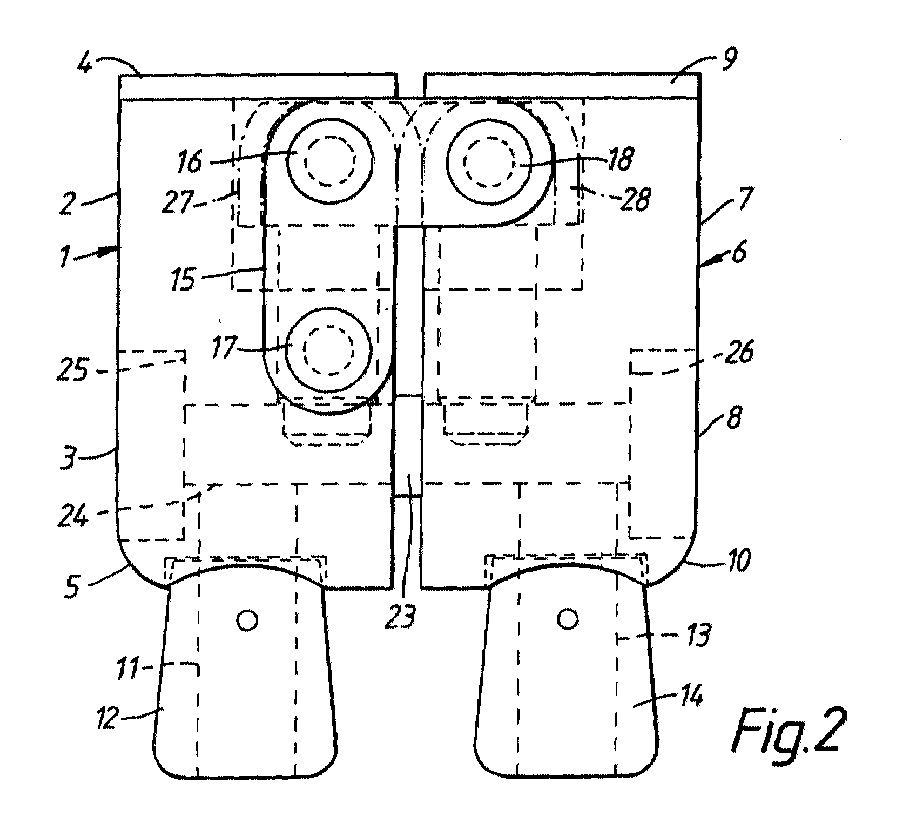
- a first housing (1) having an upper region (2) and a lower region (3);
- a second housing (6) having an upper region (7) and a lower region (8), the second
housing (6) being adjacent to the first housing (1) and being hingedly mounted with
respect to the first housing (1) in an upper region thereof (7);
- a first rotatable member (11) projecting downwardly below the lower region (3) of
the first housing (1);
- a second rotatable member (13) projecting downwardly below the lower region (8) of
the second housing (6);
- first drive means in the upper region (2) of the first housing (1) and capable of
causing rotation of the first rotatable member (11), the first drive means including
a first gear (27);
- second drive means in the upper region (7) of the second housing (6) and capable of
causing rotation of the second rotatable member (13), the second drive means including
a second gear (28), the first and second gears (27, 28) being located, meshed and
radiused so as to allow the gears to remain operatively engaged even when there is
a relative hinging between the first and second housings (1, 6) over a predetermined
angle; and
- resilient closure means (36, 37) tending to urge the lower regions (3, 8) of the first
and second housings (1, 6), and hence the first and second rotatable members (11,
13), together.
|
|
