|
(11) | EP 0 818 444 A1 |

| (12) | EUROPEAN PATENT APPLICATION |
|
|
|
|
|||||||||||||||||||
| (54) | Peroxides |
| (57) Blends of meta and para isomers of α, α'-bis(t-butylperoxy) diisopropylbenzene are
disclosed as well as methods of producing blends of α, α'-bis(t-butylperoxy) diisopropylbenzene
with desired ratios of meta and para isomers. Additionally, blends of meta and para isomers of α, α'-bis(t-butylperoxy) diisopropylbenzene and tertiary alkyl cumyl peroxides are disclosed. The peroxides are useful for absorbing in polymers and subsequently crosslinking the polymers. The peroxide blends may be adjusted to have melt points below temperatures at which the polymers become difficult to process during the absorption step because of stickiness. |
[0001] This invention relates to polyperoxides, particularly blends of meta and para isomers of α, α'-bis(t-butylperoxy) diisopropylbenzene and a method of producing blends of meta and para isomers of α, α'-bis(t-butylperoxy) diisopropylbenzene with desired ratios.
[0002] This invention additionally relates to blends of meta and para isomers of α, α'-bis(t-butylperoxy) diisopropylbenzene ("Bis Peroxide") and tertiary alkyl cumyl peroxides.
[0003] Polyperoxides are used in industry for crosslinking polymers. Amongst the polyperoxides which have been used in crosslinking polymers is α, α'-bis(t-butylperoxy) diisopropylbenzene. The α, α'-bis(t-butylperoxy) diisopropylbenzene has been available as a blend of the meta and para isomers where the ratio of meta to para isomers is about 2.0/1 and where the meta isomer constitutes about 68% of the blend and the para isomer constitutes about 32% of the blend. This blend, available from Hercules Incorporated, Wilmington, DE as Vul-Cup® R organic peroxide, is produced by a process as disclosed in U.S. Patent No. 3,658,914 using di-isopropyl benzene as a starting material.
[0004] Generally, the isomer ratio of the polyperoxide is determined by the process of alkylating cumene. This process results in a meta to para isomer ratio of about 2:1.
[0005] Also, α, α'-bis(t-butylperoxy) diisopropylbenzene is available either in its pure meta or para form.
[0006] While these blends are useful in the crosslinking of polymers, the temperature range over which these materials melt sometimes interfere with absorption of the liquid peroxide into the polymers. If the α, α'-bis(t-butylperoxy) diisopropylbenzene melts near the softening point of the polymer to be crosslinked, problems frequently arise due to polymer particles sticking together during the absorption process. This is a problem with the available 2/1 meta to para isomer ratio blend as well as with nearly pure meta or para isomers.
[0007] It has been discovered that by selecting certain ratios of the meta and para isomers in the polyperoxide, polyperoxides having lower melt point ranges may be obtained. These polyperoxides may be produced either through selecting the desired ratio of di-isopropyl benzene as starting as material if that material is to be oxidized to its corresponding diol form or through selecting di-isopropyl benzene diol with the desired isomeric ratio or through blending of meta and para isomers of the polyperoxide.
[0008] A need exists for peroxides which melt at a lower temperature than the polyperoxides described hereinabove. U.S. Patent No. 4,450,302 discloses peroxide blends that have low melting points and which are useful in the crosslinking of polymers such as polyethylene, EPDM and copolymers of ethylene and vinyl acetate. However, these peroxide blends exhibit high volatility and poor scorch resistance. Scorch is known in the art as premature crosslinking of a polymer system prior to forming the polymer into desirable shapes. Poor scorch resistance of the peroxide blends of U.S. Patent No. 4,450,302 is as a result of these peroxide blends containing dicumyl peroxide which has a scorch initiation temperature approximately 10°C below the scorch initiation temperature of the inventive peroxides blends and polyperoxides.
[0009] The peroxide blends of U.S. Patent No. 4,450,302 discloses high amounts of t-butyl cumyl peroxide. T-butyl cumyl peroxide is a relatively volatile material and has a vapor pressure of 20 mm Hg at ambient temperature. The vapor pressure of the α, α'-bis(t-butylperoxy) diisopropylbenzene is essentially 0 mm Hg at ambient temperature. It is desirable to minimize the volatility of peroxides used in crosslinking polymers because peroxide loss from polymer/peroxide blends.
[0010] The instant invention relates to a polyperoxide comprising, α, α'-bis(t-butylperoxy) diisopropylbenzene, wherein the α, α'-bis(t-butylperoxy) diisopropylbenzene comprises a blend of less than about 32% and greater than 0% para isomer and greater than 68% and less than about 100% meta isomer.
[0011] Additionally, the instant invention relates to polyperoxide blends which exhibit a Clear Point below 53°C, preferably a Clear Point below about 45°C, more preferably a Clear Point about 44°C.
[0012] Peroxides of the instant invention are useful in crosslinking polymers selected from the group consisting of natural rubber, polyethylene, polyisoprene, polybutadiene, copolymers of ethylene and other olefins with three to twelve carbon atoms. Additionally small amounts of dienes may be added as in EPDM. Other useful monomers include vinyl acetate, acrylonitrile, ethyl acrylate and other acrylates containing up to 14 carbon atoms.
[0013] Polyperoxides of the instant invention may be produced by a process comprising the steps of blending para and meta isomers of di-isopropyl benzene to obtain a blend of less than about 32% and greater than 0% para isomer and greater than 68% and less than about 100% meta isomer and then oxidizing the blend to form the corresponding diol, and reacting the diol with t-butyl hydroperoxide to form the polyperoxide.
[0014] Polyperoxides of the instant invention may also be produced by blending para and meta isomers of di-isopropyl benzene diol to obtain a blend of less than about 32% and greater than 0% para isomer and greater than 68% and less than about 100% meta isomer, and reacting the diol with t-butyl hydroperoxide to form the polyperoxide.
[0015] Alternatively, polyperoxides of the instant invention may be produced by obtaining para and meta isomers of α, α'-bis(t-butylperoxy) diisopropylbenzene, and blending the isomers to obtain a blend of less than about 32% and greater than 0% para isomer and greater than 68% and less than about 100% meta isomer.
[0016] Additionally, the instant invention relates to blends of para and meta isomers of α, α'-bis(t-butylperoxy) diisopropylbenzene and tertiary alkyl cumyl peroxides wherein the α, α'-bis(t-butylperoxy) diisopropylbenzene comprises from about 95% to about 5% by weight and the tertiary alkyl cumyl peroxides comprises from about 5% to about 95% by weight of the blend. Preferably, the α, α'-bis(t-butylperoxy) diisopropylbenzene comprises from about 50% to about 5% by weight and the tertiary alkyl cumyl peroxides comprises from about 50% to about 95% by weight of the blend, more preferably, α, α'-bis(t-butylperoxy) diisopropylbenzene comprises from about 90% to about 70% by weight and the tertiary alkyl cumyl peroxides comprises from about 10% to about 30% by weight of the blend.
[0017] The tertiary alkyl cumyl peroxide has the formula:
where R may be either hydrogen, or an alkyl group from C1 to C5.
[0018] The tertiary alkyl cumyl peroxide may be selected from the group consisting of t-butyl cumyl peroxide and t-amyl cumyl peroxide. Preferably, the tertiary alkyl cumyl peroxide comprises t-butyl cumyl peroxide.
[0019] Figure 1 is a phase diagram of the ratio of the meta to para isomers of α, α'-bis(t-butylperoxy) diisopropylbenzene. Composition is plotted versus the Clear Point temperature in degrees Celsius. From this diagram, the eutectic point of the blend of meta to para isomers can be estimated.
[0020] The polyperoxides of the instant invention may be produced using the process disclosed in U.S. Patent No. 3,658,914.
[0021] Di-isopropyl benzene ("DIB") which may be used as a starting material in the production of the polyperoxides of the instant invention may be obtained in both the meta and para isomers (available from Eastman Chemical Company, Kingsport, TN). This permits one to produce any ratio of the meta and para isomers. DIB is obtained in a desired meta/para ratio for the final polyperoxide prior to its subsequent reaction. Dialcohol derivatives of DIB are commercially available and also may be used as starting materials. Peroxide blends of the instant invention also may be made by blending mixtures of α, α'-bis(t-butylperoxy) diisopropylbenzene.
[0022] In polyperoxides of the instant invention, the ratio of the meta to para isomers is greater than about 2/1 and less than about 10/1 more preferably between about 2.3/1 and about 8/1 and most preferably about 3.5/1. The amount of para isomer is less than about 32% and greater than about 0% while the amount of meta isomer is greater than about 68% and less than about 100%, more preferably the amount of para isomer is less than about 30% and greater than about 0% and the meta isomer is greater than about 70% and less than about 100%, most preferably the amount of para isomer is about 22% and the amount of the meta isomer is about 78%. All percentages listed herein are by weight unless otherwise noted.
[0023] The polyperoxides of the instant invention have lower melting ranges, as determined by the method outlined hereinbelow, when compared to conventional polyperoxide blends. It is acknowledged that solvents, impurities or other materials will lower the melting points of peroxides.
[0024] Melting ranges of the peroxides are determined using the following method. A 2.54 cm [one (1) inch] (diameter test tube is filled approximately one half (½) full with approximately twenty (20) grams of melted peroxide. A thermometer is inserted into the peroxide. The peroxide is subsequently allowed to cool slowly. As the sample cools, a point is reached at which the sample becomes hazy. This is called the "Haze Point". The sample is continued to be cooled until the liquid column in the thermometer can no longer be seen when the thermometer is at the back side of the test tube. This point is called the "Cloud Point".
[0025] Once the peroxide has solidified and the Cloud Point has been reached, the test tube is placed in a water bath and slowly warmed. The temperature at which the liquid peroxide is no longer hazy is observed and noted. This is known as the "Haze Free Point". Heating of the test tube is continued until no solid peroxide crystals are observed in the test tube. This is known as the "Clear Point". Each sample is run through this cycle at least three times. The results of the first cycle are ignored. Results for the next two cycles should agree to within about 1°C in order to be used.
[0026] Polyperoxides of the instant invention exhibit Clear Points of below about 53°C, more preferably below about 45°C, most preferably about 44°C. Additionally, polyperoxides of the instant invention exhibit Haze Free Points of below about 39°C, more preferably below about 30°C, most preferably about 29°C.
[0027] Polyperoxides of the instant invention exhibit Clear Points of below about 53°C and Haze Free Points of below about 39°C, more preferably Clear Points below about 45°C and Haze Free Points of below about 30°C, most preferably Clear Points of about 44°C and Haze Free Points of about 29°C.
[0028] The polyperoxides and the blends of para and meta isomers of α, α'-bis(t-butylperoxy) diisopropylbenzene and tertiary alkyl cumyl peroxide of the instant invention are useful as crosslinking agents for use with various polymers. The polyperoxides and the blends of para and meta isomers of α, α'-bis(t-butylperoxy) diisopropylbenzene and tertiary alkyl cumyl peroxide are particularly useful in cross-linking olefinic polymers. Amongst the polymers which may be cured with the polyperoxides and the blends of para and meta isomers of α, α'-bis(t-butylperoxy) diisopropylbenzene and tertiary alkyl cumyl peroxide of the instant invention are polymers selected from the group consisting of natural rubber, polyethylene, polyisoprene, polybutadiene copolymers of ethylene and other olefins with three to twelve carbon atoms. Additionally small amounts of dienes may be added as in EPDM. Other useful monomers include vinyl acetate, acrylonitrile, ethyl acrylate and other acrylates containing up to 14 carbon atoms.
[0029] The invention is illustrated by the following Examples; these are provided for the purpose of representation, and are not to be construed as limiting the scope of the invention. Unless stated otherwise, all percentages, parts, etc. are by weight.
Examples
Example 1
[0030] An example of instant polyperoxide was produced in the following manner. A mixture of 22% para and 78% meta di-isopropyl benzene was obtained (Eastman Chemical Company, Kingsport, TN). The mixture was oxidized to produce the corresponding diols. The diols were reacted with t-butyl hydroperoxide to form the instant polyperoxide.
[0031] A comparative example was produced using 32% para and 68% meta di-isopropyl benzene obtained (Eastman Chemical Company, Kingsport, TN) rather than the 22% para and 78% meta ratio of the example.
[0032] Properties of the example and comparative example are as follows:
| Sample | % para by weight | % meta by weight | Haze Point | Cloud Point | Haze Free Point | Clear Point |
| Comparative Example | 32 | 68 | 46.3°C | 44.8°C | 53.0°C | 53.8°C |
| Example | 22 | 78 | 36.8°C | 35.8°C | 43.3°C | 44.0°C |
[0033] This example demonstrates that by changing the percentage of para isomer and the percentage of meta isomer in the peroxide, the values for the Haze Point, Cloud Point, Haze Free Point and the Clear Point may all be reduced.
Example 2
[0034] This example demonstrates the properties of blends of para and meta isomers of α, α'-bis(t-butylperoxy) diisopropylbenzene and t-butyl cumyl peroxide ("TBCP") are found in the following table.
| Sample | Bis-Peroxide(a) wt % | TBCP(b) wt % | Haze Point °C | Cloud Point °C | Haze Free Point °C | Clear Point °C |
| Comparative Ex. | 100 | 0 | 36.8 | 36.3 | 42.5 | 43.5 |
| Ex. 2-a | 90 | 10 | 37.0 | 31.8 | 38.5 | 39.3 |
| Ex. 2-b | 80 | 20 | 28.5 | 24.8 | 35.8 | 36.8 |
| Ex. 2-c | 70 | 30 | 22.8 | 18.8 | 31.0 | 32.3 |
| Ex. 2-d | 60 | 40 | 16.8 | 14.8 | 24.5 | 25.3 |
| Ex. 2-e | 50 | 50 | 8.5 | 3.3 | 19.3 | 20.3 |
| (a) Bis Peroxide comprised a blends of 22%para and 78% meta isomers of α, α'-bis(t-butylperoxy) diisopropylbenzene by weight. | ||||||
| (b) TBCP used was Peroxide D-16® peroxide, (available from Hercules Incorporated). |
[0035] It is not intended that the examples given herein should be construed to limit the invention, but rather they are submitted to illustrate some of the specific embodiments of the invention. Various modifications and variations of the present invention can be made without departing from the scope of the appended claims.
1. A polyperoxide comprising α, α'-bis(t-butylperoxy) diisopropylbenzene, wherein the
α, α'-bis(t-butylperoxy) diisopropylbenzene comprises a blend of less than about 32%
and greater than 0% para isomer and greater than about 68% and less than about 100%
meta isomer.
2. The polyperoxide of claim 1, wherein the α, α'-bis(t-butylperoxy) diisopropylbenzene
comprises a blend of less than about 30% and greater than about 0% para isomer and
greater than about 70% and less than about 100% meta isomer.
3. The polyperoxide of claim 2, wherein the α, α'-bis(t-butylperoxy) diisopropylbenzene
comprises a blend of about 22% para isomer and about 78% meta isomer.
4. The polyperoxide of any of claims 1-3, wherein the blend exhibits a Clear Point below
53°C.
5. The polyperoxide of claim 4, wherein the blend exhibits a Clear Point below about
45°C.
6. A polyperoxide of any of the above claims produced from a blend of meta and para isomers
of Diisopropyl benzene ("DIB"), wherein the blend comprised less than about 32% and
greater than 0% para isomer and greater than 68% and less than about 100% meta isomer.
7. A process for producing a polyperoxide comprising the steps of blending para and meta
isomers of di-isopropyl benzene to obtain a blend of less than about 32% and greater
than 0% para isomer and greater than 68% and less than about 100% meta isomer; oxidizing
the blend to form its corresponding diol; and reacting the diol with t-butyl hydroperoxide
to form the polyperoxide.
8. A process for producing a polyperoxide comprising the steps of blending para and meta
isomers of di-isopropyl benzene diol to obtain a blend of less than about 32% and
greater than 0% para isomer and greater than 68% and less than about 100% meta isomer
and reacting the diol with t-butyl hydroperoxide to form the polyperoxide.
9. A process for producing a polyperoxide comprising the steps of obtaining para and
meta isomers of α, α'-bis(t-butylperoxy) diisopropylbenzene, and blending the isomers
to obtain a blend of less than about 32% and greater than 0% para isomer and greater
than 68% and less than about 100% meta isomer.
10. A polyperoxide comprising α, α'-bis(t-butylperoxy) diisopropylbenzene, wherein the
α, α'-bis(t-butylperoxy) diisopropylbenzene comprises a blend having a ratio of meta
to para isomers greater than 2/1 and less than 10/1, more preferably between 2.3/1
and 8/1, and most preferably 3.5/1.
11. A peroxide blend comprising (a) 5% to about 95% by weight tertiary alkyl cumyl peroxide
and (b) 95% to about 5% by weight a polyperoxide of claims 1-5.
12. The peroxide blend of claim 11 wherein the blend comprises (a) 50% to about 95% by
weight tertiary alkyl cumyl peroxide and (b) 50% to about 5% by weight by weight a
polyperoxide comprising α, α'-bis(t-butylperoxy) diisopropylbenzene.
13. The peroxide blend of claim 12 wherein the blend comprises (a) 10% to about 30% by
weight tertiary alkyl cumyl peroxide, and (b) 90% to about 70% by weight a polyperoxide
comprising α, α'-bis(t-butylperoxy) diisopropylbenzene.
14. An olefinic polymer crosslinked by the peroxide of claims 1-5 or claims 10-12.
15. The olefinic polymer of claim 14, wherein the polymer is selected from the group consisting
of natural rubber, polyethylene, polyisoprene, polybutadiene copolymers of ethylene
and other olefins with three to twelve carbon atoms.
16. The olefinic polymer of claim 15, wherein the polymer is selected from the group consisting
of vinyl acetate acrylonitrile, ethyl acrylate and other acrylates containing up to
14 carbon atoms.
17. The peroxide blend of any of claims 11 to 13 wherein the tertiary alkyl cumyl peroxide
has the formula:
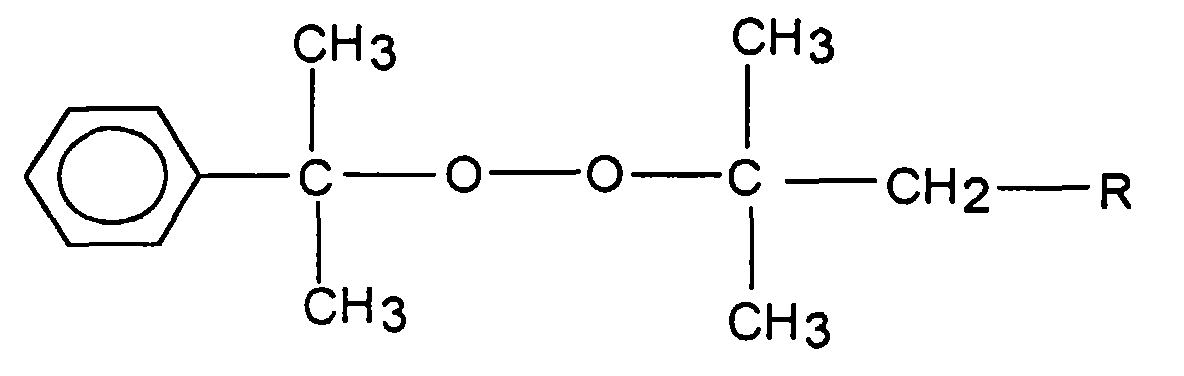
where R may be either hydrogen, or an alkyl group from C1 to C5.
where R may be either hydrogen, or an alkyl group from C1 to C5.
18. The peroxide blend of claim 17 wherein the tertiary alkyl cumyl peroxide is selected
from the group consisting of t-butyl cumyl peroxide and t-amyl cumyl peroxide.