|
(11) | EP 0 820 281 B1 |

| (12) | EUROPEAN PATENT SPECIFICATION |
|
|
| (54) |
A PHARMACEUTICAL COMPOSITION CONTAINING N-CHLOROPHENYLCARBAMATES AND N-CHLOROPHENYLTHIOCARBAMATES FOR INHIBITING THE GROWTH OF VIRUSES N-CHLORPHENYLCARBAMATE ENTHALTENDES ARZNEIMITTEL SOWIE N-CHLORPHENYLTHIOCARBAMATE ZUR HEMMUNG DES WACHSTUMS VON VIREN COMPOSITION PHARMACEUTIQUE CONTENANT DES N-CHLOROPHENYLCARBAMATES ET DES N-CHLOROPHENYLTHIOCARBAMATES POUR INHIBER LA CROISSANCE DES VIRUS |
|
|
|||||||||||||||||||||||||||||||
|
||||||||||||||||||||||||||||||||
| Note: Within nine months from the publication of the mention of the grant of the European patent, any person may give notice to the European Patent Office of opposition to the European patent granted. Notice of opposition shall be filed in a written reasoned statement. It shall not be deemed to have been filed until the opposition fee has been paid. (Art. 99(1) European Patent Convention). |
[0001] The N-chlorophenylcarbamates and N-chlorophenylthiocarbamates are known for their herbicidal activities. They are systemic herbicides used to prevent and eradicate certain plants or weeds. Systemic herbicides are differentiated from other herbicides by their ability to be absorbed by the plant and to move through the plant. This systemic ability is not a necessary requirement of the compounds of this invention.
[0002] The compounds of the present invention have the following structure
wherein n is from 1 to 3. X is oxygen or sulfur and R is selected from the group consisting of hydrogen, lower alkyl of from 1 to 4 carbon atoms, cyclohexyl, phenalkyl of up to 8 carbon atoms and phenyl, and the pharmaceutically acceptable salts of these compounds.
[0003] Preferred compounds are those in which R is alkyl with 1 to 4 carbons, preferably, isopropyl and X is oxygen, n is I and the chloro group is in the 3 position on the phenyl group. N-3-chlorophenylcarbamate is a most preferred compound.
[0004] These compounds are prepared according to the method described in U.S. 2.695.225 issued to Witman (1954) and U.S. 2,734,911 issued to Strain (1956).
[0005] Ziikah et al. (Cancer Research 41,1879-1883, may 1981) disclose that one of these compounds, i.e. chlorpropham, is capable of inhibiting the proliferation of animal tumour cells in vitro.
[0006] These compounds have now found to be effective against viruses, in particular of HIV, herpes, influenza, rhinoviruses, and have mold or no effects on normal cells.
[0007] It is a further object of this invention to provide a composition effective against HIV, herpes, influenza, rhinoviruses wherein a potentiator is used to improve the effectiveness of the composition.
[0008] These and other objects will become evident from the following detailed description of this inventions.
[0009] The invention provides the use, in the preparation of a pharmaceutical composition for treatment of virol infections in mammals, and in particular, warm blooded animals and humans, of a compound selected from N-chlorophenylcarbamates and N-chlorophenylthiocarbamates of the formula:
wherein n is from 1 to 3, X is oxygen or sulfur, and R is selected from the group consisting of hydrogen, lower alkyl of from 1 to 4 carbon atoms cyclohexyl, phenalkyl radicals of up to 8 carbon atoms, and phenyl, or a pharmaceutically acceptable inorganic or organic acid salt thereof.
DETAILED DESCRIPTION OF THE INVENTION
A. DEFINITIONS
[0011] As used herein, the term "comprising" means various components can be conjointly employed in the pharmaceutical composition of this invention. Accordingly, the terms "consisting essentially of" and "consisting of" are embodied in the term comprising.
[0012] As used herein, a "pharmaceutically acceptable" component is one that is suitable for use with humans and/or animals without undue adverse side effects (such as toxicity, irritation, and allergic response) commensurate with a reasonable benefit/risk ratio.
[0013] As used herein, the term "safe and effective amount" refers to the quantity of a component which is sufficient to yield a desired therapeutic response without undue adverse side effects (such as toxicity, irritation, or allergic response) commensurate with a reasonable benefit/risk ratio when used in the manner of this invention. The specific "safe and effective amount" will, obviously, vary with such factors as the particular condition being treated, the physical condition of the patient, the type of mammal being treated, the duration of the treatment, the nature of concurrent therapy (if any), and the specific formulations employed and the structure of the compounds or its derivatives.
[0014] As used herein, a "pharmaceutical addition salts" includes a pharmaceutically acceptable salt. These include organic or inorganic acid salts of the amines. Preferred acid salts are the hydrochlorides, acetates, salicylates, nitrates and phosphates.
[0015] As used herein, a "pharmaceutical carrier" is a pharmaceutically acceptable solvent, suspending agent or vehicle for delivering the agent to the animal or human. The carrier may be liquid or solid and is selected with the planned manner of administration in mind.
[0016] As used herein, "viruses" includes viruses which cause diseases (viral infection) in man and other warm blooded animals such as HIV virus, herpes, influenza and rhinoviruses.
[0017] As used herein "potentiators" are materials such as triprolidine and its cis-isomer which are used in combination with N-chlorophenylcarbamates and N-chlorophenylthiocarbamates, Potentiators can affect the immune system or enhance the effectiveness of the drugs.
POTENTIATORS
[0018] The "potentiators" can be any material which improves or increase the efficacy of the pharmaceutical composition or acts on the immune system. One such potentiator is triprolidine and its cis-isomer which are used in combination with the N-chlomphenylcarbamates and N-chlorophenyINocarbamates. Triprolidine is described in US 5,114,951 (1992). Another potentiator is procodazole, IH-Benzimidazole-2-propanoic acid; [β-(2-benzimidazole) propionic acid: 2-(2-carboxyethyl)benzimidazole: propazol]. Procodazole is a non-specific active immunoprotective agent against viral and bacterial infections and can be used with the compositions claimed herein. It is effective with the N-chlorophenylcarbamates and the N-chlorophenylthiocarbamates alone in treating viral infections.
[0019] Generally an amount effective to enhance the activity of the pharmaceutical composition is used.
[0020] Propionic acid and its salts and esters can also be used in combination with the pharmaceutical compositions claimed herein.
[0021] Antioxidant vitamins such as vitamins A, C and E and beta-carotene can be added to these compositions.
DOSAGE
[0022] Any suitable dosage may be given in the method of the invention. The type of compound and the carrier and the amount will vary widely depending on the species of the warm blooded animal or human, body weight being treated. Generally a dosage of between 2 milligrams (mg) per kilogram (kg) of body weight and 400 mg per kg of body weight is suitable. Preferably from 15 mg to 150 mg/kg of body weight is used. Generally, the dosage in man is lower than for small warm blooded mammals such as mice. A dosage unit may comprise a single compound or mixtures thereof with other compounds. The dosage unit can also comprise diluents, extenders, carriers and the like. The unit may be in solid or gel form such as pills, tablets, capsules and the like or in liquid form suitable for oral, rectal, topical or parenteral administration or intravenous administration or by injection.
DOSAGE DELIVERY FORMS
[0023] The compounds are typically mixed with a pharmaceutically acceptable carrier. This carrier can be a solid or liquid and the type is generally chosen based on the type of administration being used. The active agent can be coadministered in the form of a tablet or capsule, as an agglomerated powder or in a liquid form. Examples of solid carriers include lactose, sucrose, gelatin and agar. Capsule or tablets can be easily formulated and can be made easy to swallow or chew; other solid forms include granules, and bulk powders. Tablets may contain suitable binders, lubricants, diluents, disintegrating agents, coloring agents, flavoring agents, flow-inducing agents, and melting agents. Examples of liquid dosage forms include solutions or suspensions in water, pharmaceutically acceptable fats or oils, alcohols or other organic solvents, including esters, emulsion, elixirs, syrups, solutions and/or suspensions reconstituted from non-effervescent granules and effervescent preparations reconstituted from effervescent granules. Such liquid dosage forms may contain, for example, suitable solvents, preservatives, emulsifying agents, suspending agents, diluents, sweeteners, thickeners and melting agents. Oral dosage forms would contain flavorants and coloring agents. Parenteral and intravenous forms would also include minerals and other materials to make them compatible with the type of injection or delivery system chosen.
[0024] Specific examples of pharmaceutical acceptable carriers and excipients that may be used to formulate oral dosage forms of the present invention are described in US. Pat. No. 3,903.297 to Robert, issued Sept. 2, 1975. Techniques and compositions for making dosage forms useful in the present invention are described in the following references: 7 Modern Pharmaceutics. Chapters 9 and 10 (Banker & Rhodes. Editors, 1979); Lieberman et al,. Pharmaceutical Dosage Forms: Tablets (1981); and Ansel. Introduction to Pharmaceutical Dosage Forms 2nd Edition (1976).
ROUTE OF ADMINISTRATION
[0025] The route of administration can be any suitable route which is effective in the treatment of the particular virus that is being treated.
[0026] The administration route for treating viral infections may be oral, rectal, parenteral, topical or intravenous. The actual time and dosage will depend on the type of the virus being treated and the desired blood levels.
[0027] The N-chlorophenylcarbamates and the N-chlorophenylthiocarbamates of the invention can be combined with fungicides. herbicides or other antiviral agents. Preferred herbicides and fungicides include carbendazim, fluoconazole, benomyl, glyphosate and propicodazole.
[0028] The N-chlorophenylcarbamates and N-chlorophenylthiocarbamates are also effective against viruses including rhinovirus, HIV, herpes, and influenza. In the treatment of viral infections, the N-chlorophenylcarbamates and the N-chlorophenylthiocarbamates can be combined with other anti-vical agents to effectively treat viral infections.
1. The use, in the preparation of a pharmaceutical composition for treating viral infections
of a compound selected from N-chlorophenylcarbamates and N-chlorophenylthiocarbamates
of the formula:
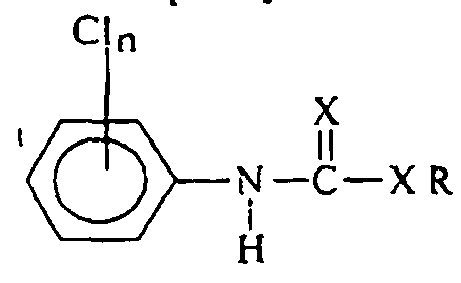
wherein n is from 1 to 3; X is selected from oxygen and sulfur and wherein R is selected from hydrogen, alkyl of from 1 to 4 carbon atoms, cyclohexyl, phenyl and phenalkyl of up to 8 carbon atoms; or pharmaceutically acceptable inorganic or organic acid salts thereof.
wherein n is from 1 to 3; X is selected from oxygen and sulfur and wherein R is selected from hydrogen, alkyl of from 1 to 4 carbon atoms, cyclohexyl, phenyl and phenalkyl of up to 8 carbon atoms; or pharmaceutically acceptable inorganic or organic acid salts thereof.
2. The use as claimed in Claim 1, wherein the composition comprises a pharmaceutically
acceptable carrier and a safe and effective amount of the said N-chlorophenylcarbamate,
N-chlorophenylthiocarbamate, or salt.
3. The use as claimed in Claim 1 or Claim 2, wherein R is alkyl of from I to 4 carbons,
n is 1, X is O and the chloro is in the 3 position of the phenyl.
4. The use as claimed in any one of the preceding Claims, wherein the composition is
a unit dosage composition.
5. The use as claimed in Claim 4 wherein the unit dose is such as to administer from
2 mg/kg body weight to 400 mg/kg of said N-chlorophenylcarbamate or N-chlorophenylthiocarbamate
6. The use as claimed in in any one of the preceding Claims, wherein the composition
is suitable for administration orally, enterically, intravenously, parenterally or
by injection.
7. The use as claimed in in any one of the preceding Claims, wherein the acid salt is
a hydrochloride, acetate, salicylate, nitrate or phosphate.
8. The use as claimed in in any one of the preceding Claims, wherein the composition
is suitable for the treatment of HIV virus infection.
9. The use as claimed in in any one of the preceding Claims, wherein the composition
is suitable for the treatment of herpes infection.
1. Verwendung einer Verbindung ausgewählt aus N-Chlorphenylcarbamaten und N-Chlorphenylthiocarbamaten
der Formel:
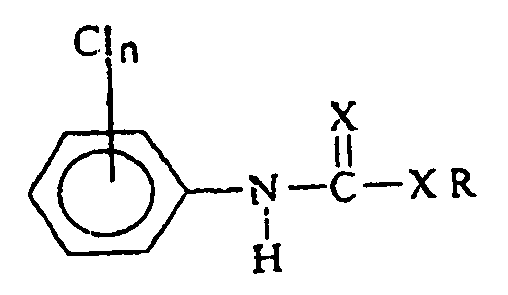
wobei n 1 bis 3 ist, X ausgewählt ist aus Sauerstoff und Schwefel und wobei R ausgewählt ist aus Wasserstoff, Alkyl mit 1 bis 4 Kohlenstoffatomen, Cyclohexyl, Phenyl und Phenalkyl mit bis zu 8 Kohlenstoffatomen, oder eines pharmazeutisch geeigneten anorganischen oder organischen Säuresalzes davon zur Herstellung einer pharmazeutischen Zusammensetzung zur Behandlung von Virusinfektionen.
wobei n 1 bis 3 ist, X ausgewählt ist aus Sauerstoff und Schwefel und wobei R ausgewählt ist aus Wasserstoff, Alkyl mit 1 bis 4 Kohlenstoffatomen, Cyclohexyl, Phenyl und Phenalkyl mit bis zu 8 Kohlenstoffatomen, oder eines pharmazeutisch geeigneten anorganischen oder organischen Säuresalzes davon zur Herstellung einer pharmazeutischen Zusammensetzung zur Behandlung von Virusinfektionen.
2. Verwendung nach Anspruch 1, wobei die Zusammensetzung einen pharmazeutisch annehmbaren
Träger und eine sichere und wirksame Menge des N-Chlorphenylcarbamats, N-Chlorphenylthiocarbamats
oder Salzes umfasst.
3. Vewendung nach Anspruch 1 oder 2, wobei R ein Alkyl mit 1 bis 4 Kohlenstoffatomen
ist, n ist 1, X ist 0 und das Chlor ist in Position 3 des Phenyls.
4. Verwendung nach einem der vorangehenden Ansprüche, wobei die Zusammensetzung eine
Einheitsdosiszusammensetzung ist.
5. Verwendung nach Anspruch 4, wobei die Einheitsdosis so gewählt ist, dass 2 mg/kg Körpergewicht
bis 400 mg/kg Körpergewicht des N-Chlorphenylcarbamats und N-Chlorphenylthiocarbamats
verabreicht werden.
6. Verwendung nach einem der vorangehenden Ansprüche, wobei die Zusammensetzung zur oralen,
enteralen, intravenösen, parenteralen Verabreichung oder Verabreichung mittels Injection
geeignet ist.
7. Verwendung nach einem der vorangehenden Ansprüche, wobei das Säuresalz ein Hydrochlorid,
Azetat, Salicylat, Nitrat oder Phosphat ist.
8. Verwendung nach einem der vorangehenden Ansprüche, wobei die Zusammensetzung für die
Behandlung einer HIV Virusinfektion geeignet ist.
9. Verwendung nach einem der vorangehenden Ansprüche, wobei die Zusammensetzung für die
Behandlung einer Herpesinfektion geeignet ist.
1. Utilisation, dans la préparation d'une composition pharmaceutique pour le traitement
d'infections virales, d'un composé choisi parmi les N-chlorophénylcarbamates et les
N-chlorophénylthiocarbamates de formule :
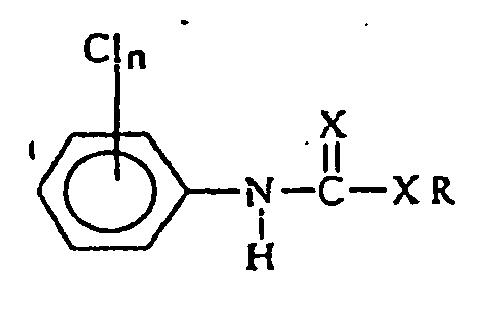
dans laquelle n est compris entre 1 et 3 ; X est sélectionné parmi l'oxygène et le soufre et dans laquelle R est sélectionné parmi l'hydrogène, un alkyle de 1 à 4 atomes de carbone, un cyclohexyle, un phényle, un phénylalkyle jusqu'à 8 atomes de carbones ; ou des sels d'acides organiques ou inorganiques de ceux-ci pharmaceutiquement acceptables.
dans laquelle n est compris entre 1 et 3 ; X est sélectionné parmi l'oxygène et le soufre et dans laquelle R est sélectionné parmi l'hydrogène, un alkyle de 1 à 4 atomes de carbone, un cyclohexyle, un phényle, un phénylalkyle jusqu'à 8 atomes de carbones ; ou des sels d'acides organiques ou inorganiques de ceux-ci pharmaceutiquement acceptables.
2. Utilisation selon la revendication 1, dans laquelle la composition comprend un transporteur
pharmaceutiquement acceptable et une quantité sûre et efficace dudit N-chlorophénylcarbamate,
N-chlorophénylthiocarbamate, ou d'un sel.
3. Utilisation selon la revendication 1 ou 2, dans laquelle R est un alkyle de 1 à 4
atomes de carbone, n vaut 1, X est de l'oxygène et le chlore est dans la position
3 du phényle.
4. Utilisation selon l'une des revendications précédentes, dans laquelle la composition
est une composition de dosage d'unité.
5. Utilisation selon la revendication 4 , dans laquelle la dose unitaire est telle pour
administrer de 2 mg/kg de poids corporel à 400 mg/kg dudit N-cholorophénylcarbamate
ou N-cholorophénylthiocarbarnate.
6. Utilisation selon l'une des revendications précédentes, dans laquelle la composition
est adaptée pour une administration par voie orale, entérique, intraveineuse, parentérale
ou par injection.
7. Utilisation selon l'une des revendications précédentes, dans laquelle le sel d'acide
est un chlorhydrate, un acétate, un salicylate, un nitrate ou un phosphate.
8. Utilisation selon l'une des revendications précédentes, dans laquelle la composition
est adaptée pour le traitement d'une infection par le virus VIH.
9. Utilisation selon l'une des revendications précédentes, dans laquelle la composition
est adaptée pour le traitement d'une infection par l'herpès.
REFERENCES CITED IN THE DESCRIPTION
This list of references cited by the applicant is for the reader's convenience only. It does not form part of the European patent document. Even though great care has been taken in compiling the references, errors or omissions cannot be excluded and the EPO disclaims all liability in this regard.
Patent documents cited in the description
Non-patent literature cited in the description
- ZIIKAH et al.Cancer Research, 1981, vol. 41, 1879-1883 [0005]
- 7 Modern Pharmaceutics.19790000 [0024]
- LIEBERMAN et al.Pharmaceutical Dosage Forms: Tablets, 1981, [0024]
- ANSELIntroduction to Pharmaceutical Dosage Forms19760000 [0024]