(57) The purpose of this invention is to provide a ferroelectric capacitor and a ferroelectric
memory device, which: can perform stable operation without causing a resistivity change
that is considered to be caused due to the leakage current and the oxygen diffusion;
in which it is difficult for dielectric fatigue to be caused in the ferroelectric
capacitor, even by repeated inversions; and in which long life and high reliability
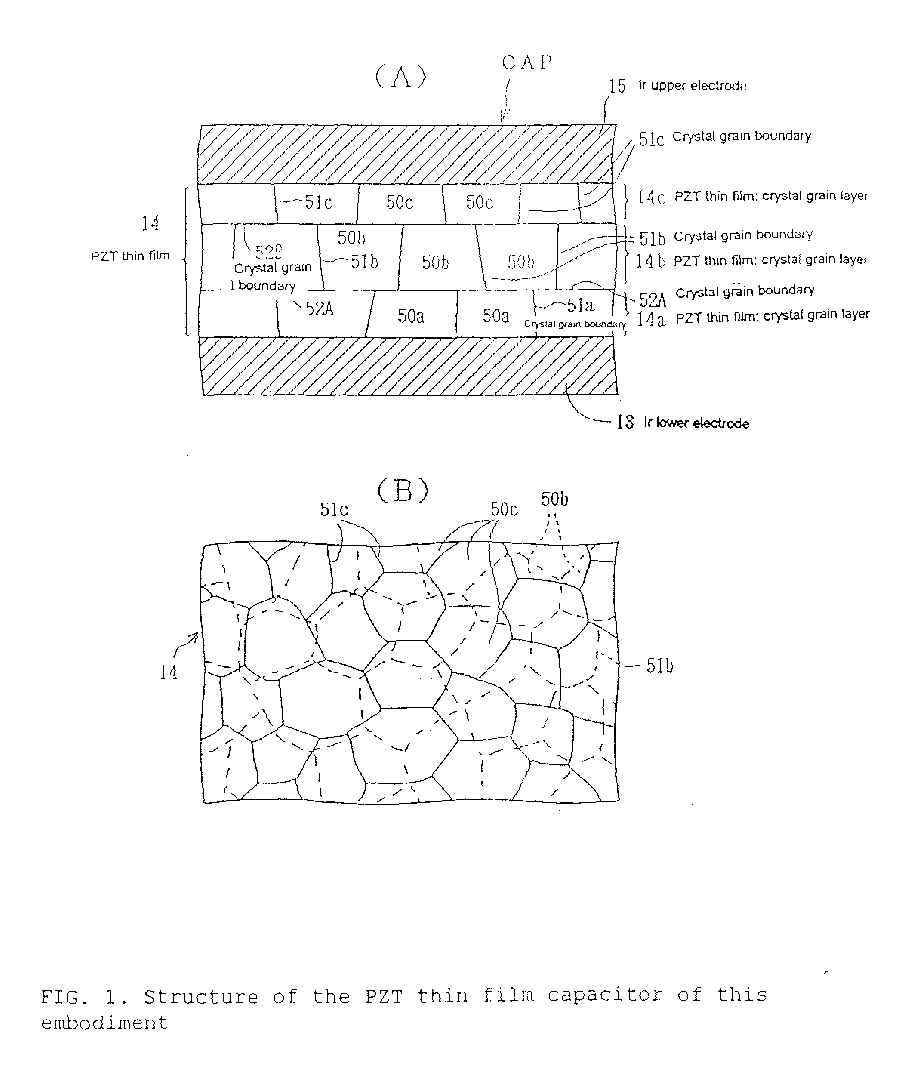
can be maintained; and to provide their manufacturing method. The constitution of
this invention includes a ferroelectric capacitor CAP which has Ir lower electrode
(13), PZT thin film (14), and Ir upper electrode (15) and in which crystal grain layers
(14a,14b,and 14c) constituted by assembling crystal grains (50a,50b,and 50c) by means
of grain boundaries (51a,51b, and 51c) are laminated by means of grain boundaries
(52A and 52B) along the surface of the Ir electrode (13), so that the ferroelectric
film (14) is formed. A method for manufacturing the ferroelectric capacitor CAP, which
meets all of the important conditions of 1) selection of an optimum electrode substance
such as Ir; 2) control of crystal growth direction by means of TiOx nucleus attachment and a surplus of Pb; and 3) optimum annealing temperature for
eliminating surface precipitates; and which deposits a titanium oxide, forms a ferroelectric
film material layer containing a surplus of lead on it, heats it at a temperature
at which the surface precipitates are substantially lost, and laminates each crystal
grain layer (14a,14b, and 14c) by repeating the above processes.
|
|
