[0001] The present invention refers to a new process meant to chrome and/ or vegetable leather
tanning.
[0002] The conventional processes for leather tanning comprise the following operations:
bating, pickle, pre-tanning and tanning.
[0003] The bating of the hides consists of deliming (removal of lime) and bating with enzymes
the hides that proceed from liming. The second step is the pickle operation, where
the bated hide is submitted to the treatment with sulfuric acid and sodium chloride
in order to avoid the hide deterioration. Afterwards is executed the pre-tannage with
chrome or glutaraldehyde, that is the process granting to the hide characteristics
of preliminary tannage, already allowing some operations, such as splitting, and afterwards
shawing the leather. This phase has as consequence the economy in subsequent steps
with the use of a smaller quantity of chemicals. Finally is performed the tanning
of the hide with chrome and/or tannins, in accordance with the specifications to be
reached.
[0004] The object of the present invention is an innovative tanning process, which through
the addition of a specific product, that is hydroxy-butaldehyde, to the bated hide
is obtained the conditioning and, later on, chrome and/or vegetable tannage. This
process results in the shifting of the isoelectric point that, as the reaction time
passes, varies from 3.0 - 3.5 to 4.0 - 4.5 with the pH in the same range. The process
proposed by the invention allows a chrome tannage favouring its penetration, as the
penetration pH range is wide, varying from 4.0 to 6.0, and the optimum point between
4.0 and 6.0 matches with the one of the process of the invention.
[0005] Advantages of the present invention over the conventional tanning processes are:
a. it is autobasifying, the addition of alkalis not being necessary;
b. elimination of the pickle and pre-tanning phases with the subsequent removal of
sulfuric acid and sodium chloride, but creating a conditioning phase;
c. removal of sodium formate and of sodium bicarbonate used in the post-pickle treatment;
d. simplification of the effluents treatment due to the reduction of the chrome quantity
and the elimination of sodium chloride (main pollution sources of the effluents);
e. reduction of the total tanning time, from 24-36 hours to 12 - 14 hours.
[0006] The tanning process object of the present invention comprises the steps of bating,
conditioning with hydroxy-butaldehyde and chrome and/or vegetable tannage. The bating
of the hides is performed in accordance with the conventional tanning processes. The
hydroxy-butaldehyde provides a conditioning on the bated hide, allowing the subsequent
tanning and retanning treatments, whenever it is the case. The conditioning is the
change of the isoelectric point of the bated hide, as a consequence of the hydroxy-butaldehyde
reaction with the amine. The hydroxy-butaldehyde blocks the amines of the collagen
(proteins found in greatest number in the hide), releasing the carboxyls and, due
to this, it reduces the isoelectric point, making the hide susceptive to the effective
chrome tannage (linking the carboxyls) or vegetable tannage (linking through hydrogen
bridges). The percentual of hydroxy-butaldehydeutilization for the conditioning varies
from 2.5 to 3.0% over the delimed hide weight, and the reaction time is approximately
3 to 4 hours. Afterwards, it is added the tanning agent, in the case of chrome the
tanning time being approximately 6 to 7 hours, and for vegetable tanning 12 to 14
hours.
[0007] Hydroxy-butaldehyde is obtained from the reaction of acetic aldehyde and its structural
formula is the following:
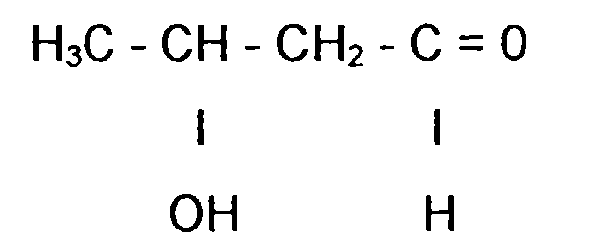
[0008] The characteristics of the product are:
- mw
- = 88.0
- pH
- = 4.2 to 4.4
- concentration
- = 40 ± 2 % of hydroxy-butaldehyde
1. "LEATHER TANNING PROCESS" characterized as comprising the steps of bating, conditioning
and chrome and/or vegetable tanning, the conditioning using hydroxy-butaldehyde, which
reacts blocking the amines of the collagen and releasing the carboxyls, thereby reducing
the isoelectric point to 4.0 - 4.5, making the hide susceptive to the chrome effective
tannage, linking the carboxyls, or to tannin, linking through hydrogen bridges.
2. "LEATHER TANNING PROCESS" in accordance with the claim 1, characterized by being used
hydroxy-butaldehydein the conditioning step, in a proportion of 2.5 - 3.0 % over the
weight of the delimed hide, in a concentration of 40 ± 2 % and with a pH of 4.2 -
4.4, the reaction time being from 3 to 4 hours.
