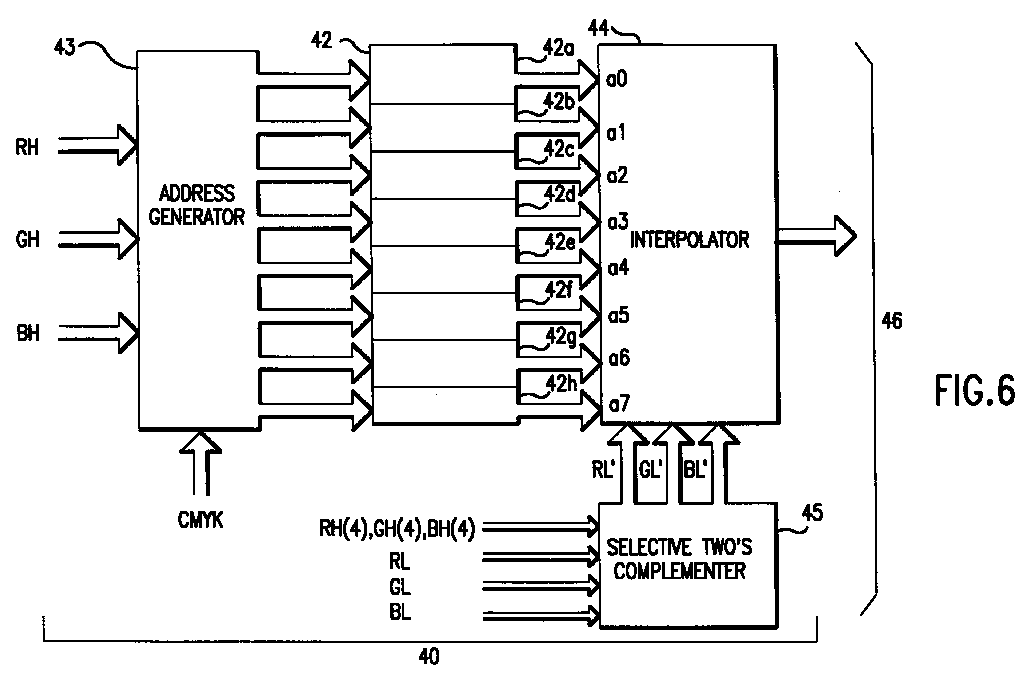
(57) An apparatus for routing interpolator input data (46) for a color space conversion
from a RGB color space to a CMYK color space includes a selective two's complementer
(45) coupled to a hardware interpolator (44). The inputs to the selective two's complementer
(45) include three sets of four lower order bits, RL, GL, and BL of a twenty four
bit RGB color space value and three least significant bits of three sets of four higher
order bits, RH, GH, and BH. The inputs to the hardware interpolator (44) include three
outputs from the selective two's complementer (45) and eight inputs (a0-a7) for receiving
interpolator input data from eight memory banks (42a-42h). The interpolation process
can be regarded as determining a location within a cube of a cubic lattice formed
from vertices represented by the interpolator input data values. The interpolator
input data values are classified into one of eight classes based upon the evenness
and oddness of the components of the vector formed from the three sets of higher order
bits specifying the location of the corresponding vertex within the cubic lattice.
Each of the eight memory banks (42a-42h) stores one of the eight classes of interpolator
input data values. The eight interpolator input data values corresponding to any cube
within the cubic lattice are stored in the eight memory banks (42a-42h). To perform
the interpolation, the eight interpolator input data values must be routed to computational
blocks within the interpolator (44) depending upon the evenness and oddness classification
of each of the three sets of higher order bits corresponding to the interpolator input
data value. By performing a two's complement on those sets of lower order bits corresponding
to those sets of higher order bits classified as odd, the routing of the interpolator
input data values is accomplished mathematically in the corresponding computational
blocks.
|
|
