|
(11) | EP 0 823 402 A2 |

| (12) | EUROPEAN PATENT APPLICATION |
|
|
|
|
|||||||||||||||||||
|
||||||||||||||||||||
| (54) | Use of biodegradable polymers in preventing corrosion and scale build-up |
| (57) A biodegradable corrosion inhibitor, scale inhibitor and dispersant is provided.
The inhibitor comprises one or more polymers from a family of poly(amino acid) polymers
that include hydroxamic acid-containing sidechains. Methods of reducing corrosion
and scale build-up and a method of dispersing solid particulates in a solution or
slurry are provided by adding a polymer of the present invention to a solution or
slurry. |
[0001] The present invention relates generally to the protection of metallic surfaces from corrosion, scaling and the accumulation of other deposits. More specifically, the present invention relates to corrosion and scale inhibiting compositions, dispersants and methods of using the same.
[0002] Corrosion occurs when metals are oxidized to their respective ions and/or insoluble salts. For example, corrosion of metallic iron can involve conversion to soluble iron in a +2 or a +3 oxidation state or insoluble iron oxides and hydroxides. Also, corrosion has a dual nature in that (1) a portion of the metal surface is removed and (2) the formation of insoluble salts contributes to the build up of scales and deposits.
[0003] First, the loss of metal on the surface will eventually cause deterioration of the structural integrity of the system or structure. Eventually, leakage between the water system and process streams can occur. Therefore, the inhabitation of corrosion of iron and steel alloys which come in contact with industrial water is critical. Corrosion difficulties result in immense maintenance costs, as well as costs incurred as a result of equipment failure or costs incurred as a result of alloyed materials if contact with corrosive elements present in industrial waters is not inhibited or prohibited.
[0004] Second, the build up of deposits interferes with heat transfer. Specifically, to efficiently transfer heat from a metal surface such as the inside surface of heat exchanger tube, to any liquid medium such as water, or vice versa, the surface of the metal should be clean and free of scales and deposits as possible. Scaled metal surfaces will reduce the rate of heat transfer between the metal surface and the water or other fluid medium and therefore, scaling reduces the efficiency of the system. Further, scaling and deposits can lead to corrosion underneath the deposits on the metallic surface and reduce the useful life of the equipment. Such scales and deposits include calcium carbonate, hydroxyaptite, calcium hydroxide, magnesium hydroxide, iron oxide or iron hydroxide and clay particulates, etc.
[0005] The most common way to combat corrosion, scaling and deposit accumulation in aqueous systems is to add corrosion and scale-inhibiting additives and dispersants to the feedwater or solution. Water has been treated with inorganic components, such as chromate or zinc salts, to inhibit corrosion. However, chromate and zinc salts have been found to be injurious to environment and therefore these treatments have fallen out of favor. Water has also been treated with inorganic phosphates or organic phosphonates to inhibit corrosion and/or scaling. However, the use of phosphates and phosphonates also leads to environmental concerns. Currently, organic polymers have been primarily used as scale-inhibitors and dispersants. However, organic polymers are normally non-biodegradable, and thus accumulate in the environment upon release from the water treatment systems, which limit the applicability of such polymers.
[0006] Some small molecules, such as gluconic acid, sucharic acid, citric acid, tartaric acid and lactobionic acid might be biodegradable, but their corrosion inhibition activities are low and therefore they are often formulated together with other inorganic corrosion inhibitors such as phosphate or zinc in order to provide effective corrosion inhibition. Underivatized polyaspartic acid is also known to be biodegradable and to have some scale inhibition activity but little or no corrosion inhibition activity. In fact, underivatized polyaspartic acid accelerates corrosion in common industrial water conditions.
[0007] Thus, there is a need for biodegradable compositions that are capable of inhibiting both corrosion and scale build up on metallic surfaces.
[0008] The present invention provides a family of compositions that reduce or inhibit development and build-up of corrosion, scales and deposits on metallic surfaces and a method of reducing development and build-up of corrosion, scales and deposits on metallic surfaces. The family of compositions provided by the present invention includes polymers comprising hydroxamic acid-containing poly (amino acids).
[0009] The present invention provides a composition for reducing corrosion on metallic surfaces, the composition characterized by a poly(amino acid) polymer including hydroxamic acid-containing sidechains.
[0010] The present invention further provides an industrial process water characterized by hardness and corrosive elements; and a poly(amino acid) polymer including hydroxamic acid-containing sidechains.
[0011] The present invention also provides a method of reducing corrosion on metallic surfaces caused by a water, characterized by comprising adding a corrosion inhibiting composition to the solution, the composition comprising a poly(amino acid) polymer including hydroxamic acid-containing sidechains.
[0012] The present invention also provides a method of reducing scale build-up on metallic surfaces caused by a water, characterized by comprising adding a scale inhibiting composition to the solution, the composition comprising a poly(amino acid) polymer including hydroxamic acid-containing sidechains.
[0013] The present invention provides a method of dispensing solid particulate in a solution or slurry containing solid particulates such as clays, characterized by comprising adding a dispersant composition to the solution or slurry containing solid particulates such as clays, the composition comprising a poly(amino acid) polymer including hydroxamic acid-containing sidechain.
[0014] The corrosion and scale inhibiting compositions of the present invention comprise poly(amino acid) polymers including hydroxamic acid-containing sidechains. More specifically, the compositions of the present invention comprise polymers of the general formula (I) as shown below:
wherein W may be CO2M or CONHOH wherein M is a metal ion; Y may be CH2CONHOH or CH2CO2M wherein M is a metal ion; M1 may be an alkaline metal, an alkaline earth metal and ammonium; (a + b)/(a + b + c + d) x 100% + (c + d)/(a + b + c + d) x 100% = 100%; (a + b)/(a + b + c + d) x 100% ranges from about O.1% to about 100%, preferred 5%-70%, more preferred 10%-50%; (c + d)/(a + b + c + d) x 100% ranges from 0% to 99.9%; a/(a + b) x 100% ranges from 0% to 100%; b/(a + b) x 100% ranges from 0% to 100%; a/(a + b) x 100% + b/(a + b) x 100% = 100%; c/(c + d) x 100% ranges from 0% to 100%; d/(c + d) x 100% ranges from 0% to 100%; c/(c + d) x 100% + d/(c + d) x 100% = 100%; and the molecular weight ranges from about 300 to about 200,000.
[0015] Other hydroxamic acid-containing poly(amino acids) of the general formula (II) as shown below are within the scope of the present invention:
wherein n 1 and 2; m ranges from O to 4; M1 is selected from the group consisting of an alkaline metal, an alkaline earth metal, and ammonium; X is selected from the group consisting of H, CH3, CH(CH3)2, CH(CH3)CH2CH3, OH, p-HOC6H4, SH, CH2SCH3, CH2OH, CH(OH)CH3, NH2, HNC(:NH)NH2, C(O)NH2,
OPO3M2, OSO3M, p-M2O3POC6H4, p-MO3SOC6H4, SPO2M2, CH2OPO3M2, CH2OSO3M, CH(OPO3M2)CH3, CH(OSO3M)CH3, wherein M is a metal ion, and, wherein W is CO2M or C(O)NR1OH; Y is (CH2)oC(O)NR1OH, (CH2)oCO2M, (CH2)oC(O)NR2R3 or (CH2)mX wherein M is a metal ion, X and m are defined above, o ranges from 1 to 2; R1, R2 and R3 may be H, alkyl, alkenyl, aryl, carboxyl, sulfonyl, OH or halide substituted alkyl, alkenyl and aryl groups; R1 may also be OR1 wherein R1 is an alkyl or an aryl; (a + b)/(a + b + c + d) x 100% ranges from about O.1% to about 100%, preferred 5% to 70%, more preferred 10% to 50%; (c + d)/(a + b + c + d) x 100% ranges from 0% to 99.9%, preferred 30%
1. A composition for reducing corrosion on metallic surfaces, the composition characterized
by a poly(amino acid) polymer including hydroxamic acid-containing sidechains.
2. The composition of claim 1, characterized in that the composition also reduces scale
accumulation on metallic surfaces.
3. The composition of claim 1, characterized in that the composition effectively disperses
particulates in a solution or slurry.
4. The composition of claim 1, characterized in that the polymer has the formula
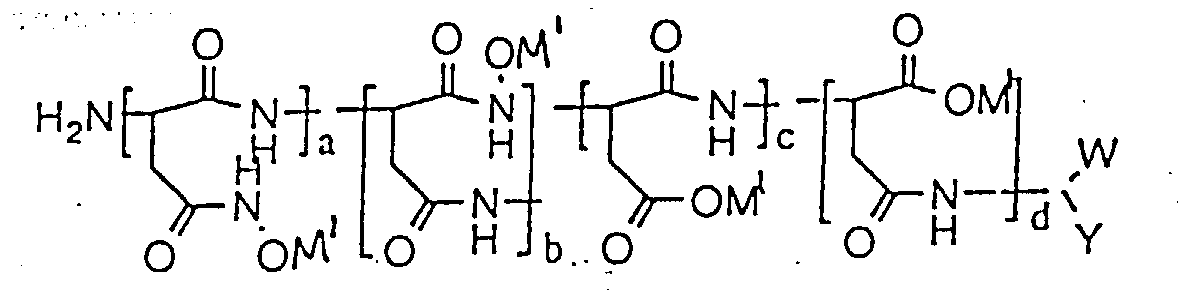
wherein W is selected from the group consisting of CO2M and CONHOH wherein M is a metal ion; Y is selected from the group consisting of CH2CONHOH and CH2CO2M wherein M is a metal ion; M1 is selected from the group consisting of an alkaline metal, an alkaline earth metal and ammonium; (a + b)/(a + b + c + d) x 100% + (c + d)/(a + b + c + d) x 100% = 100%; (a + b)/(a + b + c + d) x 100% ranges from about 0.1% to about 100%; (c + d)/(a + b + c + d) x 100% ranges from 0% to 99.9%; a/(a + b) x 100% ranges from 0% to 100%; b/(a + b) x 100% ranges from 0% to 100%; c/(c + d) x 100% ranges from 0% to 100%; d/(c + d) x 100% ranges from 0% to 100%; and c/(c + d) x 100% + d/(c + d) x 100% = 100%.
wherein W is selected from the group consisting of CO2M and CONHOH wherein M is a metal ion; Y is selected from the group consisting of CH2CONHOH and CH2CO2M wherein M is a metal ion; M1 is selected from the group consisting of an alkaline metal, an alkaline earth metal and ammonium; (a + b)/(a + b + c + d) x 100% + (c + d)/(a + b + c + d) x 100% = 100%; (a + b)/(a + b + c + d) x 100% ranges from about 0.1% to about 100%; (c + d)/(a + b + c + d) x 100% ranges from 0% to 99.9%; a/(a + b) x 100% ranges from 0% to 100%; b/(a + b) x 100% ranges from 0% to 100%; c/(c + d) x 100% ranges from 0% to 100%; d/(c + d) x 100% ranges from 0% to 100%; and c/(c + d) x 100% + d/(c + d) x 100% = 100%.
5. The composition of claim 4, characterized in that the molecular weight of the polymer
ranges from about 300 to about 200,000.
6. The composition of claim 1, characterized in that the polymer has the formula
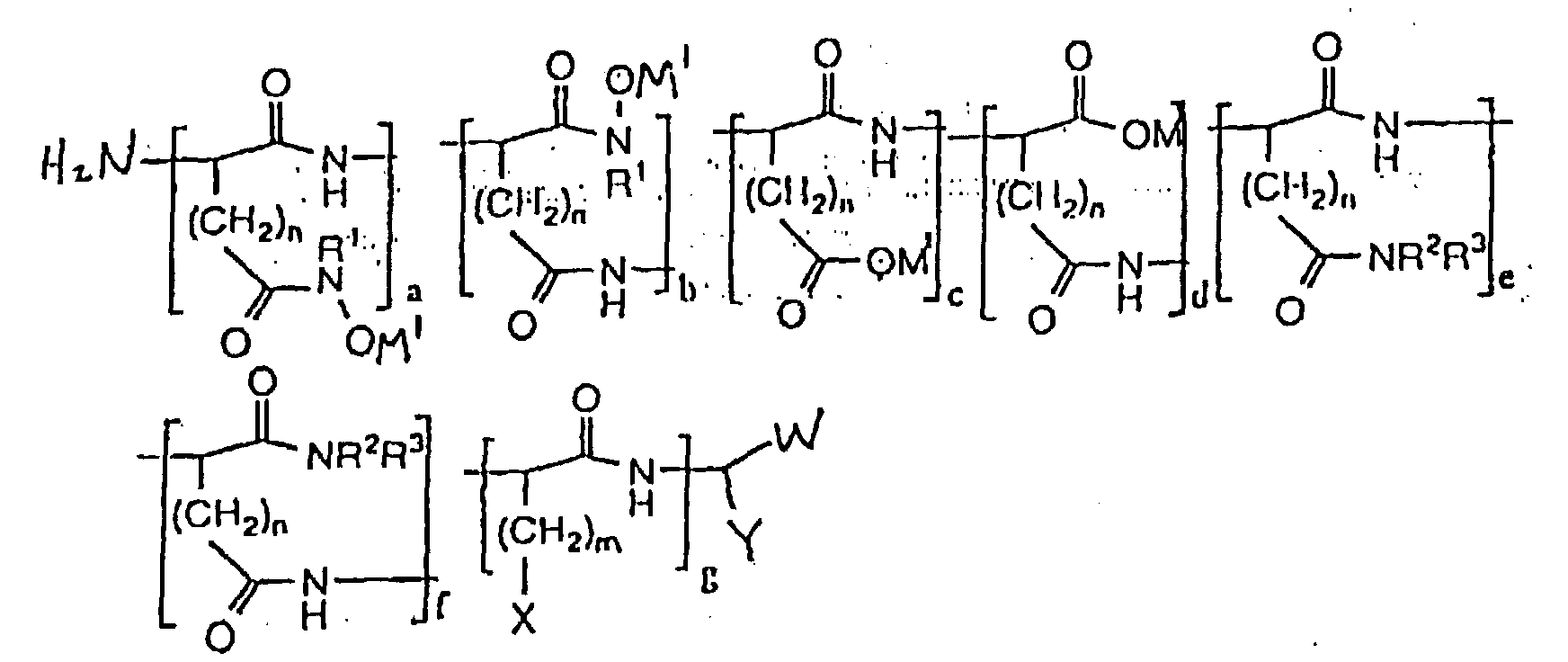
wherein n is selected from the group consisting of 1 and 2; m ranges from O to 4; M1 is selected from the group consisting of an alkaline metal, an alkaline earth metal, and ammonium; X is selected from the group consisting of H, CH3, CH(CH3)2, CH(CH3)CH2CH3, OH, p-HOC6H4, SH, CH2SCH3, CH2OH, CH(OH)CH3, NH2, HNC(:NH)NH2, C(O)NH2,
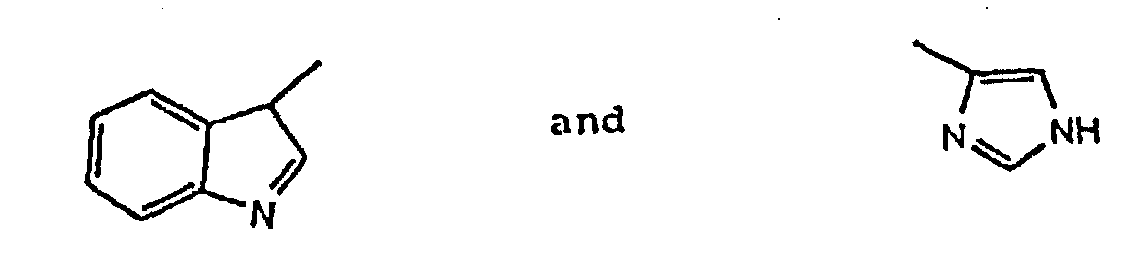
OPO3M2, OSO3M, p-M2O3POC6H4, p-MO3SOC6H4, SPO2M2, CH2OPO3M2, CH2OSO3M, CH(OPO3M2)CH3, CH(OSO3M)CH3, wherein M is a metal ion; W is selected from the group consisting of CO2M and C(O)NR1OH wherein M is a metal ion; Y is selected from the group consisting of (CH2)oC(O)NR1OH, (CH2)oCO2M, (CH2)oC(O)NR2R3 and (CH2)mX wherein M is a metal ion; o ranges from 1 to 2; R1 is selected from the group consisting of H, alkyl, alkenyl, aryl, carboxyl, sulfonyl, OH and halide substituted alkyl, alkenyl and aryl groups, and OR1 wherein R1 is selected from the group consisting of alkyl and aryl; R2 and R3 are selected from the group consisting of H, alkyl, alkenyl, aryl, carboxyl, sulfonyl, OH and halide substituted alkyl, alkenyl and aryl groups; (a + b)/(a + b + c + d) x 100% ranges from about 0.15 to about 100%; (c + d)/(a + b + c + d) x 100% ranges from 0% to 99.9%; (a + b)/(a + b + c + d) x 100% + (c + d)/(a + b + c + d) x 100% = 100%; (e + f)/(a + b + c + d + e + f + g) x 100% ranges from about 0% to about 50%; g/(a + b + c + d + e + f + g) x 100% ranges from about 0% to about 50%; (a + b + c + d)/(a + b + c + d + e + f + g) x 100% ranges from about 50% to about 100%; (a + b + c + d)/(a + b + c +d + e + f + g) x 100% + (e + f)/(a + b + c + d + e + f + g) x 100% + g/(a + b + c + d + e + f + g) x 100% = 100%; a/(a + b) x 100% ranges from 0% to 100%; b/(a + b) x 100% ranges from 0% to 100%; a/(a + b) x 100% + b/(a + b) x 100% = 100%; c/(c + d) x 100% ranges from 0% to 100%; d/(c + d) x 100% ranges from 0% to 100%; c/(c + d) x 100% + d/(c + d) x 100% = 100%; and e/(e + f) x 100% + f/(e + f) x 100% = 100%.
wherein n is selected from the group consisting of 1 and 2; m ranges from O to 4; M1 is selected from the group consisting of an alkaline metal, an alkaline earth metal, and ammonium; X is selected from the group consisting of H, CH3, CH(CH3)2, CH(CH3)CH2CH3, OH, p-HOC6H4, SH, CH2SCH3, CH2OH, CH(OH)CH3, NH2, HNC(:NH)NH2, C(O)NH2,
OPO3M2, OSO3M, p-M2O3POC6H4, p-MO3SOC6H4, SPO2M2, CH2OPO3M2, CH2OSO3M, CH(OPO3M2)CH3, CH(OSO3M)CH3, wherein M is a metal ion; W is selected from the group consisting of CO2M and C(O)NR1OH wherein M is a metal ion; Y is selected from the group consisting of (CH2)oC(O)NR1OH, (CH2)oCO2M, (CH2)oC(O)NR2R3 and (CH2)mX wherein M is a metal ion; o ranges from 1 to 2; R1 is selected from the group consisting of H, alkyl, alkenyl, aryl, carboxyl, sulfonyl, OH and halide substituted alkyl, alkenyl and aryl groups, and OR1 wherein R1 is selected from the group consisting of alkyl and aryl; R2 and R3 are selected from the group consisting of H, alkyl, alkenyl, aryl, carboxyl, sulfonyl, OH and halide substituted alkyl, alkenyl and aryl groups; (a + b)/(a + b + c + d) x 100% ranges from about 0.15 to about 100%; (c + d)/(a + b + c + d) x 100% ranges from 0% to 99.9%; (a + b)/(a + b + c + d) x 100% + (c + d)/(a + b + c + d) x 100% = 100%; (e + f)/(a + b + c + d + e + f + g) x 100% ranges from about 0% to about 50%; g/(a + b + c + d + e + f + g) x 100% ranges from about 0% to about 50%; (a + b + c + d)/(a + b + c + d + e + f + g) x 100% ranges from about 50% to about 100%; (a + b + c + d)/(a + b + c +d + e + f + g) x 100% + (e + f)/(a + b + c + d + e + f + g) x 100% + g/(a + b + c + d + e + f + g) x 100% = 100%; a/(a + b) x 100% ranges from 0% to 100%; b/(a + b) x 100% ranges from 0% to 100%; a/(a + b) x 100% + b/(a + b) x 100% = 100%; c/(c + d) x 100% ranges from 0% to 100%; d/(c + d) x 100% ranges from 0% to 100%; c/(c + d) x 100% + d/(c + d) x 100% = 100%; and e/(e + f) x 100% + f/(e + f) x 100% = 100%.
7. The composition of claim 6, characterized in that the molecular weight ranges from
about 300 to about 200,000.
8. An industrial process water characterized by hardness and corrosive elements; and
a poly(amino acid) polymer including hydroxamic acid-containing sidechains.
9. The water of claim 8, characterized in that the polymer is present in a concentration
of ranging from about 0.1ppm to about 1000ppm.
10. The water of claim 8, characterized in that the polymer has the formula
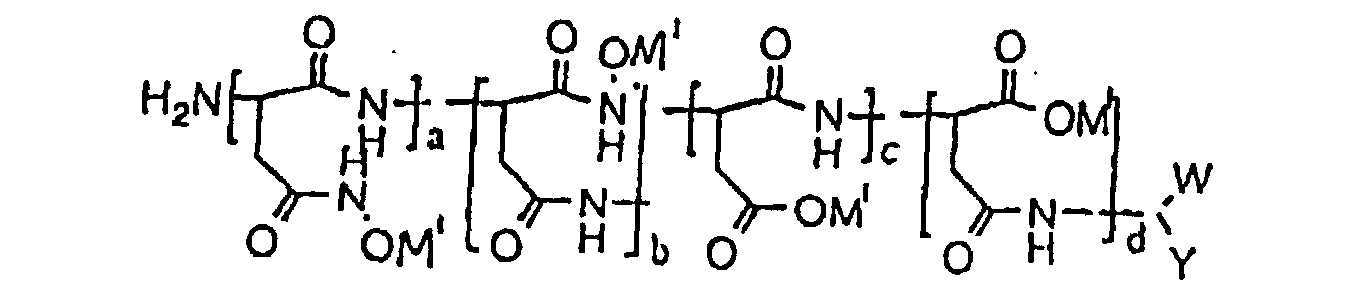
wherein W is selected from the group consisting of CO2M and CONHOH wherein M is a metal ion; Y is selected from the group consisting of CH2CONHOH and CH2CO2M wherein M is a metal ion; M1 is selected from the group consisting of an alkaline metal, an alkaline earth metal and ammonium; (a + b) /(a + b + c + d) x 100% + (c + d)/(a + b + c + d) x 100% = 100%; (a + b)/(a + b + c + d) x 100% ranges from about O.1% to about 100%; (c + d)/(a + b + c + d) x 100% ranges from 0% to 99.9%; a/(a + b) x 100% ranges from 0% to 100%; b/(a + b) x 100% ranges from 0% to 100%; c/(c + d) x 100% ranges from 0% to 100%; d/(c + d) x 100% ranges from 0% to 100%; and c/(c + d) x 100% + d/(c + d) x 100% = 100%.
wherein W is selected from the group consisting of CO2M and CONHOH wherein M is a metal ion; Y is selected from the group consisting of CH2CONHOH and CH2CO2M wherein M is a metal ion; M1 is selected from the group consisting of an alkaline metal, an alkaline earth metal and ammonium; (a + b) /(a + b + c + d) x 100% + (c + d)/(a + b + c + d) x 100% = 100%; (a + b)/(a + b + c + d) x 100% ranges from about O.1% to about 100%; (c + d)/(a + b + c + d) x 100% ranges from 0% to 99.9%; a/(a + b) x 100% ranges from 0% to 100%; b/(a + b) x 100% ranges from 0% to 100%; c/(c + d) x 100% ranges from 0% to 100%; d/(c + d) x 100% ranges from 0% to 100%; and c/(c + d) x 100% + d/(c + d) x 100% = 100%.
11. The water of claim 10, characterized in that the molecular weight of the polymer ranges
from about 300 to about 200,000.
12. The water of claim 8, characterized in that the polymer has the formula
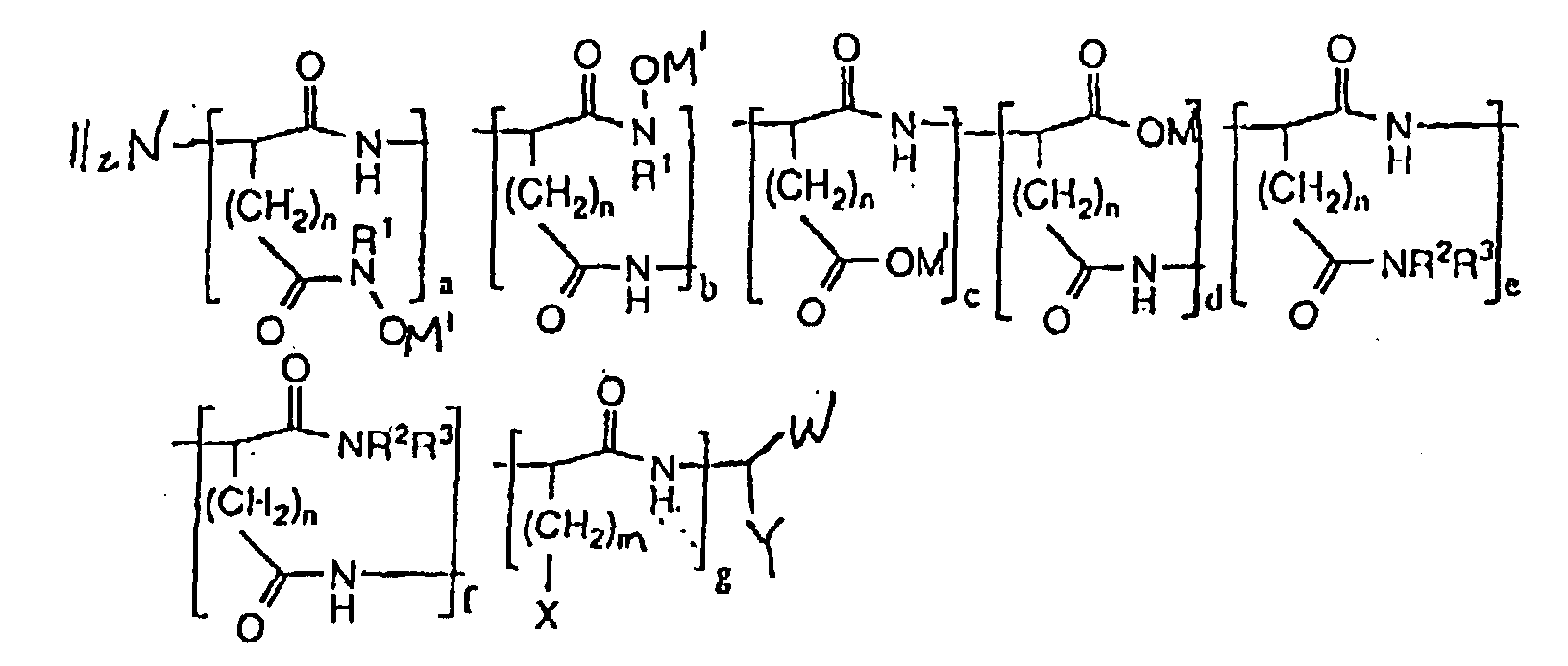
wherein n is selected from the group consisting of 1 and 2; m ranges from O to 4; M1 is selected from the group consisting of an alkaline metal, an alkaline earth metal, and ammonium; X is selected from the group consisting of H, CH3, CH(CH3)2, CH(CH3)CHzCH3, OH, p-HOC6H4, SH, CH2SCH3, CH2OH, CH(OH)CH3, NH2, HNC(:NH)NH2, C(O)NH2,

OPO3M2, OSO3M, p-M2O3POC6H4, p-MO3SOC6H4, SPO2M2, CH2OPO3M2, CH2OSO3M, CH(OPO3M2)CH3, CH(OSO3M)CH3, wherein M is a metal ion; W is selected from the group consisting of CO2M and C(O)NR1OH wherein M is a metal ion; Y is selected from the group consisting of (CH2)oC(O)NR1OH, (CH2)oCO2M, (CH2)oC(O)NR2 R3 and (CH2)mX wherein M is a metal ion, o ranges from 1 to 2; R1 is selected from the group consisting of H, alkyl, alkenyl, aryl, carboxyl, sulfonyl, OH and halide substituted alkyl, alkenyl and aryl groups, and OR1 wherein R1 is selected from the group consisting of alkyl and aryl; R2 and R3 are selected from the group consisting of H, alkyl, alkenyl, aryl, carboxyl, sulfonyl, OH and halide substituted alkyl, alkenyl and aryl groups; (a + b) /(a + b + c + d) x 100% ranges from about 0.15 to about 100%; (c + d)/(a + b + c + d) x 100% ranges from 0% to 99.9%; (a + b)/(a + b + c + d) x 100% + (c + d)/(a + b + c + d) x 100% = 100%; (e + f)/(a + b + c + d + e + f + g) x 100% ranges from about 0% to about 50%; g/(a + b + c + d + e + f + g) x 100% ranges from about 0% to about 50%; (a + b + c + d)/(a + b + c + d + e + f + g) x 100% ranges from about 50% to about 100%; (a + b + c + d)/(a + b + c + d + e + f + g) x 100% + (e + f) /(a + b + c + d + e + f + g) x100% + g/(a + b + c + d + e + f + g) x 100% = 100%; a/(a + b) x 100% ranges from 0% to 100%; b/(a + b) x 100% ranges from 0% to 100%; a/(a + b) x 100% + b/(a + b) x 100% = 100%; c/(c + d) x 100% ranges from 0% to 100%; d/(c + d) x 100% ranges from 0% to 100%; c/(c + d) x 100% + d/(c + d) x 100% = 100%; and e/(e + f) x 100% + f/(e + f) x 100% = 100%.
wherein n is selected from the group consisting of 1 and 2; m ranges from O to 4; M1 is selected from the group consisting of an alkaline metal, an alkaline earth metal, and ammonium; X is selected from the group consisting of H, CH3, CH(CH3)2, CH(CH3)CHzCH3, OH, p-HOC6H4, SH, CH2SCH3, CH2OH, CH(OH)CH3, NH2, HNC(:NH)NH2, C(O)NH2,
OPO3M2, OSO3M, p-M2O3POC6H4, p-MO3SOC6H4, SPO2M2, CH2OPO3M2, CH2OSO3M, CH(OPO3M2)CH3, CH(OSO3M)CH3, wherein M is a metal ion; W is selected from the group consisting of CO2M and C(O)NR1OH wherein M is a metal ion; Y is selected from the group consisting of (CH2)oC(O)NR1OH, (CH2)oCO2M, (CH2)oC(O)NR2 R3 and (CH2)mX wherein M is a metal ion, o ranges from 1 to 2; R1 is selected from the group consisting of H, alkyl, alkenyl, aryl, carboxyl, sulfonyl, OH and halide substituted alkyl, alkenyl and aryl groups, and OR1 wherein R1 is selected from the group consisting of alkyl and aryl; R2 and R3 are selected from the group consisting of H, alkyl, alkenyl, aryl, carboxyl, sulfonyl, OH and halide substituted alkyl, alkenyl and aryl groups; (a + b) /(a + b + c + d) x 100% ranges from about 0.15 to about 100%; (c + d)/(a + b + c + d) x 100% ranges from 0% to 99.9%; (a + b)/(a + b + c + d) x 100% + (c + d)/(a + b + c + d) x 100% = 100%; (e + f)/(a + b + c + d + e + f + g) x 100% ranges from about 0% to about 50%; g/(a + b + c + d + e + f + g) x 100% ranges from about 0% to about 50%; (a + b + c + d)/(a + b + c + d + e + f + g) x 100% ranges from about 50% to about 100%; (a + b + c + d)/(a + b + c + d + e + f + g) x 100% + (e + f) /(a + b + c + d + e + f + g) x100% + g/(a + b + c + d + e + f + g) x 100% = 100%; a/(a + b) x 100% ranges from 0% to 100%; b/(a + b) x 100% ranges from 0% to 100%; a/(a + b) x 100% + b/(a + b) x 100% = 100%; c/(c + d) x 100% ranges from 0% to 100%; d/(c + d) x 100% ranges from 0% to 100%; c/(c + d) x 100% + d/(c + d) x 100% = 100%; and e/(e + f) x 100% + f/(e + f) x 100% = 100%.
13. The water of claim 12, characterized in that the molecular weight ranges from about
300 to about 200,000.
14. The water of claim 8 characterized by further comprising minerals selected from the
group consisting of alkaline earth metal phosphates, alkaline earth metal sulfates,
alkaline earth metal carbonates, iron (hydro)oxides, zinc hydroxides, maganese oxides,
aluminum (hydro)oxides, clays and silicates.
15. The water of claim 8 characterized by further comprising at least one scale inhibitor
chosen from the group consisting of polyacrylate, polymethylacrylate, a copolymer
of acrylic acid and methacrylic acid, a copolymer of acrylic acid and acrylamide,
polymaleic anhydride, a copolymer of acrylic acid and maleic acid copolymer, polyol
esters, 1-hydroxyethylidene-1,1-diphosphonic acid, 2-phosphono-butane-1,2,4-tricarboxylic
acid (PBTC), amino tri(methylene phosphonic acid), an acrylic acid/acrylamide/amino
methane sulfonate terpolymer, polyaspartic acid and mixtures thereof.
16. The water of claim 8 characterized by further comprising at least one;yellow metal
corrosion inhibitor chosen from the group consisting of benzotriazole, tolyltriazole,
mercaptobenzothiazole and other azole compounds.
17. The water of claim 8 characterized by further comprising at least one additive selected
from the group consisting of phosphorous containing inorganic chemicals such as phosphates,
pyrophosphates, polyphosphates, hydroxycarboxylic acids or their salts such as gluconic
acid, glucaric acid; Zn2+, Ce2+, MoO42-, VO32-, WO42-.
18. The water of claim 8 characterized by further comprising at least one biocide selected
from the group consisting of Cl2, NaOCl, NaOBr, glutaldehyde, isothiazolinones, Kathon WT, sulfamic acid-stabilized
bleach and sulfamic acid-stabilized bromine.
19. A method of reducing corrosion on metallic surfaces caused by a water, characterized
by comprising adding a corrosion inhibiting composition to the solution, the composition
comprising a poly(amino acid) polymer including hydroxamic acid-containing sidechains.
20. The method of claim 19, characterized in that the polymer has the formula
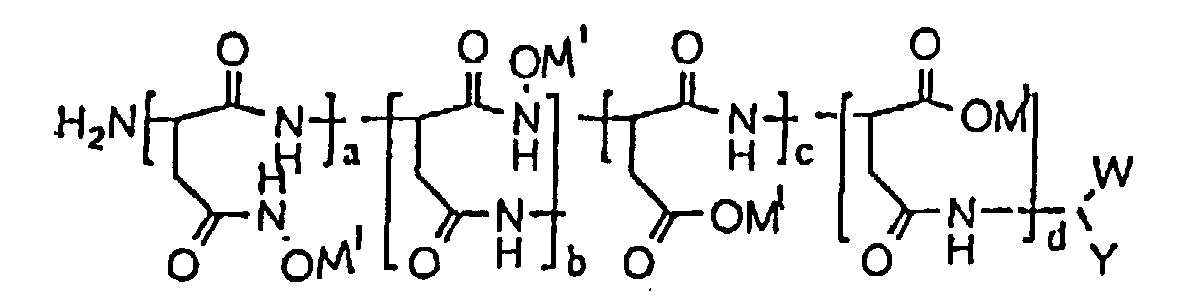
wherein W is selected from the group consisting of CO2M and CONHOH wherein M is a metal ion; Y is selected from the group consisting of CH2CONHOH and CH2CO2M wherein M is a metal ion; M1 is selected from the group consisting of an alkaline metal, an alkaline earth metal and ammonium; (a + b)/(a + b + c + d) x 100% + (c + d)f(a + b + c + d) x 100% = 100%; (a + b)/(a + b + c + d) x 100% ranges from about O.1% to about 100%; (c + d)/(a + b + c + d ) x 100% ranges from 0%, to 99.9%; a/(a + b) x 100% ranges from 0% to 100%; b/(a + b) x 100% ranges from 0% to 100%; c/(c + d) x 100% ranges from 0% to 100%; d/(c + d) x 100% ranges from 0% to 100%; and c/(c + d) x 100% + d/(c + d) x 100% = 100%.
wherein W is selected from the group consisting of CO2M and CONHOH wherein M is a metal ion; Y is selected from the group consisting of CH2CONHOH and CH2CO2M wherein M is a metal ion; M1 is selected from the group consisting of an alkaline metal, an alkaline earth metal and ammonium; (a + b)/(a + b + c + d) x 100% + (c + d)f(a + b + c + d) x 100% = 100%; (a + b)/(a + b + c + d) x 100% ranges from about O.1% to about 100%; (c + d)/(a + b + c + d ) x 100% ranges from 0%, to 99.9%; a/(a + b) x 100% ranges from 0% to 100%; b/(a + b) x 100% ranges from 0% to 100%; c/(c + d) x 100% ranges from 0% to 100%; d/(c + d) x 100% ranges from 0% to 100%; and c/(c + d) x 100% + d/(c + d) x 100% = 100%.
21. The method of claim 19, characterized in that the polymer has the formula
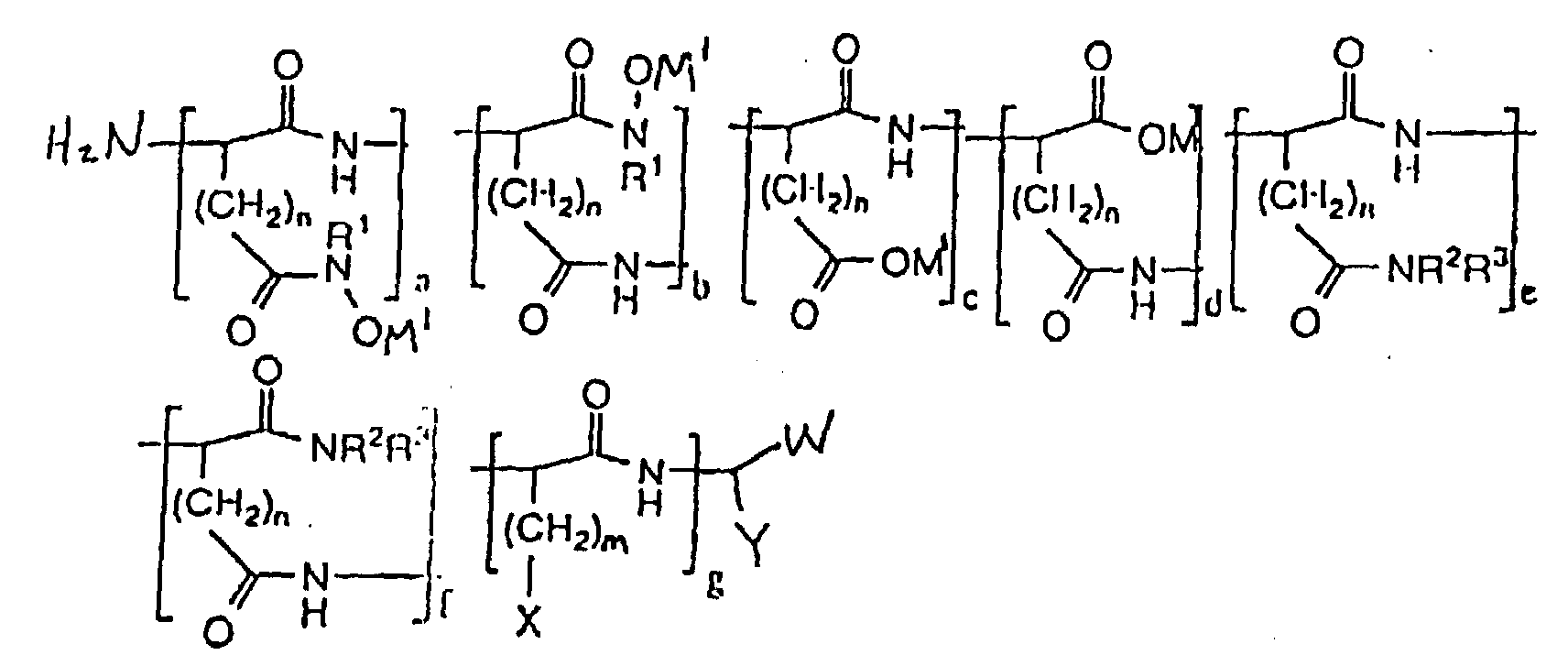
wherein n is selected from the group consisting of 1 and 2; m ranges from O to 4; M1 is selected from the group consisting of an alkaline metal, an alkaline earth metal, and ammonium; X is selected from the group consisting of H, CH3, CH(CH3)2, CH(CH3)CH2CH3, OH, p-HOC6H4, SH, CH2SCH3, CH2OH, CH(OH)CH3, NH2, HNC(:NH)NH2, C(O)NH2,
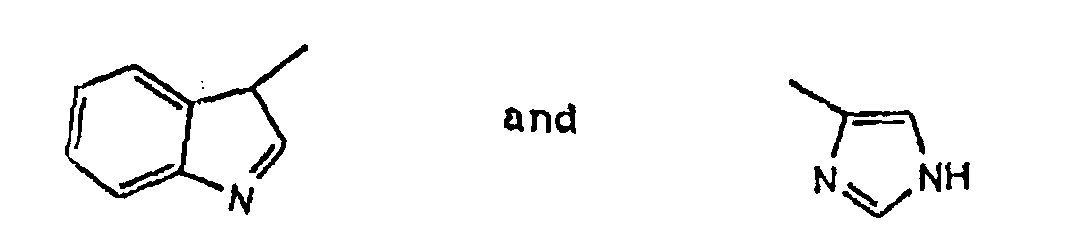
OPO3M2, OSO3M, p-M2O3POC6H4, p-MO3SOC6H4, SPO2M2 CH2OPO3M2, CH2OSO3M, CH(OPO3M2)CH3, CH(OSO3M)CH3, wherein M is a metal ion; W is selected from the group consisting of CO2M and C(O)NR1OH wherein M is a metal ion; Y is selected from the group consisting of (CH2)oC(O)NR1OH, (CH2)oCO2M, (CH2)oC(O)NR2R3 and (CH2)mX wherein M is a metal ion, o ranges from 1 to 2; R1 is selected from the group consisting of H, alkyl, alkenyl, aryl, carboxyl, sulfonyl, OH and halide substituted alkyl, alkenyl and aryl groups, and OR1 wherein R1 is selected from the group consisting of alkyl and aryl; R2 and R3 are selected from the group consisting of H, alkyl, alkenyl, aryl, carboxyl, sulfonyl, OH and halide substituted alkyl, alkenyl and aryl groups; (a + b)/(a + b + c + d) x lO0% ranges from about O.15 to about 100%; (c + d)/(a + b + c + d) x 100% ranges from 0% to 99.9%; (a + b)/(a + b + c + d) x lO0% + (c + d)/(a + b + c + d) x 100% = 100%; (e + f)/(a + b + c + d + e + f + g) x 100% ranges from about 0% to about 50%; g/(a + b + c + d + e + f + g) x 100% ranges from about 0% to about 50%; (a + b + c + d)/(a + b + c + d + e + f + g) x 100% ranges from about 50% to about 100%; (a + b + c + d)/(a + b + c + d + e + f + g) x 100% + (e + f)/(a + b + c + d + e + f + g) x 100% + g/(a + b + c + d + e + f + g) x 100% = 100%; a/(a + b) x 100% ranges from 0% to 100%; b/(a + b) x 100% ranges from 0% to 100%; a/(a + b) x 100% + b/(a + b) x 100% = 100%; c/(c + d) x 100% ranges from 0% to 100%; d/(c + d) x 100% ranges from 0% to 100%; c/(c + d) x 100% + d/(c + d) x 100% = 100%; and e/(e + f) x 100% + f/(e + f) x 100% = 100%.
wherein n is selected from the group consisting of 1 and 2; m ranges from O to 4; M1 is selected from the group consisting of an alkaline metal, an alkaline earth metal, and ammonium; X is selected from the group consisting of H, CH3, CH(CH3)2, CH(CH3)CH2CH3, OH, p-HOC6H4, SH, CH2SCH3, CH2OH, CH(OH)CH3, NH2, HNC(:NH)NH2, C(O)NH2,
OPO3M2, OSO3M, p-M2O3POC6H4, p-MO3SOC6H4, SPO2M2 CH2OPO3M2, CH2OSO3M, CH(OPO3M2)CH3, CH(OSO3M)CH3, wherein M is a metal ion; W is selected from the group consisting of CO2M and C(O)NR1OH wherein M is a metal ion; Y is selected from the group consisting of (CH2)oC(O)NR1OH, (CH2)oCO2M, (CH2)oC(O)NR2R3 and (CH2)mX wherein M is a metal ion, o ranges from 1 to 2; R1 is selected from the group consisting of H, alkyl, alkenyl, aryl, carboxyl, sulfonyl, OH and halide substituted alkyl, alkenyl and aryl groups, and OR1 wherein R1 is selected from the group consisting of alkyl and aryl; R2 and R3 are selected from the group consisting of H, alkyl, alkenyl, aryl, carboxyl, sulfonyl, OH and halide substituted alkyl, alkenyl and aryl groups; (a + b)/(a + b + c + d) x lO0% ranges from about O.15 to about 100%; (c + d)/(a + b + c + d) x 100% ranges from 0% to 99.9%; (a + b)/(a + b + c + d) x lO0% + (c + d)/(a + b + c + d) x 100% = 100%; (e + f)/(a + b + c + d + e + f + g) x 100% ranges from about 0% to about 50%; g/(a + b + c + d + e + f + g) x 100% ranges from about 0% to about 50%; (a + b + c + d)/(a + b + c + d + e + f + g) x 100% ranges from about 50% to about 100%; (a + b + c + d)/(a + b + c + d + e + f + g) x 100% + (e + f)/(a + b + c + d + e + f + g) x 100% + g/(a + b + c + d + e + f + g) x 100% = 100%; a/(a + b) x 100% ranges from 0% to 100%; b/(a + b) x 100% ranges from 0% to 100%; a/(a + b) x 100% + b/(a + b) x 100% = 100%; c/(c + d) x 100% ranges from 0% to 100%; d/(c + d) x 100% ranges from 0% to 100%; c/(c + d) x 100% + d/(c + d) x 100% = 100%; and e/(e + f) x 100% + f/(e + f) x 100% = 100%.
22. A method of reducing scale build-up on metallic surfaces caused by a water, characterized
by comprising adding a scale inhibiting composition to the solution, the composition
comprising a poly(amino acid) polymer including hydroxamic acid-containing sidechains.
23. The method of claim 22, characterized in that the polymer has the formula
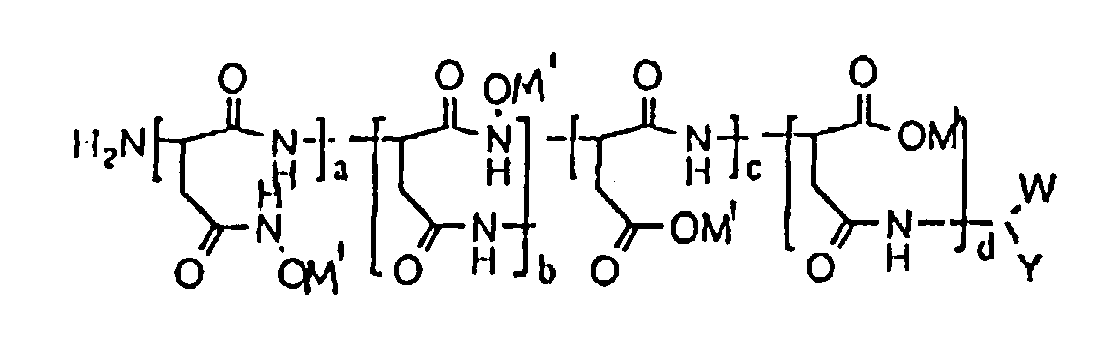
wherein W is selected from the group consisting of CO2M and CONHOH wherein M is a metal ion; Y is selected from the group consisting of CH2CONHOH and CH2CO2M wherein M is a metal ion; M1 is selected from the group consisting of an alkaline metal, an alkaline earth metal and ammonium; (a + b)/(a + b + c + d) x 100% + (c + d)/(a +b + c + d) x 100% = 100%; (a + b)/(a + b + c + d) x 100% ranges from about O.1% to about 100%; (c + d)/(a + b + c + d ) x 100% ranges from 0% to 99.9%; a/(a + b) x 100% ranges from 0% to 100%; b/(a + b) x 100% ranges from 0% to 100%; c/(c + d) x 100% ranges from 0% to 100%; d/(c + d) x 100% ranges from 0% to 100%; and c/(c + d) x 100% + d/(c + d) x 100% = 100%.
wherein W is selected from the group consisting of CO2M and CONHOH wherein M is a metal ion; Y is selected from the group consisting of CH2CONHOH and CH2CO2M wherein M is a metal ion; M1 is selected from the group consisting of an alkaline metal, an alkaline earth metal and ammonium; (a + b)/(a + b + c + d) x 100% + (c + d)/(a +b + c + d) x 100% = 100%; (a + b)/(a + b + c + d) x 100% ranges from about O.1% to about 100%; (c + d)/(a + b + c + d ) x 100% ranges from 0% to 99.9%; a/(a + b) x 100% ranges from 0% to 100%; b/(a + b) x 100% ranges from 0% to 100%; c/(c + d) x 100% ranges from 0% to 100%; d/(c + d) x 100% ranges from 0% to 100%; and c/(c + d) x 100% + d/(c + d) x 100% = 100%.
24. The method of claim 22, characterized in that the polymer has the formula
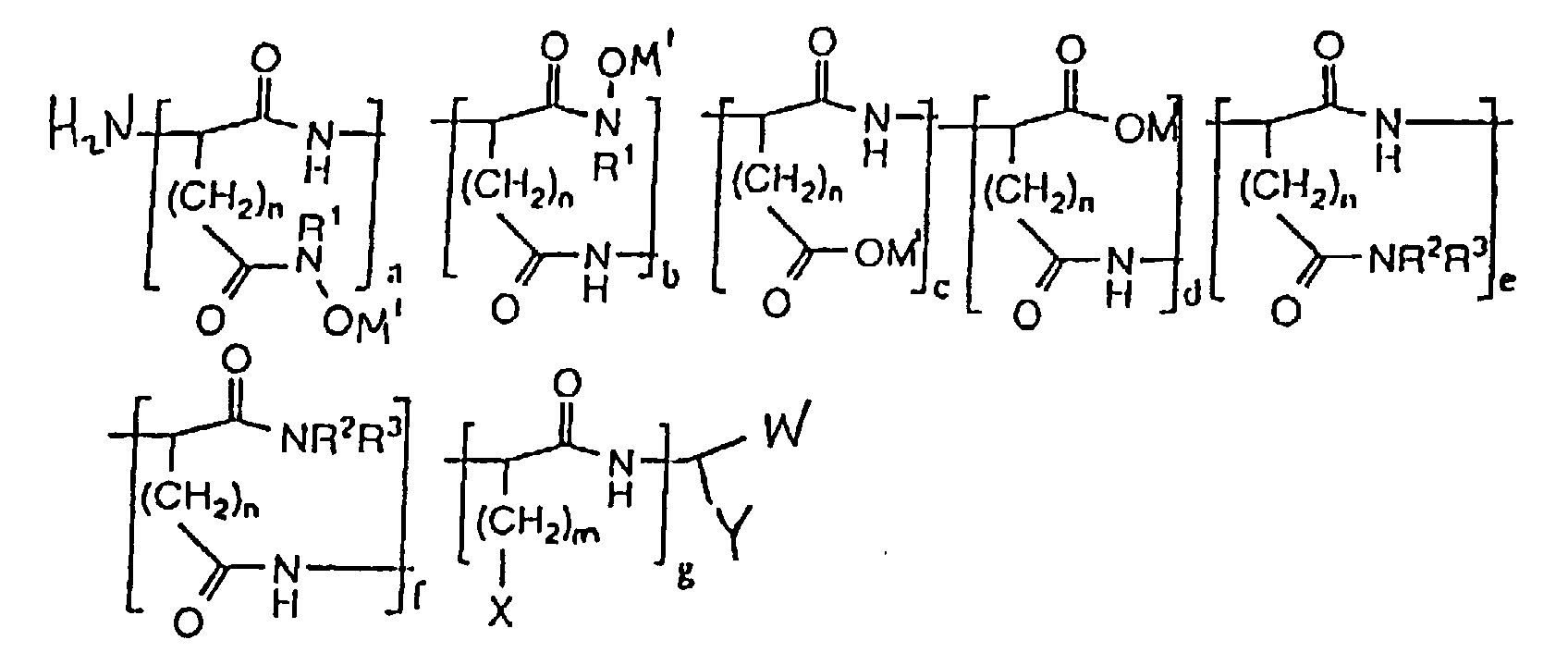
wherein n is selected from the group consisting of 1 and 2; m ranges from O to 4; M1 is selected from the group consisting of an alkaline metal, an alkaline earth metal, and ammonium; x is selected from the group consisting of H, CH3, CH(CH3)2, CH(CH3)CH2CH3, OH, p-HOC6H4, SH, CH2SCH3, CH2OH, CH(OH)CH3, NH2, HNC(:NH)NH2, C(O)NH2,
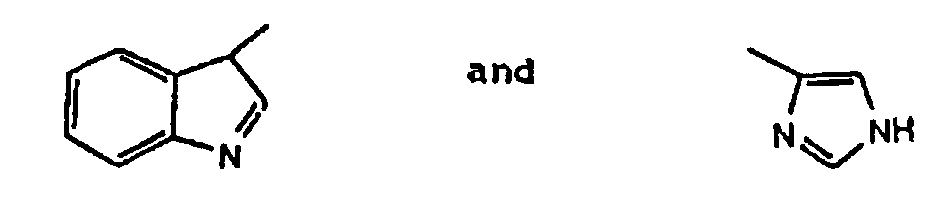
OPO3M2, OSO3M, p-M2O3POC6H4, p-MO3SOC6H4, SPO2M2, CH2OPO3M2, CH2OSO3M, CH(OPO3M2)CH3, CH(OSO3M)CH3, wherein M is a metal ion; W is selected from the group consisting of CO2M and C(O)NR1OH wherein M is a metal ion; Y is selected from the group consisting of (CH2)oC(O)NR1OH, (CH2)oCO2M, (CH2)oC(O)NR2R3 and (CH2)mX wherein M is a metal ion, o ranges from 1 to 2; R1 is selected from the group consisting of H, alkyl, alkenyl, aryl, carboxyl, sulfonyl, OH and halide substituted alkyl, alkenyl and aryl groups, and OR1 wherein R1 is selected from the group consisting of alkyl and aryl; R2 and R3 are selected from the group consisting of H, alkyl, alkenyl, aryl, carboxyl, sulfonyl, OH and halide substituted alkyl, alkenyl and aryl groups; (a + b)/(a + b + c + d) x 100% ranges from about O.15 to about 100%; (c + d)/(a + b + c + d) x 100% ranges from 0% to 99.9%; (a + b)/(a + b + c + d) x 100% + (c + d)/(a + b + c + d) x 100% = 100%; (e + f)/(a + b + c + d + e + f + g) x 100% ranges from about 0% to about 50%; g/(a + b + c + d + e + f + g) x 100% ranges from about 0% to about 50%; (a + b + c + d)/(a + b + c + d + e + f + g) x 100% ranges from about 50% to about 100%; (a + b + c + d)/(a + b + c + d + e + f + g) x 100% + (e + f)/(a + b + c + d + e + f + g) x 100% + g/(a + b + c + d + e + f + g) x 100% = 100%; a/(a + b) x 100% ranges from 0% to 100%; b/(a + b) x 100% ranges from 0% to 100%; a/(a + b) x 100% + b/(a + b) x 100% = 100%; c/(c + d) x 100% ranges from 0% to 100%; d/(c + d) x 100% ranges from 0% to 100%; c/(c + d) x 100% + d/(c + d) x 100% = 100%; and e/(e + f) x 100% + f/(e + f) x 100% = 100%.
wherein n is selected from the group consisting of 1 and 2; m ranges from O to 4; M1 is selected from the group consisting of an alkaline metal, an alkaline earth metal, and ammonium; x is selected from the group consisting of H, CH3, CH(CH3)2, CH(CH3)CH2CH3, OH, p-HOC6H4, SH, CH2SCH3, CH2OH, CH(OH)CH3, NH2, HNC(:NH)NH2, C(O)NH2,
OPO3M2, OSO3M, p-M2O3POC6H4, p-MO3SOC6H4, SPO2M2, CH2OPO3M2, CH2OSO3M, CH(OPO3M2)CH3, CH(OSO3M)CH3, wherein M is a metal ion; W is selected from the group consisting of CO2M and C(O)NR1OH wherein M is a metal ion; Y is selected from the group consisting of (CH2)oC(O)NR1OH, (CH2)oCO2M, (CH2)oC(O)NR2R3 and (CH2)mX wherein M is a metal ion, o ranges from 1 to 2; R1 is selected from the group consisting of H, alkyl, alkenyl, aryl, carboxyl, sulfonyl, OH and halide substituted alkyl, alkenyl and aryl groups, and OR1 wherein R1 is selected from the group consisting of alkyl and aryl; R2 and R3 are selected from the group consisting of H, alkyl, alkenyl, aryl, carboxyl, sulfonyl, OH and halide substituted alkyl, alkenyl and aryl groups; (a + b)/(a + b + c + d) x 100% ranges from about O.15 to about 100%; (c + d)/(a + b + c + d) x 100% ranges from 0% to 99.9%; (a + b)/(a + b + c + d) x 100% + (c + d)/(a + b + c + d) x 100% = 100%; (e + f)/(a + b + c + d + e + f + g) x 100% ranges from about 0% to about 50%; g/(a + b + c + d + e + f + g) x 100% ranges from about 0% to about 50%; (a + b + c + d)/(a + b + c + d + e + f + g) x 100% ranges from about 50% to about 100%; (a + b + c + d)/(a + b + c + d + e + f + g) x 100% + (e + f)/(a + b + c + d + e + f + g) x 100% + g/(a + b + c + d + e + f + g) x 100% = 100%; a/(a + b) x 100% ranges from 0% to 100%; b/(a + b) x 100% ranges from 0% to 100%; a/(a + b) x 100% + b/(a + b) x 100% = 100%; c/(c + d) x 100% ranges from 0% to 100%; d/(c + d) x 100% ranges from 0% to 100%; c/(c + d) x 100% + d/(c + d) x 100% = 100%; and e/(e + f) x 100% + f/(e + f) x 100% = 100%.
25. A method of dispensing solid particulate in a solution or slurry containing solid
particulates such as clays, characterized by comprising adding a dispersant composition
to the solution or slurry containing solid particulates such as clays, the composition
comprising a poly(amino acid) polymer including hydroxamic acid-containing sidechain.
26. The method of claim 25, characterized in that the polymer has the formula
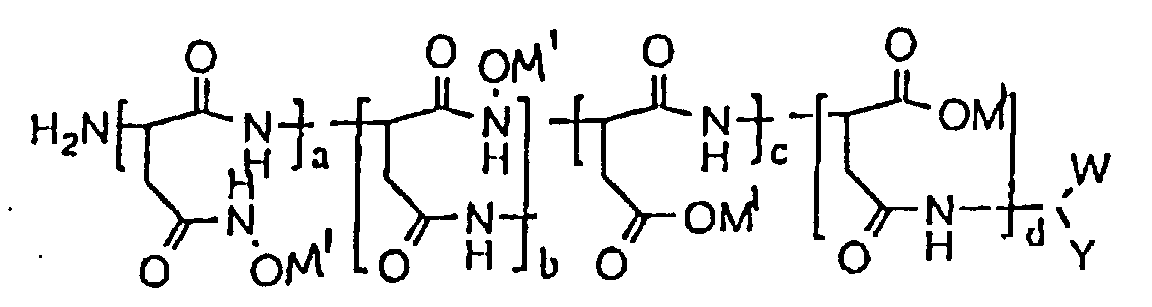
wherein W is selected from the group consisting of CO2M and CONHOH wherein M is a metal ion; Y is selected from the group consisting of CH2CONHOH and CH2CO2M wherein M is a metal ion; M1 is selected from the group consisting of an alkaline metal, an alkaline earth metal and ammonium; (a + b)/(a + b + c + d) x 100% + (c + d)/(a + b + c + d) x 100% = 100%; (a + b)/(a + b + c + d) x 100% ranges from about 0.1% to about 100%; (c + d)/(a + b + c + d ) x 100% ranges from 0% to 99.9%; a/(a + b) x 100% ranges from 0% to 100%; b/(a + b) x 100% ranges from 0% to 100%; c/(c + d) x 100% ranges from 0% to 100%; d/(c + d) x 100% ranges from 0% to 100%; and c/(c + d) x 100% + d/(c + d) x 100% = 100%.
wherein W is selected from the group consisting of CO2M and CONHOH wherein M is a metal ion; Y is selected from the group consisting of CH2CONHOH and CH2CO2M wherein M is a metal ion; M1 is selected from the group consisting of an alkaline metal, an alkaline earth metal and ammonium; (a + b)/(a + b + c + d) x 100% + (c + d)/(a + b + c + d) x 100% = 100%; (a + b)/(a + b + c + d) x 100% ranges from about 0.1% to about 100%; (c + d)/(a + b + c + d ) x 100% ranges from 0% to 99.9%; a/(a + b) x 100% ranges from 0% to 100%; b/(a + b) x 100% ranges from 0% to 100%; c/(c + d) x 100% ranges from 0% to 100%; d/(c + d) x 100% ranges from 0% to 100%; and c/(c + d) x 100% + d/(c + d) x 100% = 100%.
27. The method of claim 25, characterized in that the polymer has the formula
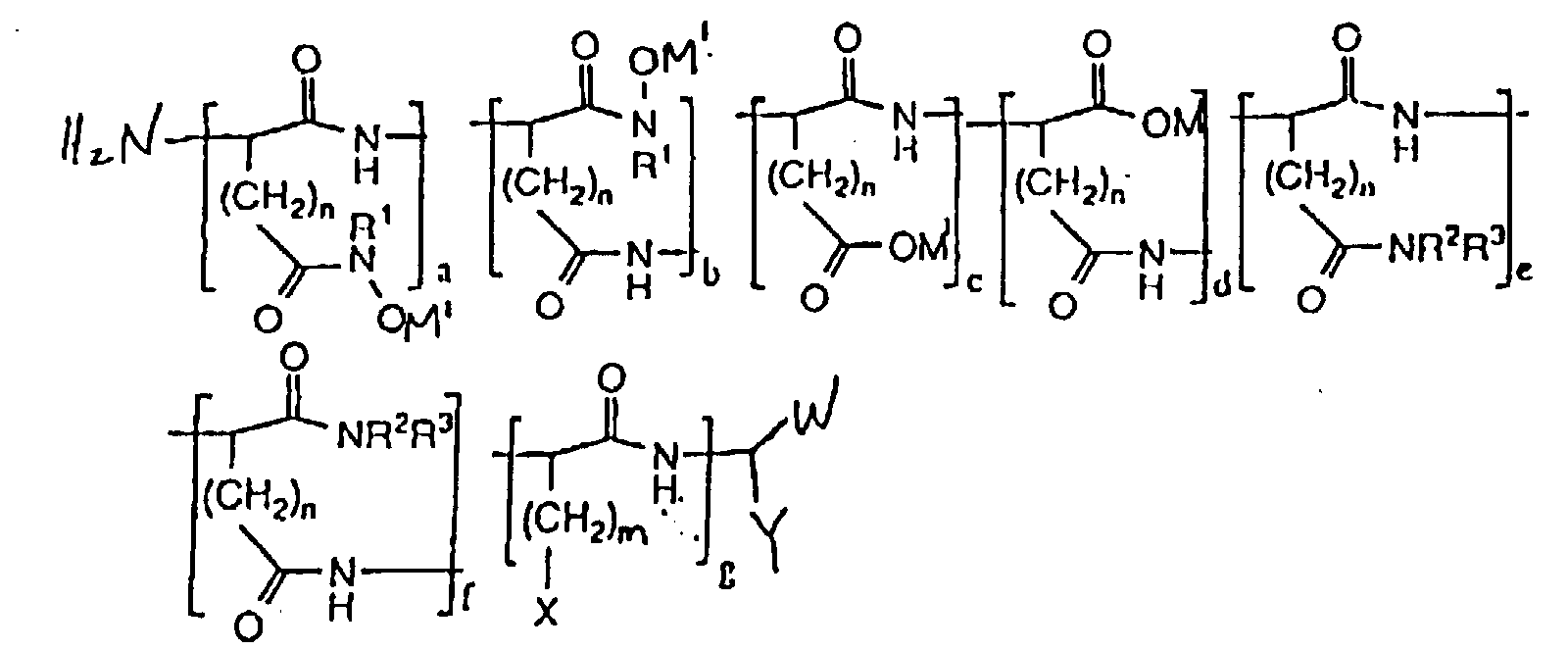
wherein n is selected from the group consisting of 1 and 2; m ranges from O to 4; M1 is selected from the group consisting of an alkaline metal, an alkaline earth metal, and ammonium; X is selected from the group consisting of H, CH3, CH(CH3)2, CH(CH3)CH2CH3, OH, p-HOC6H4, SH, CH2SCH3, CH2OH, CH(OH)CH3, NH2, HNC(:NH)NH2, C(O)NH2,
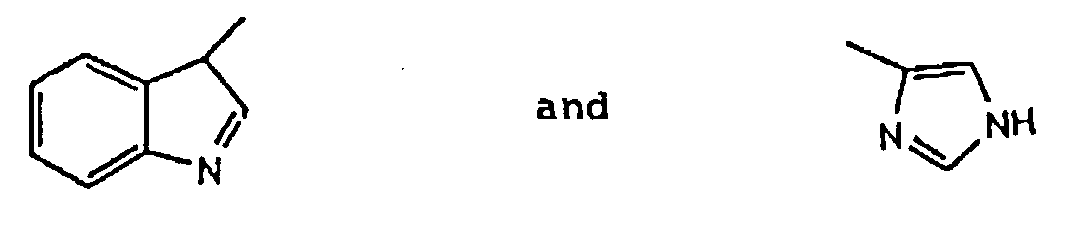
OPO3M2, OSO3M, p-M2O3POC6H4, p-MO3SOC6H4, SPO2M2, CH2OPO2M2, CH2OSO3M, CH(OPO3M2)CH3, CH(OSO3M)CH3, wherein M is a metal ion; W is selected from the group consisting of CO2M and C(O)NR1OH wherein M is a metal ion; Y is selected from the group consisting of (CH2)oC(O)NR1OH, (CH2)oCO2M, (CH2)oC(O)NR2R3 and (CH2)mX wherein m is a metal ion, o ranges from 1 to 2; R1 is selected from the group consisting of H, alkyl, alkenyl, aryl, carboxyl, sulfonyl, OH and halide substituted alkyl, alkenyl and aryl groups, and OR1 wherein R1 is selected from the group consisting of alkyl and aryl; R2 and R3 are selected from the group consisting of H, alkyl, alkenyl, aryl, carboxyl, sulfonyl, OH and halide substituted alkyl, alkenyl and aryl groups; (a + b)/(a + b + c + d) x 100% ranges from about 0.15 to about 100%; (c + d)/(a + b + c + d) x 100% ranges from 0% to 99.9%; (a + b)/(a + b + c + d) x 100% + (c + d)/(a + b + c + d) x 100% = 100%; (e + f)/(a + b + c + d + e + f + g) x 100% ranges from about 0% to about 50%; g/(a + b + c + d + e + f + g) x 100% ranges from about 0% to about 50%; (a + b + c + d)/(a + b + c + d + e + f + g) x 100% ranges from about 50% to about 100%; (a + b + c + d)/(a + b + c + d + e + f + g) x 100% + (e + f)/(a + b + c + d + e + f + g) x 100% + g/(a + b + c + d + e + f + g) x 100% = 100%; a/(a + b) x 100% ranges from 0% to 100%; b/(a + b) x 100% ranges from 0% to 100%; a/(a + b) x 100% + b/(a + b) x 100% = 100%; c/(c + d) x 100% ranges from 0% to 100%; d/(c + d) x 100% ranges from 0% to 100%; c/(c + d) x 100% + d/(c + d) x 100% = 100%; and e/(e + f) x 100% + f/(e + f) x 100% = 100%.
wherein n is selected from the group consisting of 1 and 2; m ranges from O to 4; M1 is selected from the group consisting of an alkaline metal, an alkaline earth metal, and ammonium; X is selected from the group consisting of H, CH3, CH(CH3)2, CH(CH3)CH2CH3, OH, p-HOC6H4, SH, CH2SCH3, CH2OH, CH(OH)CH3, NH2, HNC(:NH)NH2, C(O)NH2,
OPO3M2, OSO3M, p-M2O3POC6H4, p-MO3SOC6H4, SPO2M2, CH2OPO2M2, CH2OSO3M, CH(OPO3M2)CH3, CH(OSO3M)CH3, wherein M is a metal ion; W is selected from the group consisting of CO2M and C(O)NR1OH wherein M is a metal ion; Y is selected from the group consisting of (CH2)oC(O)NR1OH, (CH2)oCO2M, (CH2)oC(O)NR2R3 and (CH2)mX wherein m is a metal ion, o ranges from 1 to 2; R1 is selected from the group consisting of H, alkyl, alkenyl, aryl, carboxyl, sulfonyl, OH and halide substituted alkyl, alkenyl and aryl groups, and OR1 wherein R1 is selected from the group consisting of alkyl and aryl; R2 and R3 are selected from the group consisting of H, alkyl, alkenyl, aryl, carboxyl, sulfonyl, OH and halide substituted alkyl, alkenyl and aryl groups; (a + b)/(a + b + c + d) x 100% ranges from about 0.15 to about 100%; (c + d)/(a + b + c + d) x 100% ranges from 0% to 99.9%; (a + b)/(a + b + c + d) x 100% + (c + d)/(a + b + c + d) x 100% = 100%; (e + f)/(a + b + c + d + e + f + g) x 100% ranges from about 0% to about 50%; g/(a + b + c + d + e + f + g) x 100% ranges from about 0% to about 50%; (a + b + c + d)/(a + b + c + d + e + f + g) x 100% ranges from about 50% to about 100%; (a + b + c + d)/(a + b + c + d + e + f + g) x 100% + (e + f)/(a + b + c + d + e + f + g) x 100% + g/(a + b + c + d + e + f + g) x 100% = 100%; a/(a + b) x 100% ranges from 0% to 100%; b/(a + b) x 100% ranges from 0% to 100%; a/(a + b) x 100% + b/(a + b) x 100% = 100%; c/(c + d) x 100% ranges from 0% to 100%; d/(c + d) x 100% ranges from 0% to 100%; c/(c + d) x 100% + d/(c + d) x 100% = 100%; and e/(e + f) x 100% + f/(e + f) x 100% = 100%.