|
(11) | EP 0 824 119 B1 |

| (12) | EUROPEAN PATENT SPECIFICATION |
|
|
| (54) |
Radiation curable coatings Strahlungshärtbare Überzüge Revêtements durcissables à l'aide de radiation |
|
|
|||||||||||||||||||||||||||||||
| Note: Within nine months from the publication of the mention of the grant of the European patent, any person may give notice to the European Patent Office of opposition to the European patent granted. Notice of opposition shall be filed in a written reasoned statement. It shall not be deemed to have been filed until the opposition fee has been paid. (Art. 99(1) European Patent Convention). |
[0001] The present invention relates to radiation cured coatings which are useful for imparting improved weather resistance and abrasion resistance to solid substrates when applied and cured thereon. In particular, this invention relates to certain ultraviolet light absorbers contained in ultraviolet light cured coating formulations that provide the coatings with greatly improved resistance to microcracking and spontaneous delamination or chalking.
BACKGROUND OF THE INVENTION
[0002] Thermoplastic substrates such as polycarbonates and poly(methyl methacrylate) are generally characterized by their many advantageous properties which include clarity, high ductility, high heat deflection temperature, as well as dimensional stability. Many of these materials are transparent and are conventionally employed as replacements for glass in many commercial applications. However, such materials easily scratch and abrade, resulting in possible decrease in transparency. They often display low chemical solvent resistance and are susceptible to degradation by ultraviolet light. This results in unfavorable characteristics including yellowing and erosion of the substrate surface.
[0003] As a result, various methods to improve the weatherability and abrasion resistance of thermoplastic substrates have been developed. Such methods conventionally employ treating the thermoplastic substrate surface with a coating material, whereby the coating material typically contains ultraviolet light absorbing agents such as benzophenone and benzotriazole derivatives that decrease yellowing due to weathering conditions. The coating material may also contain a silicon compound for improved abrasion resistance. Coatings with increased abrasion resistance include so-called "silicone hardcoats", which are thermally cured, and silicon compound-containing compositions which are capable of being cured by radiation, such as ultraviolet (UV) radiation.
[0004] Ultraviolet light (i.e. radiation curable) curable abrasion resistant coating compositions are dispersions of hard colloidal silica filler in acrylic monomers which can be cured using a free radical type of photo initiator. The ultraviolet radiation-cured coating compositions are advantageous because of their short curing times. These coatings provide increased weatherability, or abrasion resistance or a combination of weatherability and abrasion resistance to the underlying thermoplastic substrate.
[0005] Many ultraviolet radiation-curable abrasion-resistant coatings are known in the art. U.S. Patent No. 4,455,205 discloses compositions comprising a silyl acrylate, aqueous colloidal silica, a photoinitiator and optionally a polyfunctional acrylate. Other materials which may be present include absorbers of ultraviolet radiation, employed as stabilizers, and hindered amines.
[0006] Other types of ultraviolet radiation-curable coating compositions are disclosed in U.S. Patent No. 4,486,504, which contain colloidal silica, a silyl acrylate, a polyfunctional acrylate and a photoinitiator. U.S. Patent No. 4,491,508 contains colloidal silica, a silyl acrylate, a polyfunctional acrylate and a photoinitiator. Both of these patents also disclose the optional presence of ultraviolet stabilizers or compounds convertible thereto. U.S. Patent No. 4,853,802 discloses coating compositions of essentially the same types further containing an ultraviolet radiation-absorbing amount of a dimeric benzotriazole compound as a stabilizer. Similar compositions employing acylphosphorous compounds such as 2,4,6-trimethylbenzoyldiphenylphosphine oxide are disclosed in U.S. Patent No. 5,162,390, which also discloses the use of benzotriazoles and benzophenones as ultraviolet stabilizers.
[0007] EP-A-0672732 discloses photostable polybenzoyl resorcinols capable of absorbing ultraviolet light which may be incorporated into polymer matrices to produce a coating material. The coating material may be employed as an ultraviolet protective layer for solid substrates and a primer for silicone hardcoats.
[0008] US-A-5391795 discloses silylated agents capable of absorbing ultraviolet light. The silylated agents are 4,6-dibenzoyl-2-(trialkoxysilylalkyl) resorcinols which are photostable and compatible in silicone hardcoat matrices.
[0009] Recently, it is becoming more and more common for thermoplastic substrates such as polycarbonate to be employed outdoors. It is thus important to impart weatherability properties on the ultraviolet radiation-curable coatings. Weather resistant coating systems can be prepared by incorporating ultraviolet absorbers, such as benzotriazoles and benzophenones, and hindered amine light stabilizers. However, prolonged exposure to sunlight, moisture and thermal cycling conditions can cause yellowing, delamination and formation of microcracks, decreasing transparency. These conditions are often noted in varying degrees in the compositions disclosed in the aforementioned patents, even when one of the properties mentioned is improved weatherability.
[0010] The instant invention, therefore, is directed to novel and improved ultraviolet light curable coatings, herein referred to as uv cured coatings, which are capable of absorbing ultraviolet light to increase the weathering characteristics of the coating. The instant invention further provides coating compositions that greatly improve weatherability of the coating and coated article by decreasing yellowing, delamination, and the formation of microcracks, as compared to presently known coatings being used for their weathering characteristics.
SUMMARY OF THE INVENTION
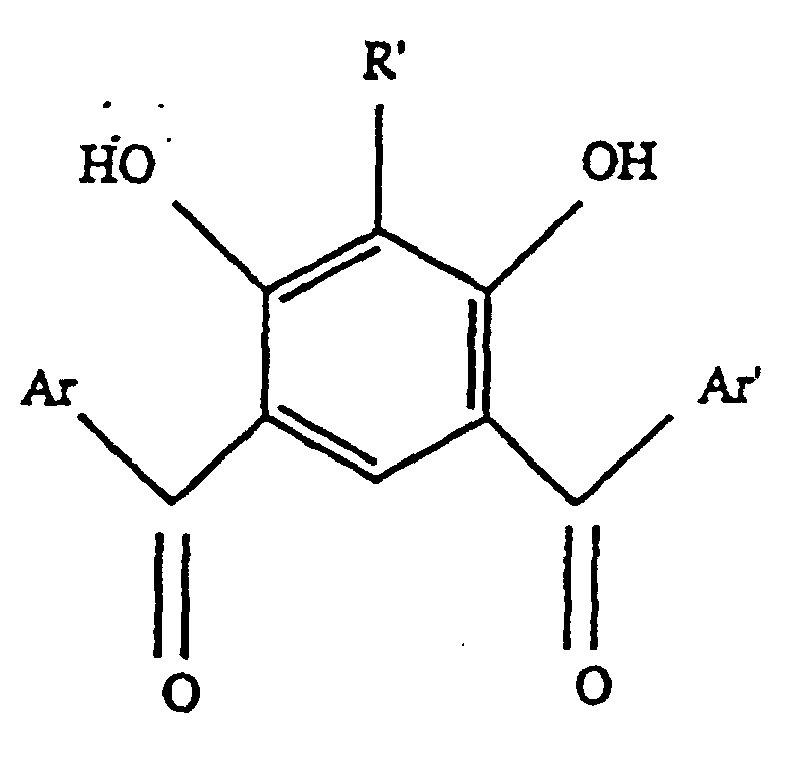
[0011] In a first aspect, the present invention provides a radiation curable coating composition comprising 5-40 weight% silyl acrylate modified colloidal silica, silica having an average particle size in the range of 15-30 nm where said silica is silane functionalized colloidal silica in hexanediol diacrylate, 50-90 weight% hexafunctional polyurethane acrylate, 0.5-5.0 weight% 2,4,6-trimethylbenzoyltriphenylphosphine oxide, 1-20 weight % UV absorber dibenzoyl resorcinol derivative having the formula
where Ar and Ar' are independently substituted or unsubstituted monocyclic or polycyclic aryl groups and R' is H or a linear or branched alkyl chain having less than about 10 carbons bearing a -Si(OR2)3, where R2 is a C1 to C6 alkyl group,
about 0.1-4.0 weight% hindered amine light stabilizer, and a surfactant or leveling agent, where said coating is diluted with an alcohol or a glycol ether type solvent or mixtures thereof.
[0012] A radiation curable coating generally is cured with ultraviolet light and can be referred to as a UV curable coating. Also, the dibenzoyl resorcinol derivative is often a 4,6-dibenzoyl-2-(3-trialkoxysilylalkyl) resorcinol and preferably 4,6-dibenzoyl-2-(3-triethoxysilylpropyl) resorcinol.
[0013] Coatings with silicon compounds and the UV light absorbers of the instant invention provide abrasion resistance and improved weatherability characteristics over coating compositions containing benzotriazoles and benzophenones as ultraviolet stabilizers.
[0014] In a second aspect of the instant invention, the above-described coating systems are applied to the surface of a solid substrate thus providing a coated solid substrate having improved weatherability, especially resistance to ultraviolet light. Such coated solid substrates may be thermoplastic substrates or weatherable substrates. The thermoplastic substrates that may be employed often include polymer substrates such as polycarbonates and polycarbonate blends, acrylic polymers including poly(methyl methacrylate), polyesters such as poly(ethylene terephathalate) and poly(butylene terephthalate), polyamides, polyimides, acrylonitrile-styrene copolymers, styrene-acrylonitrile-butadiene copolymers, polyvinyl chloride, polystyrene, blends of polystyrene and polyphenylene ethers, butyrates, polyethylene and the like. Thermoplastic substrates can be with or without pigments. Moreover, the solid substrates may also include metal substrates, painted surfaces, glass, ceramics, and textiles. However, the coating compositions of the instant invention are preferably employed to coat polycarbonates.
DESCRIPTION OF THE INVENTION
[0015] In the first aspect of the invention, there is provided a radiation curable coating composition comprising 5-40 weight% silyl acrylate modified colloical silica, silica having an average particle size in the range of 15-30 nm where said silica is silane functionalized colloidal silica in hexanediol diacrylate, 50-90 weight% hexafunctional polyurethane acrylate, 1a- 0.5-5.0 weight% 2,4,6-trimethylbenzoyltriphenylphosphine oxide, t4"·1-20 weight% W absorber dibenzoyl resorcinol derivative having the formula
where Ar and Ar' are independently substituted or unsubstituted monocyclic or polycyclic aryl groups and R' is H or a linear or branched alkyl chain having less than about 10 carbons bearing a -Si(OR2)3, where R2 is a Cl to C6 alkyl group,
about 0.1-4.0 weight% hindered amine light stabilizer, and a surfactant or leveling agent, where said coating is diluted with an alcohol or a glycol ether type solvent or mixtures thereof.
[0016] The viscosity of the discovered liquid coating composition may be adjusted by diluting it with either low viscosity monoacrylates or diacrylates as reactive dilutents or solvents or both. Other solvents may be used to adjust the viscosity of the coating, such as a mixture consisting of isopropanol and propylene glycol methyl ether. The viscosity of the coating composition is adjusted based on the method of the coating application.
[0017] The presence of the silicon compound serves to enhance the abrasion resistance of the coating in applications where scratch and mar resistance are of importance.
[0018] Silyl acrylate, is used to make silyl acrylate modified colloidal silica used in the invention. Suitable silyl acrylates include those of the formula
wherein R4 is hydrogen or methyl, R5 is C1-8 a...kylene, R6 is C1-13 alkyl or aryl, R7 is C1-8 alkyl and a is from 0 to 3. Especially preferred are acrylates wherein R4 is methyl, R5 is C2-4 alkylene and especially trimethylene, R7 is methyl and a is 0.
[0019] The 2,4,6-trimethylbenzoyldiphenylphosphine oxide is a photoinitiator and is available as Lucirin® TPO from BASF Corporation.
[0020] The ultraviolet light stabilizers are present in an amount effective to inhibit ultraviolet degradation of the type leading to microcrack formation, delamination and yellowing, but not effective to substantially inhibit ultraviolet-induced curing of the composition. A preferred UV stabilizer is 4,6-dibenzoyl-2-(3-triethoxysilylpropyl)resorcinol.
[0021] Hindered amine light stabilizers (HALS) may be any known hindered amine light stabilizer to one skilled in the art that has sufficiently low basicity so as to be compatible with the coating composition matrix. Examples include Tinuvin 123 (Ciba) and Sanduvor 3058 (Clariant). Other low basicity HALS are also expected to be effective in the coating compositions of this invention.
[0022] The silicon compound used in the coating formulations of this invention to provide abrasion resistance is a silyl acrylate modified silica, with silica having an average particle size in the range of 15-30 nm, corresponding to that of colloidal silica. Colloidal silica is a dispersion of submicron-sized silica particles in an aqueous or other solvent medium; silica concentrations therein are typically in the range of 15-50 weight percent. When an aqueous silica dispersion is employed in the preparation of the composition of this invention, hydrolysis of at least a portion of the Si-O bonds in the silyl acrylate (when a is less than 3) is possible or even likely. Therefore, the compositions of this invention may include those containing hydrolysis products of said silyl acrylate. An example of silyl acrylate modified colloidal silica is a commercial product that can be used in this invention is FCS100 manufactured by GE Silicones, which is about 50 weight percent silyl acrylate modified colloidal silica in hexanediol diacrylate monomer. Preparation methods are described in the U.S. patent 5,468,789.
[0023] Generally, the UV curable coating compositions of this invention can include surfactants, leveling agents or mixtures thereof. An example of a surfactant or leveling agent is Ebecryl 1360 a product of UCB Radcure Inc.
[0024] In general, the compositions of this invention contain 50-90 weight percent polyurethane acrylate monomer. The photoinitiator, generally comprises 0.5-5.0 weight percent, and the ultraviolet absorber, is most often employed in the amount of 1-20 percent. The hindered amine, is used in an amount of 0.1-4.0 weight percent of the composition. Silica acrylate about 5-40 weight percent of the composition.
[0025] The compositions of this invention may be prepared by simply blending the various reagents in the desired proportions. If solvents are present and/or colloidal silica is the source of the silicon compound, volatiles may be removed by conventional operations such as vacuum stripping. The composition may then be applied by conventional techniques such as dipping, brushing, roller coating or flow coating to the substrate, which is most often a polycarbonate, polyester or an acrylic resin such as poly(methyl methacrylate). The coating thus formed preferably has a thickness in the range of about 3-25 and typically about 10 microns.
[0026] Following application, the composition is cured by exposure to suitable ultraviolet radiation. Curing temperatures are not critical but may be within the range of about 25°-70°C. It is often convenient to employ a continuous line for coating and curing. Solid substrate articles coated with the compositions of this invention, as well as the curing products thereof, are other aspects of the invention.
[0027] The invention is illustrated by a series of examples in which ultraviolet light curable coating compositions were based on hexacrylate polyurethane, silyl acrylate modified colloidal silica, various UV absorbers, including particular dibenzoyl resorcinols and triazine absorbers and the traditional benzophenone and benzotriazole UV absorbers, a hindered amine light stabilizer, a surfactant, and photoinitiator. The viscosity of the compositions was adjusted by diluting with either monoacrylates as reactive dilutents or solvents or both.
EXAMPLES A-F
[0028] The coating compositions of examples A-F were based on a hexafunctional polyurethane acrylate (Ebecryl® 1290, UCB Radcure Inc.) which was mixed with 20 wt.% silyl acrylate modified colloidal silica in hexanediol diacrylate monomer (FCS100, GE Silicones), The product FCS100 is about 50 wt.% silyl acrylate modified colloidal silica in hexanediol diacrylate. Weather resistant compositions were formulated using a number of UV absorbers such as 2,4 dihydroxy benzophenone (DHBP), silanated hydroxybenzophenone (SHBP), benzotriazole (Cyagard® 5411, Cytec Industries Inc.), triazine (Tinuvin® 400, Ciba Geigy Corp.), 4,6-dibenzoylresorcinol (DBR), 4,6-dibenzoyl-2-(3-triethoxysilypropyl) resorcinol (SDBR) . In addition, the above compositions contained a hindered amine light stabilizer (Tinuvin® 123, Ciba Geigy Corp.) and a surfactant or leveling agent (Ebecryl® 1360, UCB Radcure Inc.). All compositions used 2, 4, 6-trimethylbenzoyldiphenyl phosphine oxide (Lucirin® TPO, BASF Co.) as a photoinitiator to produce cross-linked coatings. Further, the compositions were diluted with a solvent mixture consisting of isopropanol and propylene glycol methyl ether to adjust the application viscosity. Optionally, monoacrylate reactive diluents can be used to adjust the viscosity of coating compositions. The details of formulations are summarized in Table 1. All UV absorbers were used at 5.5 to 6 phr (parts per hundred resin solids) level where solids consisted of acrylic modified colloidal silica plus acrylate monomers.
The above compositions were flow coated on 10.16 cm x 15.24 cm x 0.32 cm (4" x 6" x 0.125") Lexan 9030® panels, subsequently air dried for 1 minute and dried in a convection oven for 4 minutes at 65°C to remove solvents. Coatings were cured using a UV processor equipped with two 300 watts 2.5 cm (inch) medium pressure mercury lamps by passing the coated panels under UV light six times at a conveyor belt speed of 12.7 cm/s (25 ft./min). in an air atmosphere. All compositions provided optically clear coatings. Cured coating thickness was about 10 to 15 µm (microns).
[0029] Coatings containing different UV absorbers were weathered in the xenon arc accelerated whatherometer. Optical properties such as % light transmission, % haze and yellowness index (YI) were measured periodically. Further, cross-hatch adhesion was evaluated using the tape pull test (3M) and coatings were visually examined for microcracking and spontaneous delamination or chalking. The weathering results for various failures are summarized in Table 2 in terms of the uv light exposure at 340 nm.
Table 2. Kanon-arc* Weathering Exposure to Fail (kJoule/m2 at 340 nm)
| Composition | UV Absorber | Microcracking | II > 5 | % Hazu > 10 | Dolamination or Chalking |
| A | DHBP | 3985 | 5180 | 6376 | 7976 |
| B | SHBP | 3188 | 4.4 at 4792 | % Haze 7.3 at 4782 | 4782 |
| C | Benzotriazole/ Benzophenone | 3985 | 5180 | 6376 | 7179 |
| D | Triazine | 7179 | 6777 | 7976 | > 10,000 |
| E | DBR | 4782 | 5579 | 6376 | 10,367 |
| F | SDBR | 8773 | 9171 | 9570 | 13,555 |
| *Atlas Ci35a Xenon Arc Weather-Ometer® Type 'S' borosilicate inner/outer filters. Irradiance level 0.77 W/m2 at 340 nm, black panel temperature 70-73° C, dry bulb temperature 45° C, 50% RH. Cycle consisted of 60 minutes light, 5 minutes dark, 15 minutes dark with water spray. Yellowness index (YI) and % haze values measured using Pacific-Scientific XL-935 colorimeter. |
1. A radiation curable coating composition comprising 5-40 weight% silyl acrylate modified
colloidal silica, silica having an average particle size in the range of 15-30 nm
where said silica is silane functionalized colloidal silica in hexanediol diacrylate,
50-90 weight% hexafunctional polyurethane acrylate, 0.5-5.0 weight% 2,4,6-trimethylbenzoyltriphenylphosphine
oxide, 1-20 weight% UV absorber dibenzoyl resorcinol derivative having the formula
where Ar and Ar' are independently substituted or unsubstituted monocyclic or polycyclic aryl groups and R' is H or a linear or branched alkyl chain having less than about 10 carbons bearing a -Si(OR2)3, where R2 is a C1 to C6 alkyl group,
about 0.1-4.0 weight% hindered amine light stabilizer, and a surfactant or leveling agent, where said coating is diluted with an alcohol or a glycol ether type solvent or mixtures thereof.
where Ar and Ar' are independently substituted or unsubstituted monocyclic or polycyclic aryl groups and R' is H or a linear or branched alkyl chain having less than about 10 carbons bearing a -Si(OR2)3, where R2 is a C1 to C6 alkyl group,
about 0.1-4.0 weight% hindered amine light stabilizer, and a surfactant or leveling agent, where said coating is diluted with an alcohol or a glycol ether type solvent or mixtures thereof.
2. A solid substrate coated with the composition of claim 1.
3. An article obtained by ultraviolet curing of the solid substrate according to claim
2.
1. Composition de revêtement, durcissable sous l'effet des rayonnements, comprenant :
5 à 40 % en poids de silice colloïdale modifiée par un acrylate de silyle, la silice ayant une taille moyenne de particule comprise dans l'intervalle allant de 15 à 30 nanomètres et ladite silice étant de la silice colloïdale fonctionnalisée par un silane, dans du diacrylate d'hexanediol,
50 à 90 % en poids de polyuréthane-acrylate hexafonctionnel,
0,5 à 5,0 % en poids d'oxyde de 2,4,6-triméthylbenzoyl-diphénylphosphine,
1 à 20 % en poids d'un agent absorbant les rayons UV, qui est un dérivé de dibenzoylrésorcinol de formule
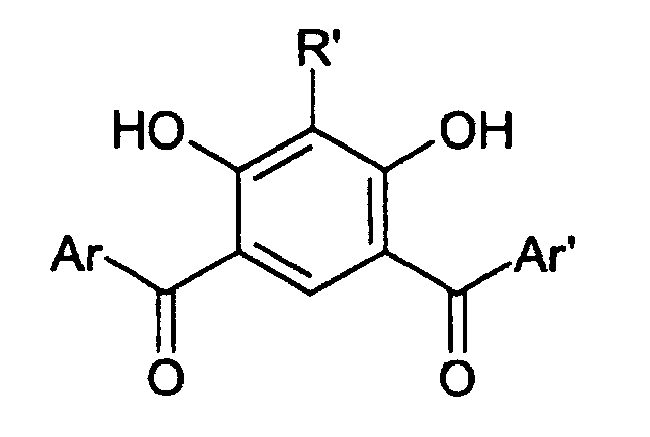
dans laquelle Ar et Ar' représentent chacun indépendamment un groupe aryle monocyclique ou polycyclique, substitué ou non-substitué, et R'représente un atome d'hydrogène ou un groupe alkyle, linéaire ou ramifié, ayant moins d'environ 10 atomes de carbone et portant un substituant -Si(OR2)3 où R2 représente un groupe alkyle en C1 à C6,
environ 0,1 à environ 4,0 % en poids d'un stabilisant vis-à-vis de la lumière, du type amine encombrée, et un tensioactif ou un agent d'égalisation,
ladite composition de revêtement étant diluée avec un solvant du type alcool ou éther de glycol ou un mélange de ces produits.
5 à 40 % en poids de silice colloïdale modifiée par un acrylate de silyle, la silice ayant une taille moyenne de particule comprise dans l'intervalle allant de 15 à 30 nanomètres et ladite silice étant de la silice colloïdale fonctionnalisée par un silane, dans du diacrylate d'hexanediol,
50 à 90 % en poids de polyuréthane-acrylate hexafonctionnel,
0,5 à 5,0 % en poids d'oxyde de 2,4,6-triméthylbenzoyl-diphénylphosphine,
1 à 20 % en poids d'un agent absorbant les rayons UV, qui est un dérivé de dibenzoylrésorcinol de formule
dans laquelle Ar et Ar' représentent chacun indépendamment un groupe aryle monocyclique ou polycyclique, substitué ou non-substitué, et R'représente un atome d'hydrogène ou un groupe alkyle, linéaire ou ramifié, ayant moins d'environ 10 atomes de carbone et portant un substituant -Si(OR2)3 où R2 représente un groupe alkyle en C1 à C6,
environ 0,1 à environ 4,0 % en poids d'un stabilisant vis-à-vis de la lumière, du type amine encombrée, et un tensioactif ou un agent d'égalisation,
ladite composition de revêtement étant diluée avec un solvant du type alcool ou éther de glycol ou un mélange de ces produits.
2. Support solide revêtu de la composition selon la revendication 1.
3. Article obtenu par durcissement au moyen des rayons UV du support solide selon la
revendication 2.
1. Eine strahlungshärtbare Überzugszusammensetzung aufweisend 5 - 40 Gew.-% Silylacrylat
modifizierte kolloidale Kieselsäure, wobei die Kieselsäure eine Durchschnittspartikelgröße
im Bereich von 15 - 30 nm hat, wobei die Kieselsäure Silan funktionalisierte kolloidale
Kieselsäure in Hexandioldiacrylat ist, 50 - 90 Gew.-% hexa-funktionales Polyurethanacrylat,
0,5 - 5,0 Gew.-% 2,4,6-Trimethylbenzoyltriphenylphosphinoxid, 1 - 20 Gew % UV Absorber
Dibenzoylresorcin Derivat mit der Formel
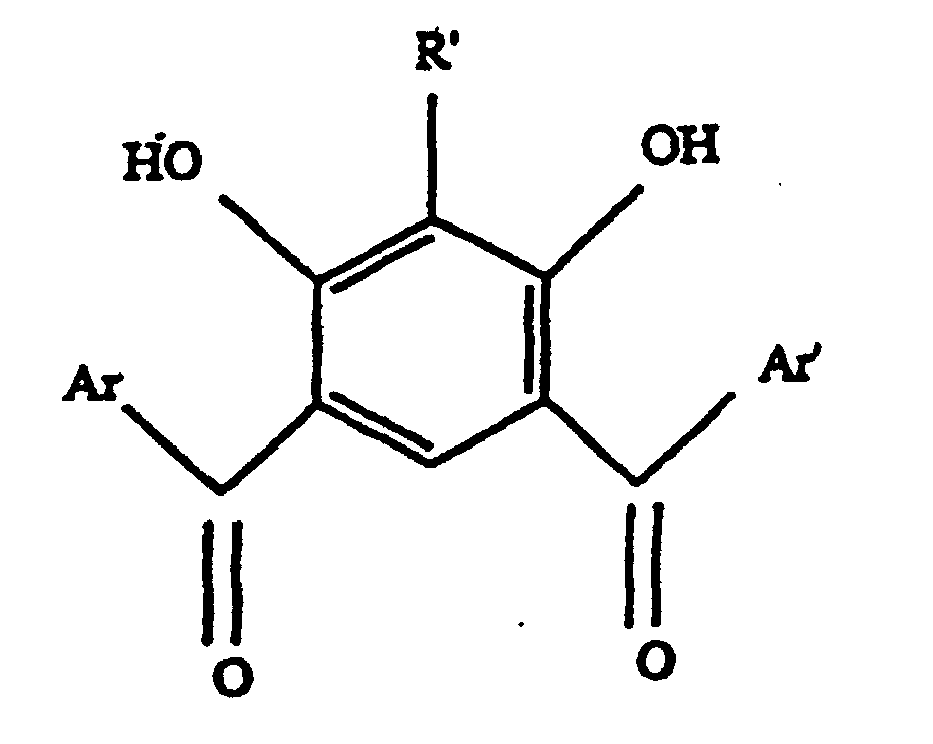
worin Ar und Ar' unabhängig substituierte oder unsubstituierte monozyklische oder polyzyklische Arylgruppen sind und R' H ist oder eine lineare oder verzweigte Alkylkette, welche weniger als etwa 10 Kohlenstoffe hat, die ein -Si (OR2)3 tragen, worin R2 eine C1 bis C6 Alkylgruppe ist,
etwa 0,1 - 4,0 Gew.% eines gehinderten Amins als Lichtstabilisator, und ein Tensid oder Verlaufsmittel, worin der Überzug mit einem Alkohol oder einem Lösungsmittel vom Glykolethertyp oder Mischungen daraus, verdünnt ist.
worin Ar und Ar' unabhängig substituierte oder unsubstituierte monozyklische oder polyzyklische Arylgruppen sind und R' H ist oder eine lineare oder verzweigte Alkylkette, welche weniger als etwa 10 Kohlenstoffe hat, die ein -Si (OR2)3 tragen, worin R2 eine C1 bis C6 Alkylgruppe ist,
etwa 0,1 - 4,0 Gew.% eines gehinderten Amins als Lichtstabilisator, und ein Tensid oder Verlaufsmittel, worin der Überzug mit einem Alkohol oder einem Lösungsmittel vom Glykolethertyp oder Mischungen daraus, verdünnt ist.
2. Ein festes Substrat überzogen mit der Zusammensetzung aus Anspruch 1.
3. Ein Gegenstand erhalten durch ultraviolettes Härten des festen Substrats gemäß Anspruch
2.