(57) A Virtual Path Group (VPG) technique that utilizes network elements (NEs), i.e.,
nodes, that are visible to ATM specific defects, and allows for fast ATM virtual connection/restoration
with a minimum of processing. This is realized by employing a Virtual Path Group transport
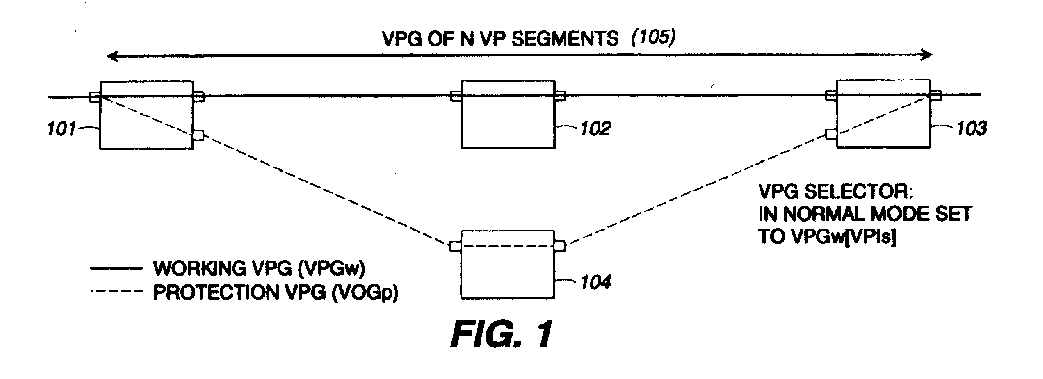
architecture comprises at least one (1) working route, one (1) protection route, and
VPG bridge and selector functions at each end of the routes. It is applicable to 1+1,
mesh and ring protection switching and is extensible to any virtual connection segment
or end-to-end network (cross-subnetwork) virtual connections, and extensible to 1:1
and M:N protection switching. Additionally, the protection switching arrangement of
the invention includes an architecture for the Virtual Path Group (VPG) concept in
which the associations among individual ATM virtual channels (VP/VCs) and VPGs are
maintained entirely within the network element management function. This allows VPG
support to be added to ATM systems and networks with minimum change from current ATM
standards. In particular, no changes are required to the Virtual Path Identifier/Virtual
Channel Identifier (VPI/VCI) addresses carried within each ATM cell across ATM interfaces.
Further, defect type indication is realized via a new, for example a F4, segment level
Operation and Maintenance (OAM) cell, to initiate the appropriate restoration action
downstream. The technique differentiates between physical layer and ATM layer defects.
An algorithm is employed in an embodiment of the invention to determine appropriate
VPG protection switch and signaling actions, driven by the F4 defect type OAM cells.
Moreover, for interworking with physical layer protection (e.g. SONET Bi-Directional
Line Switched Ring (BLSR)), a VPG protection holdoff function is employed at the VPG
protection selector. A technical advantage of this protection switching invention
is that it provides extremely fast protection switching of an extremely large number
of ATM virtual connections.
|
|
