|
(11) | EP 0 824 350 B1 |

| (12) | EUROPEAN PATENT SPECIFICATION |
|
|
| (54) |
USE OF AN ANTIFUNGAL COMPOSITION VERWENDUNG EINES ANTIMYKOTIKUM UTILISATION D'UNE COMPOSITION ANTIFONGIQUE |
|
|
|||||||||||||||||||||||||||||||
| Note: Within nine months from the publication of the mention of the grant of the European patent, any person may give notice to the European Patent Office of opposition to the European patent granted. Notice of opposition shall be filed in a written reasoned statement. It shall not be deemed to have been filed until the opposition fee has been paid. (Art. 99(1) European Patent Convention). |
[0001] The present invention relates to the treatment of human mycotic infections. It relates to antifungal compositions for use in the treatment of mycotic infections caused by azole resistant yeast strains, comprising terbinafine with an azole 14α-methyldemethylase inhibitor such as the azole fluconazole and/or itraconazole.
[0002] Although they are often present as benign commensal organisms in the digestive tract of healthy individuals, fungi, particularly Candida species produce a broad range of serious illnesses in compromised hosts. Such infections are clearly on the rise. Oropharyngeal candidiasis is the most common fungal infection in patients with human immunodeficiency virus (HIV) infection. With the introduction of azole antifungal agents that are bioavailable after oral administration, the approach to the treatment of serious Candida infections is possible. Ketoconazole, the first of these agents to become available, was quickly found to be efficacious in the setting of chronic mucocutaneous candidiasis. However, not long after the introduction of this agent, clinical failure in association with elevated minimum inhibitory concentrations (MICs) of ketoconazole that developed during prolonged therapy were reported. This problem achieved prominence with the subsequent introduction of fluconazole. Fluconazole, a water-soluble triazole with greater than 90 % bioavailability after oral administration, is used extensively to treat a wide range of Candida infections. In particular, it is widely used as therapy for oropharyngeal candidiasis in patients with advanced HIV infection and AIDS. Although oropharyngeal candidiasis usually responds readily to fluconazole, it is difficult to completely eradicate the infection and relapse often occurs within several months following the completion of therapy. For this reason, many AIDS patients receive fluconazole either continuously on intermittently over long periods of time.
To a greater extent than with other azoles, resistance to fluconazole has developed and is becoming a significant clinical problem, as attested by isolation from, in particular, AIDS patients of numerous Candida strains showing resistance (see e.g. D. Law et al., J.Antimicrob.Chemother. 34 [1994] 659-668).
[0003] It has now been found that, surprisingly, a combination of the squalene epoxidase inhibitor terbinafine (Lamisil®) and an azole 14α-methyldemethylase inhibitor such as fluconazole and/or itraconazole is active against azole-resistant fungal strains.
[0004] Suitable azole 14α-methyldemethylase inhibitors are in particular imidazole and triazole antifungal agents.
Preferred imidazole antifungal agents include clotrimazole (Arzneim.-Forsch. 22 [1972] 1280), miconazole (Arzneim.-Forsch. 21 [1971] 256; econazole (Arzneim.-Forsch. 25 [1975] 224); isoconazole (Arzneim.-Forsch. 29 [1979] 1344); trioconazole (Antimicrobial Agents Chemotherapy 15 [1979] 597-602); sulconazole (Eumycetes and Mycosis 23 [1982] 314-317; oxiconazole (Arzneim.-Forsch. 32 [1982] 17-24); cloconazole (J.Med.Chem. 26 [1983] 768-770]); bifonazole (Arzneim.-Forsch. 33 [1983] 517-524); butoconazole (J.Med.Chem. 21 [1978] 840; fenticonazole (Arzneim.-Forsch. 31 [1981] 2127); zinoconazole (J.Med.Chem. 26 [1983] 442-445) and ketoconazole (J.Med.Chem. 22 [1979] 1003-1005).
Preferred triazole antifungal agents include terconazole (J.Med.Chem. 26 [1983] 611-613); itraconazole (Antimicrobial Agents and Chemotherapy 26 [1984] 5-9); vibunazole (Arzneim.-Forsch. 33 [1983] 546); fluconazole (Antimicrobial Agents and Chemotherapy 27 [1985] 815-818), and (R)(-)-α-(4-chlorophenyl)-α-(1-cyclopropyl-1-methyl-ethyl)-1H-1,2,4-triazol-1-ethanol in free form or in salt or metal complex form (GB 2'161'483) (hereinafter briefly referred to, in free form, as "compound A").
Especially preferred azoles are itraconazole and fluconazole.
[0005] Not all combinations of antifungal drugs show synergistic or even additive effects, and even antagonistic effects have been reported in the literature. Thus in e.g. E. Martin et al., Antimicr. Agents and Chemother. 38 [1994] 1331-1338, it has been reported that fluconazole antagonizes the candidacidal action of amphotericin B; in Abstr. Ann. Meeting Am. Soc. Microbiol. 87 (1987) 392 it was reported that the use of terbinafine and ketoconazole in Candida albicans produced no enhancement of antimycotic activity; in Eur. J. Clin. Microbiol. Infect. Dis. 7 (1988) 732-735 it was stated that in vitro terbinafine appears to act antagonistically with the azoles; and in Drugs Today 24 (1988) 705-715 it is again mentioned that in combination therapy, not all combinations of antifungal drugs show synergistic or even additive effects.
It appears therefore that combination therapy with antimycotics is highly unpredictable.
Thus, while one might on theoretical grounds expect that combinations of pharmacologically active agents that inhibit a single biosynthetic pathway at two separate steps are normally more active than those which act only on one step, and that combinations of e.g. terbinafine with azoles such as fluconazole and/or itraconazole should possess at least additive activity, it is very surprising that, for unknown reasons, such combinations are still effective even where resistance to the azoles has already developed, namely, synergistic effects are maintained even in situations where the mycotic strains have become resistant to the azoles.
[0006] The composition for treating human mycotic infections caused by azole-resistant fungal strains comprises an azole 14α-methyldemethylase inhibitor such as fluconazole and/or itraconazole, and the arylmethylamine squalene epoxidase inhibitor terbinafine of formula
in free base or acid addition salt, e.g. hydrochloride acid addition salt form.
The most preferred azole is fluconazole. Terbinafine preferably is in pharmaceutically acceptable, preferably in hydrochloride salt form. The preferred fungus preferably is a yeast, if preferably is of the genus Candida, it especially is Candida albicans. The azole-resistance induced mycosis may be superficial or systemic, it especially is oropharyngeal. It is deleterious to e.g. the skin or mucosa.
The azole-resistance may be a cross-resistance and involve multiple azoles.
The antifungal composition of the present invention is prepared by incorporating the arylmethylamine of formula I to an azole 14α-methyldemethylase inhibiting antifungal agent, such as fluconazole and/or itraconazole.
[0007] The invention thus concerns the use of an antifungal composition comprising terbinafine as defined above in combination with an azole 14α-methyldemethylase inhibitor, such as fluconazole and/or itraconazole, in the preparation of a medicament for use in the treatment of mycotic infections caused by azole-resistant fungal strains.
[0008] In the antifungal composition the weight ratio of the azole antifungal agent to the arylmethylamine antifungal agent may be varied within a wide range, but is preferably within a range of from 100:1 to 1:500, more preferably from 25:1 to 1:125. By mixing the azole antifungal agent and the arylmethylamine antifungal agent terbinafine in a weight ratio within the above range, an excellent effect is obtainable in the treatment of mycosis caused by azole resistant fungal strains, particularly yeast strains, e.g. Candida strains such as Candida albicans, Candida (= Torulopsis) glabrata, Candida krusei and Candida tropicalis; Cryptococcus strains such as Cryptococcus neoformans; or Trichophyton strains, e.g. Trichophyton mentagrophytes; especially Candida strains, particularly Candida albicans.
[0009] The composition can be adapted for local administration and can be incorporated in a usual pharmaceutical carrier in a wide range of concentrations (usually in an amount of from about 0.1 % to about 10 % by weight of the total composition) to prepare a formulation. The composition can be used for oral administration in the form of tablets, capsules or a liquid, and it may also be used for non-oral administration such as subcutaneous, intramuscular or intravenous injection. It thus normally is a fixed combination. However, administration of the active agents may also be effected in the form of a free combination, i.e. separately, e.g. sequentially, in any order.
[0010] The beneficial activity can be shown in vitro using various azole-resistant strains. The assay is performed with RPMI 1640 medium in 96-well, flat-bottom microdilution plates using a chequered drug dilution system. Terbinafine (in hydrochloride salt form) and the azole are used in concentrations from 100 µg/ml to 0.006 µg/ml. Minimal inhibitory concentrations (MIC) are determined after a 48-hour incubation at 37°C. Minimal fungicidal (MFC) concentrations are evaluated 24 hours after transfer of drug-treated cells to drug-free medium. The endpoints used for MIC determination are either 100 % inhibition (Tables 1 and 4) or (as is usual) 80 % inhibition (Tables 2 and 3) (Terb = terbinafine; Flu = fluconazole; Itra = itraconazole; C. = Candida).
Table 1
| In vitro testing of the combination terbinafine/fluconazole against fluconazole-resistant strains of Candida albicans, C. glabrata, C. krusei and C. tropicalis. | ||||
| Strain | MIC for 100 % inhibition (µg/ml) | |||
| Alone | Combination | |||
| Terb | Flu | Terb | Flu | |
| C.albicans | >100 | >100 | 12.5 | 6.25 |
| C.albicans | >100 | >100 | 12.5 | 12.5 |
| C.albicans | >100 | >100 | 12.5 | 6.25 |
| C.albicans | >100 | >100 | 3.13 | 12.5 |
| C.tropicalis | >100 | >100 | >100 | >100 |
| C.glabrata | >100 | >100 | 3.13 | 25.0 |
| C.albicans | >100 | >100 | 3.13 | 50.0 |
| C.krusei | >100 | 50.0 | 3.13 | 50.0 |
[0011] In contrast to exposure of fungi to fluconazole or terbinafine alone, fungal growth was 100 % inhibited in all but one strain when combinations of fluconazole and terbinafine were used. In four of the strains, combinations of both drugs at concentrations <100 µg/ml were fungicidal in action, a result which could not be achieved with either of the drugs alone.
Table 2
| In vitro testing of the combination terbinafine/fluconazole against fluconazole-resistant Candida isolates | ||||
| Strain | MIC for 80% inhibition (µg/ml) | |||
| Alone | Combination | |||
| Flu | Terb | Flu | Terb | |
| C.albicans | >16 | >1 | 0.25 | 0.1 |
| C.albicans | >16 | >1 | 16 | 0.5 |
| C.tropicalis | >16 | >1 | >0.125 | 0.06 |
| C.glabrata | >16 | >1 | 16 | 0.125 |
Table 3
| In vitro testing of the combination terbinafine/itraconazole against itraconazole-resistant Candida isolates | ||||
| Strain | MIC for 80% inhibition (µg/ml) | |||
| Alone | Combination | |||
| Itra | Terb | Itra | Terb | |
| C.albicans | >4 | >1 | ≤0.03 | 0.03 |
| C.tropicalis | >4 | >1 | ≤0.03 | 0.03 |
Table 4
| In vitro testing of the combination terbinafine/compound A against fluconazole-resistant Candida isolates | ||||
| Strain | MIC for 100 % inhibition (µg/ml) | |||
| Alone | Combination | |||
| Compound A | Terb | Compound A | Terb | |
| C.albicans | >100 | >100 | 0.4 | 3.13 |
| C.albicans | 100 | >100 | 0.4 | 3.13 |
| C.albicans | 100 | >100 | 1.56 | 3.13 |
| C.albicans | 100 | >100 | 0.8 | 3.13 |
Table 5
| Summary of azole-resistant fungal strains in which a combination of terbinafine and an azole was found active and the azole to which resistance occurred | ||
| Fungal species | Azole | Proportion of strains showing activity |
| C. albicans | Fluconazole | 5 of 10 |
| C. albicans | Itraconazole | 9 of 10 |
| C. tropicalis | Fluconazole | 2 of 2 |
| C. krusei | Fluconazole | 1 of 4 |
| C. paratropicalis | Fluconazole | 1 of 1 |
| C. glabrata | Fluconazole | 1 of 2 |
| Cryptococcus neoformans | Fluconazole | 3 of 10 |
| C.albicans | Compound A | 4 of 4 |
1. Use of an antifungal composition comprising terbinafine of formula I
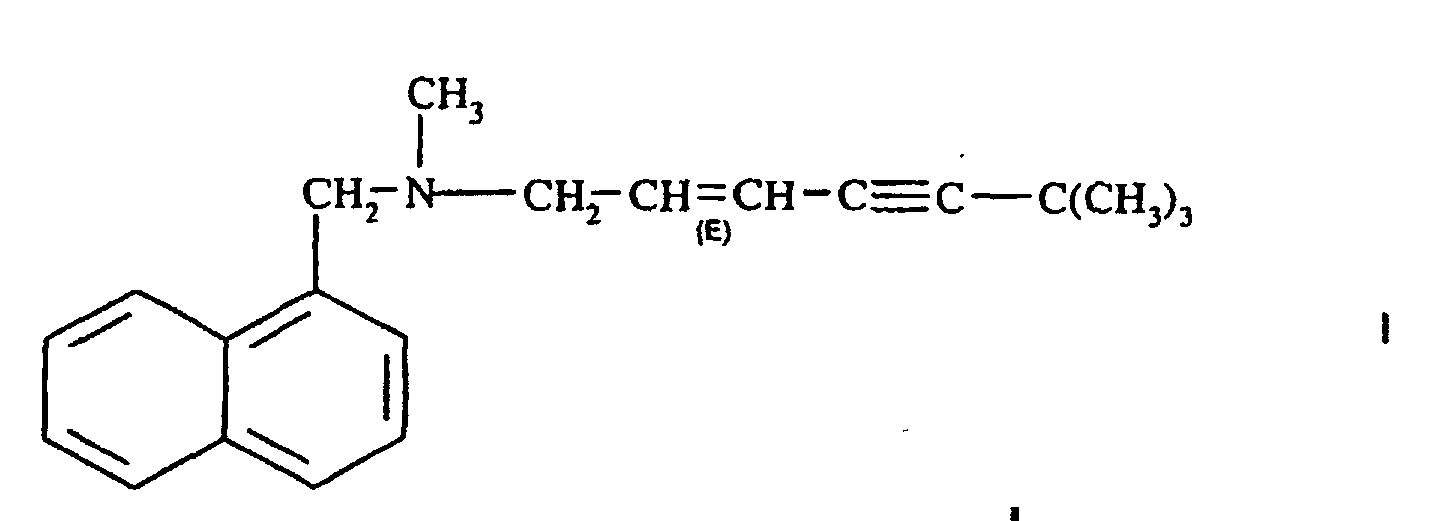
in free base or acid addition salt form in combination with an azole 14α-methyldemethylase inhibitor in the preparation of a medicament for use in the treatment of mycotic infections caused by azole-resistant fungal strains.
in free base or acid addition salt form in combination with an azole 14α-methyldemethylase inhibitor in the preparation of a medicament for use in the treatment of mycotic infections caused by azole-resistant fungal strains.
2. A use, according to claim 1 wherein terbinafine is in the form of the hydrochloride
salt.
3. A use, according to claim 1 wherein the azole is fluconazole.
4. A use, according to claim 1 wherein the azole is (R)-(-)-α-(4-chlorophenyl)-α-(1-cyclopropyl-1-methylethyl)-1H-1,2,4-triazol-1-ethanol
in free form or in salt or metal complex form.
1. Verwendung einer antimykotischen Zusammensetzung, die Terbinafin der Formel I
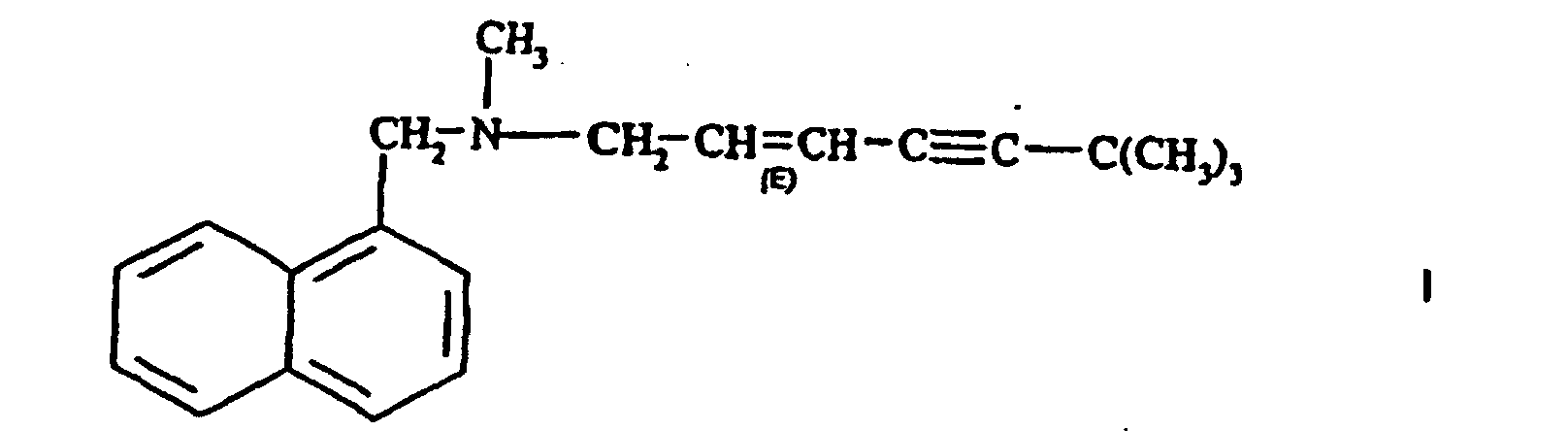
in Form der freien Base oder in Säureadditionssalzform
in Kombination mit einem Inhibitor der Azol-14α-methyldemethylase zur Herstellung eines Arzneimittels zur Verwendung bei der Behandlung von Pilzinfektionen umfaßt, die durch Azol-resistente Pilzstämme verursacht werden.
in Form der freien Base oder in Säureadditionssalzform
in Kombination mit einem Inhibitor der Azol-14α-methyldemethylase zur Herstellung eines Arzneimittels zur Verwendung bei der Behandlung von Pilzinfektionen umfaßt, die durch Azol-resistente Pilzstämme verursacht werden.
2. Verwendung nach Anspruch 1, worin Terbinafin in Form des Hydrochloridsalzes vorliegt.
3. Verwendung nach Anspruch 1, worin das Azol Fluconazol ist.
4. Verwendung nach Anspruch 1, worin das Azol (R)-(-)-α-(4-Chlorphenyl)-α-(1-cyclopropyl-1-methylethyl)-1H-1,2,4-triazol-1-ethanol
in freier Form oder in Salz- oder Metallkomplexform ist
1. Utilisation d'une composition antifongique comprenant de la terbinafine de formule
I :
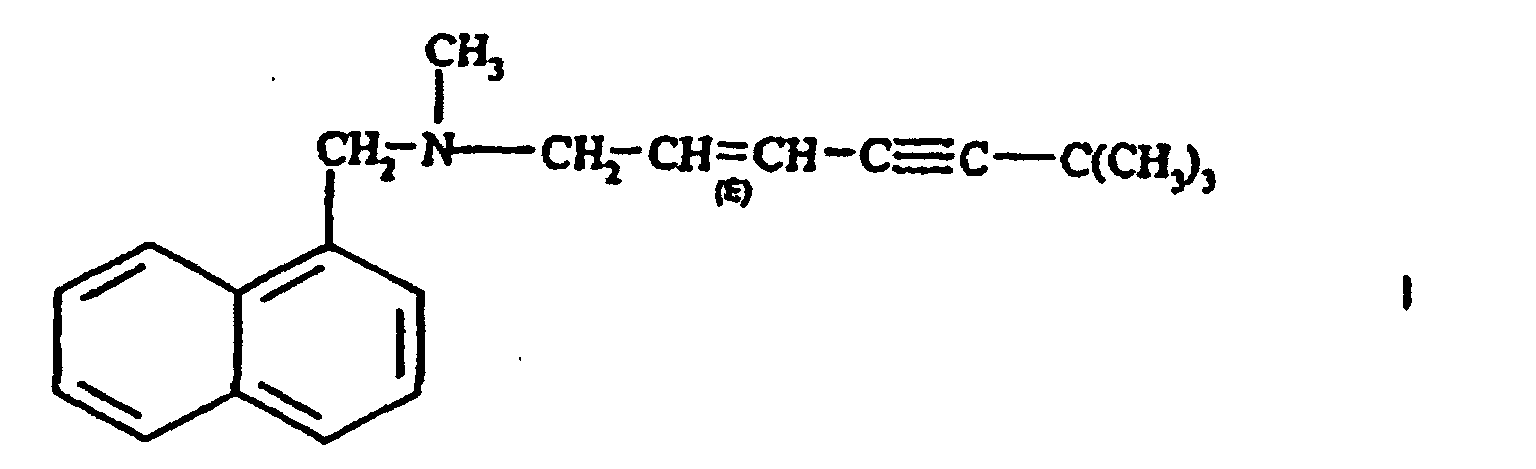
sous forme de base libre ou sous forme d'un sel d'addition d'acide, en combinaison avec un inhibiteur d'azole-14α-méthyldéméthylase, dans la préparation d'un médicament à utiliser dans le traitement d'infections mycotiques provoquées par des souches fongiques résistantes aux azoles.
sous forme de base libre ou sous forme d'un sel d'addition d'acide, en combinaison avec un inhibiteur d'azole-14α-méthyldéméthylase, dans la préparation d'un médicament à utiliser dans le traitement d'infections mycotiques provoquées par des souches fongiques résistantes aux azoles.
2. Utilisation selon la revendication 1, dans laquelle la terbinafine est sous forme
du sel consistant en chlorhydrate.
3. Utilisation selon la revendication 1, dans laquelle l'azole est le fluconazole.
4. Utilisation selon la revendication 1, dans laquelle l'azole est le (R)-(-)-α-(4-chlorophényl)-α-(1-cyclopropyl-1-méthyléthyl)-1H-1,2,4-triazol-1-éthanol
sous forme libre ou sous forme d'un sel ou d'un complexe métallique.