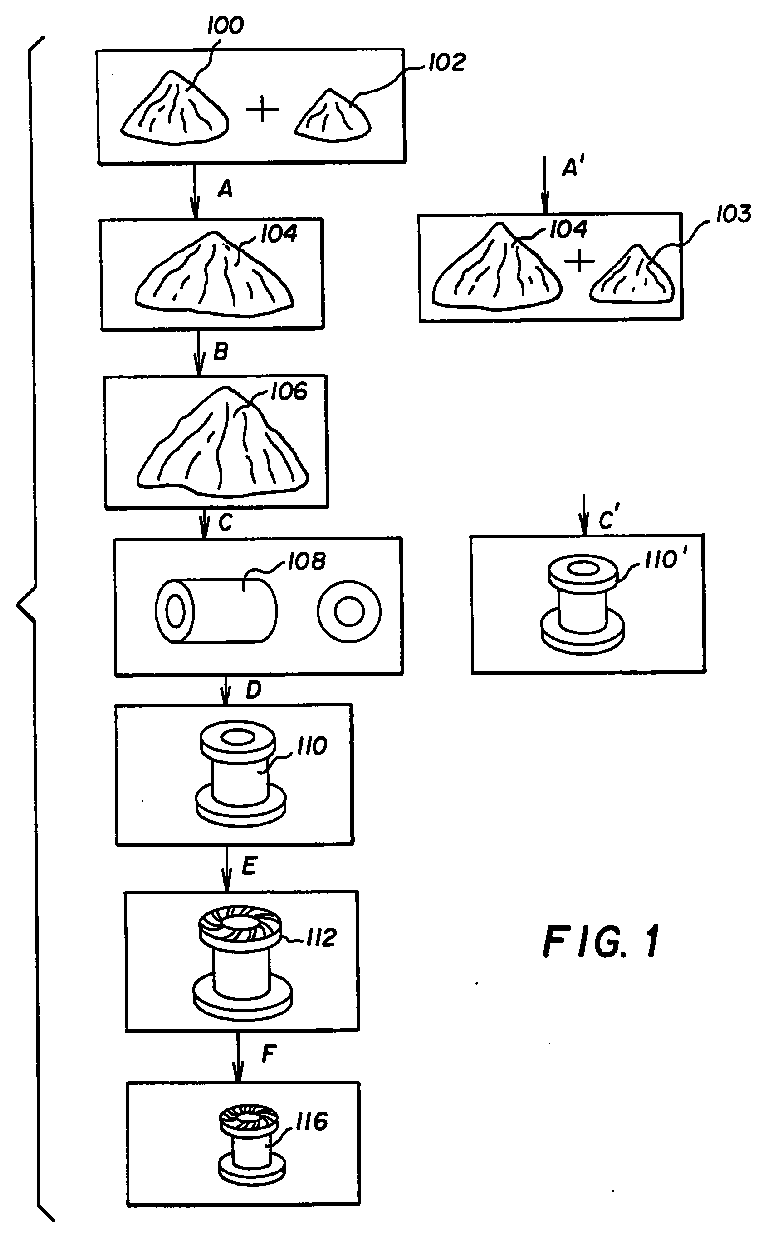
(57) A method of making a hydrodynamic ceramic bearing includes the steps of providing
ceramic powder comprising a first concentration of particulate aluminum oxide and
a second concentration of particulate zirconium oxide alloy. The zirconium oxide alloy
consists essentially of zirconium oxide and a secondary oxide selected from the group
consisting of MgO, CaO, Y2O3, Sc2O3, and rare earth oxides. The zirconium oxide alloy has a concentration of the secondary
oxide of, in the case of Y2O3, about 0.5 to about 5 mole percent; in the case of MgO, about 0.1 to about 1.0 mole
percent, in the case of CeO2, about 0.5 to about 15 mole percent, in the case of Sc2O3, about 0.5 to about 7.0 mole percent and in the case of CaO from about 0.5 to about
5 mole percent, relative to the total of the zirconium oxide alloy, the compacting
further comprising forming a blank. A mold is provided for receiving and processing
the ceramic powder thereby forming a ceramic billet. Shaping of the ceramic billet
is undertaken to form a near net-shaped ceramic bearing. Thereafter, the near net-shaped
ceramic bearing is sintered resulting in a sintered ceramic bearing. After sintering,
the ceramic bearing is further shaped or machined. After forming the ceramic bearing,
at least two air inlet ports are formed in the body portion of the bearing in fluid
communication with air channels having preferably a spiral pattern formed in at least
one flange portion of the bearing.
|
|
