| (19) |
 |
|
(11) |
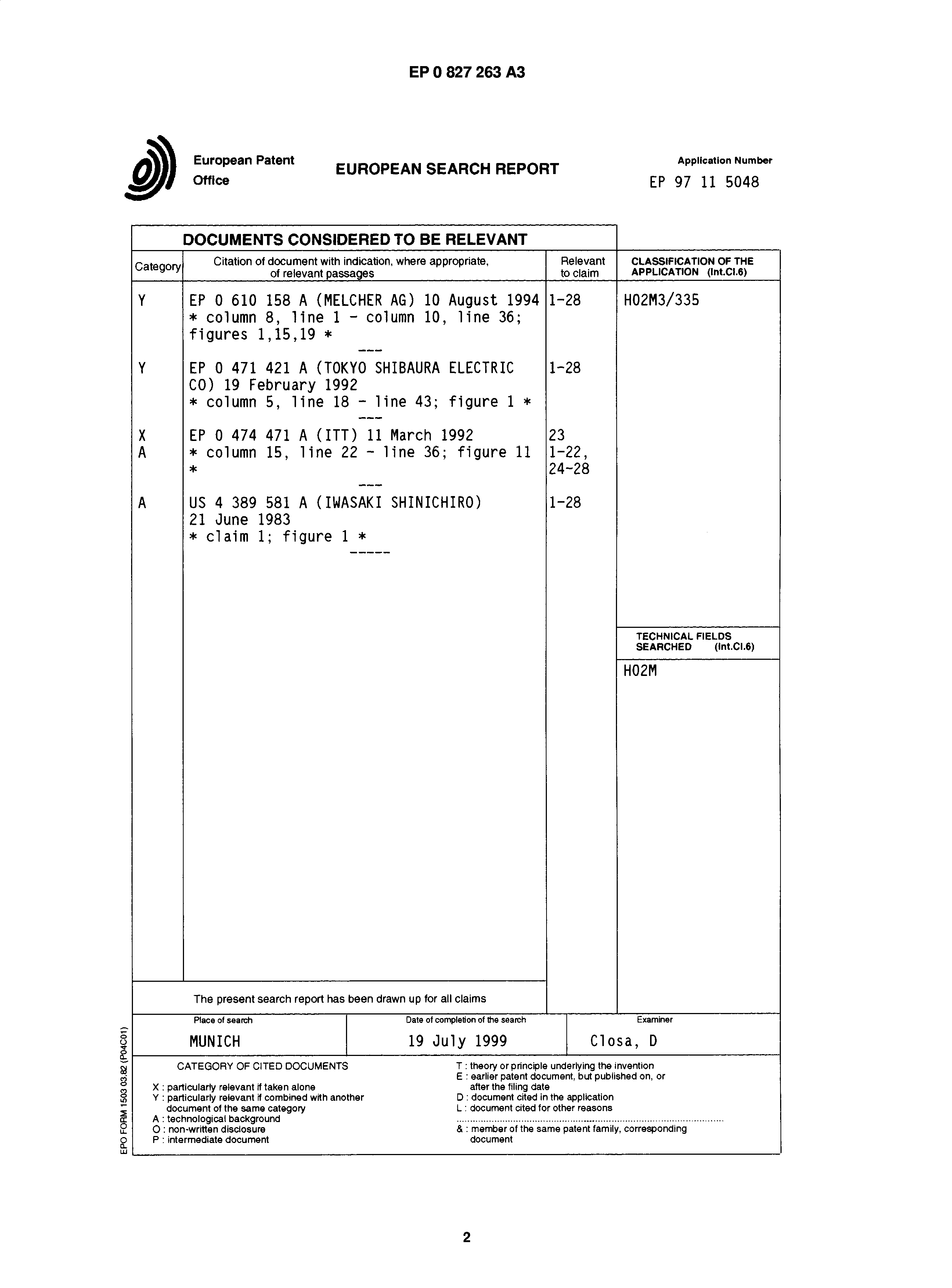
EP 0 827 263 A3 |
| (12) |
EUROPEAN PATENT APPLICATION |
| (88) |
Date of publication A3: |
|
15.09.1999 Bulletin 1999/37 |
| (43) |
Date of publication A2: |
|
04.03.1998 Bulletin 1998/10 |
| (22) |
Date of filing: 29.08.1997 |
|
| (51) |
International Patent Classification (IPC)6: H02M 3/335 |
|
| (84) |
Designated Contracting States: |
|
AT BE CH DE DK ES FI FR GB GR IE IT LI LU MC NL PT SE |
| (30) |
Priority: |
29.08.1996 US 705577
|
| (71) |
Applicant: TRW INC. |
|
Redondo Beach, CA 90278 (US) |
|
| (72) |
Inventor: |
|
- Tan, F. Dong
Irvine, CA 92612 (US)
|
| (74) |
Representative: Schmidt, Steffen J., Dipl.-Ing. |
|
Wuesthoff & Wuesthoff,
Patent- und Rechtsanwälte,
Schweigerstrasse 2
81541 München
81541 München (DE) |
|
| |
|
| (54) |
A double forward converter with soft-PWM switching |
(57) A double forward DC-to-DC converter with soft-PWM switching provides two voltage
pulses to the output low-pass filter within one switching cycle (hence, the name double
forward). The double forward DC to DC converter includes a transformer having a single
primary winding and a two secondary windings. A main switch, under the control of
a PWM control circuit, is connected is series with the primary winding. An auxiliary
switch is coupled across with the main switch by way of a resonant capacitor. The
resonant capacitor and auxiliary switch are used to automatically reset the transformer
core while the main switch is on back to the voltage source connected to the transformer
primary. A diode and snubber capacitor is connected across the drain-source terminals
for both the main and auxiliary switches for minimizing switching losses. The current
mirror used in prior art is abandoned in order to avoid the locked-up mode of operation.
The secondary windings of the transformer are connected to a pair of saturable reactors
which, in turn, are connected to rectifier diodes in order to eliminate the reverse
recovery losses of the rectifier diodes. A freewheeling diode is connected across
the secondary winding and cooperates with the saturable reactors to maintain the load
current to the secondary windings during the transitions of the main and auxiliary
switches.