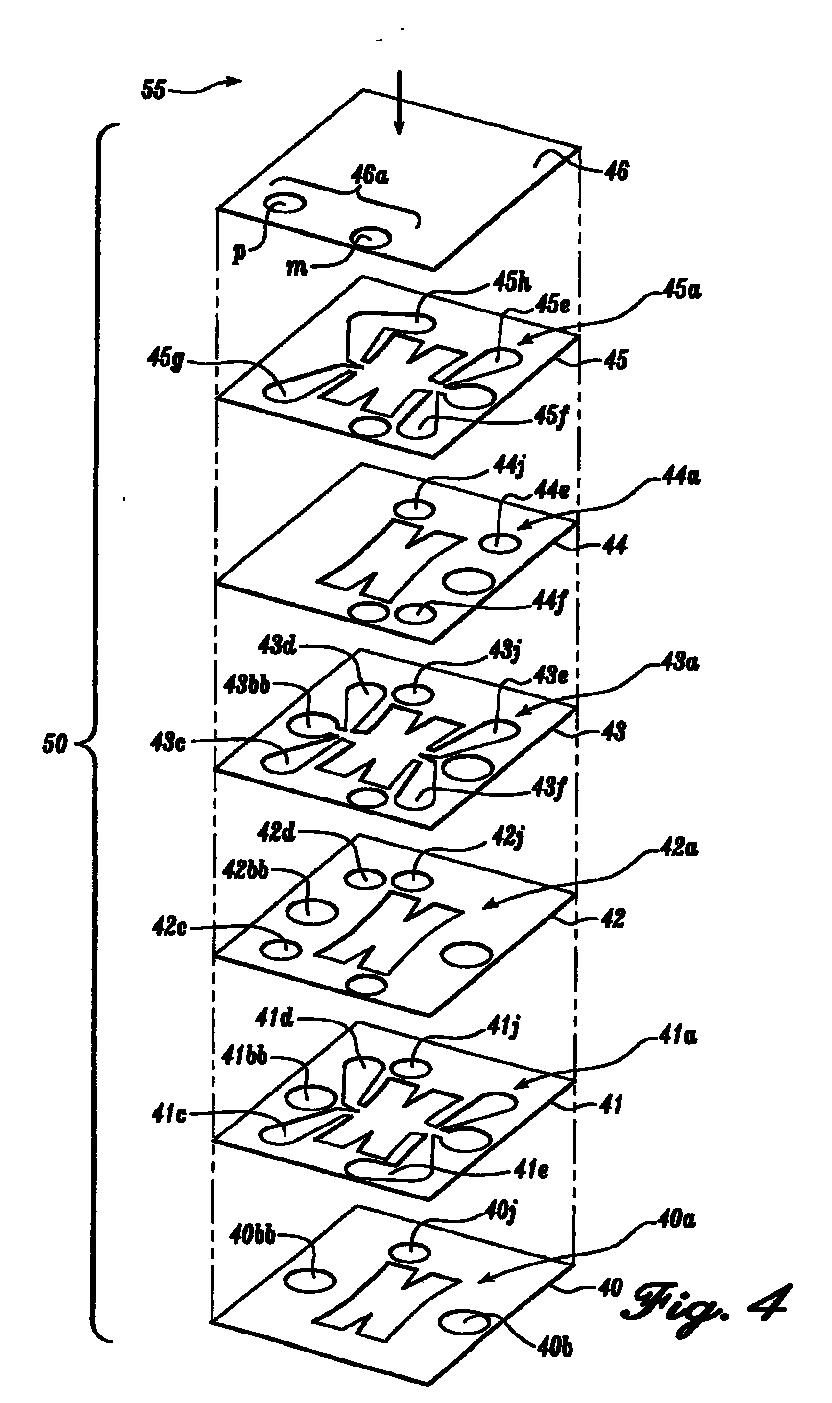
(57) Fluidic constructs (55), including grouped stacks (50) of fluidic elements (40-46),
that provide countersound to control sound in a noisy environment, prevent radiation
of sound from vibrating surfaces, reduce sound-induced vibration of surfaces, and
absorb sound that might otherwise impact on surfaces, are provided. These constructs
(55) may have a wide range of geometries for specific applications, but generally
include a face plate (46) on one side, and a back plate (40) on the other side. Supply
ports (40B) on the back plate (40) provide a supply of fluid that flows through the
construct (55), while undergoing acoustic modulation through fluidic amplifiers (41-45).
The face plate (46) includes input ports (m) that sense sound waves to be controlled,
and transmits this sound to influence the acoustic modulation of the supplied fluid.
The construct (55) produces an amplified output, having sound out of phase with the
sound sensed by the input ports (m), at output ports (p) on the face plate (46) in
a sufficient volume to substantially neutralize incoming sound waves, or reduce sound
radiation from an object. Any sound produced by the construct (55) of the invention
that is substantially in phase with sound to be neutralized is dumped at a sufficient
distance from the produced countersound to minimize interference.
|
|
