|
(11) | EP 0 832 080 B9 |

| (12) | CORRECTED EUROPEAN PATENT SPECIFICATION |
| Note: Bibliography reflects the latest situation |
|
|
| (54) |
PACLITAXEL SYNTHESIS FROM PRECURSOR COMPOUNDS AND METHODS OF PRODUCING THE SAME PACLITAXELSYNTHESE AUS VORLÄUFERVERBINDUNGEN UND VERFAHREN ZU DEREN HERSTELLUNG SYNTHESE DU PACLITAXEL A PARTIR DE COMPOSES PRECURSEURS, ET PROCEDES DE PRODUCTION DE CELUI-CI |
|
|
|||||||||||||||||||||||||||||||
| Note: Within nine months from the publication of the mention of the grant of the European patent, any person may give notice to the European Patent Office of opposition to the European patent granted. Notice of opposition shall be filed in a written reasoned statement. It shall not be deemed to have been filed until the opposition fee has been paid. (Art. 99(1) European Patent Convention). |
[0001] This invention relates to the semi-synthesis of taxol using a protected baccatin III backbone which is esterified with a suitably protected side chain acid to produce an intermediate that may thereafter be acylated and deprotected to produce paclitaxel.
[0002] The chemical compound referred to in the literature as taxol, and more recently "paclitaxel", has been approved for the chemotherapeutic treatment of several different varieties of tumors, and the clinical trials indicate that paclitaxel promises a broad range of potent anti-leukemic and tumor-inhibiting activity. Paclitaxel is a naturally occurring taxane diterpenoid having the formula:
[0003] While the paclitaxel molecule is found in several species of yew (genus Taxus, family Taxaceae), the concentration of this compound is very low. The paclitaxel compound, of course, is built upon the baccatin III backbone, and there are a variety of other taxane compounds, such as baccatin III, cephalomanine, 10-deacetylbaccatin III, etc., some which are more readily extracted in higher yields from the yew tree.
[0004] Organic chemists have spent substantial time and resources in attempting to synthesize the paclitaxel molecule. Partial synthesis of paclitaxel requires convenient access to chiral, non-racemic side chain and derivatives, an abundant natural source of baccatin III or closely related diterpenoid substances, and an effective means of joining the two. Esterification of these two units is difficult because of the hindered C-13 hydroxyl of baccatin III located within the concave region of the hemispherical taxane skeleton. For example, Greene and Gueritte-Voegelein reported only a 50% conversion after 100 hours in one partial synthesis of paclitaxel. J. Am. Chem. Soc., 1988, 110, 5917.
[0005] A promising route to the creation of significant quantities of the paclitaxel compound has been proposed by the semi-synthesis of paclitaxel by the attachment of the A-ring side chain to the C-13 position of the naturally occurring baccatin III backbone derived from the various taxanes present in the yew. See, Denis et al, a "Highly Efficient, Practical Approach to Natural Taxol", Journal of the American Chemical Society, page 5917 (1988). In this article, the partial synthesis of paclitaxel from 10-deacetylbaccatin III is described.
[0006] US Patent No 4,929,011 discloses the semi-synthesis of paclitaxel from the condensation of a (2R, 3S) side chain acid (protected with a hydroxyprotecting group at C2') with a taxane baccatin III (protected at C7 with a hydroxy protecting group). The condensation product is subsequently processed to remove the hydroxy protecting groups. The hydroxy protecting group on the baccatin III backbone is, for example, a trimethylsilyl or a trialkylsilyl radical.
[0007] An alternative semi-synthesis of paclitaxel is described in co-pending United States Patent Application S.N. 08/357,507 (corresponding to PCT Application No WO 94/18186). This application discloses semi-synthesis of paclitaxel from a baccatin III backbone by the condensation with a different side chain where the C3' nitrogen is protected as a carbamate. Preferably, the A-ring side chain is benzyloxycarbonyl (CBZ) protected. After esterification, the CBZ protecting group is removed and replaced by PhCO to lead to paclitaxel. This process generated higher yields than that described in US Patent 4,929,011. In the second of the above-cited patent publications, namely PCT Application No WO 94/18186, the preferred masking groups were selected to be trichloroethoxymethyl or trichloroethoxycarbonyl. Benzyloxymethyl (BOM) was, however, disclosed as a possible side chain hydroxyl protecting group for the 3-phenylisoserine side chain, but, according to the processes described therein, the BOM protecting group could not be removed from the more encumbered C-2' hydroxyl in the attached 3-phenylisoserine side chain. The use of the BOM protected side chain was not extensively investigated, for this reason.
[0008] United States Patent No 4,924,012, issued May 8, 1990 to Colin et al discloses a process for preparing derivatives of baccatin III and of 10-deacetylbaccatin III, by condensation of an acid with a derivative of a baccatin III or of 10-deacetylbaccatin III, with the subsequent removal of protecting groups by hydrogen. Several syntheses of TAXOTERE (Registered to Rhone-Poulenc Sante) and related compounds have been reported in the Journal of Organic Chemistry: 1986, 51, 46; 1990, 55, 1957; 1991, 56, 1681; 1991, 56, 6939; 1992, 57, 4320; 1992, 57, 6387; and 993, 58, 255; also, US Patent No 5,015,744 issued May 14, 1991 to Holton describes such a synthesis.
[0009] Tetrahedron Letters, Volume 35, No 43 (Johnson et al), pages 7893-7896 discloses 7-O-triflates as precursors to olefins and cyclopropanes. According to the authors, baccatin III-7-0-triflate is coupled with a (4S, 5R)-N-CBZ-2-(2,4-dimethoxyphenyl)-4-phenyl-5-oxazolidinecarboxylic acid. The resulting product is then transformed through various intermediates. Although these are taxane analogues, they all have a B-ring without C7-hydroxy protection and an A-ring without hydrogenatable benzyl protecting group protection at position C2'.
[0010] It is an object of the present invention to provide a new, useful and efficient protocol for the attachment of a protected A-ring side chain paclitaxel precursor to a protected baccatin III skeleton which may then be converted into paclitaxel.
[0011] Another object of the present invention is to provide method of production of various precursor compounds including a paclitaxel-analog A-ring side chain that can be condensed with a protect baccatin III backbone which, after a combination of acylation and deprotections, yields paclitaxel.
[0012] Still a further object of the present invention is to provide an efficient and cost effective protocol for the semi-synthesis of paclitaxel.
[0013] According to the present invention, an N-CBZ protected C-2' benzyl protected (2R, 3S)-3-phenyl isoserine A-ring side chain is coupled to a C-7 TES protected baccatin III backbone, after which the coupled condensation product undergoes a variety of deprotections and acylation to form paclitaxel. According to the present invention, a process of producing paclitaxel from an intermediate having the general formula:
wherein P1 is a hydrogenatable benzyl protecting group comprises the steps of deprotecting and acylating the intermediate compound at the nitrogen position of the A-ring side chain to replace the CBZ protecting group with PhCO. Next, the process includes deprotecting the C-7 TES baccatin III backbone at C-7 to replace the TES protecting group with hydrogen and deprotecting the side chain at the C-2' position to replace P1 with hydrogen. This process includes the step of condensing the N-CBZ protected C-2' benzyl protected (2R,3S)-3-phenyl isoserine side chain with the C-7 TES protected baccatin III taxane to produce the intermediate and thereafter conducting the deprotections and acylation.
[0014] Preferably, the deprotection at the C-7 site to remove the TES protecting group occurs before the removal of the hydrogenatable C-2' benzyl protecting group. Here, the step of deprotecting and acylating the side chain nitrogen occurs before the step of deprotecting at C-7 to remove the TES protecting group. Alternatively, the deprotecting at the C-7 site occurs before the step of deprotecting and acylating in the side chain nitrogen. The step of deprotecting to remove the TES protecting group at C-7 is preferably accomplished in acetonitrile in the presence of and hydrofluoric acid.
[0015] According to one process described herein, the step of deprotecting and acylating the side chain at the nitrogen site is accomplished by dissolving the intermediate compound in isopropanol and thereafter mixing with Pearlman's catalyst under a hydrogen atmosphere to form a first mixture and thereafter reducing the first mixture to residue, taking up the residue in a solvent and a tertiary amine base to which benzoyl chloride is thereafter added. Here the solvent is selected from a group consisting of ethyl acetate and toluene and the tertiary amine base is preferably triethylamine.
[0016] These and other objects of the present invention will become more readily appreciated and understood from a consideration of the following detailed description of the exemplary embodiments.
DETAILED DESCRIPTION OF THE EXEMPLARY EMBODIMENTS
[0017] The present disclosure is broadly directed to a chemical process for the efficient production of paclitaxel, intermediates and precursors therefor. More specifically the present invention concerns the semi-synthesis of paclitaxel by esterifying (suitably protected) 3-phenylisoserine acids having hydrogenatable benzyl protecting groups at C-2' to the C-13 hydroxyl of 7-0-protected baccatin III. More particularly, the present invention utilizes triethylsilyl (TES) protection at the C-7 site. The general process described herein involves the production of C-7 TES baccatin III, the production of the suitably protected 3-phenylisoserine acid having a hydrogenatable benzyl protecting group at C-2', the condensation of the two compounds, and the subsequent deprotection and acylation of the condensation product to form paclitaxel.
A. Production of C-7 TES Protected Baccatin III
[0018] As a starting point in the semi-synthesis of paclitaxel according to the exemplary embodiment of the present invention, it is necessary to provide the baccatin III backbone onto which the paclitaxel-analog side chain may be attached. According to the present invention, it is preferred that this backbone be in the form of the basic baccatin III backbone that is protected at the C-7 site with a TES protecting group. Particularly, it is desired to provide a reaction intermediate of the formula:
The compound of formula may hereinafter be referred as TES-protected baccatin III, and its preparation may be accomplished by the various routes described in the literature.
[0019] One such route is described in Denis et al, "A highly Efficient, Practical Approach to Natural Taxol, Journal of the American Chemical Society, p. 5917 (1988). Here, 10-deacetylbaccatin III is first converted to C-7 TES protected 10-deacetylbaccatin III and subsequently the C-7.TES protected 10-deacetylbaccatin III is converted to C-7 TES protected baccatin III by the acylation of the compound at the C-10 location. C-7 TES protected 10-deacetylbaccatin III is achieved according to the following reaction:
Here, 10-deacetylbaccatin III is reacted with a large excess of TES-Cl and pyridine to produce C-7 TES protected 10-deacetylbaccatin III. The product is next acylated utilizing an excess of acetyl chloride and pyridine to produce C-7 TES baccatin III.
[0020] Alternatively, C-7 TES protected baccatin III may be efficiently produced according to the procedure described in Kant et al "A Chemo Selective Approach To Functionalize the C-10 Position of 10-deacetylbaccatin III Synthesis and Biological Properties of Novel C-10 Taxol® Analogs", Tetrahedron Letters, Vol. 35, No. 31, TP5543-5546 (1994). As described in this article, C-7 TES protected C-10 hydroxy baccatin III may be obtained according to the reaction:
Here, imidazole is added while stirring to a solution of 10-deacetylbaccatin III in dimethylformamide (DMF) under a nitrogen atmosphere. Triethylsilyl chloride (TES-Cl) is then added dropwise over a period of approximately five minutes. The resulting solution is stirred or otherwise moderately agitated for three hours after which the mixture is quenched with water and extracted with two portions of either diethyl ether or methyl t-butyl ether, and the combined organics are mixed and washed with four portions of water and one portion brine. The organic and aqueous layers are then separated and the organic layer is dried and reduced under vacuum to form a crude solid. This crude solid is then recrystallized from ethyl acetate/hexane to produce C-10 hydroxy C-7 TES baccatin III.
[0021] Next, the C-10 hydroxy C-7 TES baccatin III is acylated to produce C-7 TES baccatin III according to the following reaction:
The C-10 hydroxy C-7 TES baccatin III is dissolved in anhydrous tetrahydrofuran (THF) and the solution is cooled under a nitrogen atmosphere to a temperature of less than - 20°C. n-Butyl lithium (1.6M in hexane) is added dropwise, and the mixture is stirred at the reduced temperature for approximately five minutes. Acetyl chloride is then added dropwise and the mixture warmed to O°C over an interval of five minutes and then stirred at that temperature for approximately one hour. The mixture is then quenched with water and reduced under vacuum, after which the residue is taken up in ethyl acetate and washed once with water and then brine. The organic layer may then be dried and reduced under vacuum, and the residue recrystallized with ethyl acetate/hexane to yield C-7 TES baccatin III as a white solid. The selected electrophile is AcCl. A yield of 90% was reported in this article.
[0022] Alternatively, of course, the C-7 TES protected baccatin III can be made directly from baccatin III instead of the route described above for the conversion from 10-deacetylbaccatin III.
B. Production of N-carbamate Protected C-2' hydroxyl-Benzyl Protected (2R,3S) 3-Phenyl Isoserine A-ring Side Chain
[0023] The second precursor necessary for the semi-synthesis of paclitaxel according to the present invention is the N-carbamate protected C-2' hydroxyl-benzyl protected (2R,3S) phenyl isoserine side chain having the general formula:
wherein R1 is an alkyl, olefinic, or aromatic PhCH2 and P1 is a hydrogenatable benzyl protecting group
The preferred hydrogenatable benzyl protecting group is a benzyloxymethyl (BOM) protecting group although other hydrogenatable benzyl protecting groups, including benzyl, are believed suitable as well. The preferred N-carbamate protecting group is benzyloxycarbonyl (CBZ). The starting compound to produce the desired side chain is (2R,3S)-3-phenylisoserine ethyl ester to produce N-CBZ protected (2R,3S)-3-phenylisoserine ethyl ester according to the reaction:
Here, (2R,3S)-3-phenylisoserine ethyl ester was alternatively dissolved in either equal parts diethyl ether:water or equal parts methyl t-butyl ether:water and the solution was cooled to O°C. The sodium carbonate was then added to the solution and benzylchloroformate was added dropwise over an interval of about five minutes and the resulting mixture stirred at O°C for approximately one hour. After the one hour stirring, the solution was then poured into water and extracted with methylene chloride or ethyl acetate, as desired. The organic layer is separated, dried and reduced under vacuum to residue. The residue was then recrystallized from ethyl acetate:hexane to result in N-CBZ protected (2R,3S)-3-phenylisoserine ethyl ester having the formula:
[0024] The N-CBZ protected (2R,3S)-3-phenylisoserine ethyl ester was next protected by the hydrogenatable benzyl protecting group, in several ways. For example, one route to the desired hydrogenatable benzyl protected side chain is as follows:
Here, the CBZ protected (2R,3S)-3-phenylisoserine ethyl ester is dissolved in anhydrous THF under a nitrogen atmosphere and cooled to a reduced temperature such as -40°C or -78°C, for example, in a dry ice/acetone bath followed by the dropwise addition of an alkylithium agent, such as n-butyl lithium, although it is desirable that the alkylithium agent be a straight chain alkyl. In any event, the reaction is best done at a temperature no greater than 0°C. The resulting mixture was stirred for about ten minutes. Benzyloxymethyl chloride (BOM-Cl) was then added dropwise over an interval of about five minutes and the mixture stirred for approximately two to five hours at the reduced temperature. Thereafter, the solution was warmed to -0°C and quenched with water. The resulting mixture is reduced under vacuum to residue, and this residue is thereafter taken up in ethyl acetate and washed with water and brine. The organic layer may then be dried and reduced under vacuum and the residue recrystallized from ethyl acetate:hexane or chromotographed with ethyl acetate:hexane to give the compound:
[0025] Another route in the production of the compound according to formula 5 is accomplished by dissolving the compound N-CBZ (2R,3S)-3-phenylisoserine ethyl ester in anhydrous methylene chloride. Thereafter, a tertiary amine base, such as diisopropylethylamine, is added along with BOM-C1 and the mix is refluxed for twenty-four hours. While this reaction route will produce N-CBZ protected C-2' [hydroxyl] protected (2R,3S)-3-phenylisoserine ethyl ester, the reaction proceeds much slower than the preferred route, discussed above.
[0026] In either instance, the resulting protected (2R,3S)-3-phenylisoserine ethyl ester compound of formula 5 may simply be converted to the N-CBZ protected C-2' O-BOM-protected (2R,3S) phenylisoserine intermediate hydroxyl by the reaction:
[0027] Here, the protected (2R,3S)-3-phenylisoserine ethyl ester is dissolved in ethanol/water (ratio 8:1). Lithium hydroxide (or other suitable alkali hydroxide) is added to the solution and the resulting mixture stirred for approximately three hours in order to saponify the compound. The mixture is then acidified (1N HC1) and extracted with ethyl acetate. The resulting organic layer is separated, dried and reduced under vacuum. The residue acid is then isolated for use without further purification. This produces the desired side chain having the general formula:
[0028] Benzyl itself is another example of a hydrogenatable benzyl protecting group that may be used instead of BOM. The compound of the formula:
was therefore produced as above with the substitution of benzyl bromide for BOM-Cl in Reaction V according to the reaction
Here, the CBZ protected (2R,3S)-3-phenylisoserine ethyl ester is dissolved in anhydrous THF under a nitrogen atmosphere and cooled to a reduced temperature such as -40°C or -78°C, for example, in a dry ice/acetone bath followed by the dropwise addition of an alkylithium agent, such as n-butyl lithium, although it is desirable that the alkylithium agent be a straight chain alkyl. The resulting mixture was stirred for about ten minutes. Benzyl bromide (BnBr) was then added dropwise over an interval of about five minutes and the mixture stirred for approximately two to five hours at the reduced temperature. Thereafter, the solution was warmed to-0°C and quenched with water. The resulting mixture is reduced under vacuum to residue, and this residue is thereafter taken up in ethyl acetate and washed with water and brine. The organic layer may then be dried and reduced under vacuum and the residue recrystallized from ethyl acetate:hexane or chromatographed with ethyl acetate:hexane to give the compound of Formula 10.
[0029] Alternatively, the compound of Formula 7 may be obtained according to the reaction:
Here, to a stirred solution of NaH in anhydrous DMF under N2 was added Formula 4 dissolved in DMF over five minutes. The mixture was then stirred at O°C for one half hour. After which time benzyl bromide (1.1 equivalents) was added dropwise over five minutes and the reaction stirred for two hours. The mixture was then quenched with H2O. Thereafter, a selected one of diethylether and methyl t-butyl was added. The organic layer was then washed with four portions of H2O, brine, and then dried and reduced under vacuum to produce Formula 10. Formula 7 may then be readily converted into:
by the process of Reaction VI, above.
C. Condensation of C-7 TES Protected Baccatin III and the Side Chain
[0030] The side chain designated above as Formula 6 (or Formula 8) as well as the C-7 TES protected baccatin III may now be condensed, again by a variety of routes. By way of example, this condensation may proceed in the presence of a diisopropylcarbodiimide and dimethylamino pyridine (DMAP) in toluene at 80°C according to the reaction:
Here, C-7 TES protected baccatin III (1 equivalent) and the acid side chain of Formula 9 (6 equivalents) are dissolved in toluene. To this mixture DMAP (2 equivalents) and diisopropylcarbodiimide (6 equivalents) are added, and the resulting mixture heated at 80°C for three to five hours. It should be noted, however, that other dialkyl carbodiimides may be substituted for the diisopropylcarbodiimide, with one example being dicyclohexylcarbodiimide (DCC). Next, the solution was cooled to O°C and held at this temperature for twenty-four hours. After this time it was filtered and the residue rinsed with either ethyl ether or methyl t-butyl ether. The combined organics were then washed with hydrochloric acid (5%), water and, finally, brine. The organic phase was separated, dried and reduced under vacuum. The resulting residue was then dissolved in ethyl acetate:hexane and eluted over a silica gel plug. The eluent is then reduced under vacuum to result in the compound:
D. Deprotections and Acylation to Form Paclitaxel
[0031] The compound according to the Formula 9 may now be converted into paclitaxel by removing the CBZ protecting group and acylating the side chain, removing the TES protecting group and removing the hydrogenatable benzyl protecting group. Here, several convenient routes have been found although in general, it is necessary to deprotect the C-7 site by removing the TES protecting group prior to deprotecting the C-2' site with the hydrogenatable benzyl protecting group. If the TES protecting group is not removed first, it is believed difficult at best to remove the hydrogenatable protecting group in a later processing step.
[0032] In any event, the preferred route of producing paclitaxel is to first remove the CBZ protecting group according to the reaction:
Here, the coupled product of Formula 9 is dissolved in isopropanol to which the Pearlman's catalyst is added. The resulting mixture is stirred under one atmosphere of hydrogen for twenty-four hours. Thereafter, the mixture is filtered through diatomaceous earth and reduced under vacuum to residue. The residue may then be taken up in ethyl acetate or toluene and a tertiary amine base, such as triethylamine is added. Benzoyl chloride was added dropwise, and the mixture stirred for two hours. The resulting mixture was then washed with dilute NaHCO3, water, and finally brine. The resulting organic phase was then separated, dried and reduced under vacuum to yield the CBZ deprotected/acylated compound:
[0033] Next, the compound of Formula 10 is deprotected at C-7 according to the reaction:
Here, the compound of Formula 10 was dissolved in acetonitrile (CH3CN) at 0°C. Hydrofluoric acid (40% aqueous) was then added and the mixture stirred for ten hours while being held at 0°C. Thereafter, the mixture is diluted with ethyl acetate, saturated NaHCO3, water and finally brine. The organic phase was separated, dried and reduced under vacuum to produce a deprotected product at the C-7 position according to the formula:
[0034] Finally, the compound of Formula 11 is deprotected at C-2' to remove the hydrogenatable benzyl (BOM) protecting group and to liberate the C-2' hydroxy group thereby resulting in the desired paclitaxel. This is accomplished according to the reaction:
[0035] Alternatively, the compound of Formula 9 may first be dissolved in CH3CN at 0°C and hydrofluoric acid (40% aqueous) added to deprotect the compound at the C-7 site by removing the TES protecting group. This results in a compound according to the formula:
Next, the CBZ protecting group may be removed in a manner similar to that described above. Here, the compound of Formula 15 is dissolved in isopropanol and Pearlman's catalyst was added along with trifluoroacetic acid (TFA) (1 equivalent). The mixture was held at 40 psi of hydrogen at room temperature for approximately four days. This removes the CBZ protecting group and forms the C-2' BOM protected paclitaxel compound as a TFA salt. The mixture was filtered through diatomaceous earth and reduced under vacuum. Next, a base plus an acylating agent was added to the residue. Specifically, the TFA salt of the C-2' BOM protected compound was dissolved in pyridine and either benzoyl chloride or benzoic anhydride was added. The resulting product is:
[0036] The compound of Formula 13 is dissolved in isopropyl alcohol and placed in a Parr bottle and Pearlman's catalyst was added. The mixture was hydrogenated for twenty-four hours at 40 psi of hydrogen. Thereafter, the mixture was filtered through diatomaceous earth and the eluent reduced under vacuum. The residue may then be column chromatographed according to any desired technique or recrystallized from ethyl acetate:hexane for the final paclitaxel product.
1. A process of producing paclitaxel from an intermediate compound having the general
formula:
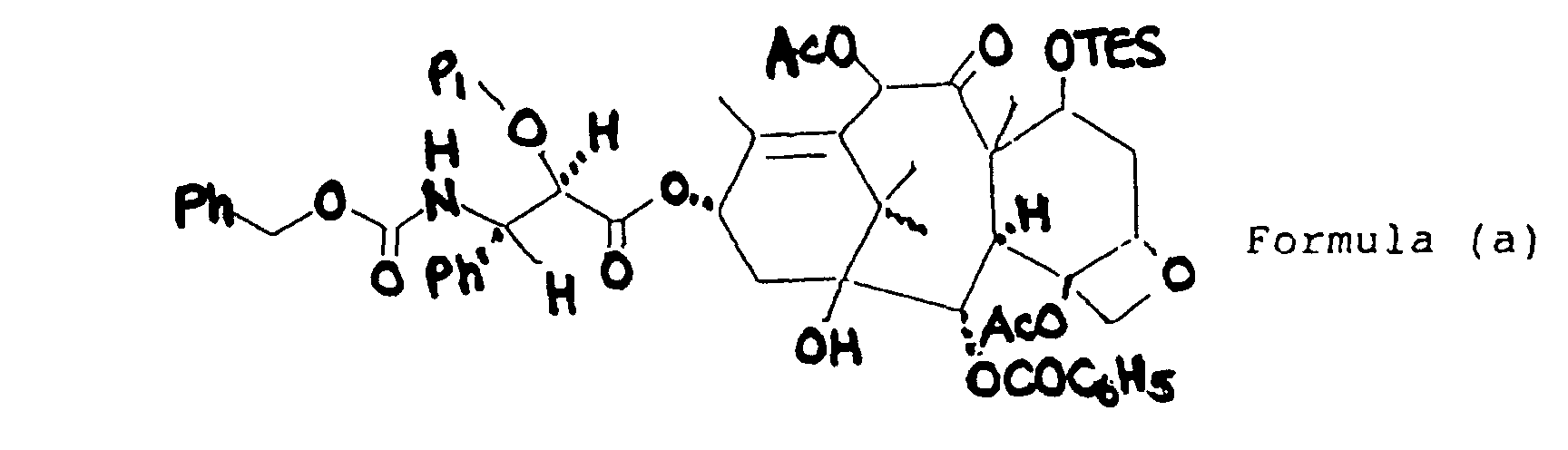
wherein P1 is a hydrogenatable benzyl protecting group comprising the steps of deprotecting and acylating the intermediate - compound at the nitrogen position of the A-ring side chain to replace the CBZ protecting group with PhCO, deprotecting the side chain at the C-2' position to replace P1 with H and deprotecting at C-7 to replace the TES protecting group with H.
wherein P1 is a hydrogenatable benzyl protecting group comprising the steps of deprotecting and acylating the intermediate - compound at the nitrogen position of the A-ring side chain to replace the CBZ protecting group with PhCO, deprotecting the side chain at the C-2' position to replace P1 with H and deprotecting at C-7 to replace the TES protecting group with H.
2. A process as claimed in claim 1 wherein the step of deprotecting at C-7 occurs before
the removal of the hydrogenatable C-2' benzyl protecting group.
3. A process as claimed in claim 1 or claim 2 wherein the step of deprotecting and acylating
the side chain nitrogen occurs before the step of deprotecting at C-7.
4. A process as claimed in claim 1 or claim 2 wherein the step of deprotecting at C-7
occurs before the step of deprotecting and acylating the side chain nitrogen.
5. A process as claimed in any preceding claim wherein the step of deprotecting and acylating
the side chain nitrogen is accomplished by dissolving the compound of Formula (a)
in isopropanol and thereafter adding Pearlman's catalyst under a hydrogen atmosphere
for a first interval of time to form a first mixture and thereafter reducing said
first mixture to residue and taking up said residue in a solvent, adding a tertiary
amine base and thereafter adding benzoyl chloride.
6. A process as claimed in claim 5 wherein said solvent is ethyl acetate or toluene.
7. A process as claimed in claim 5 or claim 6 wherein the tertiary amine base is triethylamine.
8. A process as claimed in any preceding claim wherein the step of deprotecting at C-7
is accomplished in acetonitrile in the presence of hydrofluoric acid.
1. Ein Verfahren zur Herstellung von Paclitaxel aus einem Zwischenprodukt der allgemeinen
Formel
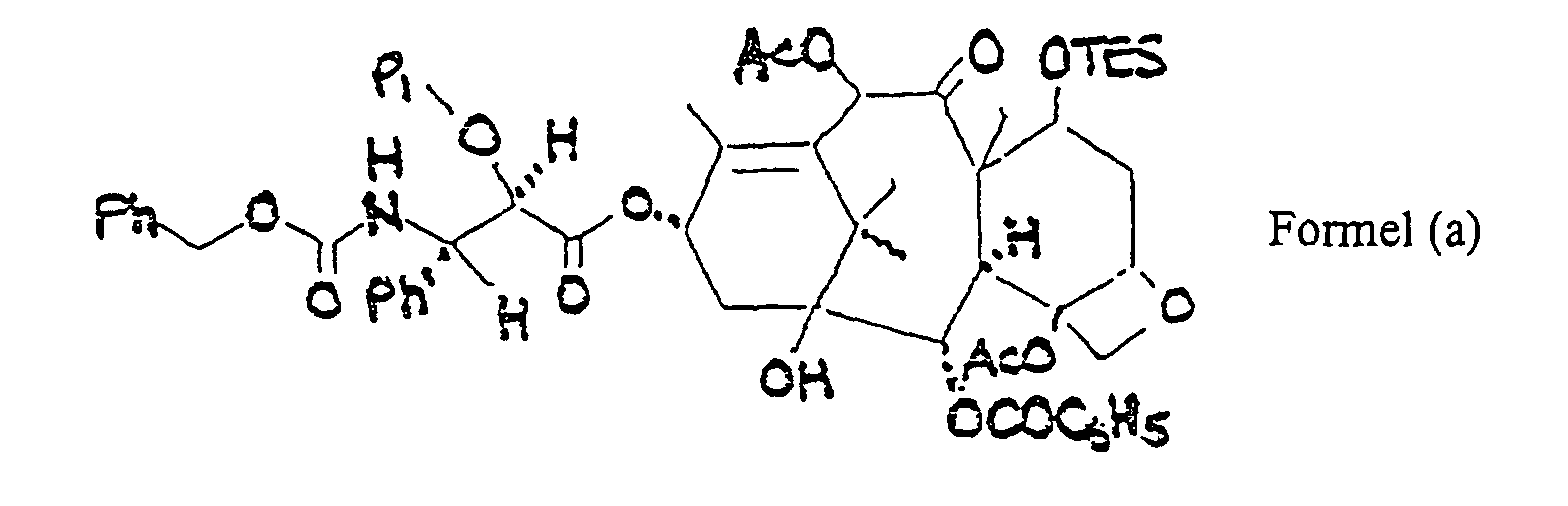
worin P1 eine hydrierbare Benzylschutzgruppe ist, umfassend die Schritte des Entfemens der Schutzgruppe und Acylierens des Zwischenprodukts an der Stickstoff-Position der A-Ring-Seitenkette, um die CBZ-Schutzgruppe durch PhCO zu ersetzen, Entfernen der Schutzgruppe der Seitenkette an der C-2'-Position, um P1 durch H zu ersetzen und Entfemen der Schutzgruppe an C-7, um die TES-Schutzgruppe durch H zu ersetzen.
worin P1 eine hydrierbare Benzylschutzgruppe ist, umfassend die Schritte des Entfemens der Schutzgruppe und Acylierens des Zwischenprodukts an der Stickstoff-Position der A-Ring-Seitenkette, um die CBZ-Schutzgruppe durch PhCO zu ersetzen, Entfernen der Schutzgruppe der Seitenkette an der C-2'-Position, um P1 durch H zu ersetzen und Entfemen der Schutzgruppe an C-7, um die TES-Schutzgruppe durch H zu ersetzen.
2. Verfahren nach Anspruch 1, wobei der Schritt des Entfernens der Schutzgruppe an C-7
vor der Entfernung der hydrierbaren C-2'-Benzylschutzgruppe stattfindet.
3. Verfahren nach Anspruch 1 oder 2, wobei der Schritt des Entfernens der Schutzgruppe
und des Acylierens des Seitenketten-Stickstoffatoms vor dem Schritt des Entfernens
der Schutzgruppe an C-7 stattfindet.
4. Verfahren nach Anspruch 1 oder 2, wobei der Schritt des Entfernens der Schutzgruppe
an C-7 vor dem Schritt des Entfernens der Schutzgruppe und des Acylierens des Seitenketten-Stickstoffatoms
stattfindet.
5. Verfahren nach einem der vorstehenden Ansprüche, wobei der Schritt des Entfernens
der Schutzgruppe und des Acylierens des Seitenketten-Stickstoffatoms durch Lösen der
Verbindung der Formel (a) in Isopropanol und danach Zugeben von Pearlman's Katalysator
unter einer Wasserstoffatmosphäre für einen ersten Zeitraum zur Bildung eines ersten
Gemisches und danach Konzentrieren des ersten Gemisches zu einem Rückstand und Aufnehmen
des Rückstands in einem Lösungsmittel, Zugeben einer tertiären Aminbase und danach
Zugeben von Benzoylchlorid durchgeführt wird.
6. Verfahren nach Anspruch 5, wobei das Lösungsmittel Ethylacetat oder Toluol ist.
7. Verfahren nach Anspruch 5 oder 6, wobei die tertiäre Aminbase Triethylamin ist.
8. Verfahren nach einem der vorstehenden Ansprüche, wobei der Schritt des Entfernens
der Schutzgruppe an C-7 in Acetonitril in Gegcnwart von Fluorwasserstoffsäure durchgeführt
wird.
1. Procédé pour préparer le paditaxel à partir d'un composé intermédiaire ayant la formule
générale :
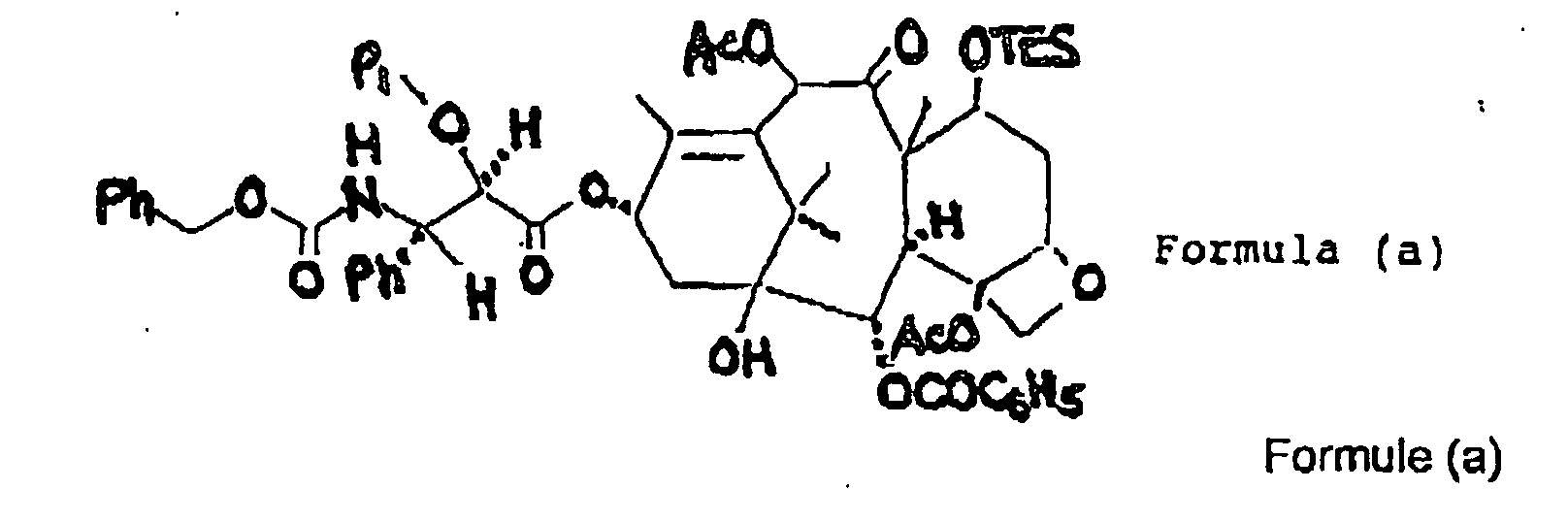
dans laquelle P1 est un groupe protecteur benzyle hydrogénable comprenant les étapes de déprotection et d'acylation du composé intermédiaire à la position de l'azote de la chaîne latérale du cycle A pour remplacer le groupe protecteur CBZ (benzyloxycarbonyl) par PhCO, de déprotection de la chaîne latérale à la position C-2' pour remplacer P1 par H et de déprotection à la position C-7 pour remplacer le groupe protecteur TES (triéthylsilyl) par H.
dans laquelle P1 est un groupe protecteur benzyle hydrogénable comprenant les étapes de déprotection et d'acylation du composé intermédiaire à la position de l'azote de la chaîne latérale du cycle A pour remplacer le groupe protecteur CBZ (benzyloxycarbonyl) par PhCO, de déprotection de la chaîne latérale à la position C-2' pour remplacer P1 par H et de déprotection à la position C-7 pour remplacer le groupe protecteur TES (triéthylsilyl) par H.
2. Procédé selon la revendication 1 dans lequel l'étape de déprotection à la position
C-7 est réalisée avant le retrait du groupe protecteur benzyle C-2' hydrogénable.
3. Procédé selon la revendication 1 ou 2 dans lequel l'étape de déprotection et d'acylation
de la chaîne latérale porteuse de l'azote est réalisée avant l'étape de déprotection
à la position C-7.
4. Procédé selon la revendication 1 ou 2 dans lequel l'étape de déprotection à la position
C-7 est réalisée avant l'étape de déprotection et d'acylation de la chaîne azotée.
5. Procédé selon l'une quelconque des revendications précédentes dans lequel l'étape
de déprotection et d'acylation de la chaîne latérale azotée est réalisée par dissolution
du composé de formule (a) dans l'isopropanol et ensuite par ajout du catalyseur de
Pearlman sous atmosphère d'hydrogène pendant un premier intervalle de temps pour former
un premier mélange et ensuite la réduction dudit premier mélange en un résidu, puis
la récupération dudit résidu dans un solvant, en ajoutant une base amine tertiaire
et ensuite du chlorure de l'acide benzoïque.
6. Procédé selon la revendication 5 dans lequel ledit solvant est l'acétate d'éthyle
ou le toluène.
7. Procédé selon la revendication 5 ou 6 dans lequel la base d'amine tertiaire est la
triéthylamine.
8. Procédé selon l'une quelconque des revendications précédentes dans lequel l'étape
de déprotection à la position C-7 est réalisée dans l'acétonitrile en présence d'acide
fluorhydrique.