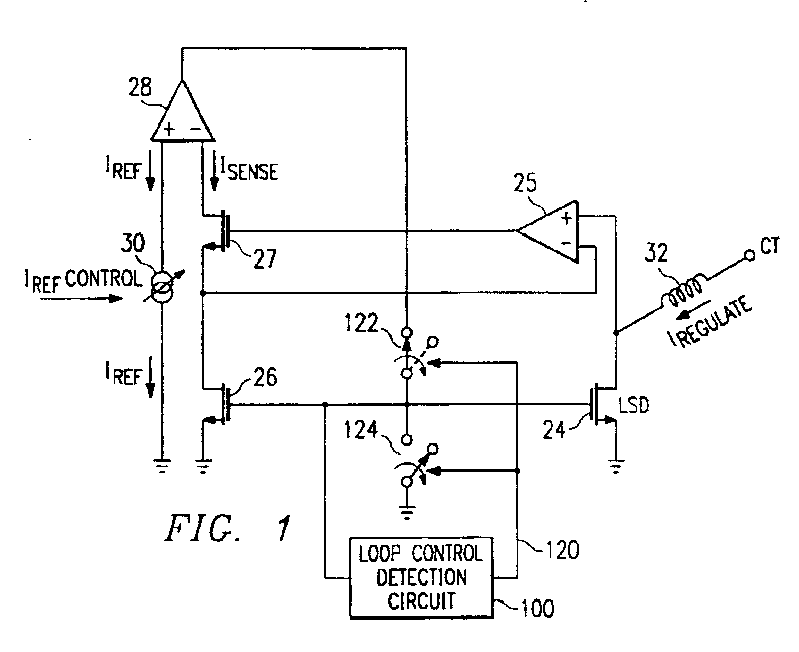
(57) A loop control detection circuit (100) is provided for detecting feedback values
in a current feedback control loop to determine if the control loop is in or out of
control. The loop control detection circuit (100) includes a comparison circuit and
a register circuit. The comparison circuit includes a first comparator (102) and a
second comparator (106) that receive a feedback control loop signal from a current
feedback control loop that is provided as the gate or gate-to-source voltage of a
low side driver (24). The first comparator (102) compares the feedback control loop
signal to a first voltage reference signal that corresponds to the threshold voltage
of the low side driver (24) and generates a first comparison output signal in response.
The second comparator (106) compares the feedback control loop signal to a second
voltage reference signal that corresponds to the rail or supply voltage of a reference
amplifier (28) of the current feedback control loop and generates a second comparison
output signal in response. The register circuit includes a first flip-flop (104),
a second flip-flop (108), and an enabling circuit (110). The first flip-flop (104)
and the second flip-flop (108) receive a timing signal in an enabled state, such as
a commutator control signal, at their clock inputs and, in response, generate a first
loop control detection signal and a second loop control detection signal, respectively,
in a state indicating that the current feedback control loop is in control. The first
flip-flop (104) and the second flip-flop (108) receive the first comparison output
signal and the second comparison output signal, respectively, and generate the first
loop control detection signal and the second loop control detection signal, respectively.
The first loop control detection signal is generated in a state indicating that the
current feedback control loop is out of control in response to receiving the first
comparison output signal in a state indicating that the first reference signal is
larger than the feedback control loop signal. The second loop control detection signal
is generated in a state indicating that the current feedback control loop is out of
control in response to receiving the second comparison output signal in a state indicating
that the second reference signal is less than the feedback control loop signal. The
enabling circuit (110) receives the first loop control detection signal and the second
loop control detection signal and generates a loop control detection signal (120)
in a state indicating that the current feedback control loop is out of control in
response to receiving the first loop control detection signal or the second loop control
detection signal in a state indicating that the current feedback control loop is out
of control.
|
|
