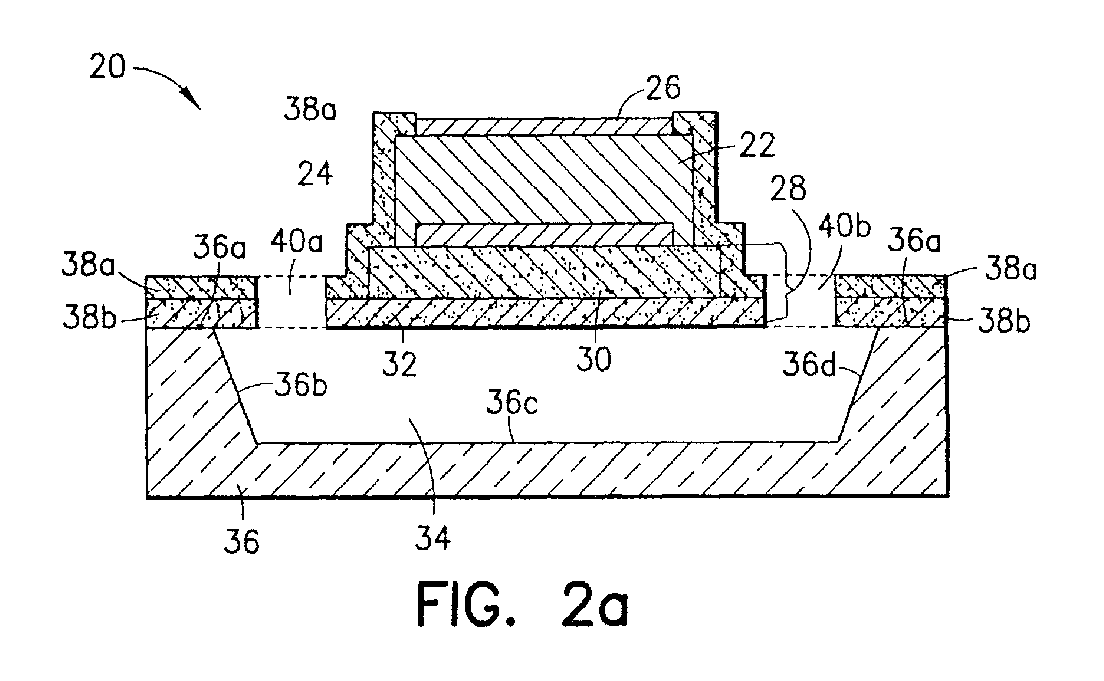
(57) A Bulk Acoustic Wave (BAW) resonator (20) is provided which comprises a piezoelectric
layer (22); a first and second protective layer (38b,a), a first electrode (24), a
second electrode (26), a bridge (also referred to as a "membrane" (28), a pair of
etch windows (40a,b), an air gap (34), and a substrate (36). A portion of the piezoelectric
layer (22) is positioned atop the first electrode (24), and the second electrode (26)
is positioned atop the piezoelectric layer (22); thereby forming a parallel plate
structure between which the piezoelectric layer (22) is allowed to resonate or vibrate.
The piezoelectric layer (22) comprises, by example, zinc-oxide (ZnO), and has a thickness
of 1.7 µm. The electrodes (24,26) comprise, by example, gold (Au) and have thicknesses
of 0.1 µm.
The membrane (28) comprises two layers (30,32) namely a top layer (30) and a bottom
layer (32). The top layer (30), which preferably has a thickness of 0.6 µm and comprises
poly-silicon, has a top surface which is in contact with the first electrode (24)
and portions of the piezoelectric layer (22). The top layer (30) is situated atop
a portion of the bottom layer (32), which preferably has a thickness of 0.4 µm and
is comprised of silicon-dioxide (SiO2).
A portion of a bottom surface of the membrane (28) is situated adjacent to the air
gap (34), which separates this portion of the membrane's bottom surface from a portion
of the substrate (36). This air gap (34), which is typically filled with air but any
suitable material may be used, is formed by etching a portion of the substrate (36).
The air gap (34) is bounded by the etch windows (40a,b), by a portion of the first
protective layer (38b), by the bottom surface portion of the membrane (28), and by
inner faces (36b,c,d) of the substrate (36). The air gap (34) functions to isolate
acoustic vibrations created by the piezoelectric layer (22) from the substrate (36).
|
|
