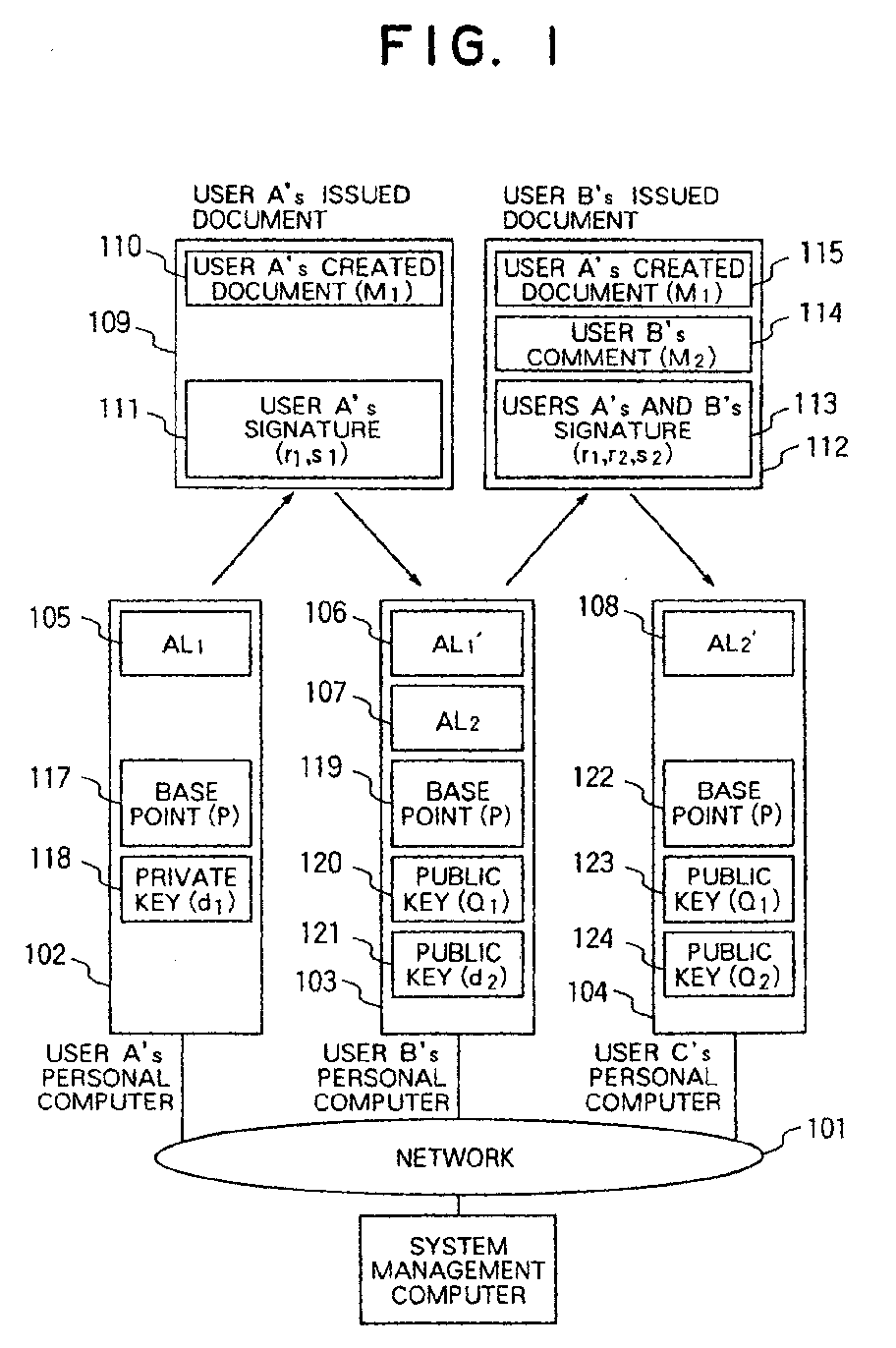
(57) A digital signature generating/verifying method using a public key encryption scheme
which ensures high security, reduction in length of the digital signature and independency
of the length of the digital signature on that the order of a base point. In generating
a digital signature, a first hash value (e) satisfying a condition that e = H(M) is
determined for a given message (M) by using a hash function (H), a numerical value
(x) is obtained from translation of a random number, a hash value (r) satisfying a
condition that r = h(x) is determined by using a hash function (h) whose output value
is shorter than that of the first hash function (H), and the digital signature is
generated by using the hash values (e) and (r) as determined. For verification of
an inputted digital signature, the hash value (e) satisfying the condition that e
= H(M) is determined, and for a numerical value (x) obtained from arithmetic operation
of a public key (Q), a base point (P) and the inputted digital signature (r, s), a
hash value (r') satisfying a condition that r' = h(x) on the basis of the hash value
(e), the digital signature (r, s), the base point (P) and the public key (Q) by using
a hash function (h) whose output value is shorter than that of the first hash function
(H). The hash value (r') is then compared with a tally (r) of the inputted digital
signature to thereby verify the inputted digital signature.
|
|
