Scope of Application
[0001] The invention pertains to metallurgy, in particular, compositions of steels used
for fabrication of critical parts for machine-building industry.
Previous Technology Level
[0002] The alloyed construction steel with the composition (wt. %) shown below is known:
| Carbon |
0.4 max |
| Silicon |
0.56-1.5 |
| Manganese |
0.30-2.0 |
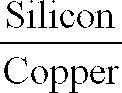
| Chromium |
0.71-3.0 |
| Vanadium |
0.21-1.0 |
| Aluminum |
0.3 max |
| Iron |
Rem. |
| (JP, A, # 52-27584) |
|
[0003] This steel does not offer the required complex of properties, especially plasticity,
elimination of intercrystalline brittleness and boosted nitration process.
[0004] Also known is the alloyed construction steel that has the following components, wt.
%:
| Carbon |
0.30-0.45 |
| Manganese |
0.30-0.60 |
| Silicon |
0.17-0.37 |
| Chromium |
1.50-2.50 |
| Vanadium |
0.20-0.50 |
| Germanium |
0.20-0.80 |
| Iron |
Rem. |
| (SU, A, # 926060) |
|
[0005] The advantage of this steel is low strength at satisfactory plasticity across the
cross section of the part made thereof following both traditional hardening methods
and low-temperature nitration. Besides, there is a likelihood of temper brittleness
typical of nitrided steels that are currently used.
[0006] The alloyed construction steel that contains carbon, silicon, manganese, chromium,
molybdenum, nickel, vanadium and iron in proportions shown below (wt. %) is the closest
from the point of view of the technological content and result sought:
| Carbon |
0.27-0.34 |
| Silicon |
0.17-0.60 |
| Manganese |
0.30-0.60 |
| Chromium |
2.30-2.70 |
| Molybdenum |
0.20-0.30 |
| Nickel |
0.12-0.30 |
| Vanadium |
0.06-0.12 |
| Iron |
Rem. |
| (Steel 30X3MΦ, GOST 4543-71. Alloyed construction steel, grades and specifications). |
[0007] The disadvantage of this steel are low yield and hardness, slow rate of saturation
during nitrating and presence of scarcely available molybdenum arid nickel that results
in high production costs. Besides, there is a likelihood of temper brittleness typical
of nitrided steels that are currently used.
Disclosure Of The Invention
[0008] This invention is based on the objective to ensure high physical and mechanical properties
of steel combined with high plasticity across the cross section of the part made thereof,
following both traditional hardening techniques (quenching, tempering) and low-temperature
nitration at 470-520°C, with minimum tendency for temper brittleness, as well as fabrication
cost reduction.
[0009] The nature of the invention lies in the fact that, besides carbon, silicon, manganese,
chromium, vanadium and iron, the alloyed construction steel additionally contains
a chemical element that enhances plasticity and boosts the nitration process. The
content of components is as follows, wt. %:
| Carbon |
0.10-0.63 |
| Silicon |
0.20-1.20 |
| Manganese |
0.40-0.60 |
| Chromium |
0.60-3.00 |
| Plasticity-enhancing and nitration-boosting chemical element |
0.40-1.50 |
| Vanadium |
0.15-0.35 |
| Iron |
Rem. |
[0010] Also, either copper or germanium are used as the chemical element that enhances plasticity
and boosts the nitration process.
[0011] The copper content is 0.40-0.80 wt. %, provided the silicon/copper ratio is 1.5-2.5.
[0012] The germanium content is 0.60-1.50 wt. %, provided the silicon content is 0.20-0.40
wt. %.
[0013] The combination of essential features described above is aimed at achieving the technical
result sought and is related to it through cause and consequence, as it makes it possible
to:
- ensure superior strength and hardness properties of the alloyed construction steel
that has high plasticity across the entire cross section of the part made thereof,
due to the chemical composition of the steel, shown above;
- boost the nitration process and ensure high plasticity across the cross section of
parts;
- bring the steel making cost down by eliminating scarcely available components.
[0014] Besides, the invention may be used commercially in various industries for fabrication
of critical parts and components.
[0015] Thus, a conclusion may be drawn that the technical invention claimed meets the requirements
of its patentability.
The Best Way to Exercise The Invention
[0016] An experimental batch of alloyed construction steel is produced in an induction furnace.
This experimental batch is then used to fabricate blanks that are to be exposed to
quenching for 20 minutes at 890°C and to oil cooling and tempering for 3 hrs at 200°C
and air cooling.
[0017] Standard mechanical properties are to be determined, i.e.: ultimate tensile strength
σ
B, yield point σ
0.2, elongation δ, reduction ψ, impact strength KCV
+20 and Rockwell hardness, HRC, as well as surface hardness HV, layer thickness up HV-400,
comparative wear resistance, fatigue strength of nitrided samples σ
-1, endurance strength of nitrided samples σ
k-1 and impact strength of nitrided samples KCV
+20.
[0018] Table 1 shows steel compositions which use copper as the plasticity-enhancing and
nitration-boosting the element; Table 2 contains steel compositions in which germanium
is used as the plasticity-enhancing and nitration-boosting element. Mechanical properties
of steels listed in Table 1 are shown in Table 3; operational properties of steels
included in Table 1, after nitration, are described in Table 4; mechanical properties
of steels listed in Table 2 are summarized in Table 5 and operational properties of
steels included in Table 2, after nitration, are included in Table 6.
Commerical Use
[0019] Use of the alloyed construction steel in question will help to ensure superior physical
and mechanical properties combined with high plasticity across the entire cross section
of the part made thereof, with minimum tendency for temper brittleness, and reduce
the steel making cost by 30-40%.
Table 1
| Component |
Composition, mass % |
| |
1 |
2 |
3 |
Prototype |
| Carbon |
0.10 |
0.35 |
0.63 |
0.30 |
| Silicon |
0.80 |
0.90 |
1.20 |
0.27 |
| Manganese |
0.40 |
0.50 |
0.60 |
0.45 |
| Chromium |
0.60 |
1.80 |
3.00 |
2.50 |
| Chemical element that enhances plasticity and boosts |
0.40 |
0.50 |
0.80 |
- |
| nitration - copper |
0.15 |
0.25 |
0.35 |
0.09 |
| Vanadium |
Rem. |
Rem. |
Rem. |
Rem. |
| Iron |
|
|
|
|
|
2.0 |
1.8 |
1.5 |
- |
Table 2
| Component |
Composition, mass % |
| |
1 |
2 |
3 |
Prototype |
| Carbon |
0.10 |
0.35 |
0.63 |
0.30 |
| Silcon |
0.20 |
0.29 |
0.40 |
0.27 |
| Manganese |
0.40 |
0.50 |
0.60 |
0.45 |
| Chromium |
0.60 |
1.80 |
3.00 |
2.50 |
| Chemical element that enhances plasticity and boosts |
0.60 |
1.02 |
1.50 |
- |
| nitration - germanium |
0.15 |
0.20 |
0.35 |
0.09 |
| Vanadium |
Rem. |
Rem. |
Rem. |
Rem. |
| Iron |
|
|
|
|
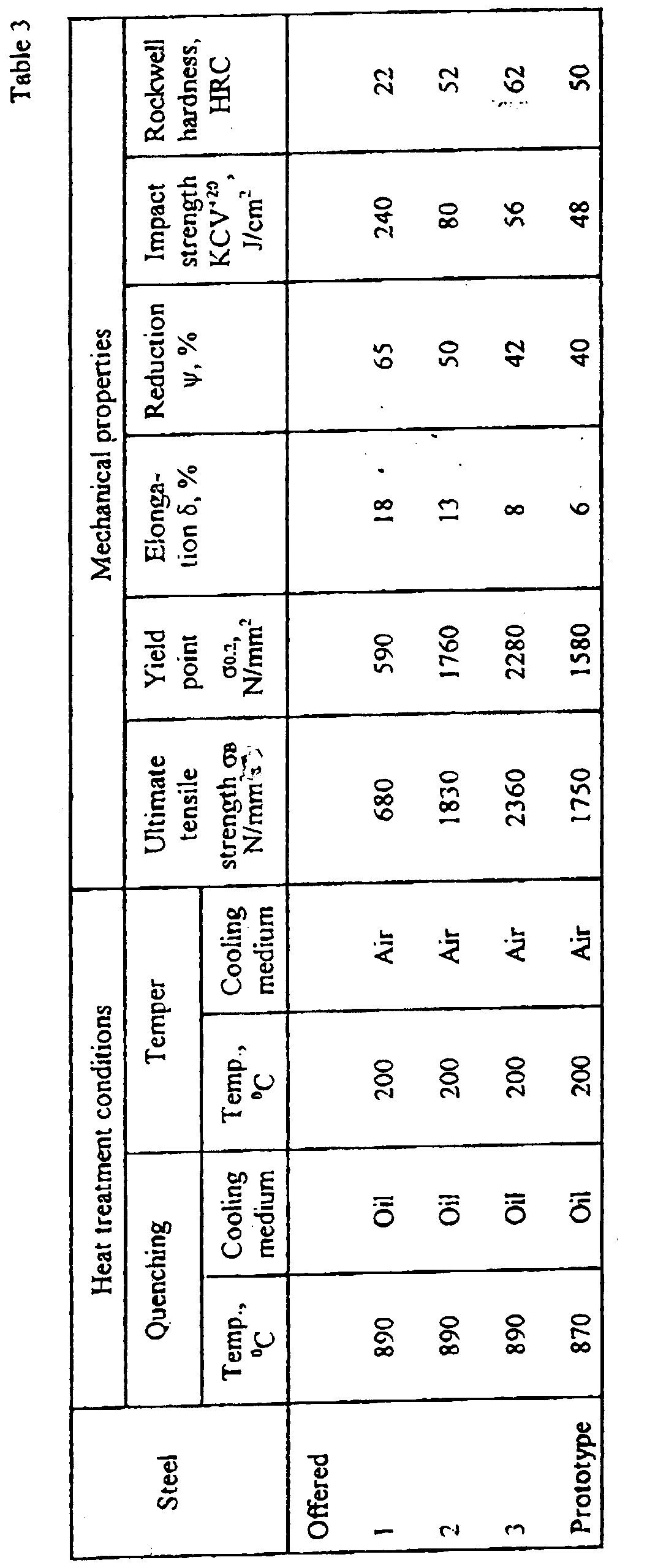
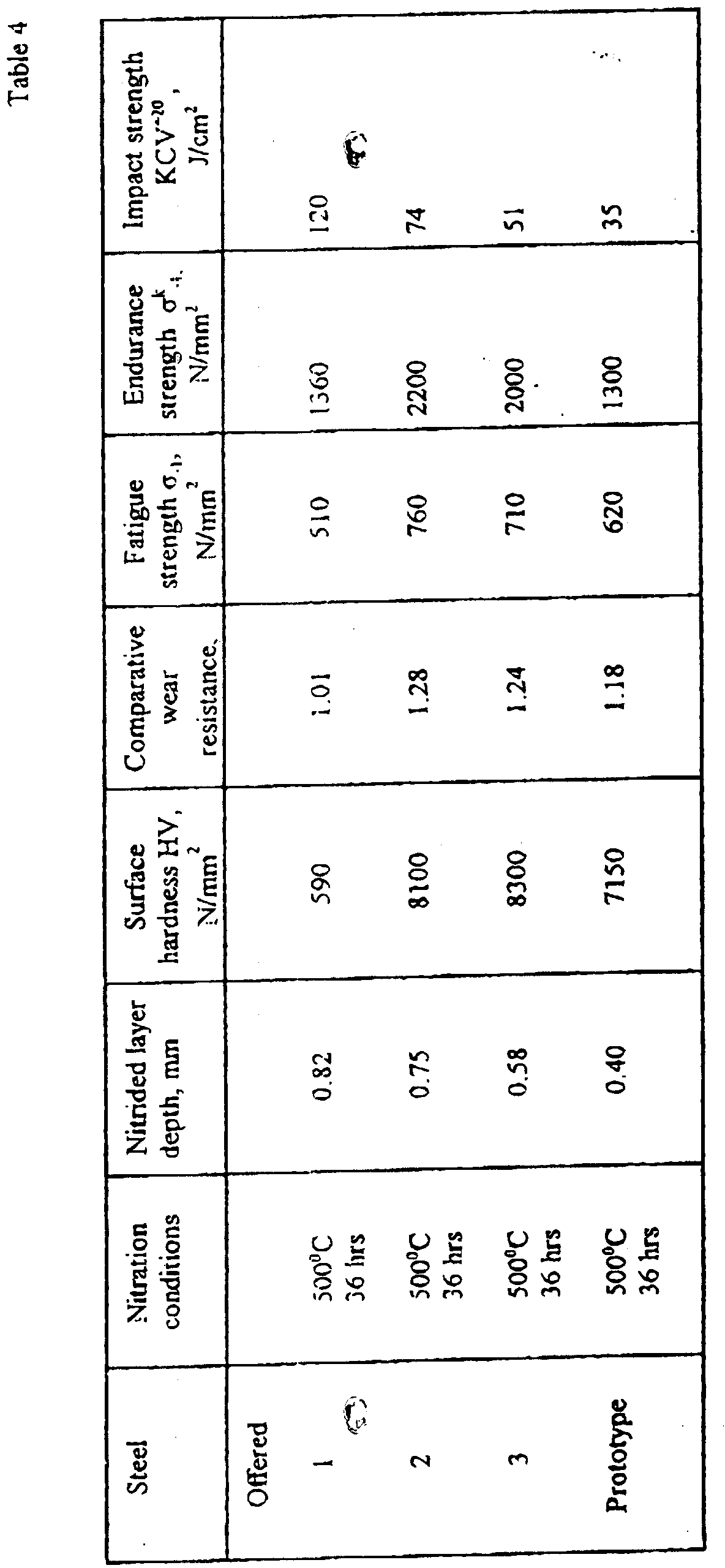
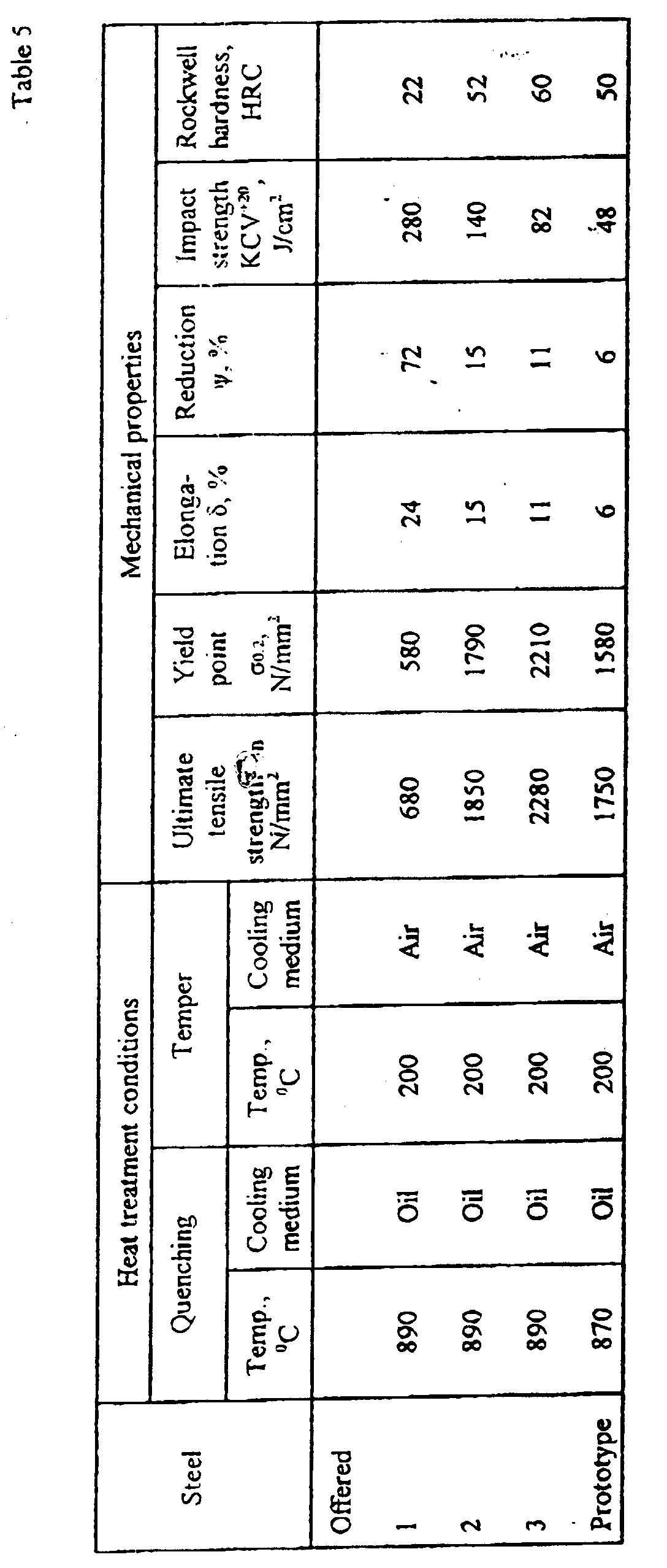
Table 6
| Steel |
Nitration conditions |
Nitrided layer depth, mm |
Surface hardness HV, N/mm2 |
Comparative wear resistance, |
Fatigue strength σ-1, N/mm2 |
Endurance strength N/mm2 |
| Offered |
|
|
|
|
|
|
| 1 |
500°C 36 hrs |
0.98 |
580 |
1.02 |
530 |
1420 |
| 2 |
500°C 36 hrs |
0.87 |
7800 |
1.31 |
890 |
2320 |
| 3 |
500°C 36 hrs |
0.74 |
7950 |
1.28 |
780 |
2200 |
| Prototype |
500°C 36 hrs |
0.40 |
7150 |
1.18 |
620 |
1300 |
1. Alloyed construction steel containing carbon, manganese, chromium, vanadium and iron,
characterized by containing, in addition, a chemical element that enhances plasticity
and boosts the nitration process, the component ratio being (wt/%):
| Carbon |
0.10-0.63 |
| Silicon |
0.20-1.20 |
| Manganese |
0.40-0.60 |
| Chromium |
0.60-3.00 |
| Plasticity-enhancing and nitration-boosting chemical element |
0.40-1.50 |
| Vanadium |
0.15-0.35 |
| Iron |
Rem. |
2. Alloyed construction steel according to claim 1, characterized by the use of copper
or germanium or as the plasticity-enhancing and nitration-boosting chemical element.
3. Alloyed construction steel according to claims 1 and 2, characterized in that the
copper content is 0.40-0.80 wt.%, provided the silicon copper ratio is maintained
at 1.5-2.5.
4. Alloyed construction steel according to claims 1 and 2, characterized in that the
germanium content is 0.60-1.50 wt.%, provided the silicon content is 0.20-0.40 wt.%.
