(57) Heretofore, an operator has been required to judge the type of image on a display
and select any of various effect processings manually, thus automation has been impossible.
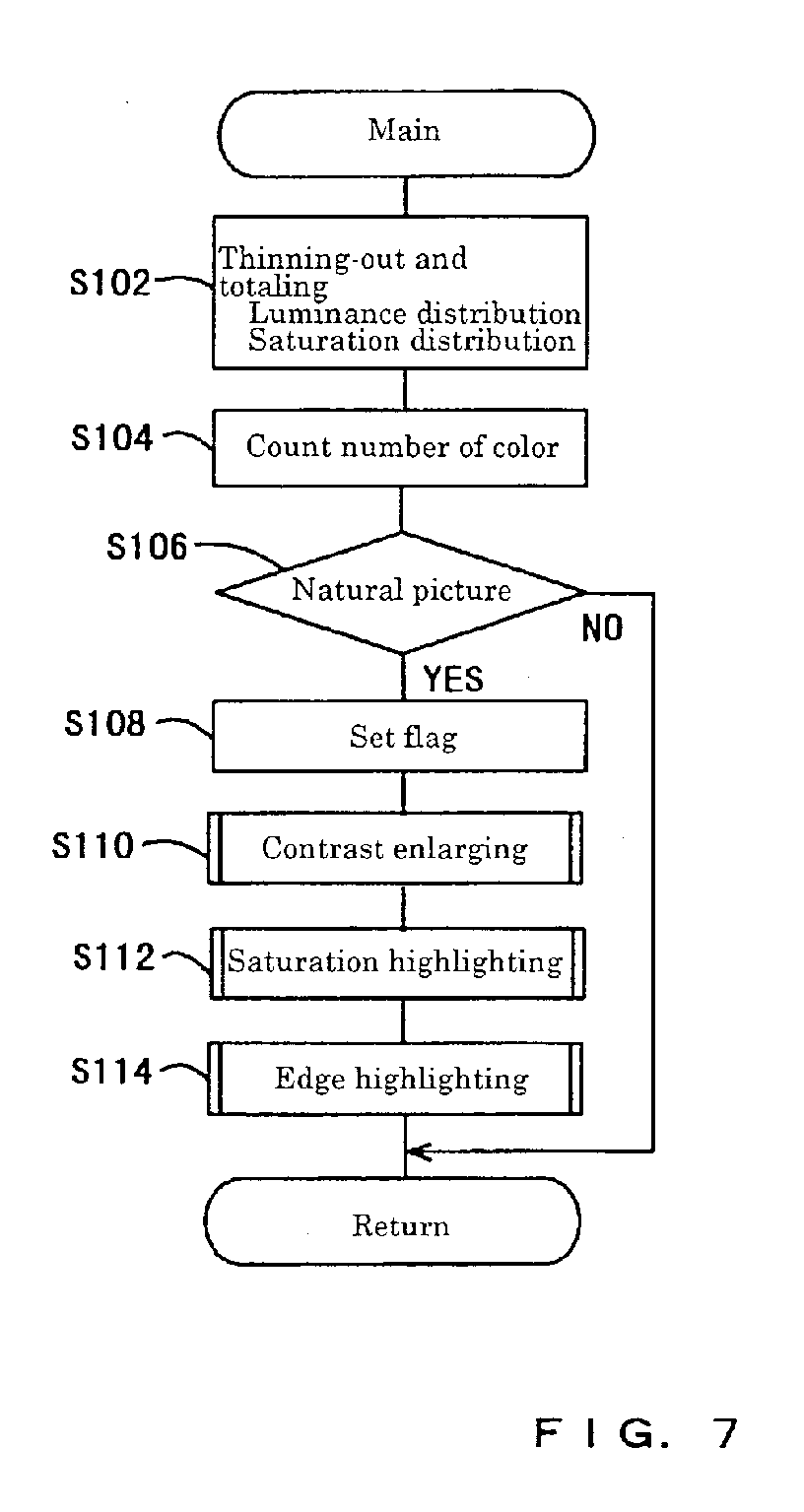
By totaling luminance values of pixels into a luminance distribution which pixels
have been selected by a thinning-out processing for image data (step S102) it becomes
possible to count the number of colors used (step S104). As a result, if the number
of colors used in image data is large, it can be judged that the image data is of
a natural picture. Besides, a contrast enlarging process (step S110), a saturation
highlighting process (step S112) and an edge highlighting process (S114), which are
suitable for application to a natural picture on the basis of the results of such
judgment, can be selected automatically while changing the respective highlighting
degrees. Also in a printing process, if an inputted image is a natural picture, there
is performed a color transformation using a pre-gray level transformation (S508),
while if the image is not a natural picture, there is performed a color transformation
using a combination of cache + interpolating operation (S506), and thus it is possible
to automatically select a color transformation processing of a small processing volume.
|
|
