| (19) |
 |
|
(11) |
EP 0 845 071 B1 |
| (12) |
EUROPEAN PATENT SPECIFICATION |
| (45) |
Mention of the grant of the patent: |
|
17.12.2003 Bulletin 2003/51 |
| (22) |
Date of filing: 13.08.1996 |
|
| (86) |
International application number: |
|
PCT/GB9601/978 |
| (87) |
International publication number: |
|
WO 9700/7318 (27.02.1997 Gazette 1997/10) |
|
| (54) |
THROUGH-TUBING LATERAL RE-ENTRY
WIEDEREINTRITT DURCH DEN TUBING IN EINEN SEITENKANAL
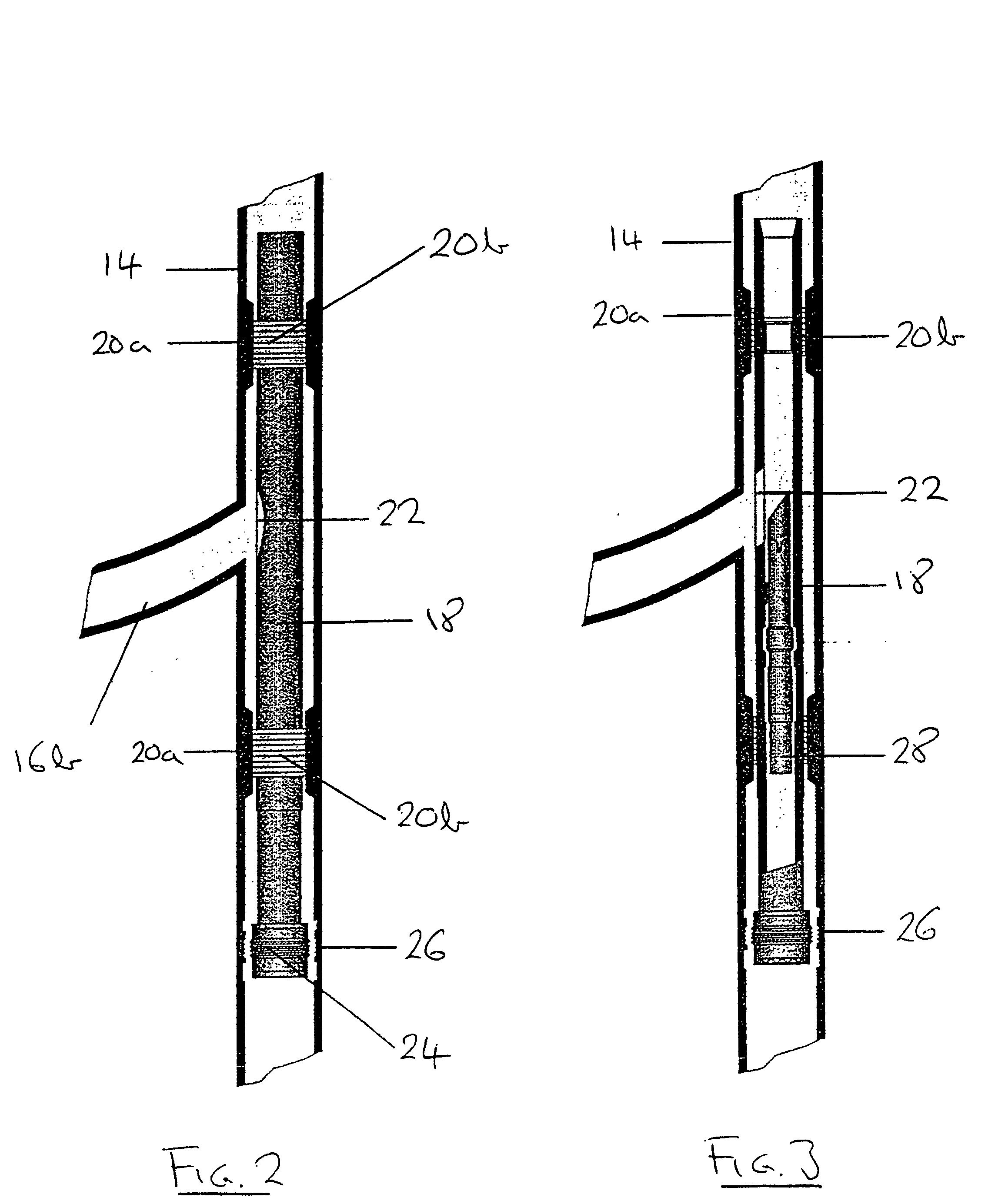
RE-ENTREE LATERALE DE TUBE TRAVERSANT
|
| (84) |
Designated Contracting States: |
|
DE FR GB IT NL |
| (30) |
Priority: |
14.08.1995 GB 9516632
|
| (43) |
Date of publication of application: |
|
03.06.1998 Bulletin 1998/23 |
| (73) |
Proprietor: Varco I/P, Inc. |
|
Houston, TX 77042 (US) |
|
| (72) |
Inventors: |
|
- MORRELL, Terence, Robert
The Old Manse
Wareham
Dorset BH20 4AG (GB)
- NORRIS, Robert, Martin
Dorset BH20 4EG (GB)
|
| (74) |
Representative: Gordon, Michael Vincent et al |
|
GILL JENNINGS & EVERY,
Broadgate House,
7 Eldon Street
London EC2M 7LH
London EC2M 7LH (GB) |
| (56) |
References cited: :
EP-A- 0 664 372
US-A- 5 195 591
|
WO-A-94/03697
US-A- 5 222 554
|
|
| |
|
|
|
|
| |
|
| Note: Within nine months from the publication of the mention of the grant of the European
patent, any person may give notice to the European Patent Office of opposition to
the European patent
granted. Notice of opposition shall be filed in a written reasoned statement. It shall
not be deemed to
have been filed until the opposition fee has been paid. (Art. 99(1) European Patent
Convention).
|
[0001] The present invention relates to through-tubing lateral re-entry, by which is meant
the ability to enter an existing lateral offshoot from a main borehole without removal
of downstream completion tubing from the main borehole.
[0002] The need for such an ability has arisen because of the increasingly common practice
of improving well output by drilling a lateral bore, or more often multiple lateral
bores, from a common main borehole in order to gain access to different levels or
zones of an oil or gas reservoir.
[0003] Typically, the main borehole, at least in the region of the multi-lateral offshoots,
can be deviated from the vertical plane or even horizontal, and the multi-lateral
offshoots can themselves be deviated from the vertical plane or even horizontal.
[0004] This means that the well needs to be serviced by coiled tube technology relying on
hydraulics, rather than by traditional wireline technology relying on gravity.
[0005] It is known for a lateral bore to be drilled by providing a steel liner for the main
borehole with a window which is closed by a softer material such as fibreglass. The
liner is also provided upstream of the window with a latch down collar having an orienting
device. Using conventional drilling technology, the steel liner is lowered into position
and then fixed in position by cement, with the window facing in a predetermined direction.
[0006] A whipstock is run down through the liner until an orienting device on the whipstock
locates with the orienting device on the liner to latch and hold the whipstock at
a desired orientation.
[0007] Next, a drill string is run down through the liner and is deflected by the whipstock
to drill through the softer material closing the window before drilling into the surrounding
stratum. After the lateral bore has been drilled, the drill string is withdrawn and
then the whipstock is retrieved leaving the latch down collar with its orienting device.
Finally, conventional completion tubing is run down through the main borehole to a
desired position downstream of the lateral bore.
[0008] There are a number of reasons why it would be desirable to be able to re-enter a
selected lateral bore after it has been drilled.
[0009] For example, there may be a wish for a particular lateral bore to be:-
a) plugged and isolated from the main borehole;
b) acid washed or stimulated to remove unwanted mud from the lateral bore or the surrounding
stratum;
c) subjected to logging to give a series of readings indicating the presence or absence
of oil or water; or
d) controlled by opening or closing a device, such as a slotted supporting sleeve,
at an interface of the lateral bore and the surrounding stratum.
[0010] There are also, however, a number of reasons why it would not be desirable to remove
the downstream completion tubing - not only does the downstream completion tubing
protect the main borehole casing from corrosive well fluids and provide total control
over the well fluids, but removal in a so-called workover can cost up to $1,000,000.
[0011] It has recently been proposed that a special small diameter whipstock be deployed
through the completion tubing and then oriented directly in the large diameter liner
to allow through-tubing lateral re-entry.
[0012] According to one aspect of the present invention, however, a method is provided for
allowing entry of an existing lateral offshoot from a main borehole, without removal
of downstream completion tubing from the main borehole, comprising the use of both
a liner and a whipstock inserted through the completion tubing to a position within
the liner, characterised in that an intermediate device has been provided which, in
use, is located between the liner and the whipstock so that the whipstock merely needs
to locate with the intermediate device rather than the liner.
[0013] Other aspects of the present invention reside in the provision of an intermediate
device for use in the method and of a well assembly resulting from use of the method.
[0014] Such an intermediate device needs to be located in the liner before the completion
tubing is located in the liner, and a separate intermediate device needs to be associated
with each of the lateral bores for which re-entry is to be required.
[0015] Nevertheless, an advantage of the present invention is that the whipstock can be
of a simple construction, because it merely needs to locate with the intermediate
device, whose inner diameter can be chosen to be compatible with that of the completion
tubing, rather than needing to locate with the much larger inner diameter of the liner.
[0016] A further advantage of the present invention, when there are multi-lateral offshoots,
is that the whipstock can be arranged to recognise each of the intermediate devices
sequentially, and locate with just a pre-selected intermediate device to provide access
to a pre-selected lateral offshoot.
[0017] Preferably, in order to avoid potential disruption caused by running tool snagging
at bends and kinks, the intermediate device has a passageway extending linearly therethrough.
[0018] Indeed, the intermediate device is preferably in the form of a hollow sleeve. It
may be locatable by packers and orientable by a gyroscope. Preferably, however, the
intermediate device has locating, latching and orienting components for co-operation
with complementary components provided by the liner.
[0019] The liner may also be provided with a protrusion, such as a polished liner nipple,
upstream of its window for sealing abutment with the outside of the intermediate device.
Preferably, however, the liner is also provided with a similar protrusion downstream
of its window, for sealing abutment with the outside of the intermediate device. Thus,
the intermediate device needs to be itself provided with a window.
[0020] The above-noted orientation ensures that the window in the intermediate device is
aligned with the window in the liner.
[0021] Preferably, the whipstock has locating, latching and orienting components for co-operation
with complementary components provided by the intermediate device.
[0022] As already indicated, the whipstock is adapted to recognise each of the intermediate
devices sequentially to enable locating, latching and orienting with just a pre-selected
intermediate device to provide access to a pre-selected lateral offshoot.
[0023] Indeed, said recognition preferably involves the use of locator keys of different
profile rather than passageways of different diameter. The locator keys on the whipstock
can stop and latch out when they see a matching profile on the intermediate device.
By avoiding the use of passageways of progressively decreasing diameter, there are
no restrictions on the number of intermediate devices before running tool progress
through the passageways is blocked.
[0024] The locating, latching and orienting components provided by the whipstock can all
be of known type including, in addition to the locator keys, a trigger for moving
along a helix presented by the intermediate device to orient the deflecting surface
of the whipstock, which can also have a known type of releasable connection with the
running tool.
[0025] The intermediate device preferably also has parts thereof adapted for co-operation
with plugs and an isolation sleeve to enable the lateral offshoot to be sealed off
from the main borehole.
[0026] An example of through-tubing lateral re-entry according to the present invention
is shown in the accompanying drawings wherein:-
Figure 1 shows a typical oil well completion with two lateral bores;
Figure 2 shows an intermediate device associated with one of the lateral bores of
Figure 1; and
Figure 3 shows a whipstock associated with the intermediate device of Figure 2.
[0027] In the accompanying drawings, conventional completion tubing 10 is shown extending
through a main borehole casing 12 into a liner 14 from which extend two lateral bores
16a, 16b.
[0028] Although the liner 14 is shown in a vertical position in Figure 1 it is more likely
in practice to extend horizontally.
[0029] As shown in Figure 2, an intermediate device 18 is located in the liner 14 opposite
the lateral bore 16b. The liner 14 is formed with a pair of inwardly projecting protrusions
20a for abutment with complementary parts 20b of the intermediate device 18. The intermediate
device 18 is also formed with a window 22 as well as a lower (upstream) locating,
latching and orienting device 24 for co-operation with a latch down collar and orienting
device 26 provided by the liner 14.
[0030] A whipstock 28 can be pushed by coiled tubing, acting as a running tool, through
the completion tubing 10 and into the lower end of the intermediate device 18. The
whipstock 28 can now be located, latched and oriented by co-operation of complementary
components provided by the whipstock 28 and the intermediate device 18 when the coiled
tubing is pulled upwards.
[0031] It will be appreciated that it is now possible for further operating equipment to
be run through the completion tubing 10 and be deflected by the whipstock 28 thereby
achieving through-tubing lateral re-entry.
1. A method for allowing entry of an existing lateral offshoot from a main borehole,
without removal of downstream completion tubing from the main borehole, comprising
the use of both a liner (14) and a whipstock (28) inserted through the completion
tubing (10) to a position within the liner (14), characterised in that an intermediate device (18) comprises a hollow sleeve being linear along an entire
length thereof and having a window (22) positioned between a deflecting surface of
the whipstock (28) and an associated window through the liner (14), the intermediate
device (18) having at least one part (20b) thereof adapted for sealing abutment with
a protrusion (20a) projecting inwardly of the liner (14) so that the whipstock (28)
locates with the intermediate device (18) rather than the liner (14) to allow entry
of an existing lateral offshoot without removal of the completion tubing.
2. A method according to claim 1, characterised in that the intermediate device (18) has parts thereof adapted for co-operation with plugs
and an isolation sleeve to enable the lateral offshoot to be sealed off from the main
borehole.
3. A method according to claim 1, characterised in that the intermediate device (18) has locating, latching and orienting components (24)
for co-operation with complementary components (26) provided by the liner (14).
4. A method according to claim 1, characterised in that the intermediate device (18) has' a passageway extending linearly therethrough.
5. A method according to claim 1, characterised in that the whipstock (28) has locating, latching and orienting components for co-operation
with complementary components provided by the intermediate device (18).
6. A method according to claim 5, characterised in that the whipstock (28) is adapted to recognise each of the intermediate devices (18)
sequentially to enable locating, latching and orienting with just a pre-selected intermediate
device (18) to provide access to a preselected lateral offshoot (16a, 16b)
7. A method according to claim 6, characterised in that said recognition involves the use of locator keys of different profile rather than
passageways of different diameter.
8. A method according to claim 1, characterised in that a separate intermediate device (18) is provided for each of a plurality of lateral
offshoots (16a, 16b).
9. A method according to claim 8, characterised in that the whipstock (18) is adapted to recognise each of the intermediate devices (18)
sequentially to enable locating, latching and orienting with just a pre-selected intermediate
device (18) to provide access to a pre-selected lateral offshoot (16a, 16b)
10. A method according to claim 9, characterised in that said recognition involves the use of locator keys of different profile rather than
passageways of different diameter.
1. Verfahren, mit dem ein vorhandenes seitliches Zweigrohr von einem Hauptbohrloch aus
ohne Herausnahme eines stromab befindlichen Vervollständigungsrohrs aus einem Hauptbohrloch
eingebracht werden kann, mit der Verwendung sowohl einer Linerhülse (14) als auch
eines durch das Vervollständigungsrohr (10) bis zu einer Stelle innerhalb der Linerhülse
(14) eingeführten Richtkeils (28), dadurch gekennzeichnet, daß eine Zwischenvorrichtung (18) eine hohle Hülse umfaßt, die längs einer gesamten Länge
derselben linear ist und ein zwischen einer Ablenkfläche des Richtkeils (28) und einem
durch die Linerhülse (14) hindurch führenden zugeordneten Fenster (22) positioniertes
Fenster aufweist, wobei an der Zwischenvorrichtung (18) mindestens ein Teil (20b)
derselben zur abdichtenden Anlage mit einem von der Linerhülse (14) nach innen vorstehenden
Vorsprung (20a) eingerichtet ist, so daß sich der Richtkeil (28) mit der Zwischenvorrichtung
(18) anordnet und nicht mit der Linerhülse (14), so daß ein vorhandenes seitliches
Zweigrohr eingebracht werden kann, ohne daß das Vervollständigungsrohr herausgenommen
wird.
2. Verfahren nach Anspruch 1, dadurch gekennzeichnet, daß bei der Zwischenvorrichtung (18) Teile derselben zum Zusammenwirken mit Stopfen und
mit einer Isolierhülse eingerichtet sind, so daß das seitliche Zweigrohr gegen das
Hauptbohrloch abgedichtet werden kann.
3. Verfahren nach Anspruch 1, dadurch gekennzeichnet, daß die Zwischenvorrichtung (18) Festlegungs-, Einschnapp- und Ausrichtungsteile (24)
zum Zusammenwirken mit durch die Linerhülse (14) bereitgestellten komplementären Teilen
(26) aufweist.
4. Verfahren nach Anspruch 1, dadurch gekennzeichnet, daß die Zwischenvorrichtung (18) einen linear durch diese hindurch verlaufenden Kanal
aufweist.
5. Verfahren nach Anspruch 1, dadurch gekennzeichnet, daß der Richtkeil (28) Festlegungs-, Einschnapp- und Ausrichtungsteile zum Zusammenwirken
mit durch die Zwischenvorrichtung (18) bereitgestellten komplementären Teilen aufweist.
6. Verfahren nach Anspruch 5, dadurch gekennzeichnet, daß der Richtkeil (28) jede der Zwischenvorrichtungen (18) nacheinander erkennen kann,
um das Festlegen, Einschnappen und Ausrichten mit nur einer vorgewählten Zwischenvorrichtung
(18) zu ermöglichen, um für den Zugang zu einem vorgewählten seitlichen Zweigrohr
(16a, 16b) zu sorgen.
7. Verfahren nach Anspruch 6, dadurch gekennzeichnet, daß bei der Erkennung Festlegungskeile mit unterschiedlichem Profil und keine Kanäle
mit unterschiedlichem Durchmesser verwendet werden.
8. Verfahren nach Anspruch 1, dadurch gekennzeichnet, daß eine gesonderte Zwischenvorrichtung (18) für jedes von mehreren seitlichen Zweigrohren
(16a, 16b) vorgesehen ist.
9. Verfahren nach Anspruch 8, dadurch gekennzeichnet, daß der Richtkeil (28) jede der Zwischenvorrichtungen (18) nacheinander erkennen kann,
um das Festlegen, Einschnappen und Ausrichten mit nur einer vorgewählten Zwischenvorrichtung
(18) zu ermöglichen, um für den Zugang zu einem vorgewählten seitlichen Zweigrohr
(16a, 16b) zu sorgen.
10. Verfahren nach Anspruch 9, dadurch gekennzeichnet, daß bei der Erkennung Festlegungskeile mit unterschiedlichem Profil und keine Kanäle
mit unterschiedlichem Durchmesser verwendet werden.
1. Procédé pour permettre une entrée d'une ramification latérale existante à partir d'un
forage principal, sans enlever du forage principal le tubage d'achèvement situé en
aval, comprenant l'utilisation à la fois d'une colonne perdue (14) et d'un sifflet
déviateur (28) inséré par le tubage d'achèvement (10) jusqu'à une position située
à l'intérieur de la colonne perdue (14), caractérisé en ce qu'un dispositif intermédiaire (18) comprend un manchon creux droit sur toute sa longueur
et présentant une fenêtre (22) positionnée entre une surface de déflexion du sifflet
déviateur (28) et une fenêtre associée percée à travers la colonne perdue (14), au
moins une partie (20b) du dispositif intermédiaire (18) étant adaptée pour une butée
étanche avec une protubérance (20a) faisant saillie vers l'intérieur de la colonne
perdue (14), de sorte que le sifflet déviateur (28) se positionne par rapport au dispositif
intermédiaire (18), plutôt que par rapport à la colonne perdue (14), pour permettre
une entrée d'une ramification latérale existante sans enlever le tubage d'achèvement.
2. Procédé selon la revendication 1, caractérisé en ce que le dispositif intermédiaire (18) présente des parties adaptées pour coopérer avec
des bouchons et un manchon d'isolation pour permettre à la ramification latérale d'être
entièrement étanchée par rapport au forage principal.
3. Procédé selon la revendication 1, caractérisé en ce que le dispositif intermédiaire (18) dispose d'organes (24) de localisation, de verrouillage
et d'orientation, pour coopérer avec des organes complémentaires (26) fournis par
la colonne perdue (14).
4. Procédé selon la revendication 1, caractérisé en ce que le dispositif intermédiaire (18) présente un chemin de passage qui le traverse linéairement.
5. Procédé selon la revendication 1, caractérisé en ce que le sifflet déviateur (28) dispose d'organes de localisation, de verrouillage et d'orientation,
pour coopérer avec des organes complémentaires fournis par le dispositif intermédiaire
(18).
6. Procédé selon la revendication 5, caractérisé en ce que le sifflet déviateur (28) est adapté pour reconnaître chacun des dispositifs intermédiaires
(18) de manière séquentielle, pour permettre la localisation, le verrouillage et l'orientation
avec précisément un dispositif intermédiaire (18) présélectionné, pour permettre un
accès à une ramification latérale (16a, 16b) présélectionnée.
7. Procédé selon la revendication 6, caractérisé en ce que ladite reconnaissance implique l'utilisation de clés de localisation de profils différents,
plutôt que des chemins de passages de diamètres différents.
8. Procédé selon la revendication 1, caractérisé en ce qu'un dispositif intermédiaire (18) séparé est prévu pour chacune des multiples ramifications
latérales (16a, 16b) .
9. Procédé selon la revendication 8, caractérisé en ce que le sifflet déviateur (28) est adapté pour reconnaître chacun des dispositifs intermédiaires
(18), de manière séquentielle, pour permettre la localisation, le verrouillage et
l'orientation avec précisément un dispositif intermédiaire (18) présélectionné, pour
permettre un accès à une ramification latérale (16a, 16b) présélectionnée.
10. Procédé selon la revendication 9, caractérisé en ce que ladite reconnaissance implique l'utilisation de clés de localisation de profils différents,
plutôt que de chemins de passages de diamètres différents.