|
(11) | EP 0 845 911 B1 |

| (12) | EUROPEAN PATENT SPECIFICATION |
|
|
| (54) |
Device for displaying 3d images Anzeigegerät für 3D-Bilder Appareil d'affichage d'images 3D |
|
|
|||||||||||||||||||||||||||||||
| Note: Within nine months from the publication of the mention of the grant of the European patent, any person may give notice to the European Patent Office of opposition to the European patent granted. Notice of opposition shall be filed in a written reasoned statement. It shall not be deemed to have been filed until the opposition fee has been paid. (Art. 99(1) European Patent Convention). |
[0001] The present invention relates to a device for displaying a sequence of 3D images on the basis of a first sequence of source images corresponding to the left eye and of a second sequence of source images corresponding to the right eye of an observer, said source images being conveyed respectively by a video signal S1 and by a video signal S2 of respective luminous intensities E1 and E2 and either emanate from reception and/or decoding units which split the light along a first analysis path for light corresponding to the left eye and along a second analysis path corresponding to the right eye of the observer, or are produced in a manner known per se by electronic means of image synthesis.
[0002] The 3D display or stereoscopic display of images usually consists in viewing on one and the same device a series of images corresponding to the right eye and a series of images corresponding to the left eye of an observer. These two video sequences are in general captured or generated in such a way as to make it possible to conply with the geometry of human vision so that the offsets between the left view and the right view of the observer are reconstructed correctly by the psychovisual process which allows stereoscopic vision.
[0003] Among the known solutions for generating a luminous signal compatible with stereoscopic vision, the double-display or double-projection devices display the two video sequences simultaneously. The two paths are combined by polarizing one of these two paths in a first specified direction and by polarizing the other path in a second direction orthogonal to the first direction. Separation of the two paths, at the observer, is achieved by appropriate polarizing glasses. These devices have the drawback, however, of duplicating the number of image generator devices which may be, for example, television type monitors stationed symmetrically on each side of a semi-reflecting plate, so that the screens appear merged from the viewpoint of the observer. In this case, it is necessary to station a polarizing filter in front of each screen so as to create the desired polarization orientation. The image generator devices may also consist of two video projectors. In this case, it is necessary to fit out each beam with an appropriate polarizing filter. Furthermore, projection must be carried out onto a special screen so as to preserve the orientation of the polarization. This considerably raises the complexity and cost of such devices.
[0004] Other known solutions use either time-sequencing devices or spatial-interlacing devices. In the first case, the images are time-division multiplexed for example, by interlacing, on one and the same signal and at video rate, video signals corresponding respectively to the right eye and left eye of the observer. Said paths are separated in general by special glasses which block off the right eye and the left eye alternately and in synchronism with the interlacing. In a manner known per se, the blocking off of a path is achieved by stationing a liquid crystal cell between a polarizer and an analyser. The rotation (by 90°) or non-rotation of the polarization by the liquid crystal makes it possible to render the glass passing or blocking at the desired rate. A major drawback of this type of device stems from the fact that the apparent frequency of display (for each eye) is halved as compared with non-stereoscopic display.
[0005] As far as the spatial-interlacing devices are concerned, they consist of micropolarizing halftone filters enabling each R, G or B sub-pixel of an image to be assigned an identified polarization direction. Multiplexing the signals S1 and S2 in tandem with the polarization frame makes it possible to generate a suitable luminous signal. In these types of device, the apparent spatial resolution (for each eye) is halved as compared with non-stereoscopic display.
[0006] The purpose of the invention is to alleviate the drawbacks of the prior art devices by means of a compact device which makes it possible to preserve the frequency of display and the resolution of the images to be displayed at least at the same level as those achieved by non-stereoscopic devices.
[0008] The display device according to the invention includes a first means of calculation intended to generate from said video signals S1 and S2 a video signal S having an overall luminous intensity E calculated as a function of the luminous intensities E1 and E2, said first means of calculation co-operating with a second means of calculation in such a way as to split, for each pixel, the overall luminous intensity E in proportion to the luminous intensities E1 and E2.
[0009] The display of 3D images is carried out according to a process which includes the following steps :
- for each pixel of the image to be displayed, a video signal S having an overall luminous intensity E calculated as a function of the luminous intensities E1 and E2 is generated from the video signals S1 and S2, and then
- said overall luminous intensity E is split over each analysis path in proportion to the luminous intensities E1 and E2.
[0010] Thanks to the device and the process in accordance with the invention, the frequency of display and the apparent spatial resolution of the image are kept identical to those of the video signals representing the source images. Furthermore, with the device of the invention, it is no longer necessary to duplicate the image-generating source. This makes it possible appreciably to simplify the structure of the device for displaying images in 3D, and hence to reduce the cost of their manufacture.
[0011] Other characteristics and advantages of the invention will emerge from the description which follows, taken by way of non-limiting example with reference to the appended figure diagrammatically representing a device for generating 3D images in accordance with the invention.
[0012] The device of Figure 1 represents a device for displaying a sequence of 3D images on the basis of a first sequence of source images corresponding to the left eye and of a second sequence of source images corresponding to the right eye of an observer. These source images are conveyed respectively by a video signal S1 and by a video signal S2 of respective luminous intensities E1 and E2 and are delivered, for example, by reception/decoding units 2 and 4.
[0013] As may be seen in Figure 1, each of the reception/decoding units 2 and 4 is linked, on the one hand, to a first means of calculation 6 and, on the other hand, to a second means of calculation 8. The output of the first means of calculation 6 is linked to the input of a first module for correcting non-linearities 10, the output of which is linked to a viewing unit 12, whilst the output of the second means of calculation 8 is linked to the input of a second module for correcting non-linearities 14, the output of which is linked to a polarization orientation element 16.
[0014] The first means of calculation 6 is intended to generate a luminous signal S having an overall luminous intensity proportional to the quadratic sum of the luminous intensities E1 and E2. This signal S drives the viewing unit 12 which is mounted in cascade with the polarization orientation unit 16. This polarization orientation unit 16 is controlled by signals generated by the second means of calculation 8 in such a way as to split, for each pixel, the luminous intensity transmitted by the viewing unit 12, in proportion to the luminous intensities E1 and E2, over a first analysis path corresponding to the left eye and over a second analysis path corresponding to the right eye of the observer. A conjugation element 18, intended to optimize the luminous flow exiting from the viewing unit 12, can be inserted between this viewing unit 12 and the polarization orientation unit 16.
[0015] According to a preferred embodiment of the invention, the viewing unit 12 consists of a polarized emissive element such as, for example, a first LCD screen, whilst the polarization orientation unit 16 consists of a second LCD screen. This second LCD screen is of the twisted nematic type and possesses a geometry identical to that of the first LCD screen 12. Furthermore, the second LCD screen 16 is controlled in such a way as to effect a suitable polarization orientation for each pixel or sub-pixel of the image. We note, however, that it is possible to use, by way of polarized emissive element, a polarized television tube, a tube or a projector valve. Moreover, in order that the transmitted luminous signal should retain its polarization during its propagation, the element for orienting the polarization does not include any analyser at exit.
[0016] As was stated above, the images conveyed by the signals S1 and S2 are either received from a transmitter or are synthesized by an electronic device for image synthesis. In both cases, the signals S1 and S2 are provided simultaneously, on the one hand, to the first means of calculation 6 and, on the other hand, to the second means of calculation 8. If the overall electric field required in order to display a pixel P is represented by the vector
, and the luminous electric fields corresponding to the video signals S1 and S2 are represented respectively by the vectors
1 and
2, said overall field can be expressed through the vector relation :
The first means of calculation 6 makes it possible to calculate the intensity of this overall electric field given by the expression :
where k is a coefficient of proportionality.
[0017] Whilst the second means of calculation makes it possible to calculate the angle
where k' is a coefficient of proportionality. The angle a represents the orientation of the electric field
required in order to split the intensity E over each of the analysis paths so that the energy perceived on the first path is proportional to the intensity E1 and that the energy perceived on the second path is proportional to the intensity E2.
1. Device for displaying a sequence of 3D images on the basis of a first sequence of
source images corresponding to the left eye and a second sequence of source images
corresponding to the right eye of an observer, said source images being conveyed respectively
by a video signal S1 and by a video signal S2 of respective luminous intensities E1 and E2, characterized in that it includes a first means of calculation (6) intended to generate from said video
signals S1 and S2 a video signal S having an overall luminous intensity E calculated as a function
of the luminous intensities E1 and E2, said means of calculation (6) co-operating with a second means of calculation (8)
in such a way as to split, for each pixel, the overall luminous intensity E in proportion
to the luminous intensities E1 and E2.
2. Device according to Claim 1, characterized in that it includes a viewing unit (12) mounted in cascade with a polarization orientation
element (16), said viewing unit (12) being driven by the signal S, whilst the polarization
orientation element (16) is controlled by signals generated by the second means of
calculation (8).
3. Device according to Claim 2, characterized in that the viewing unit (12) consists of a polarized emissive element.
4. Device according to Claim 3, characterized in that the polarized emissive element (12) is a first LC device.
5. Device according to Claim 2, characterized in that the polarization orientation unit (16) consists of a second LC device of twisted
nematic type.
6. Device according to one of Claims 2 to 5, characterized in that it includes a conjugation element disposed between the viewing unit (12) and the
polarization orientation element (16) and intended to optimize the luminous flow exiting
from said viewing unit (12).
7. Process for generating 3D images from a first sequence of source images intended for
a first analysis path for light corresponding to the left eye and from a second sequence
of source images intended for a second analysis path corresponding to the right eye
of an observer, said source images being conveyed respectively by a video signal S1 and by a video signal S2 of respective luminous intensities E1 and E2, characterized in that, for each pixel, a video signal S having an overall luminous intensity E calculated
as a function of the luminous intensities E1 and E2 is generated from the video signals S1 and S2, and then said overall luminous intensity E is split over each analysis path in proportion
to the luminous intensities E1 and E2.
8. Process according to Claim 7, characterized in that the overall luminous intensity E is calculated by forming the quadratic sum
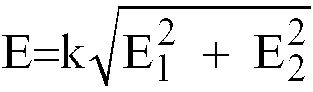
where k is a coefficient of proportionality, and a viewing unit (12) is then controlled on the basis of the overall luminous intensity E calculated.
where k is a coefficient of proportionality, and a viewing unit (12) is then controlled on the basis of the overall luminous intensity E calculated.
9. Process according to either of Claims 7 and 8, characterized in that said overall luminous intensity E is split over each analysis path by modifying the
polarization angle of the luminous signal S.
10. Process according to Claim 9, characterized in that the polarization of the signal S is modified by calculating, for each signal S generated,
the angle
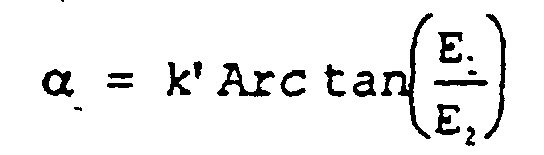
where k' is a coefficient of proportionality, and a polarization orientation element (16) is then controlled on the basis of the angle α calculated.
where k' is a coefficient of proportionality, and a polarization orientation element (16) is then controlled on the basis of the angle α calculated.
1. Vorrichtung zur Wiedergabe einer Folge von 3D-Bildern aus einer ersten Folge von Quellenbildern,
die dem linken Auge entsprechen, und einer zweiten Folge von Quellenbildern, die dem
rechten Auge eines Betrachters entsprechen, wobei die Quellenbilder durch ein Videosignal
S1 bzw. ein Videosignal S2 mit Helligkeitswerten E1 bzw. E2 übertragen werden,
gekennzeichnet durch
Berechnungsmittel (6), um aus den Videosignalen S1 und S2 ein Videosignal S mit einem Gesamthelligkeitswert E zu erzeugen, der in Abhängigkeit von den Helligkeitswerten E1 und E2 berechnet wird, wobei die Berechnungsmittel (6) mit zweiten Berechnungsmitteln (8) derart zusammenarbeiten, daß für jedes Pixel der Gesamthelligkeitswert E proportional zu den Helligkeitswerten E1 und E2 aufgeteilt wird.
gekennzeichnet durch
Berechnungsmittel (6), um aus den Videosignalen S1 und S2 ein Videosignal S mit einem Gesamthelligkeitswert E zu erzeugen, der in Abhängigkeit von den Helligkeitswerten E1 und E2 berechnet wird, wobei die Berechnungsmittel (6) mit zweiten Berechnungsmitteln (8) derart zusammenarbeiten, daß für jedes Pixel der Gesamthelligkeitswert E proportional zu den Helligkeitswerten E1 und E2 aufgeteilt wird.
2. Vorrichtung nach Anspruch 1, gekennzeichnet durch eine Betrachtungseinheit (12) in Kaskade mit einem Element (16) zur Polarisationsausrichtung,
wobei die Betrachtungseinheit (12) durch das Signal S gesteuert wird, während das Element (16) für die Polarisationsausrichtung
durch Signale gesteuert wird, die durch die zweiten Berechnungsmittel (8) erzeugt werden.
3. Vorrichtung nach Anspruch 2, dadurch gekennzeichnet, daß die Betrachtungseinheit (12) aus einem polarisierten Emissionselement besteht.
4. Vorrichtung nach Anspruch 3, dadurch gekennzeichnet, daß das polarisierte Emissionselement (12) ein erster LCD-Schirm ist.
5. Vorrichtung nach Anspruch 2, dadurch gekennzeichnet, daß die Einheit (16) für die Polarisationsausrichtung aus einem zweiten LCD-Schirm oder
einem Schirm vom tordierten nematischen Typ besteht.
6. Vorrichtung nach einem der Ansprüche 1 bis 5, gekennzeichnet durch ein Konjugationselement zwischen dem ersten LCD-Schirm (12) und dem zweiten LCD-Schirm
(16) zur Optimierung des Helligkeitsflusses, der von dem ersten LCD-Schirm (12) ausgeht.
7. Verfahren zur Erzeugung von 3D-Bildern aus einer ersten Folge von Quellenbildern für
einen ersten Analyseweg für Licht entsprechend dem linken Auge und aus einer zweiten
Folge von Quellenbildern für einen zweiten Analyseweg entsprechend dem rechten Auge
eines Betrachters, wobei die Quellenbilder über ein Videosignal S1 bzw. über ein Videosignal S2 mit Helligkeitswerten E1 bzw. E2 übertragen werden, dadurch gekennzeichnet, daß für jedes Pixel ein Videosignal S mit einem Gesamthelligkeitswert E, der in Abhängigkeit
von den Helligkeitswerten E1 und E2 berechnet wird, aus den Videosignalen S1 und S2 erzeugt wird und dann der Gesamt-Helligkeitswert E über jeden Analyseweg proportional
zu den Helligkeitswerten E1 und E2 aufgeteilt wird.
8. Verfahren nach Anspruch 7, dadurch gekennzeichnet, daß der Gesamt-Helligkeitswert E durch Bildung der Quadratsumme
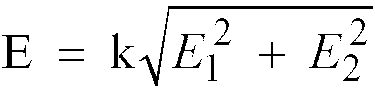
berechnet wird, wobei k ein Proportionalitätskoeffizient ist und eine Betrachtungseinheit (12) dann aus dem Gesamt-Helligkeitswert E berechnet wird.
berechnet wird, wobei k ein Proportionalitätskoeffizient ist und eine Betrachtungseinheit (12) dann aus dem Gesamt-Helligkeitswert E berechnet wird.
9. Verfahren nach einem der Ansprüche 7 und 8, dadurch gekennzeichnet, daß der Gesamt-Helligkeitswert E durch Änderung des Polarisationswinkels des Helligkeitssignals
S auf jeden Analyseweg aufgeteilt wird.
10. Verfahren nach Anspruch 9, dadurch gekennzeichnet, daß die Polarisation des Signals S durch Berechnung, für jedes erzeugte Signal S, des
Winkels
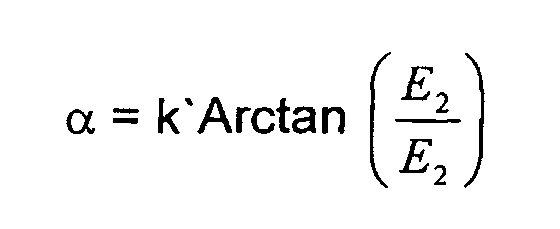
geändert wird,
wobei k' ein Proportionalitätskoeffizient ist und ein Element (16) für die Polarisationsausrichtung dann aus dem berechneten Winkel α gesteuert wird.
geändert wird,
wobei k' ein Proportionalitätskoeffizient ist und ein Element (16) für die Polarisationsausrichtung dann aus dem berechneten Winkel α gesteuert wird.
1. Appareil d'affichage d'une séquence d'images 3D sur la base d'une première séquence
d'images source correspondant à l'oeil gauche et d'une seconde séquence d'images source
correspondant à l'oeil droit d'un observateur, lesdites images source étant transportées,
respectivement, par un signal vidéo S1 et un signal vidéo S2 d'intensités lumineuses respectives E1 et E2, caractérisé en ce qu'il inclut un premier moyen de calcul (6) ayant pour objectif de générer, à partir
desdits signaux vidéo S1 et S2, un signal vidéo S possédant une intensité lumineuse globale E calculée comme une
fonction des intensités lumineuses E1 et E2, ledit moyen de calcul (6) coopérant avec un second moyen de calcul (8) de manière
à répartir, pour chaque pixel, l'intensité lumineuse globale E proportionnellement
aux intensités lumineuses E1 et E2.
2. Appareil selon la revendication 1, caractérisé en ce qu'il inclut une unité de visualisation (12) montée en cascade avec un élément d'orientation
de polarisation (16), ladite unité de visualisation (12) étant pilotée par le signal
S, tandis que l'élément d'orientation de polarisation (16) est contrôlé par des signaux
générés par le second moyen de calcul (8).
3. Appareil selon la revendication 2, caractérisé en ce que l'unité de visualisation (12) est composée d'un élément émissif polarisé.
4. Appareil selon la revendication 3, caractérisé en ce que l'élément émissif polarisé (12) est un premier écran LCD.
5. Appareil selon la revendication 4, caractérisé en ce que l'unité d'orientation de polarisation (16) est composée d'un second écran LCD de
type nématique en hélice.
6. Appareil selon l'une des revendications 1 à 5, caractérisé en ce qu'il inclut un élément de conjugaison disposé entre le premier écran LCD (12) et le
second écran LCD (16) et ayant pour objectif d'optimiser le flux lumineux quittant
le premier écran LCD (12).
7. Procédé de génération d'images 3D à partir d'une première séquence d'images source
destinées à un premier chemin d'analyse de la lumière correspondant à l'oeil gauche
et à partir d'une seconde séquence d'images source destinées à un second chemin d'analyse
correspondant à l'oeil droit d'un observateur, lesdites images source étant transportées,
respectivement, par un signal vidéo S1 et par un signal vidéo S2 d'intensités lumineuses
respectives E1 et E2, caractérisé en ce que, pour chaque pixel, un signal vidéo S possédant une intensité lumineuse globale E
calculée comme une fonction des intensités lumineuses E1 et E2 est généré à partir des signaux vidéo S1 et S2, puis ladite intensité lumineuse globale
E est répartie sur chaque chemin d'analyse proportionnellement aux intensités lumineuses
E1 et E2.
8. Procédé selon la revendication 7, caractérisé en ce que l'intensité lumineuse globale E est calculée en formant la somme quadratique
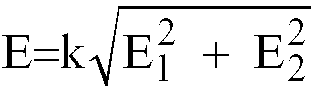
où k est un coefficient de proportionnalité, et une unité de visualisation (12) est ensuite contrôlée en fonction de l'intensité lumineuse globale E calculée.
où k est un coefficient de proportionnalité, et une unité de visualisation (12) est ensuite contrôlée en fonction de l'intensité lumineuse globale E calculée.
9. Procédé selon la revendication 7 ou 8, caractérisé en ce que ladite intensité lumineuse globale E est répartie sur chaque chemin d'analyse en
modifiant l'angle de polarisation du signal lumineux S.
10. Procédé selon la revendication 9, caractérisé en ce que la polarisation du signal S est modifiée par le calcul, pour chaque signal S généré,
de l'angle

où k' est un coefficient de proportionnalité, et un élément d'orientation de polarisation (16) est ensuite contrôlé en fonction de l'angle α calculé.
où k' est un coefficient de proportionnalité, et un élément d'orientation de polarisation (16) est ensuite contrôlé en fonction de l'angle α calculé.