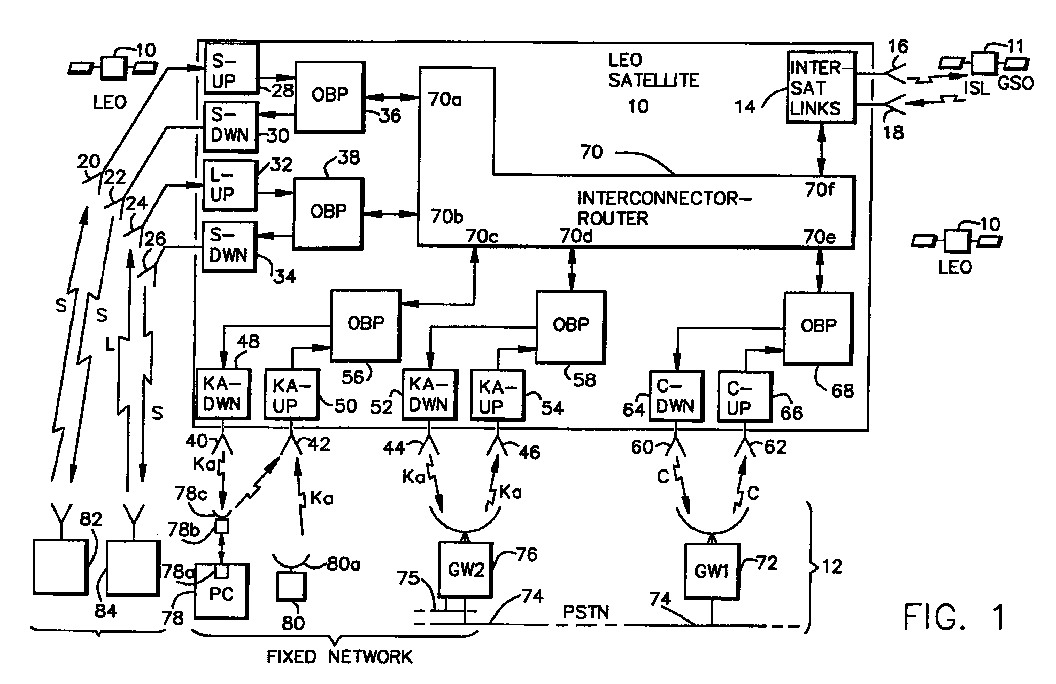
(57) A communications system includes at least one low earth orbit first satellite (10),
at least one second satellite (11) in other than a low earth orbit, and a ground segment
(12) that includes a plurality of user transceivers (78, 80, 82, 84) and at least
one gateway (76) coupled to a publicly-accessible terrestrial communications system,
such as a PSTN and/or a fiber optic network. The first satellite includes a first
transceiver for communication with the at least one gateway, a second transceiver
for communication with at least one user transceiver, and a third transceiver for
communication with the at least one second satellite. The first, second and third
transceivers are switchably coupled together on-board the first satellite by on-board
processors (36, 38, 56) and a switching matrix (70) for relaying a user communication
between the at least one gateway (76) and the at least one user transceiver via the
at least one second satellite. The plurality of user transceivers can include a plurality
of data processors which are interconnected into a network through the at least one
first satellite (10). This network can be considered as a virtual network, and can
have a mesh, star, or other topology. In a presently preferred, but not limiting embodiment
of this invention, the user transceivers are adapted to transmit and receive direct
sequence, code division/multiple access communications. Transmission of signals to
and from the user transceivers is accomplished by spreading a digital data stream
(e.g., voice, data, image, video) with assigned spreading codes.
|
|
