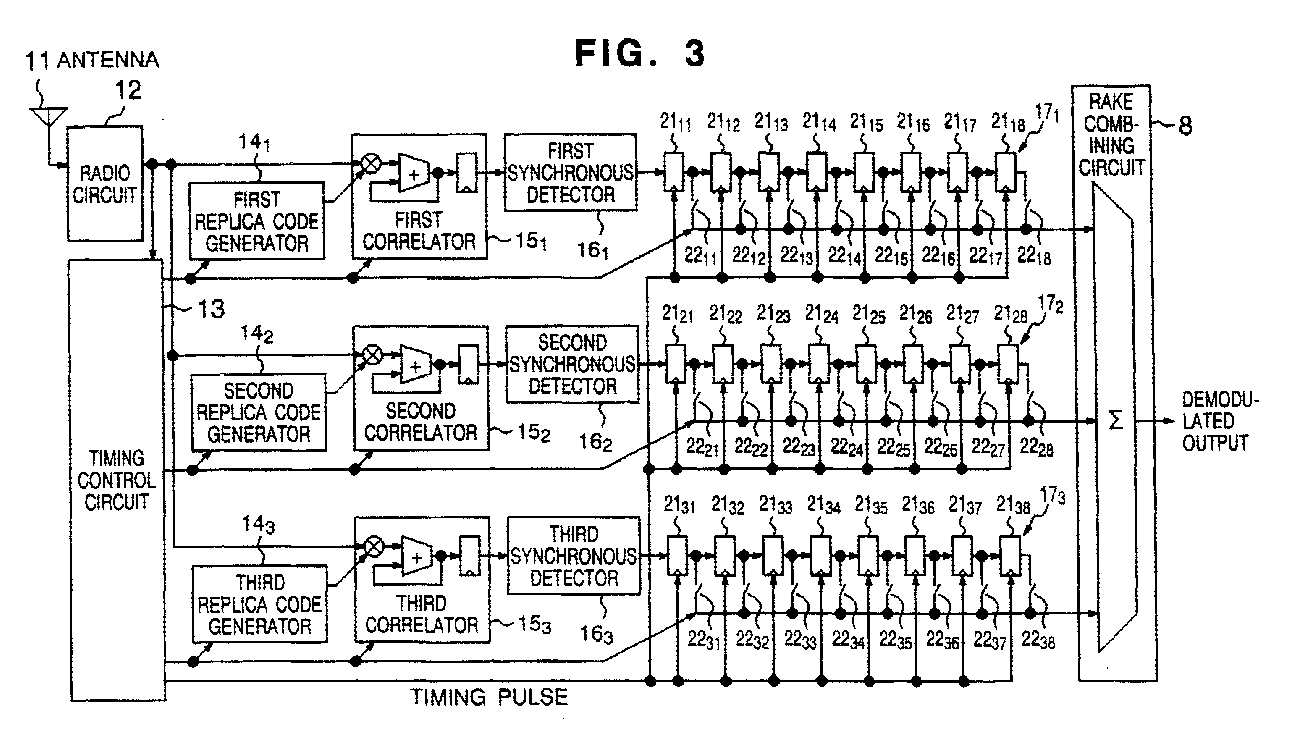
(57) A high frequency signal received by an antenna (11) is converted into a base-band
signal through frequency conversion and quadrature detection in a radio circuit (12).
Through search processing of the base-band signal in a timing control circuit (13;
33), timings for a plurality of paths are detected, whereby first and second replica
code timing indicating signals, a timing pulse, and first and second delay time indicating
signals are generated. In first and second replica code generators (141, 142), first and second replica codes are generated at timings indicated by the first
and second replica code timing indicating signals, respectively. In first and second
correlators (151, 152), a correlation value of the base-band signal and the first replica code and a correlation
value of the base-band signal and the second replica code are determined, respectively.
In first and second synchronous detectors (161, 162), output signals of the first and second correlators undergo synchronous detections,
respectively, whereby first and second symbols are outputted. In first and second
timing adjusting buffers (171, 172), the first and second symbol signals are latched in response to the timing pulses,
respectively, and the first and second symbol signals as latched are outputted with
delay times indicated by the first and second delay time indicating signals, respectively.
Output signals from the first and second timing adjusting buffers (171, 172) are combined together by a RAKE combining circuit (18).
|
|
