|
(11) | EP 0 853 093 A1 |

| (12) | EUROPEAN PATENT APPLICATION |
|
|
|
|
|||||||||||||||||||||||
| (54) | Copolymers of polyorganosiloxane, polyisobutylene and alkyl acrylates or methacrylates |
| (57) Method of making copolymers of (i) an acrylic or methacrylic-functional polyisobutylene
macromonomer, (ii) a polydiorganosiloxane macromonomer, and optionally (iii) a radical
polymerizable monomer such as an alkyl acrylate or alkyl methacrylate. These copolymers
are prepared by copolymerizing the monomers in a miniemulsion using a free radical
initiator at high temperature. Therein, the monomers are mixed with surfactant(s)
and optionally cosurfactant(s) and subjected to high shear. |
[0001] This invention is directed to miniemulsion polymerization of (i) an acrylic or methacrylic-functional polyisobutylene (PIB) macromonomer, (ii) a polydiorganosiloxane macromonomer, and optionally (iii) a radical polymerizable monomer such as an alkyl acrylate or alkyl methacrylate.
[0002] Emulsion polymerization is an important industrial method, because it produces high molecular weight polymers and because there is no or negligible content of volatile organic compounds (VOC). In a normal emulsion polymerization technique, the oil is emulsified in water with a conventional surfactant using a mechanical shearing device, to produce droplets of 1,000-10,000 nanometers (nm) in diameter. The polymerization is achieved with the assistance of a water or oil soluble initiator or catalyst. These emulsions are generally opaque, milky and viscous; but they can also be translucent emulsions with particle sizes ranging from 8-80 nm, when a very high surfactant concentration is employed.
[0003] In conventional emulsion polymerization, the micelles are the primary site for polymerization. However, El-Aasser et al in the Journal of Applied Polymer Science, Volume 43, Pages 1059-1066, (1991), show that nucleation can also occur in monomer droplets if they are very small. They termed this phenomenon "miniemulsion polymerization", with particle sizes ranging from 50-500 nm. According to El-Aasser et al, the miniemulsions are more stable compared to conventional emulsions; they have small particle size, i.e., 50-500 nm. High shear devices such as a submicron disperser, a MICROFLUIDIZER® or an ultrasonication unit are used to make the miniemulsion.
[0004] According to their technique, a cosurfactant is employed, which is typically a low molecular weight, water insoluble compound such as cetyl alcohol or hexadecane. It is used for the purpose of retarding the diffusion of the monomer out of the droplets. They postulate that the stability of such a cetyl alcohol system is attributed to the formation of intermolecular complexes at the oil/water interface, resulting in lower interfacial tension.
[0005] El-Aasser et al do not describe the copolymerization of an acrylic or methacrylic-functional PIB macromonomer, a polydiorganosiloxane macromonomer, and optionally an alkyl acrylate or alkyl methacrylate. We are not aware of any published report on the copolymerization of such monomers. Where there is reference to polymerization of macromonomers, the references are focused toward copolymerization of non-silicon atom containing macromonomers with conventional low molecular weight monomers, i.e., Journal of Macromolecular Science, Pure Applied Chemistry, Aniko Takacs & Rudolf Faust, A33(2), Pages 117-131, (1996); and Journal of Polymer Science, Polymer Chemistry Edition, Joseph P. Kennedy & Misao Hiza, Vol. 21, Pages 1033-1044, (1983). In particular, these references only relate to the preparation of poly(methyl methacrylate-graft-isobutylene) copolymers, i.e., PMMA-g-PIB; and neither disclose copolymers of a PIB macromonomer, a polydiorganosiloxane macromonomer, and optionally a radical polymerizable monomer such as an alkyl acrylate or alkyl methacrylate. In addition, both references use solution polymerization rather than a miniemulsion polymerization technique.
[0006] Our invention provides a method of making a copolymer in an emulsion by heating and shearing a reaction mixture formed by combining (i) water; (ii) an anionic surfactant, a cationic surfactant, a nonionic surfactant or a combination thereof; optionally (iii) a cosurfactant which is a hydrophobic solvent or a compound having low water solubility, such as a fatty alcohol, an n-alkane or a halogen substituted n-alkane; (iv) a mono-acryloxyalkyl terminated polydiorganosiloxane macromonomer or a mono-methacryloxyalkyl terminated polydiorganosiloxane macromonomer; (v) an acrylic or methacrylic-functional PIB macromonomer prepared by reacting (A) a PIB polymer containing at least one carbon-bonded silanol group in its molecule with (B) a silane having both an acrylic or methacrylic-containing group and a silicon-bonded hydrolyzable group in its molecule; optionally (vi) a radical polymerizable monomer such as an alkyl acrylate or an alkyl methacrylate; and (vii) a free radical initiator.
[0007] Our invention also relates to the copolymer made by our method and to an emulsion containing the copolymer.
[0008] A macromonomer is a polymer of molecular weight ranging from several hundred to tens of thousands, having a functional group at the chain end that will further polymerize. The term macromonomer is an abbreviation of macromolecular monomer. While the functional group may be any polymerizable group, most typically it is vinyl, epoxy, dicarboxylic acid, diol, diamine, acryloyl or methacryloyl.
[0009] The PIB-macromonomer component used to prepare our copolymers is an acrylic or methacrylic-functional PIB macromonomer prepared by reacting (A) a PIB polymer containing at least one carbon-bonded silanol group in its molecule with (B) a silane having both an acrylic or methacrylic-containing group and a silicon-bonded hydrolyzable group in its molecule; or by reacting an alcohol-functional PIB and acryloyl chloride or methacryloyl chloride.
[0010] This component and methods of making it are described in further detail in US Patent 5,665,823, issued September 9, 1997, entitled "Polyisobutylene Polymers Having Acrylic Functionality". Said patent is commonly assigned to the proprietor of this invention.
[0011] In general, the silanol-functional PIB polymer (A) is prepared by first silylating the corresponding allyl or vinyl-functional PIB polymer with a silane of the formula
HSiR(3-x)(Z)x (ii)
followed by hydrolysis of the resulting hydrolyzable group containing functional polymer. In formula (ii), R is a hydrocarbon group with 1-14 carbon atoms or a halogenated hydrocarbon group with 1-10 carbon atoms, excluding groups containing aliphatic unsaturation; Z is a hydrolyzable group such as halogen, alkoxy, acyloxy, alkenyloxy, oximo or aminoxy; and x is 1 or 2. Preferably, Z is chlorine. This scheme is illustrated by the following two equations, wherein "(Polymer)-" represents the PIB polymer chain residue and Z is chlorine.
[0012] The first of these reactions is typically catalyzed by a hydrosilylation catalyst such as platinum on carbon, chloroplatinic acid or a platinum complex.
[0013] The silanol-functional PIB polymer (A) shown in formula (iv) is then reacted with a silane (B) of the formula
where R is as defined above; G is a difunctional alkylene oxide group having 1-4 carbon atoms, i.e., -(CH2)nO- where n is 1-4; and L is a hydrogen atom or a methyl radical, corresponding to acryl and methacryl functionality, respectively. In formula (v), X is a silicon-bonded hydrolyzable group capable of condensing with the silanol group of (A) to form a siloxane linkage (i.e., ≡Si-O-Si≡) or capable of hydrolyzing to form an SiOH group on silane (B), which then condenses with the SiOH of silanol-functional polymer (A), to form a siloxane linkage. These X groups are selected from the hydrolyzable Z groups previously described in connection with silane (ii) which are used to prepare the silanol-functional polymer (A). Preferably, X is chlorine and preferred silanes (v) are 3-acryloxypropyldimethylchlorosilane H2C=CHCO2(CH2)3SiCl(CH3)2 or 3-methacryloxypropyldimethylchlorosilane H2C=C(CH3)CO2(CH2)3SiCl(CH3)2. The following equation illustrates this last reaction for the case where the silanol-functional polymer has the formula (iv):
[0014] Therein, Q is -Si(R2)-G-C(O)C(L)=CH2 and R, X, G, L and x have their previously defined meanings.
[0015] The PDMS-macromonomer component used to prepare our copolymers is a mono-acryloxyalkyl terminated polydiorganosiloxane macromonomer (I) or a mono-methacryloxyalkyl terminated polydiorganosiloxane macromonomer (II) having the formula
where R in each formula is a divalent hydrocarbon radical with 1-20 carbon atoms; R' in each formula is a hydrogen atom, a C1-8 alkyl radical, a haloalkyl radical or an aryl radical; and z in each formula is 1-1,000. These macromonomers are prepared by methods known in the art, i.e., reacting a silanol endblocked polydimethylsiloxane with acryloxypropyldimethylchlorosilane or methacryloxypropyldimethylchlorosilane, in the presence of an acid acceptor such as dibutylamine, for example.
[0016] The radical polymerizable monomer used to prepare our copolymers is preferably an acrylate monomer, such as an alkyl acrylate or an alkyl methacrylate containing 1-10 carbon atoms in the alkyl chain. Examples of some suitable acrylate monomers are methyl acrylate H2C=CHCO2CH3, ethyl acrylate H2C=CHCO2C2H5, amyl (pentyl) acrylate H2C=CHCO2C5H11, 2-ethylhexyl acrylate H2C=CHCO2CH2CH(C2H5)(CH2)3CH3, methyl methacrylate H2C=C(CH3)CO2CH3, ethyl methacrylate H2C=C(CH3)CO2C2H5, butyl methacrylate H2C=C(CH3)CO2(CH2)3CH3, hexyl methacrylate H2C=C(CH3)CO2(CH2)5CH3 and 2-ethylhexyl methacrylate H2C=C(CH3)CO2CH2CH(C2H5)(CH2)3CH3. Examples of other radical polymerizable monomers that can be used are styrene C6H5CH=CH2, methylstyrene C6H5C(CH3)=CH2, acrylonitrile H2C=CHCN and (meth)acrylic acid H2C=C(CH3)CO2H.
[0017] The free radical initiator is an azo initiator conforming generally to the formula:
where R is an alkyl radical and Q is a simple carboxylic acid residue or a derivative thereof such as a nitrile ester.
[0019] Similar initiating properties are obtained using 4,4'-azo-4-cyanopentanoic acid (ACPA), a compound shown in the previous formula where R is -CH3 and Q is -(CH2)2-COOH. ACPA is soluble in water, unlike AIBN.
[0020] Other classes of useful free radical initiators include dialkyl hyponitrites, diaroyl peroxides, dialkyl peroxydicarbonates, dialkyl peroxalates, dialkyl peroxides, alkyl hydroperoxides and disulfides.
[0021] The reaction medium contains ionic, nonionic and mixtures of ionic and nonionic surfactants to stabilize the copolymer in the emulsion. Ionic surfactants can be cationic or anionic including surfactants known in the art as useful in emulsion polymerization.
[0022] Suitable anionic surfactants include sulfonic acids and their derivatives. Useful anionic surfactants are alkali metal sulfosuccinates; sulfonated glyceryl esters of fatty acids, such as sulfonated monoglycerides of coconut oil acids; salts of sulfonated monovalent alcohol esters, such as sodium oleyl isothionate; amides of amino sulfonic acids, such as the sodium salt of oleyl methyl taurate; sulfonated products of fatty acid nitriles, such as palmitonitrile sulfonate; sulfonated aromatic hydrocarbons, such as sodium alpha-naphthalene monosulfonate; condensation products of naphthalene sulfonic acids with formaldehyde; sodium octahydro anthracene sulfonate; alkali metal alkyl sulfates; ether sulfates having alkyl groups of eight or more carbon atoms; and alkylaryl sulfonates having one or more alkyl groups of eight or more carbon atoms. Commercial anionic surfactants useful in our invention include dodecylbenzene sulfonic acid (DBSA) sold under the name BIOSOFT™ S-100 by Stepan Company, Northfield, Illinois; and the sodium salt of dodecylbenzene sulfonic acid sold under the name SIPONATE™ DS-10 by Alcolac Inc., Baltimore, Maryland.
[0023] Useful cationic surfactants are the various fatty acid amines, amides and derivatives and salts of fatty acid amines and amides. Cationic surfactants are exemplified by aliphatic fatty amines and derivatives, such as dodecyl amine acetate, octadecyl amine acetate and acetates of amines of tallow fatty acids; homologues of aromatic amines having fatty chains, such as dodecyl aniline; fatty amides derived from aliphatic diamines, such as undecyl imidazoline; fatty amides derived from di-substituted amines, such as oleylamino diethylamine; derivatives of ethylene diamine; quaternary ammonium compounds, such as tallow trimethylammonium chloride, dioctadecyldimethyl ammonium chloride, didodecyldimethyl ammonium chloride and dihexadecyldimethyl ammonium chloride; amide derivatives of amino alcohols, such as beta-hydroxyethyl stearyl amide; amine salts of long chain fatty acids; quaternary ammonium bases derived from fatty amides of di-substituted diamines, such as oleylbenzylamino ethylene diethylamine hydrochloride; quaternary ammonium bases of benzimidazolines, such as methylheptadecyl benzimidazole hydrobromide; basic compounds of pyridinium and derivatives, such as cetylpyridinium chloride; sulfonium compounds, such as octadecyl sulfonium methyl sulfate; quaternary ammonium compounds of betaine, such as betaine compounds of diethylamino acetic acid and octadecylchloromethyl ether; urethanes of ethylene diamine, such as condensation products of stearic acid and diethylene triamine; polyethylene diamines; and polypropanol polyethanol amines. Commercial cationic surfactants include products sold under the names ARQUAD™ T-27W, 16-29, C-33, T-50; and ETHOQUAD™ T/13 and T/13 ACETATE; by Akzo Chemicals Inc., Chicago, Illinois. The anionic or cationic surfactant is present at 0.05-30% by weight of the total emulsion and preferably 0.5-20%.
[0024] Useful nonionic surfactants have a hydrophilic-lipophilic balance (HLB) of 10-20. Nonionic surfactants with HLB of less than 10 may be used but hazy solutions may result due to limited solubility of the nonionic surfactant in water. When using a nonionic surfactant with HLB less than 10, a nonionic surfactant with HLB greater than 10 should be added during or after polymerization. Commercial nonionic surfactants are exemplified by 2,6,8-trimethyl-4-nonyloxy polyethylene oxyethanols (6EO) and (10EO) sold under the names TERGITOL® TMN-6 and TERGITOL® TMN-10; alkyleneoxy polyethylene oxyethanol (C11-15 secondary alcohol ethoxylates 7EO, 9EO and 15EO) sold under the names TERGITOL® 15-S-7, TERGITOL® 15-S-9, TERGITOL® 15-S-15; other C11-15 secondary alcohol ethoxylates sold under the names TERGITOL® 15-S-12, 15-S-20, 15-S-30, 15-S-40; and octylphenoxy polyethoxy ethanol (40EO) sold under the name TRITON® X-405. All of these surfactants are sold by Union Carbide Corporation, Danbury, Connecticut. Other commercial nonionic surfactants are nonylphenoxy polyethoxy ethanol (10EO) sold under the name MAKON™ 10 by Stepan Company, Northfield, Illinois. One especially useful nonionic surfactant is polyoxyethylene 23 lauryl ether (Laureth-23) sold commercially under the name BRIJ™ 35 by ICI Surfactants, Wilmington, Delaware.
[0025] Some commercially available ionic surfactants have characteristics of both ionic and nonionic surfactants combined and can be used herein. One example is methyl polyoxyethylene (15) octadecyl ammonium chloride, sold under the name ETHOQUAD™ 18/25 by Akzo Chemicals Inc., Chicago, Illinois.
[0026] A cosurfactant is optional, but can also be used in the method according to our invention. The cosurfactant is preferably a hydrophobic solvent or a compound having low water solubility. Representative cosurfactants are, for example, fatty alcohols such as cetyl alcohol C16H33OH; and n-alkanes such as n-hexadecane (cetane) C16H34 or the halogen substituted derivatives thereof, such as 1-chlorodecane (decyl chloride) CH3(CH2)9Cl. The presence of such a low molecular weight and relatively water-insoluble compound retards diffusion of monomer out of the droplets.
[0027] The reaction mixture is formed by combining 50-80 percent by weight of water; 5-15 percent by weight of the surfactant(s); 1-5 percent by weight of the cosurfactant(s); 10-50 percent by weight of the macromonomer(s) or monomer(s); and 0.5-15 percent by weight of the free radical initiator. It is not essential that these ingredients be combined in any given order, although one preferred procedure is to combine water, surfactant(s) and cosurfactant(s), followed by addition of monomer(s) and initiator. However, it is essential to have agitation during and following addition of the ingredients and to have achieved or to heat to the polymerization temperature as the ingredients are combined. Where practical, agitation and heating should be continued until the monomer(s) is consumed in forming the emulsion.
[0028] The process we used for making miniemulsions is similar to the El-Aasser et al procedure; although our initiator was not the same as the initiator used by El-Aasser et al.
[0029] According to our process, sodium lauryl sulfate, cetyl alcohol and water, were first heated at 65°C. for 2 hours, cooled to 30-35°C. and passed through a high shear device to break the gel which formed. The high shear device was a high pressure impingement emulsifier, sold under the name MICROFLUIDIZER®, by Microfluidics Corporation, Newton, Massachusetts.
[0030] Such high shear devices are described in detail, for example, in US Patent 4,533,254. In general, these high shear devices include a high pressure pump (i.e., as much as 25,000 psi/172,370 kPa) and an interaction chamber where emulsification occurs. A reaction mixture is passed through the emulsifier once at a pressure between 5,000-15,000 psi/34,474-103,422 kPa. Multiple passes through the high shear device result in smaller average particle size and a narrower range for the particle size distribution.
[0031] The macromonomer(s) and the AIBN initiator are then added to the surfactant mixture and stirred at ambient/room temperature (20-25°C./68-77°F.). The mixture is again introduced to the MICROFLUIDIZER® and passed 10 times at 8,000-14,000 psi/55,158-96,527 kPa. Particle size was measured with the aid of a NICOMP™ particle size analyzer in dilute solutions. The emulsion was transferred to a 3-neck flask and after bubbling nitrogen, the emulsion was heated at 60-65°C. for a period of time.
[0032] After polymerization was complete, the emulsion was broken by adding sodium chloride and methanol. The precipitate was separated from the mixture by filtration and dried in a vacuum. Molecular weight of each starting PIB macromonomer and polydimethylsiloxane (PDMS) macromonomer was determined by Gel Permeation Chromatography (GPC), in toluene or tetrahydrofuran (THF) using standard PIB samples or PDMS samples, respectively, for molecular weight calibration and a Refractive Index (RI) detector. The copolymers were further analyzed and characterized by GPC, IR, 13C and 29Si Nuclear Magnetic Resonance (NMR) to confirm molecular structure.
[0033] Our invention is illustrated in more detail in the following examples. All reactions were carried out in an atmosphere of nitrogen. GPC analyses were performed on a WATERS™ 150C Chromatograph, using a flow rate of 1.2 ml/minute and an injection volume of 200 µl. IR spectra were measured on neat liquids in KBr plates on a Perkin Elmer™ Spectrophotometer. Particle size measurements were made with a NICOMP™ 370 particle size analyzer. All parts and percentages in these examples are on a weight basis and all measurements were obtained at 25°C. unless indicated to the contrary. Averages of molecular weight such as the number-average molecular weight Mn and the weight-average molecular weight Mw, are used to describe the general shape of the molecular weight distribution.
Example 1 - Preparation of PIB-macromonomer
[0034] Glissopal® 1000 was hydrosilylated with dimethylchlorosilane (CH3)2HSiCl as follows. Glissopal® 1000 is described as a polyisobutylene (PIB) having a high proportion of terminal double bonds and having a Mw of 1,180. It is a product of BASF™ AG, Ludwigshafen, Germany. Glissopal® 1000 (400 gm) was charged to a three-neck flask fitted with a magnetic stirring bar, condenser and dropping funnel. A reaction product of chloroplatinic acid and 1,3-divinyltetramethyldisiloxane H2C=CH(CH3)2SiOSi(CH3)2CH=CH2 (200 µl of catalyst prepared according to US Patent 3,419,593) was added and the solution was heated to 70°C. under an atmosphere of nitrogen. Dimethylchlorosilane was added dropwise. The addition rate of silane was then controlled to maintain a reaction temperature of 65-70°C. (total silane added was 76 g). The solution was stirred overnight at 70-75°C. and the solvent and excess silane were stripped off in a rotary evaporator at 85-90°C./(0.3-0.7 kPa)2-5 torr/3 hours. A pale yellow polymer was obtained. NMR analysis confirmed a PIB polymer wherein the vinyl functionality was quantitatively converted to end groups of the formula -Si(Me2)Cl, in which Me hereinafter represents a methyl radical.
[0035] The resulting hydrosilylated product (105 g) was dissolved in 225 g of THF. Sodium bicarbonate solution (10% in water, 100 g) was slowly added. The mixture was shaken vigorously for 2-3 minutes. The water and organic layers were separated and the organic layer was dried over Na2SO4 for 10 minutes. The salt byproduct was filtered through a pressure filter and the solvent was removed by vacuum distillation. A pale yellow polymeric material was obtained. IR and 29Si NMR showed the presence of SiOH groups but showed little of the ≡Si-O-Si≡ structure. Mw at this point was 2,180 and Mn was 1,500.
[0036] The above SiOH-functional PIB (97 g, 0.08 mole) was dissolved in tetrahydrofuran (125 g) and this solution was charged to a 500 ml 3-neck flask equipped with a magnetic stirring bar and a nitrogen purge. Triethylamine (12.24 g, 0.12 mole) was added under an atmosphere of nitrogen. 3-methacryloxypropyldimethylchlorosilane (18 g, 0.08 mole) was slowly added and the mixture was stirred overnight at room temperature. This product was filtered through a pressure filter and the solvent and excess reactants were removed by vacuum distillation. A pale yellow polymeric material was obtained which had a Mw of 2,070 and Mn of 1,540. It had a structure consistent with the formula
(PIB)-Si(Me2)OSi(Me2)-CH2CH2CH2-OC(O)C(Me)=CH2
wherein PIB represents the residue of the polyisobutylene chain. This PIB-macromonomer was subsequently used in Examples 4 and 5.
Example 2 - Preparation of PIB-macromonomer
[0037] The procedure of Example 1 was used to prepare another PIB-macromonomer. Herein, the SiOH-functional PIB (8 g) was dissolved in tetrahydrofuran (15 g) and this solution was also charged to a 100 ml 3-neck flask equipped with a magnetic stirring bar and a nitrogen purge. Triethylamine (1 g) was added under an atmosphere of nitrogen. 3-methacryloxypropyldimethylchlorosilane (2 g) was slowly added and the mixture was stirred overnight at room temperature. This product was filtered through a pressure filter and the solvent and excess reactants were removed by vacuum distillation. A pale yellow polymeric material was obtained which had a Mw of 2,277 and Mn of 1,630. It had a structure consistent with the formula
(PIB)-Si(Me2)OSi(Me2)-CH2CH2CH2-OC(O)C(Me)=CH2
wherein PIB represents the residue of the polyisobutylene chain. This PIB-macromonomer was used in Example 6.
Example 3 - Preparation of PDMS-macromonomer
[0038] A mono-SiOH-functional polydimethylsiloxane (PDMS) (500 g) was charged to a one liter 3-neck flask equipped with a magnetic stirring bar and a nitrogen purge. Dibutylamine (10.5 g) was added under an atmosphere of nitrogen. 3-methacryloxypropyldimethylchlorosilane (13.25 g) was slowly added and the mixture was stirred overnight at room temperature. This product was filtered through a pressure filter and the solvent and excess reactants were removed by vacuum distillation. An off white polymeric material was obtained which had a Mw of 13,530 and Mn of 12,650. It had a structure consistent with the formula
(PDMS)-Si(Me2)OSi(Me2)-CH2CH2CH2-OC(O)C(Me)=CH2
wherein PDMS represents the residue of the polydimethylsiloxane chain. This PDMS-macromonomer was subsequently used in Examples 4 and 5.
Example 4 - Preparation of Copolymer of PIB-macromonomer and PDMS-macromonomer
[0039] Deionized water (160 gm) was added to a 250 ml beaker provided with a magnetic stirrer. Sodium laurel sulfate (0.2 gm) and cetyl alcohol (0.8 gm) were added to the water and the contents were heated to 65-67°C. for 2 hours. The contents were allowed to cool to 30-35°C. and a white gel-like material was obtained. The gel-like material was introduced to a MICROFLUIDIZER® and the contents were circulated at 5,000-6,000 psi/34,474-41,369 kPa. The PDMS-macromonomer (20 gm) prepared in Example 3 and the PIB-macromonomer (20 gm) prepared in Example 1 were added and the contents were additionally stirred for 30 minutes with a magnetic stirrer. At this point, AIBN (2,2'-azobisisobutyronitrile, 0.45 gm) was added. The mixture was again introduced to the MICROFLUIDIZER® and cycled at least 10 times at 8,000 psi/55,158 kPa. The average particle size was 303 nm. The emulsion was transferred to a 3-neck flask fitted with a nitrogen inlet, condenser and thermometer. Nitrogen was bubbled through the solution. The emulsion was heated at 65°C. for 24 hours. More AIBN was added (0.2 g) after 24 and 48 hours and the heating was continued for a total of 72 hours. Some whitish gray precipitate appeared which was filtered. The precipitate was insoluble in toluene. The emulsion was broken by pouring it into methanol (600 gm) and a solution of NaCl in water (5 gm in 25 ml). The mixture was shaken vigorously and filtered. A white precipitate was obtained which was next dissolved in hexane and dried over MgSO4. It was filtered and the solvent was removed. An off white highly viscous polymer was obtained. GPC: in THF; Mn = 50050, Mw = 147700.
Example 5 - Preparation of Copolymer of PIB-macromonomer, PDMS-macromonomer and Acrylate monomer
[0040] Deionized water (160 gm) was added to a 250 ml beaker equipped with a magnetic stirrer. Sodium laurel sulfate (0.2 gm) and cetyl alcohol (0.8 gm) were added to the water and the contents were heated to 65-67°C. for 2 hours. The contents were allowed to cool to 30-35°C. and a white gel-like material was obtained. The gel-like material was introduced to the MICROFLUIDIZER® and the contents were circulated at least 5 times at 10,000 psi/68,948 kPa. The PDMS-macromonomer (10 gm) prepared in Example 3, methyl methacrylate (20 gm) and the PIB-macromonomer (10 gm) prepared in Example 1, were added and the contents stirred for 30 minutes with a magnetic stirrer. At this point, AIBN (0.6 gm) was added. The mixture was again introduced to the MICROFLUIDIZER® and cycled at least 10 times at 12,000 psi/82,738 kPa. The average particle size was 395 nm. The emulsion was transferred to a 3-neck flask fitted with a nitrogen inlet, condenser and thermometer. Nitrogen was bubbled through the solution. The emulsion was heated at 65°C. for 24 hours. More AIBN was added (0.2 g) after 24 and 48 hours and the heating was continued for a total of 72 hours. The emulsion was broken by pouring it into methanol (800 gm) and a solution of NaCl in water (5 gm in 25 ml). The mixture was shaken vigorously and filtered. A white solid was obtained which was dried in vacuum. GPC: in Toluene; Mn = 71030, Mw = 127100. 13C NMR data showed that the product was a copolymer of the PIB-macromonomer, the PDMS-macromonomer and methyl methacrylate.
Example 6 - Preparation of Copolymer of PIB-macromonomer, PDMS-macromonomer and Acrylate monomer
[0041] Deionized water (150 gm) was added to a 250 ml beaker equipped with a magnetic stirrer. Sodium laurel sulfate (0.2 gm) and cetyl alcohol (0.8 gm) were added to the water and the contents were heated to 65-67°C. for 2 hours. The contents were allowed to cool to 30-35°C. and a white gel-like material was obtained. The gel-like material was introduced to the MICROFLUIDIZER® and the contents were circulated at least 5 times at 10,000 psi/68,948 kPa. The PDMS-macromonomer (5 gm) prepared in Example 3, methyl methacrylate (40 gm) and the PIB-macromonomer (5 gm) prepared in Example 2, were added and the contents stirred for 30 minutes with a magnetic stirrer. At this point, AIBN (0.42 gm) was added. The mixture was again introduced to the MICROFLUIDIZER® and cycled at least 10 times at 14,000 psi/96,527 kPa. The particle size was 171 nm. The emulsion was transferred to a 3-neck flask fitted with a nitrogen inlet, condenser and thermometer. Nitrogen was bubbled through the solution. The emulsion was heated at 65°C. for 45 hours. The average particle size was 192 nm. The emulsion was broken by pouring it into methanol (400 gm) and a solution of NaCl in water (5 gm in 25 ml). The mixture was shaken vigorously. A white solid was obtained which was filtered and dried in vacuum. GPC: in THF; Mn = 137900, Mw = 505300. 13C NMR data showed that the product was a copolymer of the PIB-macromonomer, the PDMS-macromonomer and methyl methacrylate.
[0042] The preparation of copolymers of (i) an acrylic or methacrylic-functional PIB macromonomer, (ii) a polydiorganosiloxane macromonomer, and optionally (iii) a radical polymerizable monomer such as an alkyl acrylate or alkyl methacrylate, in emulsion form provides many advantages and benefits. For example, the miniemulsion polymerization process herein provides a technique where monomers are polymerized to high molecular weight copolymers and yet the emulsions are very stable. The resulting water-based emulsions provide low content of volatile organic compound (VOC) and allow for ease of handling of the copolymers.
[0043] These copolymers have applications in the personal care arena, i.e. as cosmetics; and in the ink, paint and coating industries. Typically, these emulsions are used without first extracting the copolymer; and this is convenient for use in water-based products, especially in personal care. The result is a significant savings in cost of production.
1. A method of making a copolymer in an emulsion comprising heating and shearing a reaction
mixture formed by combining (i) water; (ii) an anionic surfactant, a cationic surfactant,
a nonionic surfactant or a combination thereof; optionally (iii) a cosurfactant which
is a hydrophobic solvent or a compound selected from the group consisting of fatty
alcohols, n-alkanes and halogen substituted n-alkanes; (iv) a mono-acryloxyalkyl terminated
polydiorganosiloxane macromonomer (I) or a mono-methacryloxyalkyl terminated polydiorganosiloxane
macromonomer (II) having the formula
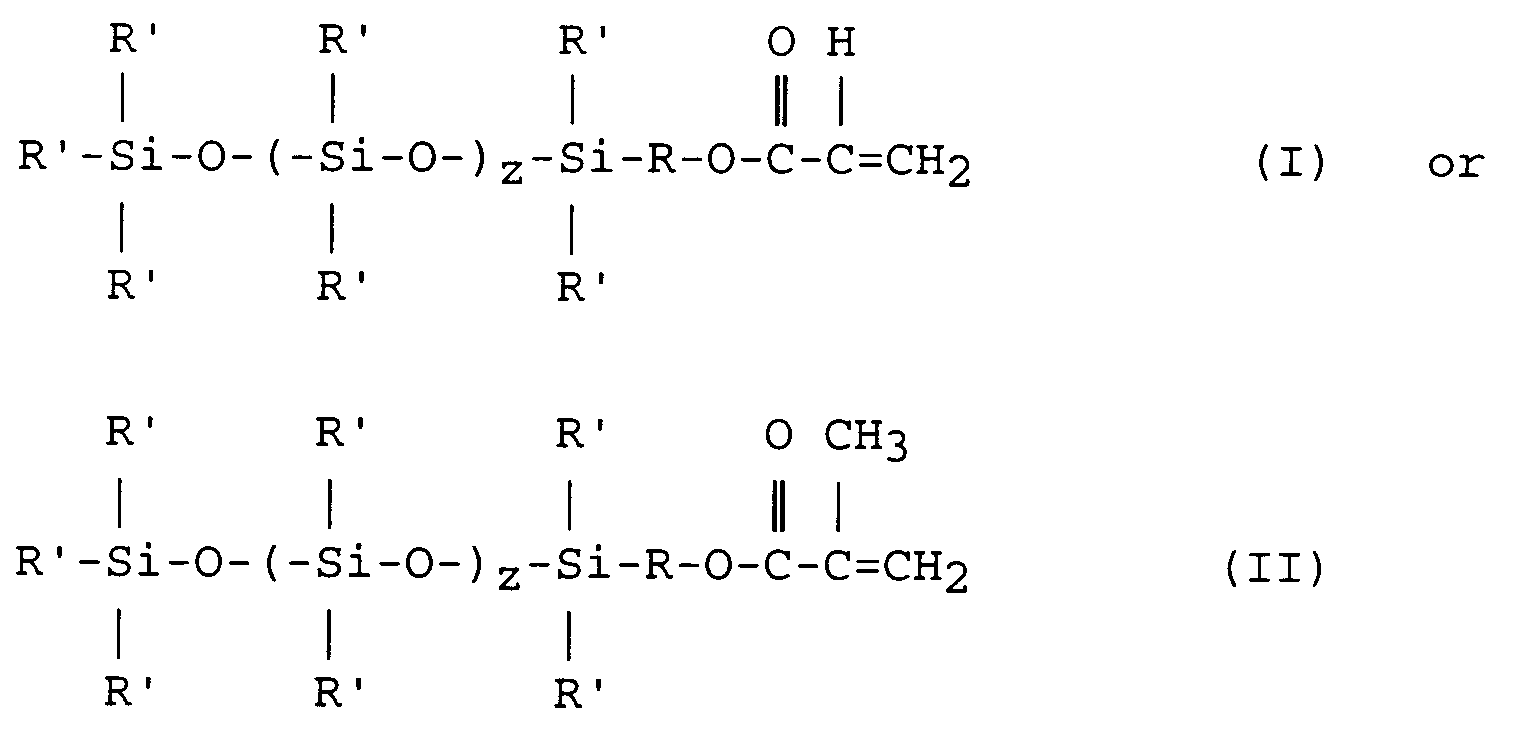
where R in each formula is a divalent hydrocarbon radical with 1-20 carbon atoms; R' in each formula is a hydrogen atom, a C1-8 alkyl radical, a haloalkyl radical or an aryl radical; and z in each formula is 1-1,000; (v) an acrylic or methacrylic-functional polyisobutylene macromonomer; optionally (vi) a radical polymerizable monomer; and (vii) a free radical initiator.
where R in each formula is a divalent hydrocarbon radical with 1-20 carbon atoms; R' in each formula is a hydrogen atom, a C1-8 alkyl radical, a haloalkyl radical or an aryl radical; and z in each formula is 1-1,000; (v) an acrylic or methacrylic-functional polyisobutylene macromonomer; optionally (vi) a radical polymerizable monomer; and (vii) a free radical initiator.
2. A method according to claim 1 in which the optional cosurfactant is a compound selected
from the group consisting of cetyl alcohol, n-hexadecane and 1-chlorodecane.
3. A method according to claim 2 in which the free radical azo initiator is a compound
having the formula

where R'' is an alkyl radical and Q is a carboxylic acid residue.
where R'' is an alkyl radical and Q is a carboxylic acid residue.
4. A method according to claim 1 in which the optional radical polymerizable monomer
is an alkyl acrylate or an alkyl methacrylate selected from the group consisting of
methyl acrylate, ethyl acrylate, amyl acrylate, 2-ethylhexyl acrylate, methyl methacrylate,
ethyl methacrylate, butyl methacrylate, hexyl methacrylate and 2-ethylhexyl methacrylate.
5. A method according to claim 1 in which the acrylic or methacrylic-functional polyisobutylene
macromonomer is obtainable by reacting (A) a polyisobutylene polymer containing at
least one carbon-bonded silanol group in its molecule with (B) a silane having both
an acrylic or methacrylic-containing group and a silicon-bonded hydrolyzable group
in its molecule.
6. A method according to claim 5 in which silanol containing polyisobutylene polymer
(A) is obtainable by first silylating an allyl or vinyl-functional polyisobutylene
polymer with a silane of the formula
HSiR'''(3-x)(Z)x
where R''' is a hydrocarbon group with 1-14 carbon atoms or a halogenated hydrocarbon group with 1-10 carbon atoms, excluding groups containing aliphatic unsaturation; Z is a hydrolyzable group selected from the group consisting of halogen, alkoxy, acyloxy, alkenyloxy, oximo and aminoxy; and x is 1 or 2; followed by hydrolysis of the resulting hydrolyzable group containing polyisobutylene polymer.
HSiR'''(3-x)(Z)x
where R''' is a hydrocarbon group with 1-14 carbon atoms or a halogenated hydrocarbon group with 1-10 carbon atoms, excluding groups containing aliphatic unsaturation; Z is a hydrolyzable group selected from the group consisting of halogen, alkoxy, acyloxy, alkenyloxy, oximo and aminoxy; and x is 1 or 2; followed by hydrolysis of the resulting hydrolyzable group containing polyisobutylene polymer.
7. A method according to claim 5 in which silane (B) is a compound having the formula
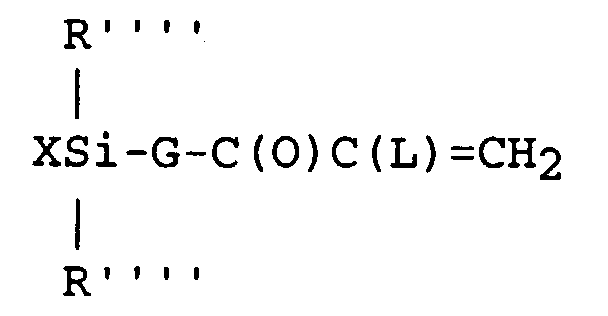
where R'''' is a hydrocarbon group with 1-14 carbon atoms or a halogenated hydrocarbon group with 1-10 carbon atoms, excluding groups containing aliphatic unsaturation; G is a difunctional alkylene oxide group having 1-4 carbon atoms; L is hydrogen or a methyl radical; and X is a silicon bonded hydrolyzable group selected from the group consisting of halogen, alkoxy, acyloxy, alkenyloxy, oximo and aminoxy.
where R'''' is a hydrocarbon group with 1-14 carbon atoms or a halogenated hydrocarbon group with 1-10 carbon atoms, excluding groups containing aliphatic unsaturation; G is a difunctional alkylene oxide group having 1-4 carbon atoms; L is hydrogen or a methyl radical; and X is a silicon bonded hydrolyzable group selected from the group consisting of halogen, alkoxy, acyloxy, alkenyloxy, oximo and aminoxy.
8. A method according to claim 1 in which the reaction mixture is formed by combining
50-80 percent by weight of water, 5-15 percent by weight of surfactant, 1-5 percent
by weight of cosurfactant, 10-50 percent by weight of macromonomers and monomer and
0.5-15 percent by weight of free radical initiator.
9. An emulsion obtainable by the method according to any of claims 1-8.
10. A method of preparing a copolymer of mono-(meth)acryloxyalkyl terminated polydiorganosiloxane
macromonomers, (meth)acrylic-functional polyisobutylene macromonomers and optionally
radical polymerizable monomer by isolating the copolymer from the emulsion of claim
9.
11. Copolymer obtainable by the process of claim 10.