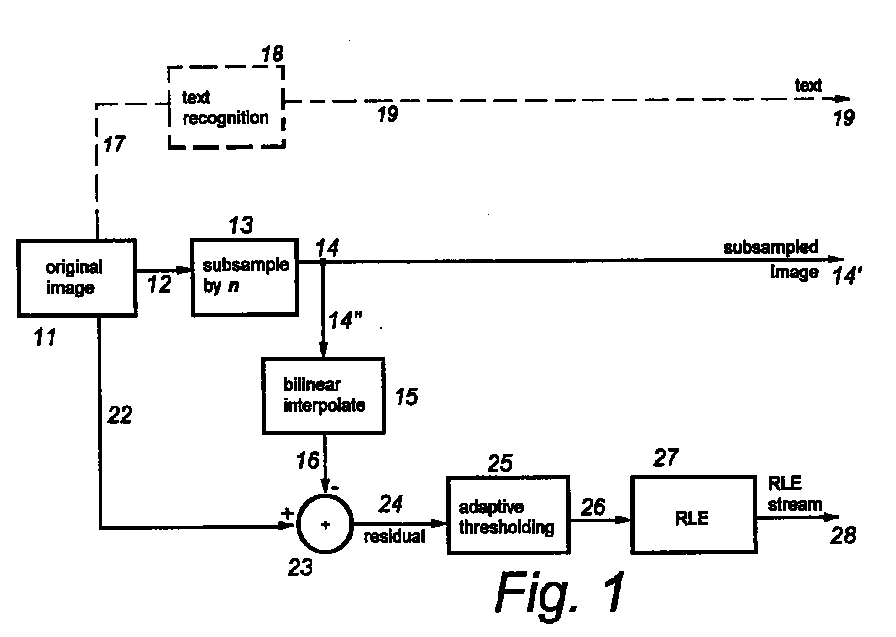
(57) Pixel-based image data (11) are subsampled (13) for transmission (14') to a printer
(Fig. 2) and later bilinear interpolation (31) in the printer. The transmission system
(Fig. 1) evaluates (15, 23) the error (24) that will remain after interpolation. In
response to this evaluation, the transmission system also forms (25) trim data (26)
for later application to the interpolated subsample (32, Fig. 3c) to remove a significant
part of the error (24). Preferably trim data points (be'', bf'', df'') are selected
based on relative importance (Fig. 3d) of the associated correction ― specifically,
size of the error that will remain after interpolation ― but also the amount of trim
data is controlled to maintain a significant advantage in overall transmission time,
relative to transmitting the entire image-data set. The amount of trim data is held
roughly to a certain fraction, about five percent, of the number of points in each
data block (e. g., swath), essentially independent of the error evaluation. Preferably
this controlled amount of trim data is padded out with zeroes (ab'', ad'' etc.) to
form a complete trim-data array ― which is then run-length encoded (Fig. 3f). The
encoded trim data (28) and the subsample (14', Fig. 3b) are sent to the printer. (Preferably
pure-text portions [19] are sent separately.) The printer applies (35) the trim data
(28) to the interpolated subsample (32, Fig. 3c) to obtain a better approximation
(36, Fig. 3g) to the original image data (11, Fig. 3a).
|
|
