|
(11) | EP 0 854 143 A1 |

| (12) | EUROPEAN PATENT APPLICATION |
|
|
|
|
|||||||||||||||||||
| (54) | Diels-Alder reaction of aldehydes with simple dienes |
| (57) The invention concerns Diels-Alder reactions between non-activated aldehydes RCHO
in which R is a C1-C10 aliphatic group or phenyl group, which is unsubstituted or
substituted with one or more C1-C5 alkyl groups or one other functional group, with
simple aliphatic dienes R1CH=CR2-CR3=CHR4 in which R1-R4 are H or C1-C5 alkyl groups using as a catalyst a perfluorinated organic sulphonic
acid or a Brönsted acid derivative thereof. The reaction leads to dihydropyrans of
the structure below in which R1-R4 have the meaning indicated above. The preferred perfluorinated organic sulfonic acids are perfluorooctanesulphonic acid, triflic acid, Nafion or a Brönsted acid derivative of triflic acid. The preferred aldehydes are those wherein R is a C2-C6 aliphatic group or a phenyl group which is unsubstituted or mono-substituted with C1-C3 alkyl or with 4-Cl, 4-nitro or 3-methoxy. The preferred dienes are those wherein the groups R1-R4 are H or methyl. |
[0001] The invention relates to catalysed Diels-Alder reactions between non-activated aldehydes and simple dienes leading to dihydropyrans.
[0002] The hetero Diels-Alder (D-A) reaction between aldehydes and dienes has been limited mainly to the reaction of either highly electron rich dienes (Danishefsky's and similar dienes) with a broad range of aldehydes, or of highly activated aldehydes (e.g. chloral and glyoxylates) with a broad range of dienes, see e.g. H Waldmann, Synthesis 1994, 535. Recently the reaction between simple dienes and unactivated aldehydes has been achieved using a cationic Pd2+ catalyst, see: S. Oi et al, Tet. Letters., 37 (1996), 6351. Furthermore, the Lewis acid catalysed D-A reaction of non-activated aldehydes and simple dienes has been described in US 5,162,551 in which a mixture of AlCl3 or SnCl4 with nitroalkanes (particularly 2-nitropropane) is used. The reported yields are good, but the catalyst system is potentially explosive and difficult to handle. J. Inanaga. New J. Chem. 1995 19, 707 reported the use of lanthanide (III) salts of superacids such as trifluoromethanesulfonic acid (triflic acid, TfOH) and perfluorooctanesulfonic acid (PfOH) as catalysts in D-A reactions. He reports that with 30 moles% of Yb(OPf)3 and Sc(OPf)3 high yields of 2-phenyl-4,5-dimethyl-2,3-dihydropyran were obtained from benzaldehyde and 2,3-dimethyl-butadiene. With Sc(OTf)3 only moderate yields were obtained.
[0003] Furthermore, various reactions between simple aliphatic dienes and non-activated aldehydes catalysed by strong Brönsted acids and leading to 5,6-dihydropyrans have been reported as outlined below. This reaction has also been categorized as a Prins-type reaction.
i AU 13822/70: formaldehyde + 1,3-butadiene with sulphuric acid;
ii M.F. Ansell and A.A. Charalambides, J.C.S. Chem. Comm., 1972, 739: benzaldehyde + 2,3-dimethyl-butadiene with p-toluene-sulphonic acid at 80°C;
iii H. Griengl and K.P. Geppert, Monatsh. Chem. 107 (1976), 675: 1,3-butadiene, isoprene or 2,3-dimethyl-1,3-butadiene + benzaldehyde with concentrated sulphuric acid.
[0004] In i very low yields were reported, in ii the reaction had to be carried out at 80°C and in iii a tenfold excess of aldehyde was used and moreover, the reaction with isoprene and with 1,3-butadiene produced a complicated reaction mixture.
[0005] The D-A reaction between non-activated aromatic aldehydes and simple aliphatic dienes is particularly useful for preparing dihydropyrans. Examples are the fragrance materials 6-phenyl-4-methyl-5,6-dihydropyran, also known as Rosyrane, 6-phenyl-2,4-dimethyl-dihydropyran and 6-butyl-2,4-dihydropyran. Rosyrane is itself a starting material for the preparation of the fragrance material Mefrosol, also known as Phenoxanol, through reductive ringopening in acidic media (see US 5,162,551).
[0006] Although the use of the above mentioned lanthanide salts would appear to give good prospects for such D-A reactions, lanthanide salts are expensive, a high molar ratio of catalyst (30 mole%) appears to be required and lanthanide salts of perfluorooctanesulfonic acid are high molecular weight materials. The latter means that high amounts of solid material need to be handled which adds considerably to the production costs.
[0007] It has now been found that non-activated aldehydes RCHO, in which R is a C1-C10 aliphatic group or phenyl group which is unsubstituted or substituted with one or more C1-C5 alkyl groups or one other functional group, may be reacted in a D-A reaction with simple aliphatic dienes R1CH=CR2-CR3=CHR4, in which R1 - R4 are H or C1-C5 alkyl groups, using as a catalyst a perfluorinated organic sulphonic acid or a Brönsted acid derivative thereof.
[0008] Thus, the invention provides a process for the preparation of 5,6-dihydropyrans of the general formula: in which the groups R and R1-R4 have the meaning given above, comprising reacting the corresponding aldehyde with the corresponding diene under the influence of a perfluorinated organic sulphonic acid or a Brönsted acid derivative thereof.
[0009] Preferred are perfluorooctanesulphonic acid, triflic acid, polymeric perfluoroalkanesulfonic acids such as those known as Nafion*, as well as Brönsted acid derivatives of triflic acid, particularly trifluoromethanesulfonimide (triflimide). The acids can be pure, but need not necessarily be water-free.
* Trademark of Dupont de Nemours of Wilmington Delaware
[0010] Preferably the groups R1-R4 are H or methyl, more preferably at most two of R1-R4 are methyl and the others are hydrogen. Particularly preferred dienes are isoprene, 2,3-dimethyl-butadiene, 1,3-dimethyl-butadiene and 1,3-pentadiene.
[0011] R is preferably a C2-C6 aliphatic group or a phenyl group which is unsubstituted or mono-substituted with C1-C3 alkyl or with 4-Cl, 4-nitro or 3-methoxy. Particularly preferred phenyl groups are: phenyl and 4-methylphenyl.
[0012] The aldehyde/diene ratio does not have much influence on the course of the reaction. Ratios between 10:1 and 1:20 are suitable and between 5:1 and 1:10 are preferred. In practice an about equimolar ratio or slight excess of diene works very well.
[0013] The amount of catalyst is preferably chosen between 0.01 and 50 mol% based on the reactant being present in lowest molar amount, more preferably between 0.1 and 20%, most preferably between 0.2 and 15%.
[0014] The reaction is conveniently carried out in an organic solvent. This does not necessarily have to be completely water-free, as would be necessary with many Lewis acid catalysts. Preferred are low polarity or non-polar solvents; particularly preferred are hydrocarbons such as hexane, cyclohexane, toluene and petroleum spirit.
[0015] The reaction is conveniently carried out above -10°C and below +80°C, more preferably between 0 and 60°C, most preferably between 10 and 40°C. Ambient reaction temperatures and pressures are most convenient from a practical point of view, although higher pressures may sometimes be useful, e.g. with volatile dienes. Since the reaction is not very exothermic no expensive measures have to be taken to keep the reaction temperature within the desired limits.
[0016] The reaction proceeds regioselectively, leading predominantly to one positional isomer if an unsymmetric diene is used. Thus, the reaction between benzaldehyde and isoprene leads to 4-methyl-6-phenyl-5,6-dihydropyran. Some double bond isomerisation may take place leading to the presence of the 4-methylene- and/or the 2,3-dihydro-isomers in the reaction product
[0017] The reaction mixtures can be worked up in the usual way and the reaction product isolated and purified by conventional means such as distillation, chromatographic techniques and the like. Non-aqueous work-up is particularly convenient as it reduces the amount of waste water.
Example 1
Preparation of 4-methyl-6-phenyl-5,6-dihydropyran.
[0018] To a rapidly stirred solution of 70% aqueous triflic acid (2.10g, 0.01 mol) and benzaldehyde (106.1g, 1.0 mol) in 100ml toluene was added isoprene (150 cm3, 1.5 mol) over 4 hrs. at 25°C. The mixture was stirred at room temperature for a further 11 hours after which the reaction mixture was quenched by the addition of Polyrad* (2g) and solid sodium carbonate (5g). The crude mixture was distilled under reduced pressure to give pure rosyrane (56% yield) as a colorless oil.
* Trademark of Hercules for polyethoxylated abietyl amine.
Examples 2-6
[0019] Under the same conditions the following aldehydes and dienes were reacted, leading to the indicated yields of the corresponding dihydropyran (GC detected yield given):
| Aldehyde | Diene | Yield (%) |
| benzaldehyde | isoprene | 72 |
| 4-methyl-benzaldehyde | isoprene | 65 |
| 4-Cl-benzaldehyde | isoprene | 68 |
| benzaldehyde | 2,3-dimethylbutadiene | 85 |
| benzaldehyde | 1,3-dimethylbutadiene | not det. |
Example 7
[0020] Bis-trifluoromethanesulphonimide (70,5mg, 0.25mmol) was stirred in hexane (4ml) at room temperature. Benzaldehyde (510µl, 5.0mmol) and isoprene (750µl, 7.5mmol) were added and the mixture stirred at room temperature overnight. Water (5ml) was added and the aqueous layer was extracted with hexane (3x3ml). The combined organic layers were filtered through celite and analysed by glc. A yield of 42% of 4-methyl-6-phenyl-5,6-dihydropyran was observed.
1. Process for the preparation of 5,6-dihydropyrans of the general formula:
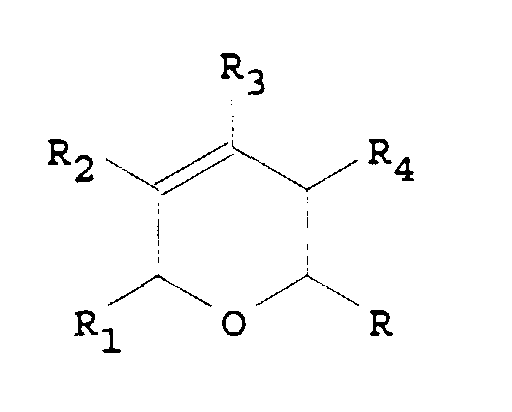
in which R is a C1-C10 aliphatic group or phenyl group which is unsubstituted or substituted with one or more C1-C5 alkyl groups or one other functional group and in which R1-R4 are H or C1-C5 alkyl groups, comprising reacting the corresponding aldehyde RCHO with the corresponding diene R1CH=CR2-CR3=CHR4 under the influence of a perfluorinated organic sulphonic acid or a Brönsted acid derivative thereof.
in which R is a C1-C10 aliphatic group or phenyl group which is unsubstituted or substituted with one or more C1-C5 alkyl groups or one other functional group and in which R1-R4 are H or C1-C5 alkyl groups, comprising reacting the corresponding aldehyde RCHO with the corresponding diene R1CH=CR2-CR3=CHR4 under the influence of a perfluorinated organic sulphonic acid or a Brönsted acid derivative thereof.
2. Process according to claim 1 wherein the perfluorinated organic sulfonic acid is perfluoro-octanesulphonic
acid, triflic acid, Nafion or a Brönsted acid derivative of triflic acid.
3. Process according to claim 2 wherein the Brönsted acid derivative of triflic acid
is bis-trifluoromethanesulfonimide.
4. Process according to any one of claims 1-3 wherein R is a C2-C6 aliphatic group or
a phenyl group which is unsubstituted or mono-substituted with C1-C3 alkyl or with
4-Cl, 4-nitro or 3-methoxy.
5. Process according to any one of claims 1-4 wherein the groups R1-R4 are H or methyl, preferably at most two of R1-R4 are methyl and the others are hydrogen.
6. Process according to any one of claims 1-5 wherein the aldehyde/diene ratio is between
10:1 and 1:20, preferably between 5:1 and 1:10.
7. Process according to any one of claims 1-6 wherein the amount of catalyst is between
0.01 and 50 mol% based on the reactant being present in the lowest molar amount, preferably
between 0.1 and 20%.