|
(11) | EP 0 854 177 A1 |

| (12) | EUROPEAN PATENT APPLICATION |
|
|
|
|
|||||||||||||||||||
| (54) | Ink compositions |
| (57) An ink composition comprised of a colorant and a reversible crosslinked component
vehicle obtained from the reaction product of an anhydride and an organoamine, and
which ink possesses a viscosity of from about 1 mPa.s (centipoise) to about 25 mPa.s
(centipoise) at a temperature of from about 125°C to about 185°C. The ink compositions
are particularly suitable for use in acoustic ink jet printing. |
[0001] The present invention is directed to ink compositions and, more specifically, the present invention relates to hot melt inks especially useful for acoustic ink printing, processes and apparatuses.
[0002] More specifically, the present invention is directed to hot melt acoustic ink compositions wherein there can be generated with such inks excellent developed images with acceptable image permanence, excellent projection efficiency on transparencies without a post fusing step, and excellent crease resistance, and wherein the inks possess acceptable, and in embodiments superior lightfastness and superior waterfastness. Moreover, in embodiments of the present invention there is enabled the elimination, or minimization of undesirable paper curl since water is not present, or very small amounts thereof are selected, in the invention inks, and it is preferred that there be an absence of water, and since water is not present in the inks a dryer can be avoided thereby minimizing the cost of the acoustic ink jet apparatus and process.
[0003] In acoustic ink printing, the printhead produces approximately 2.2 picoliter droplets by an acoustic energy process. The ink under these conditions should display a melt viscosity of about 5 centipoise or less at the jetting temperature. Furthermore, once the ink is jetted onto the paper, the ink image should be of excellent crease property, and should be nonsmearing waterfast, of excellent transparency and excellent fix qualities. In selecting an ink for such applications, it is desirable that the vehicle display a low melt viscosity, such as from about 1 mPa.s (1 centipoise) to about 25 mPa.s (25 centipoise) in the acoustic head, while also displaying solid like properties after being jetted onto paper. Since the acoustic head can tolerate a temperature up to about 180°C, and preferably up to a temperature of from about 140°C to about 160°C, the vehicle for the ink should preferably display liquid like properties, such as a viscosity of 1 to about 10 centipoise, at a temperature of from about 125°C to about 165°C, and solidify or harden after jetting onto paper such that the ink displays a hardness value of from about 0.1 to about 0.5 millimeter utilizing a penetrometer according to the ASTM penetration method D1321.
[0004] Ink jet printing processes that employ inks that are solid at room temperature and liquid at elevated temperatures are known. For example, U.S. Patent 4,490,731, discloses an apparatus for dispensing certain solid inks for printing on a substrate such as paper. The ink dye vehicle is chosen to have a melting point above room temperature so that the ink, which is melted in the apparatus, will not be subject to evaporation or spillage during periods of nonprinting. The vehicle selected possesses a low critical temperature to permit the use of the solid ink in a thermal ink jet printer. In thermal ink jet printing processes employing hot melt inks, the solid ink is melted by a heater in the printing apparatus and utilized as a liquid in a manner similar to that of conventional thermal ink jet printing. Upon contact with the printing substrate, the molten ink solidifies rapidly, enabling the dye to remain on the surface instead of being carried into the paper by capillary action, thereby attempting to enable higher print density than is generally obtained with liquid inks. Hot melt ink jets are somewhat similar to thermal ink jets, however, a hot melt ink contains no solvent. Thus, rather than being liquid at room temperature, a hot melt ink is typically a solid or semi-solid having a wax-like consistency. These inks usually need to be heated, for example, to approximately 100°C before the ink melts and turns into a liquid. With hot melt inks, a plurality of ink jet nozzles are provided in a printhead. A piezoelectric vibrating element is located in each ink channel upstream from a nozzle so that the piezoelectric oscillations propel ink through the nozzle. After the hot melt ink is applied to the substrate, the ink is resolidified by freezing on the substrate.
[0005] Each of these types of known ink jets, however, has a number of advantages and disadvantages. One advantage of thermal ink jets is their compact design for the integrated electronics section of the printhead. Thermal ink jets are disadvantageous in that the thermal ink has a tendency to soak into a plain paper medium. This blurs the print or thins out the print locally thereby adversely affecting print quality. Problems have been encountered with thermal ink jets in attempting to rid the ink of moisture fast enough so that the ink does not soak into a plain paper medium. This is particularly true when printing with color. Therefore, usually when printing with thermal ink, one needed to use coated papers, which are more expensive than plain paper.
[0006] One advantage of a hot melt ink jet is its ability to print on plain paper since the hot melt ink quickly solidifies as it cools and, since it is waxy in nature, does not normally soak into a paper medium. However, hot melt ink jets can be cumbersome in structure and in design, that is, the associated integrated electronics of a thermal ink jet head are considerably more compact than those of a hot melt ink jet head.
[0007] While the known ink compositions and processes may be suitable for their intended purposes, a need remains for acoustic hot melt ink compositions suitable for thermal ink jet printing. In addition, there is a need for hot melt ink compositions which are compatible with a wide variety of plain papers. Further, there is a need for hot melt ink compositions which generate high quality, waterfast images on plain papers. There is also a need for hot melt ink jet ink compositions which generate high quality, fast-drying images on a wide variety of plain papers at low cost with high quality text and high quality graphics. Further, there is a need for hot melt ink jet ink compositions which exhibit minimal feathering. Additionally, there is a need for hot melt ink jet ink compositions which exhibit minimal intercolor bleed. There is also a need for hot melt ink jet ink compositions which exhibit excellent image permanence. Additionally, there is a need for hot ink compositions suitable for ink jet printing processes wherein the substrate is heated prior to printing and is cooled to ambient temperature subsequent to printing (also known as heat and delay printing processes). There is also a need for ink compositions suitable for ink jet printing wherein high optical densities can be achieved with relatively low dye concentrations. A need also remains for ink compositions suitable for ink jet printing wherein curling of the substrate, such as paper, subsequent to printing is minimized, or avoided. These and other needs can be achievable with the inks of the present invention in embodiments thereof.
[0008] One object of the present invention is to provide hot ink jet ink compositions which exhibit low viscosity of from about 1 to about 10 mPa.s (1 to about 10 centipoise) at a temperature of from about 125°C to about 160°C.
[0009] Another object of the present invention is to provide hot melt ink jet ink compositions which exhibit minimal intercolor bleed.
[0010] A further object of the present invention is to provide hot melt ink jet ink compositions which exhibit excellent image permanence.
[0011] A still further object of the present invention is to provide hot ink jet ink compositions that contain no water and which are suitable for use in acoustic ink jet printing processes.
[0012] According to one aspect of the present invention there is provided an ink composition comprised of a colorant and a reversible crosslinked vehicle obtained from the reaction product of an anhydride and an organic amine, including diamines, triamines, tetraamines, or mixtures thereof, and which ink possesses a viscosity of from about 1 centipoise to about 25 centipoise at a temperature of from about 125°C to about 185°C.
[0013] In embodiments the ink compositions of the present invention comprise a dye or pigment, and a reversible crosslinked vehicle, and wherein the colorant is present in various effective amounts, such as from about 2 to about 10 weight percent, and the vehicle is present in an amount of from about 60 to about 90 weight percent.
[0014] Embodiments of the present invention include an ink composition comprised of a dye, a reversible crosslinked vehicle obtained from the reaction of an anhydride and diamine or triamine, and resulting in the equilibria reaction mixture of an organoimide-amine and polyamide.
[0015] Embodiments of the present invention include an ink composition comprised of a colorant and a reversible crosslinked component vehicle obtained from the reaction product of an anhydride and an organoamine, and which ink possesses a viscosity of from about 1 mPa.s (centipoise) to about 25 mPa.s (centipoise) at a temperature of from about 125°C to about 185°C; an ink composition wherein said reversible crosslinked vehicle is obtained from the reaction product of an anhydride like phthalic anhydride and an organoamine, such as a diamine or a triamine, and which reaction product results in a temperature dependent equilibria reaction mixture of an imido amine and polyamide of the structure
wherein R is hydrogen, alkyl, or alkenyl, each with from about 1 to about 36 carbon atoms, and R1 is an alkylene or polyoxyalkylene, each with from about 2 to about 36 carbon atoms; an ink composition wherein the vehicle I or II is comprised of from about 75 to about 95 percent by weight of polyamide and from about 5 to about 25 percent by weight of imido amine at a temperature of from about 20°C to about 100°C, and the vehicle I or II is comprised of from about 75 to about 95 percent by weight of imido amine and from about 5 to about 25 percent by weight of polyamide at a temperature of from about 120°C to about 160°C; an ink composition wherein the anhydride is selected from the group consisting of phthalic anhydride, 3-methylphthalic anhydride, succinic anhydride, 2-alkylsuccinic anhydride such as 2-methylsuccinic anhydride, 2-ethylsuccinic anhydride, 2-propylsuccinic anhydride, 2-butylsuccinic anhydride, 2-octylsuccinic anhydride, 2-stearylsuccinic anhydride, 2-octadecen-2yl-succinic anhydride, 2-decen-2yl-succinic anhydride, and 2-dodecen-2yl-succinic anhydride; an ink composition wherein the polyamide possesses a molecular weight, Mw, of from about 1,500 to about 15,000 grams per mole; an ink composition wherein the ink is a solid at room temperature, about 20°C to about 40°C; an ink composition wherein said polyamide of I or II is present in an amount of from about 60 to about 99 weight percent at a temperature of from about 20°C to about 120°C; an ink composition wherein said polyamide of I or II is present in an amount of from about 85 to about 97 weight percent at a temperature of from about 20°C to about 120°C; an ink composition wherein said imido amine of I or II is present in an amount of from about 60 to about 99 weight percent at a temperature of from about 120°C to about 165°C; an ink composition wherein said imido amine of I or II is present in an amount of from about 85 to about 97 weight percent at a temperature of from about 120°C to about 165°C; a printing process which comprises incorporating into an acoustic ink jet printer an ink comprised of a colorant and a crosslinked reversible vehicle obtained from the reaction product of an anhydride and an organic amine, and which ink possesses a viscosity of from about 1 mPa.s (centipoise) to about 25 mPa.s (centipoise) at a temperature of from about 125°C to about 185°C, a viscosity of from about 5 mPa.s (centipoise) to about 20 mPa.s (centipoise) at a temperature of from about 125°C to about 185°C, and causing droplets of the ink to be ejected in imagewise pattern onto a substrate; a process which comprises (a) providing an acoustic ink printer having a pool of liquid ink with a free surface, and a printhead including at least one droplet ejector for radiating the free surface of said ink with focused acoustic radiation to eject individual droplets of ink therefrom on demand, said radiation being brought to focus with a finite waist diameter in a focal plane, said ink comprising a colorant and a reversible crosslinked resin obtained from the reaction product of an anhydride and an organic amine, and which ink possesses a viscosity of from about 1 mPa.s (centipoise) to about 25 mPa.s (centipoise) at a temperature of from about 125°C to about 185°C, viscosity of from about 5 centipoise to about 20 centipoise at a temperature of from about 125°C to about 185°C, and (b) causing droplets of said ink to be ejected onto a recording sheet in an imagewise pattern at a temperature of from about 120°C to about 185°C; an ink composition wherein alkyl contains from 1 to 6 carbon atoms; an ink composition wherein alkenyl contains from 1 to about 10 carbon atoms; an ink composition wherein R1 is alkenyl with from 2 to about 8 carbon atoms; an ink composition wherein the colorant is a pigment; and an ink composition wherein said organic amine is a tetraamine, a diamine, a triamine or mixtures thereof.
[0016] The organic amine, preferably an organic diamine, can be selected from the group consisting of 1,2-diaminoethane, 1,2Ä diaminopropane, 1,4-diaminobutane, 1,5-diaminopentane, 2Ämethylpentylene diamine, 1,6-diaminohexane, 1,8-diaminooctane, 1,10Ädiaminodecane, 1,12-diaminododecane, poly(oxyalkyleneoxy)-diamine available from Huntsman Corporation as JEFFAMINE™ 148, 230, 400, 192, 700 and 403, illustrated by the formula
wherein R is hydrogen or alkyl like CH3 ; and n is 2 to 21; and which diamine is utilized in an amount of, for example, from about 0.35 mole equivalent to about 0.65 mole equivalent of the vehicle.
[0017] The anhydride utilized in the preparation of the reversible crosslink vehicle can be selected from the group consisting of phthalic anhydride, 3-methylphthalic anhydride, succinic anhydride, 2-alkylsuccinic anhydride such as 2-methylsuccinic anhydride, 2-ethylsuccinic anhydride, 2-propylsuccinic anhydride, 2-butylsuccinic anhydride 2-octylsuccinic anhydride, 2-stearylsuccinic anhydride, 2-octadecen-2yl-succinic anhydride, 2-decen-2yl-succinic anhydride, 2-dodecen-2yl-succinic anhydride. mixtures thereof, and the like, including other known anhydrides, and which anhydride is utilized in an amount of, for example, about 0.35 mole equivalent to about 0.65 mole equivalent of the vehicle.
[0018] Examples of the imido amines include N-aminododecyl phthalimide, N'-10-amino-decyl phthalimide, N'-8-amino-octyl phthalimide, N'-6-amino-hexyl phthalimide, N'-5-amino-pentyl phthalimide, N'-4-amino-butyl phthalimide, N'-3-amino-propyl phthalimide, N'-2-amino-ethyl phthalimide, N'-ethyloxyethylamine phthalimide, N'-ethyloxyethyloxyethylamine phthalimide, N'-ethyloxyethyloxyethyloxyethylamine phthalimide, N'-ethyloxyethyloxyethyloxyethyloxyethylamine phthalimide. N'-(polyethyloxy)ethylamine phthalimide, N'-(polypropyloxy)propylamine phthalimide, N'-12-aminododecyl 3-methylphthalimide, N'-(polyethyloxy)ethylamine 3-methylphthalimide, N'-(polypropyloxy)propylamine 3-methylphthalimide, N'-12-aminododecyl succinimide, N'-(polyethyloxy)ethylamine succinimide, N'-(polypropyloxy)propylamine succinimide, N'-12-aminododecyl 2-octylsuccinimide, N'-(polyethyloxy)ethylamine 2-octylsuccinimide, N'-(polypropyloxy)propylamine 2-octylsuccinimide, N'-12-aminododecyl 2-stearylsuccinimide, N'-(polyethyloxy)ethylamine 2-stearylsuccinimide, N'-(polypropyloxy)propylamine 2-stearylsuccinimide, N'-(polyethyloxy)ethylamine 2-octadecen-2yl-succinimide, N'-12-aminododecyl 2-octadecen-2yl-succinimide, N'-12-aminododecyl 2-decen-2yl-succinimide, and N'-12-aminododecyl 2-dodecen-2yl-succinmide, and which amine is preferably present in an effective amount of from about 60 to about 97 percent by weight of the ink at a temperature of from about 120°C to about 165°C during jetting from the acoustic printing device onto paper, and present in an amount of from about 5 to about 35 percent by weight of the ink when the ink is on the paper or substrate, and cooled to a temperature of from about 20°C to about 45°C.
[0019] Examples of the polyamide include a crosslinked poly(N'-12-aminododecyl) phthalamide, crosslinked poly(N'-10-aminodecyl) phthalamide, crosslinked poly(N'-8-amino-octyl) phthalamide, crosslinked poly(N'-6-amino-hexyl) phthalamide, crosslinked poly(N'-5-amino-pentyl) phthalimade, crosslinked poly(N'-4-amino-butyl) phthalamide, crosslinked poly(N'-3-amino-propyl) phthalimide, crosslinked poly(N'-2-amino-ethyl) phthalamide, crosslinked poly(N'-ethyloxyethylamine) phthalamide, crosslinked poly(N'-ethyloxyethyloxyethylamine) phthalamide, crosslinked poly(N'-ethyloxyethyloxyethyloxyethylamine) phthalamide, crosslinked poly(N'-ethyloxyethyloxyethyloxyethyloxyethylamine) phthalamide, crosslinked poly(N'-(polyethyloxy)ethylamine) phthalamide, crosslinked poly(N'-(polypropyloxy)propylamine) phthalamide, crosslinked poly(N'-12-aminododecyl) 3-methylphthalamide, crosslinked poly(N'-(polyethyloxy)ethylamine) 3-methylphthalamide, crosslinked poly(N'-(polypropyloxy)propylamine) 3-methylphthalamide, crosslinked poly(N'-12-aminododecyl) succinamide, crosslinked poly(N'-(polyethyloxy)ethylamine) succinamide, crosslinked poly(N'-(polypropyloxy)propylamine) succinamide, crosslinked poly(N'-12-aminododecyl) 2-octylsuccinamide, crosslinked poly(N'-(polyethyloxy)ethylamine) 2-octylsuccinamide, crosslinked poly(N'-(polypropyloxy)propylamine) 2-octylsuccinamide, crosslinked poly(N'-12-aminododecyl) 2-stearylsuccinamide, crosslinked poly(N'-(polyethyloxy)ethylamine) 2-stearylsuccinamide, crosslinked poly(N'-(polypropyloxy)propylamine) 2-stearylsuccinamide, crosslinked poly(N'-(polyethyloxy)ethylamine) 2-octadecen-2yl-succinamide, crosslinked poly(N'-12-aminododecyl) 2-octadecen-2yl-succinamide, crosslinked poly(N'-12-aminododecyl) 2-decen-2yl-succinamide, and crosslinked poly(N'-12-aminododecyl) 2-dodecen-2yl-succinamide, and which polyamide is preferably present in an effective amount of, for example, from about 5 to about 65 percent by weight of the ink at a temperature of from about 120°C to about 165°C during jetting from the acoustic printing device onto paper, and which polyamide is, for example, present in an amount of from about 65 to about 97 percent by weight of the ink when the ink is on the paper or substrate and cooled to a temperature of from about 20°C to about 45°C.
[0020] Examples of colorants, preferably dyes selected for the inks of the present invention, are known, reference the Color Index, and include those as illustrated in U.S. Patent 5,310,887 and, for example, Resorcin Crystal Violet, Orasol Black RL or Intraplast Black RL/Solvent Black 29, Lapranol Black BR, Savinyl Black RLS, Orasol Black RLP, Neozapon Black X57; solvent yellow dyes inclusive of Savinyl Yellow 2 RLS, Savinyl Yellow RLSN, Intraplast Yellow 2GLN, Neozapon Yellow 081, Neozapon Yellow 141, Levaderm Lemon Yellow, Zapon Fast Yellow CGR, Aizen Fast Yellow CGNH, Zapon Yellow 100, Zapon Yellow 157, and Savinyl Yellow RLS; magenta dyes such as Neozapon Red 492, Direct Brilliant Pink B, Savinyl Pink 6 BLS, Savinyl Red 3 BLS, Orasol Red 2 BL, Intraplast Red G (Orasol Red), Savinyl Red BLSN, Savinyl Scarlet RLS, Savinyl Fire Red 3GLS, and Zapon Red 335; cyan dyes such as Orasol Blue 2 GLN, Neozapon Blue 807, Savinyl Blue RLS, Savinyl Blue GLS, Orasol Blue GN, and Losol Blue; brown dyes inclusive of Zapon Brown 187 and Savinyl Brown GLS, Solvent Green 3, Sudan Black B, Ceres Blue 2V, Liquid Oil Jet Black, Macrolex Red G Gram, Macrolex Yellow 3G, Victoria Blue R, available from Bayer AG, Leverkusen, Germany, Morfast Blue 100, Morfast Red 104, and Morfast Red 100, available from Morton International Specialty Chemicals Group, Chicago, IL; mixtures thereof; and the like with preferred dyes in embodiments including Reactint Black 57AB, Reactint Black X40LV, Reactint Blue 17AB, Reactint Blue X3LV, Reactint Blue X19, Reactint Red X26B-50, Reactint Red X520, Reactint Violet X80LT, Reactint Orange X38, and Reactint Yellow X15, all available from Milliken Chemicals. Typically, the dye or pigment is present in the ink in an amount of from about 0.01 to about 10 percent by weight, preferably from about 0.05 to about 4 percent by weight, and more preferably from about 0.1 to about 3 percent by weight, although the amount can be outside these ranges. Specific pigment examples include carbon black, magenta, yellow, cyan pigments, or mixtures thereof selected in effective amounts of, for example, from 1 to about 10 weight percent
[0021] Optional ink additives include biocides, such as Dowicil 150, 200, and 75, benzoate salts, sorbate salts, and the like, present in effective amounts, such as for example an amount of from about 0.0001 to about 4 percent by weight, and preferably from about 0.01 to about 2.0 percent by weight; pH controlling agents such as acids; or bases, phosphate salts, carboxylates salts, sulfite salts, amine salts, and the like, present, for example, in an amount of from 0 to about 1 percent by weight and preferably from about 0.01 to about 1 percent by weight, based on the weight of the ink components
[0022] The inks of the present invention are particularly suitable for printing processes wherein the substrate, such as paper, transparency material, or the like, is heated during the printing process to facilitate formation of the liquid crystalline phase within the ink. When transparency substrates are employed, temperatures typically are limited to a maximum of about 100°C to about 110°C, since the polyester typically employed as the base sheet in transparency sheets tends to deform at higher temperatures. Specially formulated transparencies and paper substrates can. however, tolerate higher temperatures, and frequently are suitable for exposure to temperatures of 150°C or even 200°C in some instances. Typical heating temperatures are from about 40°C to about 140°C, and preferably from about 60°C to about 95°C, although the temperature can be outside these ranges.
[0023] The reversible crosslinked vehicle can be prepared by reacting an anhydride with an organic diamine compound by a condensation process. In one embodiment of this invention, the reversible crosslinked vehicle can be prepared, for example, by charging a reactor, such as a 300 milliliter Parr reactor equipped with a distillation apparatus, with from about 0.5 mole equivalent of an anhydride, such as phthalic anhydride or succinic anhydride, with about 0.5 mole equivalent of an organic diamine such as 1,12-dodecane diamine, and optionally a condensation catalyst, such as dibutylstannoic acid, at a temperature of from about 150°C to about 185°C with stirring for a duration of from about 3 to 6 hours. During this time, water is collected as a byproduct in the distillation receiver. The reaction mixture is then poured into a pan and allowed to cool to room temperature, about 25°C.
[0024] The inks of the present invention can be prepared by any suitable method. For example, the inks can be prepared by gently stirring or shaking the individual components, such as melt mixing the vehicle with a colorant at a temperature of from about 90°C to about 130°C, followed by cooling to about 25°C.
EXAMPLE I
[0025] Synthesis of the reversible crosslinked vehicle from JEFFAMINE™ EDR-192, a poly(ethylylene glycol) bis(2-aminopropyl ether) of a molecular weight of 192 grams per mole, and phthalic anhydride was accomplished as follows:
[0026] A 300 milliliter Parr reactor equipped with a mechanical stirrer and a distillation apparatus was charged with 94 grams of JEFFAMINE™ 192 obtained from Huntsman Chemical Company, and 74 grams of phthalic anhydride. The mixture was then heated to 100°C over a 2 hour period. followed by increasing the temperature slowly to 150°C and then to 175°C over a four hour period. The pressure was then reduced from atmospheric pressure to about 1 millimeter Hg, and these conditions were maintained for an additional one hour, wherein the total amount of water collected in the distillation receiver during the process was measured to be about 5 milliliters. The pressure was then increased to atmospheric pressure and the product, a viscous liquid, comprised of a mixture of N'-ethyloxyethyloxy ethyloxyethylamine phthalimide and crosslinked poly(N'-(ethyloxyethyloxy ethyloxy)ethylamine) phthalamide, was poured into a metal container and left undisturbed to cool down to room temperature (about 25°C throughout the Examples).
EXAMPLE II
[0027] Synthesis of the reversible crosslinked vehicle from JEFFAMINE™ D-230, a poly(propylene glycol) bis(2-aminopropyl ether) of molecular weight of 230 grams per mole, and phthalic anhydride was accomplished as follows:
[0028] A 300 milliliter Parr reactor equipped with a mechanical stirrer and a distillation apparatus was charged with 115 grams of JEFFAMINE™ D-230 obtained from Huntsman Chemical Company, and 74 grams of phthalic anhydride. The mixture was then heated to 100°C over a 2 hour period, followed by increasing the temperature slowly to 150°C and then to 175°C over a four hour period. The pressure was then reduced from atmospheric pressure to about 1 millimeter Hg, and these conditions were maintained for an additional one hour, wherein the total amount of water collected in the distillation receiver during the process was measured to be about 8 milliliters. The pressure was then increased to atmospheric pressure and the product, a viscous liquid comprised of a mixture of N'-(polypropyloxy)propylamine phthalimide crosslinked poly(N'-(polypropyloxyl)propylamine) phthalamide, was poured into a metal container and left undisturbed to cool down to room temperature.
EXAMPLE III
[0029] Synthesis of the reversible crosslinked vehicle obtained from JEFFAMINE™ D-400, a poly(propylene glycol) bis(2-aminopropyl ether) of a molecular weight of 400 grams per mole, and phthalic anhydride was accomplished as follows:
[0030] A 300 milliliter Parr reactor equipped with a mechanical stirrer and a distillation apparatus was charged with 100 grams of JEFFAMINE™ D-400 obtained from Huntsman Chemical Company, and 37 grams of phthalic anhydride. The mixture was then heated to 100°C over a 2 hour period, followed by increasing the temperature slowly to 150°C and then to 175°C over a four hour period. The pressure was then reduced from atmospheric pressure to about 1 millimeter Hg, and these conditions were maintained for an additional hour, wherein the total amount of water collected in the distillation receiver during the process was measured to be about 4 milliliters. The pressure was then increased to atmospheric pressure and the product, a viscous liquid comprised of a mixture of N'-(polypropyloxy)propylamine phthalimide and crosslinked poly(N'-(polypropyloxyl)propylamine) phthalamide, was poured into a metal container and left undisturbed to cool down to room temperature.
EXAMPLE IV
[0031] Synthesis of the reversible crosslinked vehicle obtained from JEFFAMINE™ T-403, a poly(propylene glycol) tris(2-aminopropyl ether) of molecular weight of 403 grams per mole, and phthalic anhydride was accomplished as follows:
[0032] A 300 milliliter Parr reactor equipped with a mechanical stirrer and a distillation apparatus was charged with 100.8 grams of JEFFAMINE™ T-403 obtained from Huntsman Chemical Company, and 37 grams of phthalic anhydride obtained from Fisher Chemical Company. The mixture was then heated to 100°C over a 2 hour period, followed by increasing the temperature slowly to 150°C and then to 175°C over a four hour period. The pressure was then reduced from atmospheric pressure to about 1 millimeter Hg, and these conditions were maintained for an additional one hour, wherein the total amount of water collected in the distillation receiver during the process was measured to be about 4 milliliters. The pressure was then increased to atmospheric pressure and the product, a viscous liquid comprised of a mixture of N'-(polypropyloxy)propylamine phthalimide and crosslinked poly(N'-(polypropyloxyl)propylamine) phthalamide, was poured into a metal container and left undisturbed to cool down to room temperature.
EXAMPLE V
[0033] Synthesis of the reversible crosslinked vehicle generated from 1,12-dodecanediamine and phthalic anhydride was accomplished as follows:
[0034] A 300 milliliter Parr reactor equipped with a mechanical stirrer and a distillation apparatus was charged with 66.8 grams of 1,12-dodecanediamine obtained from E.I. DuPont and 49.4 grams of phthalic. The mixture was then heated to 100°C over a 2 hour period, followed by increasing the temperature slowly to 150°C and then to 175°C over a four hour period. The pressure was then reduced from atmospheric pressure to about 1 millimeter Hg, and these conditions were maintained for an additional hour, wherein the total amount of water collected in the distillation receiver during the process was measured to be about 5 milliliters. The pressure was then increased to atmospheric pressure and the product comprised of a mixture of N'-(12-aminododecyl) phthalimide and crosslinked poly(N'-12-aminododecyl) phthalamide, was poured into a metal container and left undisturbed to cool down to room temperature.
EXAMPLE VI
[0035] Synthesis of the reversible crosslinked vehicle polymer generated from 1,12-dodecanediamine and dodecenyl succinic anhydride was accomplished as follows:
[0036] A 300 milliliter Parr reactor equipped with a mechanical stirrer and a distillation apparatus was charged with 66.8 grams of 1,12-dodecanediamine obtained from E.I. DuPont, and 88.7 grams of dodecenyl succinic anhydride obtained from Lonza. The mixture was then heated to 100°C over a 2 hour period, followed by increasing the temperature slowly to 150°C and then to 175°C over a four hour period. The pressure was then reduced from atmospheric pressure to about 1 millimeter Hg, and these conditions were maintained for an additional hour, wherein the total amount of water collected in the distillation receiver during the process was measured to be about 5 milliliters. The pressure was then increased to atmospheric pressure and the product comprised of a mixture of N'-(12-aminododecyl) 2-stearylsuccinimide crosslinked poly(N'-12-aminododecyl)2-stearylsuccinamide was poured into a metal container and left undisturbed to cool down to room temperature.
Viscosity Measurements
[0037] The rheological characterization, and more specifically, the viscosity of the above prepared vehicles was performed using the Carri-Med CSL-100 controlled stress rheometer using a 4 centimeter, 2 degree cone and plate geometry.
| Example | Viscosity (mPa.s (cp)) at 160°C |
| I | 13 |
| II | 13 |
| III | 8 |
| IV | 10 |
| V | 15 |
[0038] The vehicles were melt mixed with 5 percent by weight of Neopan Blue dye to form inks, and each ink was incorporated into an acoustic ink jet printing test fixture utilizing the ejection mechanism disclosed in J. Appl. Phys. 65(9), 1 May 1989, and references therein, the disclosure of which are totally incorporated herein by reference. A jetting frequency of 160 MHz was used to generate drops of about 2 picoliters, up to 12 drops per pixel at 600 spi. The images formed exhibited excellent quality, high definition, sharp edges, and waterfastness.
1. An ink composition comprised of a colorant and a reversible crosslinked component
vehicle obtainable from the reaction product of an anhydride and an organoamine, and
which ink possesses a viscosity of from about 1 mPa.s (centipoise) to about 25 mPa.s
(centipoise) at a temperature of from about 125°C to about 185°C.
2. An ink composition in accordance with claim 1 wherein said reversible crosslinked
vehicle is obtainable from the reaction product of an anhydride and an organoamine,
and which reaction product results in a temperature dependent equilibria reaction
mixture of an imido amine and polyamide
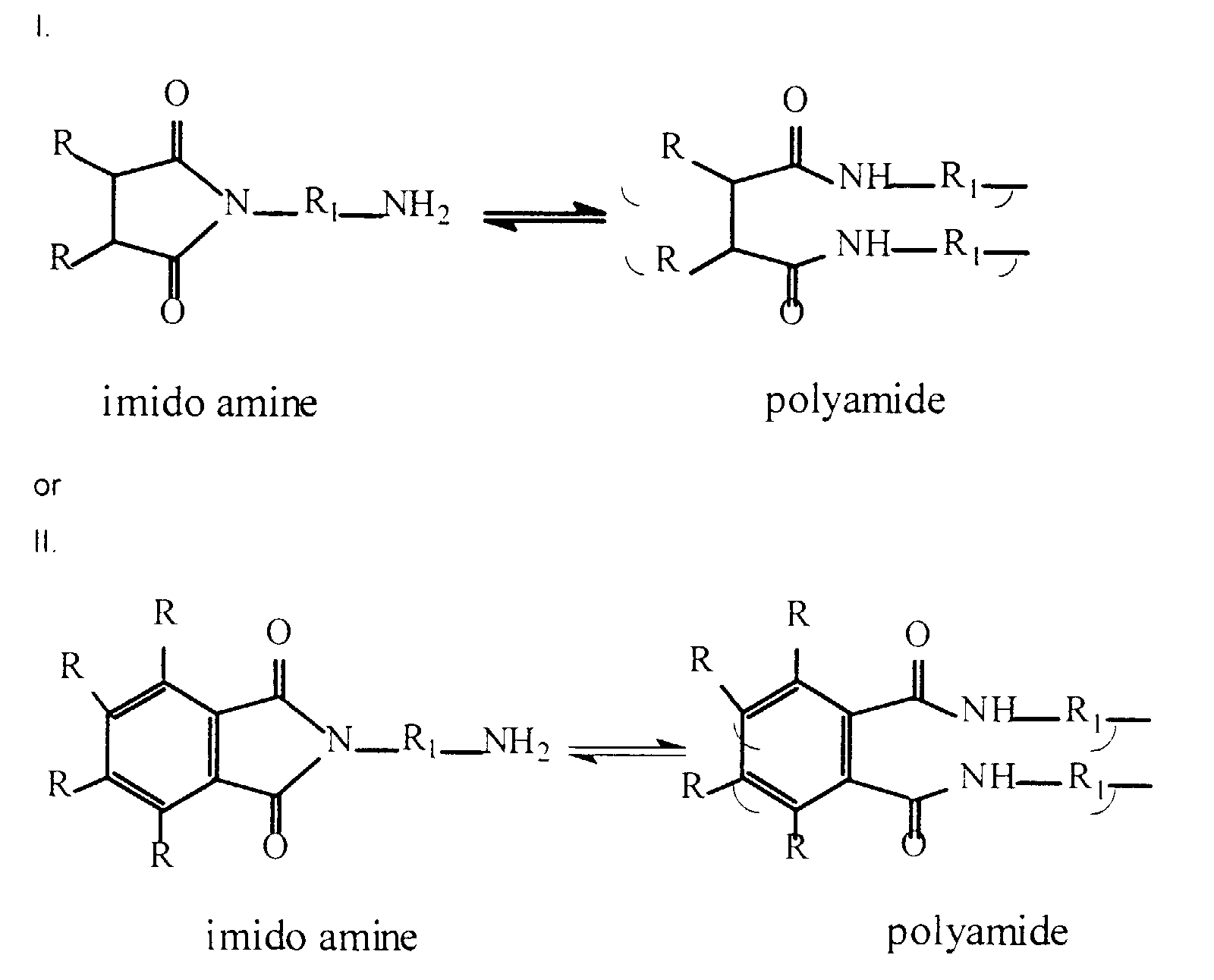
wherein R is hydrogen, alkyl, or alkenyl, each with from about 1 to about 36 carbon atoms. and R1 is an alkylene or polyoxyalkylene, each with from about 2 to about 36 carbon atoms.
wherein R is hydrogen, alkyl, or alkenyl, each with from about 1 to about 36 carbon atoms. and R1 is an alkylene or polyoxyalkylene, each with from about 2 to about 36 carbon atoms.
3. An ink composition in accordance with claim 2 wherein the vehicle I or II is comprised
of from about 75 to about 95 percent by weight of polyamide and from about 5 to about
25 percent by weight of imido amine at a temperature of from about 20°C to about 100°C,
and the vehicle I or II is comprised of from about 75 to about 95 percent by weight
of imido amine and from about 5 to about 25 percent by weight of polyamide at a temperature
of from about 120°C to about 160°C.
4. An ink composition in accordance with claim 1 wherein the anhydride is selected from
the group consisting of phthalic anhydride, 3-methylphthalic anhydride, succinic anhydride,
2-alkylsuccinic anhydride, 2-methylsuccinic anhydride, 2-ethylsuccinic anhydride,
2-propylsuccinic anhydride, 2-butylsuccinic anhydride, 2-octylsuccinic anhydride,
2-stearylsuccinic anhydride, 2-octadecen-2yl-succinic anhydride, 2-decen-2yl-succinic
anhydride, and 2-dodecen-2yl-succinic anhydride.
5. An ink composition in accordance with claim 2 wherein the organoamine is an organic
diamine of 1,2-diaminoethane, 1,2-diaminopropane, 1,4-diaminobutane, 1,5-diaminopentane,
2-methylpentylene diamine, 1,6-diaminohexane, 1,8-diaminooctane, 1,10-diaminodecane,
1,12-diaminododecane, or poly(oxyalkyleneoxy)-diamine of the formula
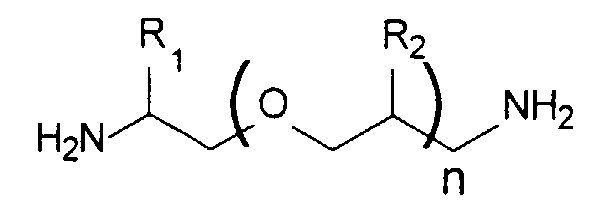
wherein R is hydrogen or alkyl; and n is a number of from about 2 to about 21.
wherein R is hydrogen or alkyl; and n is a number of from about 2 to about 21.
6. An ink composition in accordance with claim 2 wherein the imido amine is selected
from the group consisting of N-aminododecyl phthalimide, N'-10-aminodecyl phthalimide,
N'-8-amino-octyl phthalimide, N'-6-amino-hexyl phthalimide, N'-5-amino-pentyl phthalimide,
N'-4-amino-butyl phthalimide, N'-3-amino-propyl phthalimide, N'-2-amino-ethyl phthalimide,
N'-ethyloxyethylamine phthalimide, N'-ethyloxyethyloxyethylamine phthalimide, N'-ethyloxyethyloxyethyloxyethylamine
phthalimide, N'-ethyloxyethyloxyethyloxyethyloxyethylamine phthalimide, N'-(polyethyloxy)ethylamine
phthalimide, N'-(polypropyloxy)propylamine phthalimide, N'-12-aminododecyl 3-methylphthalimide,
N'-(polyethyloxy)ethylamine 3-methylphthalimide, N'-(polypropyloxy)propylamine 3-methylphthalimide,
N'-12-aminododecyl succinimide, N'-(polyethyloxy)ethylamine succinimide, N'-(polypropyloxy)propylamine
succinimide, N'-12-aminododecyl 2-octylsuccinimide, N'-(polyethyloxy)ethylamine 2-octylsuccinimide,
N'-(polypropyloxy)propylamine 2-octylsuccinimide, N'-12-aminododecyl 2-stearylsuccinimide,
N'-(polyethyloxy)ethylamine 2-stearylsuccinimide, N'-(polypropyloxy)propylamine 2-stearylsuccinimide,
N'-(polyethyloxy)ethylamine 2-octadecen-2yl-succinimide, N'-12-aminododecyl 2-octadecen-2yl-succinimide,
N'-12-aminododecyl 2-decen-2yl-succinimide, and N'-12-aminododecyl 2-dodecen-2yl-succinmide.
7. An ink composition in accordance with claim 2 wherein said polyamide is poly(N'-12-aminododecyl)
phthalamide, crosslinked poly(N'-10-aminodecyl) phthalamide, crosslinked poly(N'-8-amino-octyl)
phthalamide, crosslinked poly(N'-6-amino-hexyl) phthalamide, crosslinked poly(N'-5-amino-pentyl)
phthalimade, crosslinked poly(N'-4-amino-butyl) phthalamide, crosslinked poly(N'-3-amino-propyl)
phthalimade, crosslinked poly(N'-2-amino-ethyl) phthalamide, crosslinked poly(N'-ethyloxyethylamine)
phthalamide, crosslinked poly(N'-ethyloxyethyloxyethylamine) phthalamide, crosslinked
poly(N'-ethyloxyethyloxyethyloxyethylamine) phthalamide, crosslinked poly(N'-ethyloxyethyloxyethyloxyethyloxyethylamine)
phthalamide, crosslinked poly(N'-(polyethyloxy)ethylamine) phthalamide, crosslinked
poly(N'-(polypropyloxy)propylamine) phthalamide, crosslinked poly(N'-12-aminododecyl)
3-methylphthalamide, crosslinked poly(N'-(polyethyloxy)ethylamine) 3-methylphthalamide,
crosslinked poly(N'-(polypropyloxy)propylamine) 3-methylphthalamide, crosslinked poly(N'-12-aminododecyl)
succinamide, crosslinked poly(N'-(polyethyloxy)ethylamine) succinamide, crosslinked
poly(N'-(polypropyloxy)propylamine) succinamide, N'-12-aminododecyl) 2-octylsuccinamide,
crosslinked poly(N'-(polyethyloxy)ethylamine) 2-octylsuccinamide, crosslinked poly(N'-(polypropyloxy)propylamine)
2-octylsuccinamide, crosslinked poly(N'-12-aminododecyl) 2-stearylsuccinamide, crosslinked
poly(N'-(polyethyloxy)ethylamine) 2-stearylsuccinamide, crosslinked poly(N'-(polypropyloxy)propylamine)
2-stearylsuccinamide, crosslinked poly(N'-(polyethyloxy)ethylamine) 2-octadecen-2yl-succinamide,
crosslinked poly(N'-12-aminododecyl) 2-octadecen-2yl-succinamide, crosslinked poly(N'-12-aminododecyl)
2-decen-2yl-succinamide, or crosslinked poly(N'-12-aminododecyl) 2-dodecen-2yl-succinamide.
8. An ink composition in accordance with claim 1 wherein the crosslinked vehicle is solid
at about 25°C, and liquid at jetting temperatures of from about 120°C to about 165°C.
9. An ink composition in accordance with any of claims 1 to 8 wherein said colorant is
a dye present in an amount of from about 0.05 to about 20 weight percent.
10. A printing process which comprises incorporating into an acoustic ink jet printer
an ink in accordance with any of claims 1 to 9. and causing droplets of the ink to
be ejected in imagewise pattern onto a substrate.