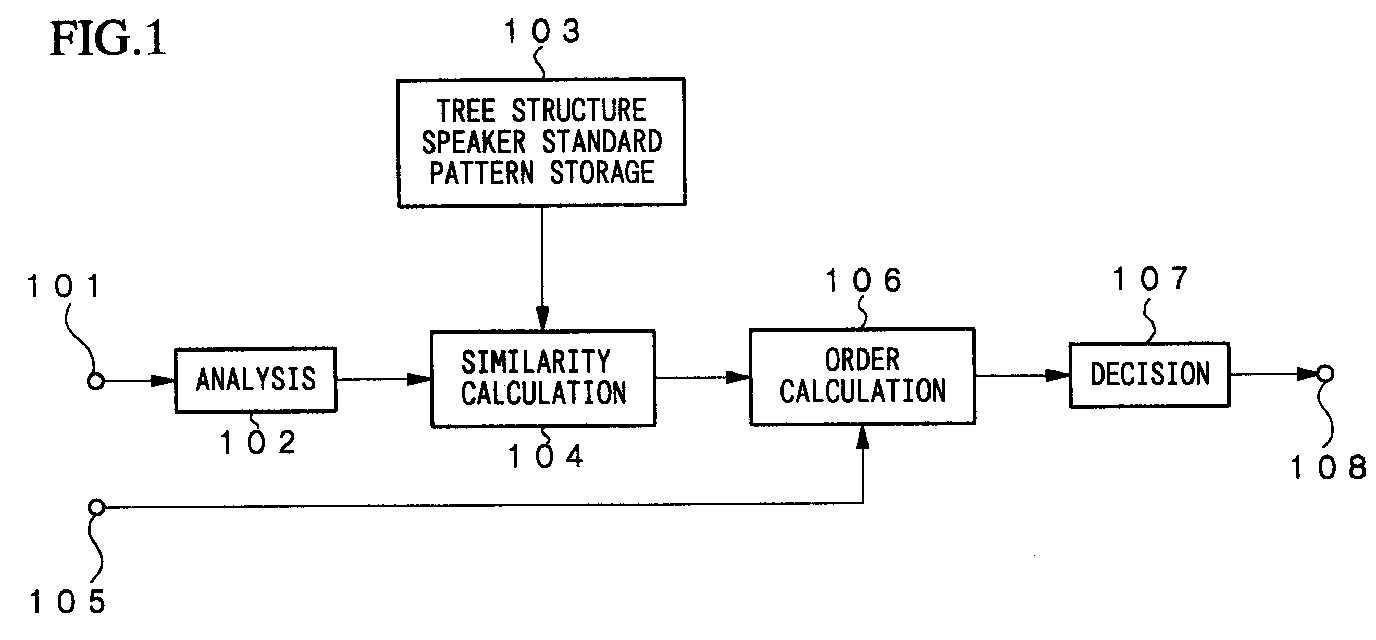
(57) A speaker recognition device is designed to actualize speaker recognition which is
capable of coping with an increase of enrolled speakers with a small amount of processing
and to provide a high precision of speaker recognition regardless of a variety of
disturbances. Herein, sound analysis is performed on input voice data of an input
speaker to produce an input pattern representing sound characteristics. The device
stores standard patterns (e.g., time series of sound parameters or HMM parameters)
with regard to enrolled speakers in a form of a tree structure which is constructed
by nodes mutually connected together from a root to leaves. Similarity calculations
are performed in a direction from the root to the leaves of the tree structure to
produce similarity scores between the input pattern and the standard patterns respectively.
An order is determined for the calculated similarity scores from the highest to the
lowest. In addition, a similarity score is calculated for a designated speaker who
is specified by speaker information input to the device. If a place of the order set
for the designated speaker belongs to a prescribed range of places of the order, the
device makes a decision of acceptance that the input speaker coincides with the designated
speaker. If not, the device makes a decision of rejection that the input speaker feigns
to be the designated speaker.
|
|
