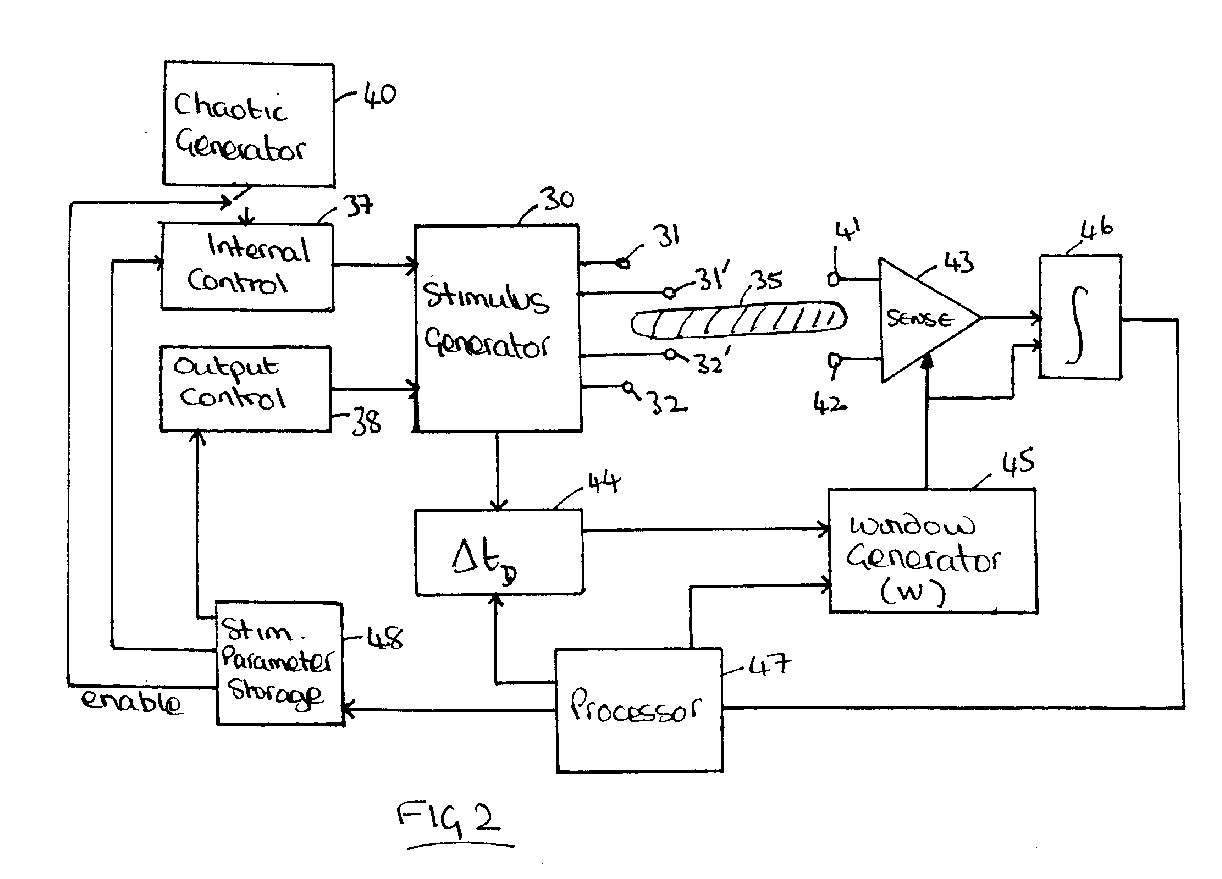
(57) There is provided a measurement system for measuring signals evoked in response to
stimulus pulses applied to a nerve, muscle or like physiological portion of a patient.
The measurement system is characterized by delivering stimulus pulses at randomly
generated intervals, and enabling the sense circuitry-to track the timing of the stimulus
pulse generation so as to aid in discriminating the evoked response pattern from surrounding
noise. Specifically, after each stimulus pulse a delay is timed out for a time corresponding
to the expected latency between the delivered pulse and the arrival of the evoked
response at another location. The delay signal is then used to initiate time out of
a window which controls operation of the sensing circuit for a window duration corresponding
to when the evoked response pattern is appearing. Limiting the sensing operation to
the window duration enables tracking of the response pattern, and minimizes power
consumption. The sensed evoked response signals are further processed to provide control
signals for adjustment of the delay and window, thereby optimizing the sensing operation.
The measurement system is suitably part of a larger implantable stimulus system, which
includes the ability to adjust pulse-to-pulse interval, or rate, and also pulse output
level as a function of measured evoked response patterns. In a further embodiment,
the stimulus system involves steering of stimulus pulses to selected nerve fibers
or muscle tissue, and the measurement system provides feedback for adjusting the steering
parameters.
|
|
