(57) Bidirectional scanning printheads (20, 20', 23-26) discharge color-ink drops (18,
19) at ultrahigh resolution while scanning in each direction (16, 17), to form color
swaths (Fig. 12) on a print medium (4A). The heads are at least partially aligned
with respect to the longitudinal axis (85) of the medium, so that the swaths at least
partly overlap (86) in that direction. An advance mechanism (31, 35) intermittently
steps (42A) the print medium longitudinally, to enable displacement of successive
swaths. A control system (15) alternates
- one full reciprocation (18, 19) of the heads, to discharge drops while scanning each
way across the medium, with
- each step (42A) of the advance mechanism.
Preferably the heads print, while scanning each way, a respective generally fixed
nonzero fraction of the total amount of each secondary color (23 plus 24, or 23 plus
25, or 24 plus 25) to be printed. In this way the overall appearance of each secondary
is essentially consistent and partway between two appearances respectively produced
by scanning two ways. This invention avoids the long-print-zone drawbacks associated
with full-height-staggered heads. Preferably the fractions for all the swaths are
about equal, so that the consistent appearance for each secondary is essentially the
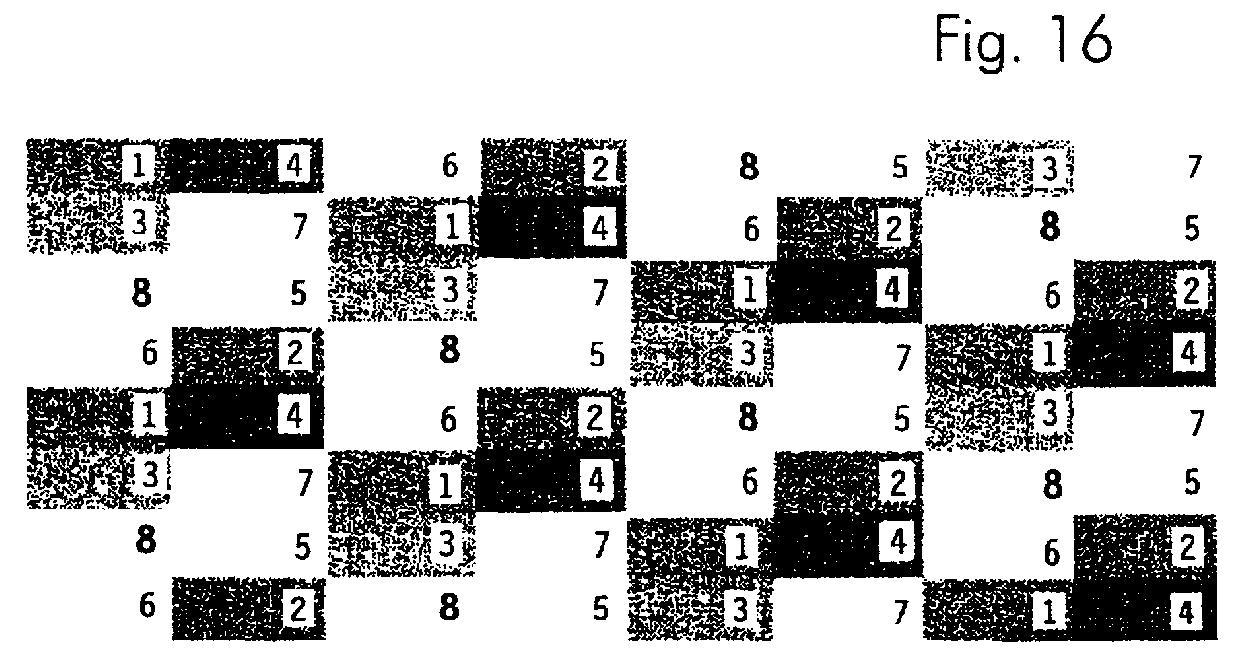
average of two appearances respectively produced by scanning two ways. Various printmasks
complete each swath in eight passes with four print-medium advances (Fig. 16), or
four passes and two advances (Fig. 21), or two and one (Fig. 22) - in each case printing
in every pass.
|
|
