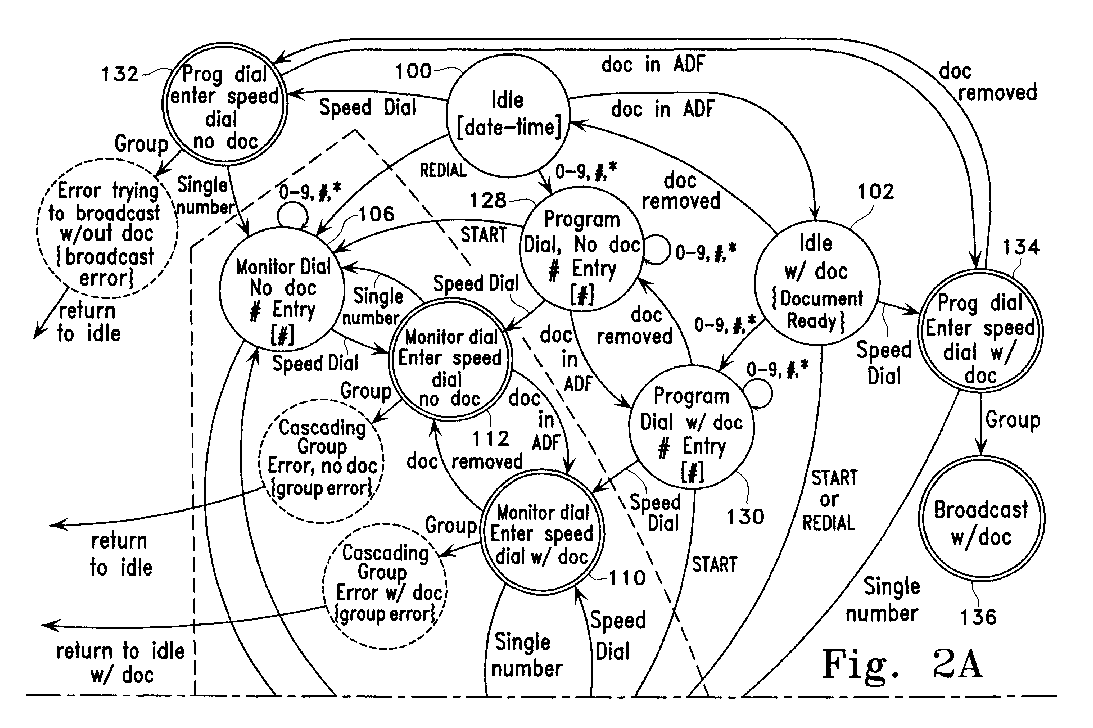
(57) A facsimile machine which may be successfully operated by a user, using a dialing
mode with which the user is already familiar. Programed dialing, monitor dialing,
and speed dialing are integrated in a way that does not artificially constrain the
user to only certain combinations of commands. Users who are dialing through a PBX
or placing the call through a credit card company, may dial the call interactively
using one or mcre string of numbers stcred in memory along with numbers entered directly
from the keypad, with the user receiving audible feedback in the form of dial tones,
beeps and tcnes, and recorded verbal instructions. Various international dialing functions
such as Mercury are stored and accessed in the same way the user would access other
numbers stored in a speed dial or one-touch dial memory location. The various dialing
modes and functicns may be cascaded, whereby the user may access one speed dial number
(or special function such as Mercury) and then continue to dial additional speed-dial
numbers or digits from the front panel keypad. The number cf buttons on the front
panel is kept to a minimum, with multiple functions being assigned to a common button
in optimal functional groupings whereby the user may readily locate, identify, and
use all available functions, using a conventional keypad and two dedicated front panel
buttcns; "Start" and "Speed Dial", with appropriate messages being displayed on the
front panel. In particular, the Start button is used both to cause the machine to
go off-hook and to dial any previously speed dialing sequences, as well as to accept
a displayed speed dial entry, while the Speed Dial button is used to invoke the speed
dial function and to select between single and double digit entries and to scroll
through successive entries.
|
|
