|
(11) | EP 0 865 101 A1 |

| (12) | EUROPEAN PATENT APPLICATION |
|
|
|
|
|||||||||||||||||||||||
| (54) | Shaped reflecting antenna with sector coverage |
| (57) A shaped reflecting antenna with sector coverage that, located nearby a settlement,
makes possible the distribution of the signal towards users positioned in the sector
of antenna coverage for a maximum distance that depends on the power of the transmitting
system. The purpose of the invention is to create an antenna able to radiate energy
towards various users in such fashion as to assure a signal/noise ratio independent
of the distance of the user from the sending antenna. It is then an antenna with a
radiation pattern constant in azimuth for an angular sector chosen on the basis of
the angle of view of the zone served, and shaped in the vertical plane in such fashion
as to assure a signal/noise ratio independent of the distance of the user from the
sending antenna. The reflector may have a grille structure. The invention finds its
use in the field of microwave and millimeter-wave antennas, with shaped reflectors,
and with sector coverage. |
[0001] The invention concerns a shaped reflector antenna with sector coverage that, set up nearby a settlement, makes possible the distribution of the signal towards the users located in the antenna's sector of coverage for a maximum distance that depends on the power of the transmitting system. The invention finds its use in the field of microwave and millimeter-wave antennas, with shaped reflectors, with sector coverage.
[0002] What is proposed with this invention is to create an antenna able to radiate energy towards its various users in such fashion that they enjoy an identical signal/noise ratio on reception, i.e. one that is independent of the distance between transmitting and receiving antennas. The subject then of the invention is an antenna having a radiation pattern constant in azimuth over an angular sector chosen on the basis of the angle of view of the served area, and shaped in the vertical plane in such fashion as to assure a signal/noise ratio independent of the distance between the two antennas of the link.
[0003] The originality of the antenna lies in the shaping, or configuration, of the reflector, which, rather than being concave, as in traditional single-reflector antennas, has its vertical sections vaguely concave, and its horizontal sections convex.
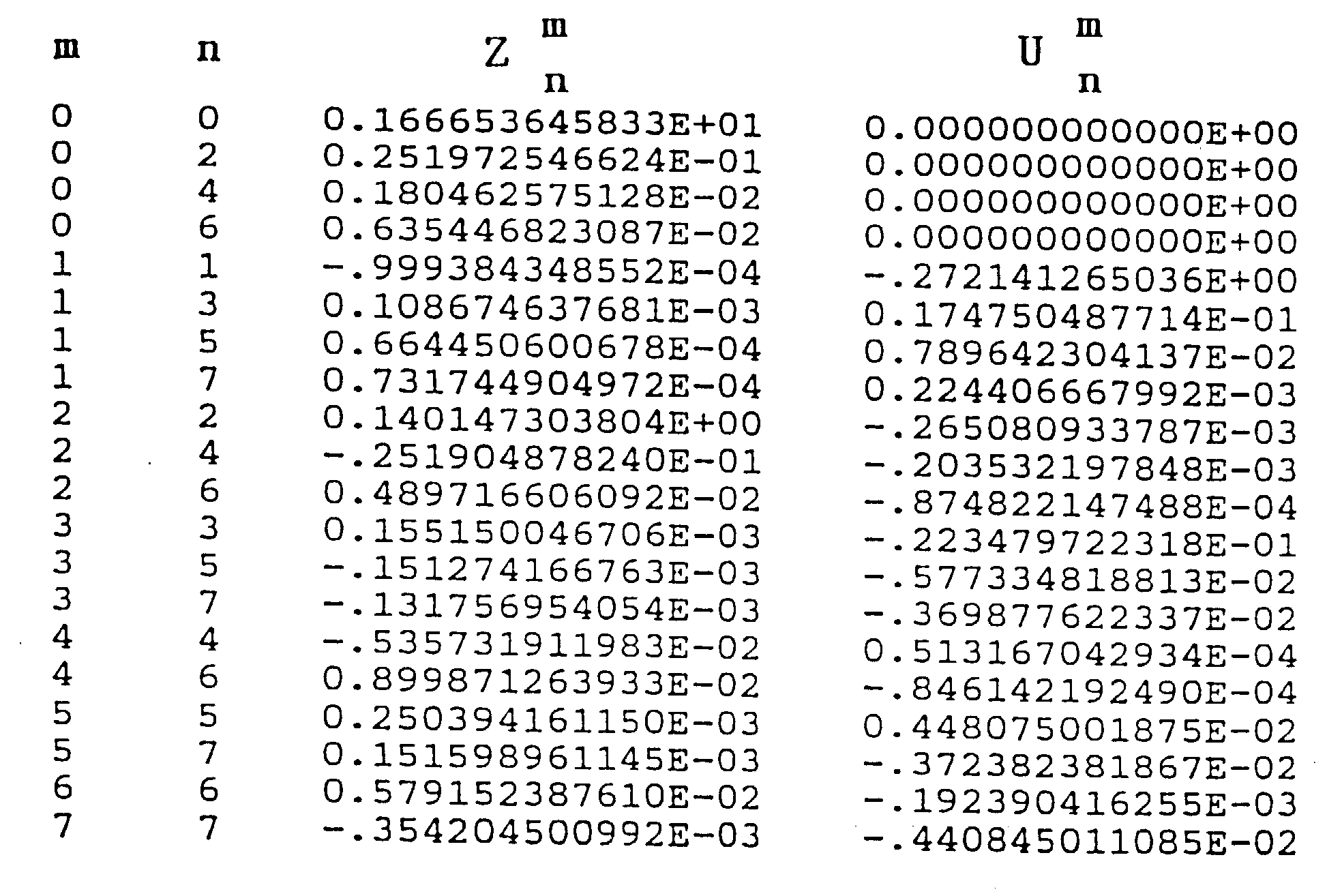
[0004] The shape of the surface of the shaped reflector is the result of a process of optimization based on a two-dimensional series expansion of the surface function, one that is not susceptible of representation in closed form with a simple algebraic expression.
[0005] The antenna in question was conceived essentially to solve such problems as that of the "last mile", which comes up in the laying of the national fiber optics network, where enormous difficulties of application are encountered. At issue is an alternative to the laying of fiber optics.
[0006] By the "last mile" is meant, as those concerned know, that territory in which it is necessary to carry out work to connect users to a central cable laid by any telephone company that does not concern itself with the connection of the central cable to the user, which may be, for example, a condominium apartment building. A telephone company undertakes to convert its systems up to the point that is within its jurisdiction; however, the condominiums that must permit the laying of the cables will generally not agree to undertake the expensive masonry works needed to modify their systems.
[0007] To give an example, in Venice the laying of fiber optics was forbidden for reasons having to do with the protection of artworks.
[0009] One solution to the problem of the last mile is then a microwave connection between a transmitting station and the various surrounding users. But this antenna, conceived essentially to resolve the problem of the last mile, can find many other applications as well: for example, it could be used in private communications systems for data transmission. Analogously, it could find use too in military applications, for connections, whether improvised or stable, over distances of the order of tens of kilometers or even more.
[0011] The invention is now to be discribed on the basis of a version currently preferred by the inventor, reference being made to the figures listed below:
[0019] On the basis of fig. 1, the sector antenna structure is composed of a shaped reflector 1 connected to boom 3 supporting the horn 2, the whole being supported by an element 5 that forms the interface with the tower 4 that supports the entire antenna, needed to so position the antenna as to enable it to "see" the buildingtops in the settlement of concern,and member 6 (shown inFig.6) for positioning the horn.
[0020] The shaped reflector 1 (fig. 4) displays a convexoidal configuration. By "convexoidal" is meant that it has a partly convex configuration. In order to better understand the shaping of the reflector, observe that the central horizontal section AB through the reflector is definitely convex. The central vertical section through the reflector is so delineated (fig. 4) as to present a parabolic section, one slightly deformed as follows:
[0021] Section EF is parabolic, and therefore concave, while section FD is convex in such fashion as to generate the shaping of the reflector and of the beam in the vertical plane.This aspect is to be considered original, especially when compared with earlier solutions, which instead all present a concave configuration.
[0022] This convexity of the central horizontal section through the reflector AB, is what enables the distribution of the signal with constant amplitude over a rather extensive angular sector. On the other hand, the central vertical section enables the distribution of the signal with an amplitude such as to assure the same signal/noise ratio whatever the "transmitting-antenna/user" distance, over the entire angular sector served.
[0023] Fig. 3 shows a graphic representation obtained from the computer on the basis of the method to be described further on. Fig. 2 furnishes an example of how the antenna is to be set up in the neighborhood of a settlement.
[0024] Figure 1 furnishes an overall view of the antenna installed. Fig. 5 is a radiation pattern in the vertical plane, shown in order to display the shaping of the radiated beam that is necessary to assure a constant signal/noise ratio, whatever the distance between user and sector antenna. Fig. 7 is a radiation pattern in the horizontal plane, included to show the uniformity of the radiation obtained in an angular sector of some 70 degrees of aperture.
[0025] The function describing the shaped reflector surface is not susceptible of being represented in closed form using a simple algebraic expression, but is found through an optimization process based on its two-dimensional series expansion, and thus has nothing in common with the functions describing radar antennas in which the optimization process develops but one of the two reflector sections, since the other is exclusively parabolic in form. It is important to bring out that the reflector can also be built with a gridded structure, so as to radiate, where such is needed, very low levels of cross-polarization.
[0026] The optimization process mentioned, needed to synthesize the function describing the antenna forming the subject of the patent application, starts with a quadric surface in such manner as to generate a defocussing of the reflector-horn optical system; this tends to generate a rather wide antenna beam, one such as to cover the angular sector served. To make this clear, the desired result can be obtained by the method described below.
[0027] An arbitrary surface g(x,y) can be represented with a Zernike series
which converges within a circle x2 + y2 ≤ 1. The coefficients of expansion bmm can be determined by the relation of orthogonality
where
[0028] In (1) the asterisk(*) denotes the complex conjugate. A special property of the Zernike polynomials is that they have a polar form:
where Rmn is a polynomial of nth degree in ρ.
[0029] Since the reflector surface is real, it is convenient to use the imaginary and real parts of Vmn(x,y)
It is clear that
so that only the functions Z and U with positive and zero values of m are needed in the expansion of a real function.
[0031] The polynomials Znm are even functions of y, while the polynomials Unm are odd functions of y.
[0032] An arbitrary real function g(x,y) can be approximated by a truncated Zernike series as follows:
[0033] A special feature of the method used, for the antenna design in question, is the limited number of coefficients considered in the optimization process, that is, only Zernike polynomials of order less than ten need be considered.
1. Shaped reflector antenna with sector coverage, including (fig. 1) a shaped reflector
(1) with circular aperture (boundary), a corrugated conical horn (2), a support boom
(3) for the horn , a support member (4) and a mechanical interface (5) for fastening
the reflector (1) to the support member (4), characterized by the fact that said reflector
(1) has a definitely convex central horizontal section AB (fig. 4), while regarding
the central vertical section the portion EF follows a parabolic curve and is therefore
concave, while portion FD is convex.
2. Shaped reflector antenna with sector coverage, according to claim 1, characterized
by the fact that the shaped reflector surface is obtained by means of an optimization
process based on a two-dimensional series expansion of the function describing the
surface (the function itself not being closed form); being said optimization process
carried out by starting with a quadric surface able to generate a defocussing of the
optics of the reflector that tends to generate a rather wide antenna beam, one such
as to cover the angular sector served.
3. Shaped reflecting antenna with sector coverage, according to claim 2 , characterized
by the fact that the Zernike polynomials used are only those of rather small orders
m and n: i.e., less than 10.
4. Antenna, according to claim 1, characterized by the fact that the reflector can also
be made up from a gridded structure.