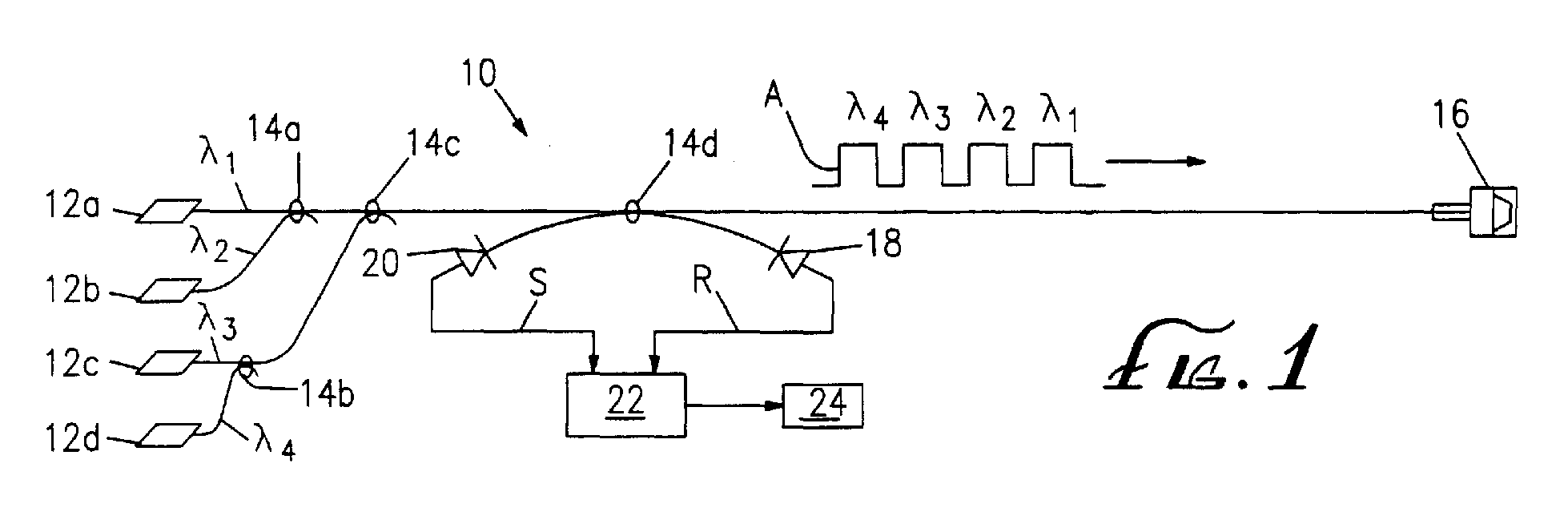
(57) A pressure sensing system (10) employs a plurality of pulsed lasers (12a, 12b, 12c,
12d), each emitting a distinct wavelength (λ1, λ2, λ3, λ4) whereby a multiplexed incident beam is generated. The incident beam is split into
a first portion directed to a first photodetector (18) that generates a reference
signal (R) for each wavelength, and a second portion that interrogates a Fabry-Perot
pressure sensor (16). The interrogation beam portion is phase-modulated by gap width
variations in the sensor, and is transmitted to a second photodetector (20) that generates
a measured intensity signal (5) for each wavelength. For each wavelength, the ratio
(S/R) of the measured intensity signal (S) to the reference intensity signal (R) is
taken, and yields two terms, one of which is an interference term that is proportional
to the cosine of the Fabry-Perot phase shift angle ϕ, which is a function of the gap
width. By choosing wavelengths that are in quadrature relationship for a nominal.
Fabry-Perot gap width, the algebraic differences can be taken among the ratios to
yield two expressions proportional, respectively, to the cosine and sine of the phase
shift angle ϕ. An arctangent calculation is used to obtain the measure of ϕ, which
is proportional to the gap width, which, in turn, is a known function of the pressure
applied to the sensor (16).
|
|
