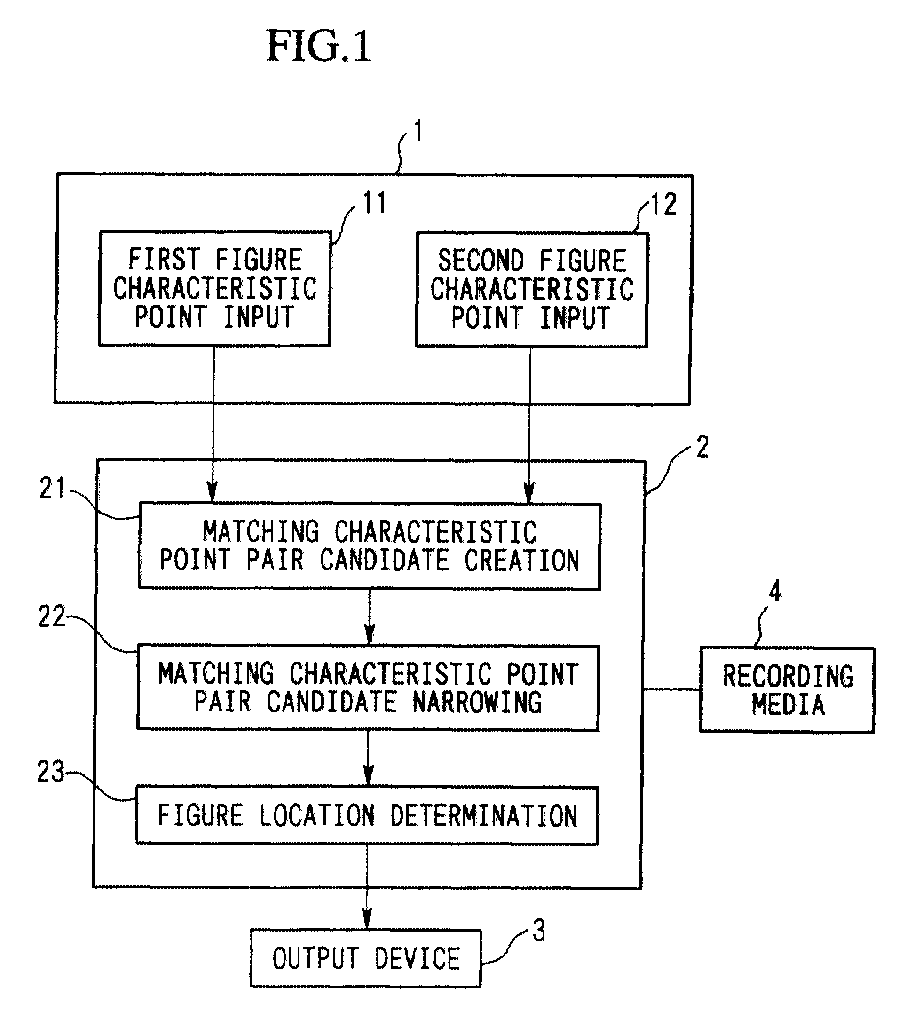
(57) A figure location detecting system is designed to detect a location of a first figure
(e.g., search fingerprint) within a second figure (e.g., file fingerprint). Particularly,
the system is designed to correctly match characteristic points of the first figure
with characteristic points of the second figure even if the first figure contains
a plenty of similar characteristic points whose characteristics are similar with each
other and/or even if the first figure is (partially) distorted. Herein, the system
creates matching characteristic point pair candidates each corresponding to a pair
of a first characteristic point, corresponding to one of the characteristic points
of the first figure, and a second characteristic point corresponding to one of the
characteristic points of the second figure. The matching characteristic point pair
candidates are created on the basis of relative characteristics which are calculated
for proximity characteristic points which exist in proximity to the first and second
characteristic points respectively. Then, the system narrows down the matching characteristic
point pair candidates to matching characteristic point pairs by removing wrong matching
characteristic point pair candidates, each of which is detected as a wrong match in
consideration of a matching situation of the proximity characteristic points. Coordinate
matching parameters are produced with respect to each of the matching characteristic
point pairs. Thus, the system outputs most concentrated coordinate matching parameters
which values of the coordinate matching parameters sequentially produced concentrate
in most frequently (Fig. 1).
|
|
